Elevator Modernization Incentives and Financing Options for Arizona Commercial Buildings: Complete FAQ
Commercial elevator modernization in Arizona is not just a capital expenditure — it is a strategic investment supported by multiple federal tax incentives, financing vehicles, and energy efficiency programs. Building owners in Phoenix, Scottsdale, Tucson, and Mesa who understand the full landscape of available options can dramatically reduce out-of-pocket costs while achieving code compliance, improved energy performance, and enhanced tenant satisfaction. This FAQ covers every dimension of the topic, from federal tax code provisions to local financing structures and ASME compliance timelines.
1. What is elevator modernization, and why does it matter for Arizona commercial buildings?
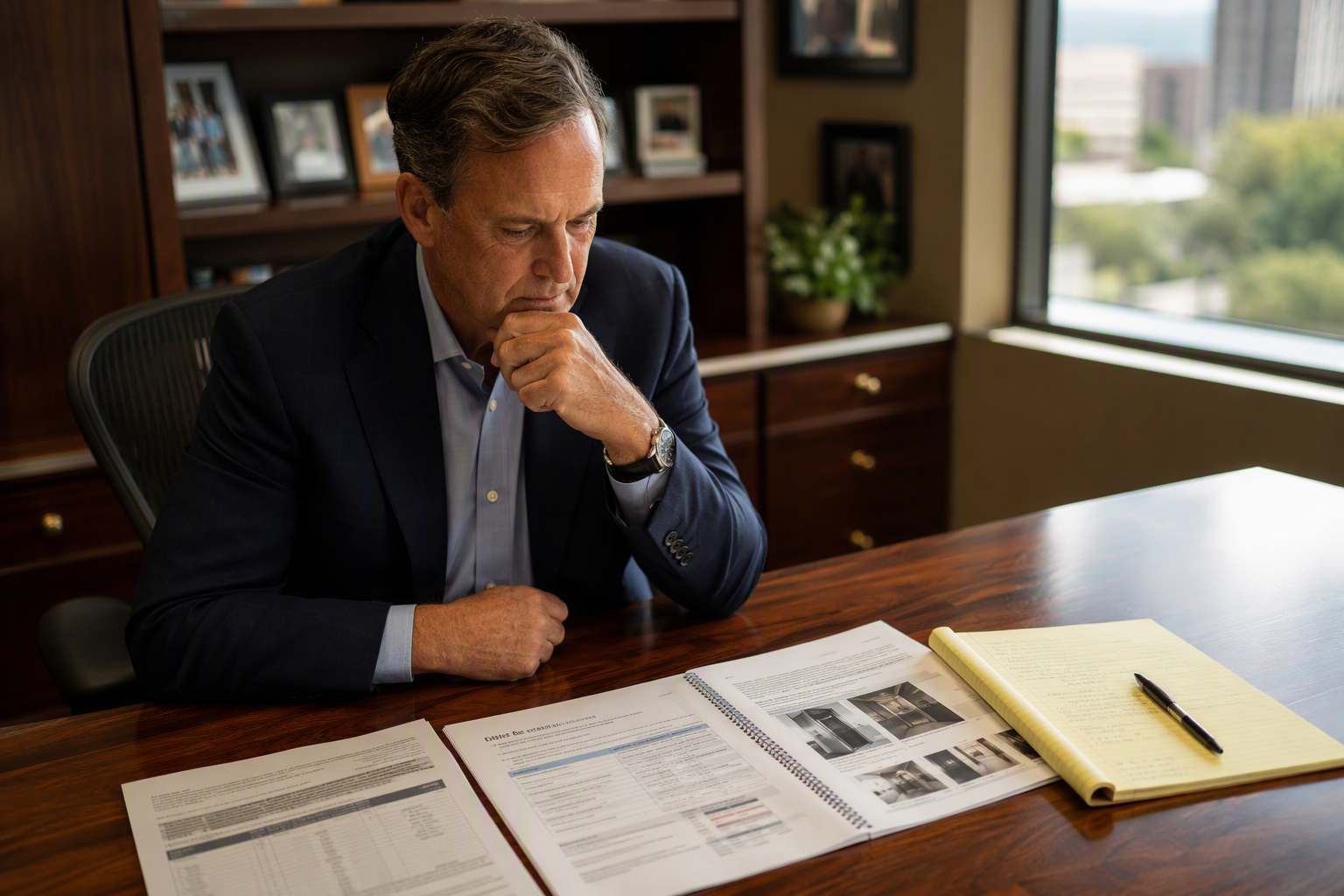
Elevator modernization is the process of upgrading aging elevator components — controls, drives, cab interiors, door systems, safety devices, and mechanical equipment — to meet current safety codes, energy standards, and accessibility requirements.
Arizona commercial buildings often house elevator systems that are decades old. As these systems age, replacement parts become scarce, energy consumption rises, downtime increases, and the gap between installed equipment and current code requirements widens. Modernization addresses all of these issues simultaneously rather than through piecemeal repairs that compound over time.
Under ASME A17.3 Safety Code for Existing Elevators and Escalators, existing installations are subject to periodic safety upgrades as local Authorities Having Jurisdiction (AHJs) adopt new code editions. In Arizona, the state and individual municipalities enforce elevator safety through the Arizona Department of Occupational Safety and Health (ADOSH), which references ASME standards. A full modernization brings an elevator into alignment with both current ASME requirements and ADA accessibility mandates, reducing liability exposure and avoiding citation-driven emergency repairs.
2. What federal tax incentives are available for elevator modernization in commercial buildings?
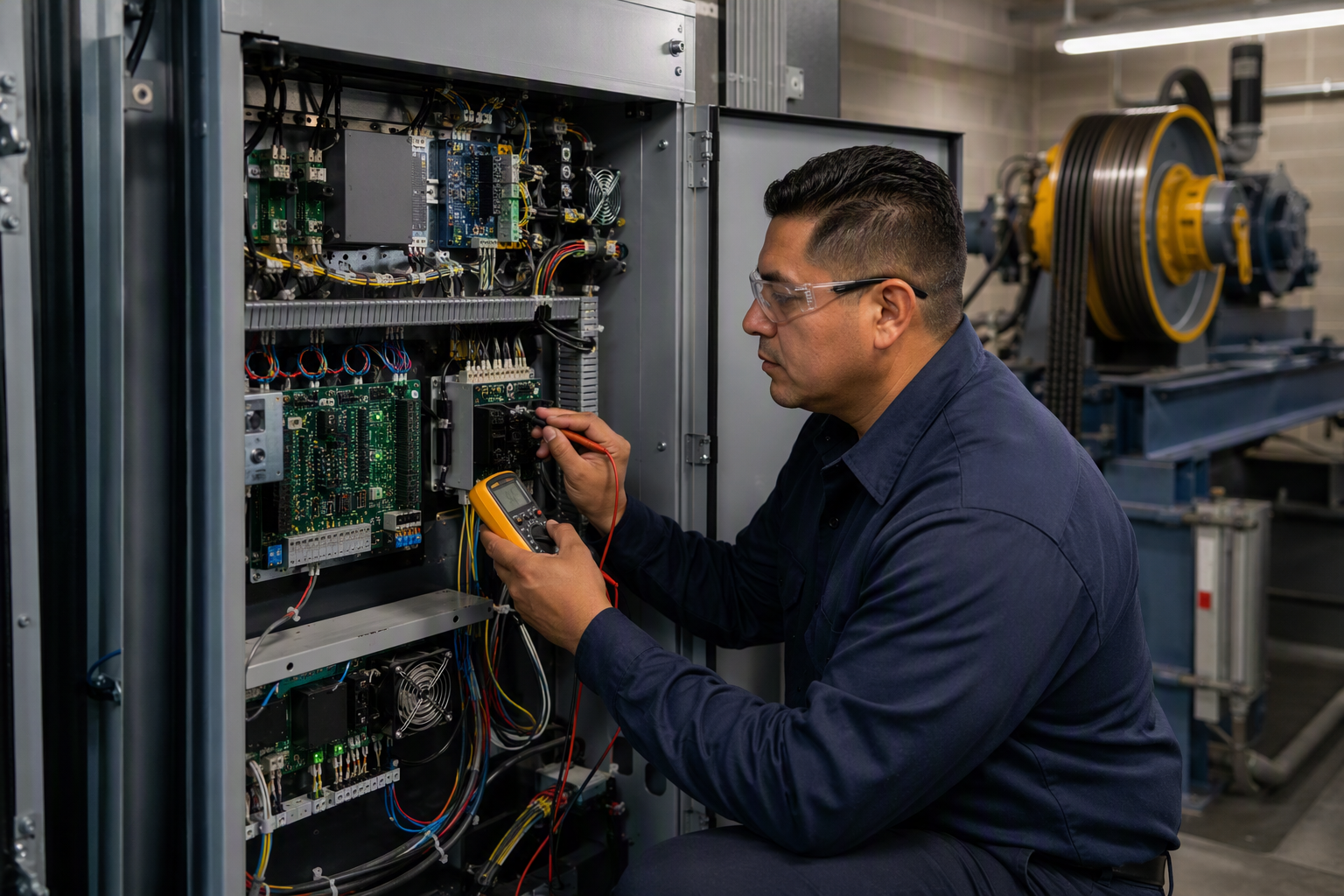
The primary federal tax incentives applicable to commercial elevator modernization include the IRS Section 179D energy-efficient commercial building deduction, the Section 44 Disabled Access Credit for small businesses, and the Section 190 barrier removal deduction.
Each incentive addresses a different dimension of a modernization project. Building owners and their tax advisors should evaluate which combination applies to their specific project scope and entity type. These are federal provisions available to qualifying Arizona commercial property owners and operators.
Section 179D allows owners and designers of commercial buildings to deduct costs associated with energy-efficient improvements, which can include elevator drive system upgrades (such as replacing hydraulic systems with regenerative traction drives) that reduce overall building energy consumption. The deduction amount depends on verified energy savings relative to a baseline standard, and the building must meet a certified energy performance threshold. Tax advisors familiar with the Inflation Reduction Act’s 2023 expansions of 179D should be consulted, as the qualifying criteria and deduction caps were updated.
Section 44 (Disabled Access Credit) provides eligible small businesses — those with gross receipts under a specified threshold or fewer than a specified number of full-time employees — a nonrefundable tax credit for costs incurred to comply with the ADA. Elevator modifications that improve accessibility, such as adding compliant cab controls, Braille signage, audible signals, and leveling accuracy improvements, may qualify.
Section 190 (Architectural and Transportation Barrier Removal Deduction) allows businesses of any size to deduct up to a capped annual amount for costs associated with removing barriers for people with disabilities. ADA-driven elevator upgrades are a textbook qualifying expense under this provision.
Because tax law is complex and project-specific, Arizona Elevator Solutions recommends that building owners consult a qualified CPA or tax attorney when structuring a modernization project to maximize these benefits.
3. How does the ADA create a financial obligation — and a financing opportunity — for elevator modernization?
The Americans with Disabilities Act requires that places of public accommodation and commercial facilities remove architectural barriers when doing so is “readily achievable,” and the associated costs of compliant elevator upgrades create direct eligibility for federal tax relief under Sections 44 and 190.
For elevators specifically, ADA compliance requirements include cab dimensions, door width and timing, control panel height and reach ranges, Braille and raised character signage, audible and visual floor indicators, and leveling accuracy so that the cab floor aligns within a specified tolerance of the landing floor. Many older elevator installations in Arizona commercial buildings — particularly those built before 1993 — fall short of one or more of these standards.
The ADA’s “readily achievable” standard means that the removal of barriers must be accomplishable without much difficulty or expense, and it is evaluated relative to the overall financial resources of the building owner or operator. This standard evolves over time, meaning that barriers that were once considered too costly to address may now be considered readily achievable as costs change. Building owners who proactively pursue ADA compliance through modernization, rather than waiting for a complaint or lawsuit, are in a stronger legal position and can layer tax incentive benefits on top of their investment.
4. What ASME codes govern elevator modernization requirements in Arizona?
Arizona elevator modernization is governed primarily by ASME A17.1, the Safety Code for Elevators and Escalators (for new installations and major alterations), and ASME A17.3, the Safety Code for Existing Elevators and Escalators (for retroactive safety upgrades on existing equipment).
ASME A17.1 sets the safety requirements that must be met when an elevator undergoes a major alteration — which modernization typically qualifies as. ASME A17.3 establishes which safety requirements apply retroactively to existing installations based on the code edition in effect at the time of installation and the edition currently adopted by the local AHJ.
In Arizona, ADOSH serves as the primary enforcement authority for elevator safety statewide, with individual municipalities potentially maintaining their own inspection programs. Building owners undertaking modernization projects should confirm the current adopted code edition with their local AHJ before finalizing a scope of work, as adopted editions can vary by jurisdiction. Arizona Elevator Solutions works directly with AHJs across Phoenix, Scottsdale, Mesa, and Tucson to ensure that modernization projects are designed and executed to the correct code requirements.
5. What types of commercial equipment financing are available for elevator modernization?
Arizona commercial building owners can finance elevator modernization through equipment loans, capital leases, operating leases, and SBA loan programs, each with different accounting, ownership, and tax treatment implications.
- Equipment loans: The building owner borrows funds to purchase the modernization outright, owns the equipment from day one, and can depreciate it. Interest paid on the loan may be deductible.
- Capital leases (finance leases): Structured similarly to ownership; the asset appears on the balance sheet and is depreciated, but the owner does not pay the full purchase price upfront.
- Operating leases: The modernization is treated as an off-balance-sheet expense, lease payments are typically deductible as a business expense, and the lender retains ownership. This option preserves capital for other uses.
- SBA 504 loans: Small Business Administration 504 loans finance fixed assets including building improvements and equipment. Commercial elevator modernization qualifies as a fixed-asset improvement, making SBA 504 a viable vehicle for eligible Arizona small business property owners.
- SBA 7(a) loans: More flexible than 504 loans, 7(a) loans can cover a broader range of business purposes including equipment upgrades and facility improvements. Eligible borrowers in Phoenix, Tucson, Scottsdale, and Mesa can apply through SBA-approved lenders in Arizona.
Financing terms vary by lender, creditworthiness, and project size. Building owners should obtain multiple quotes and evaluate total cost of capital alongside the tax incentive benefits available for the project.
6. Do Arizona utility companies offer rebates for energy-efficient elevator upgrades?
Arizona’s major electric utilities, including Arizona Public Service (APS) and Tucson Electric Power (TEP), operate commercial energy efficiency programs that may offer rebates or incentives for equipment upgrades that measurably reduce energy consumption — and certain elevator modernization components qualify.
Elevator drives are among the most energy-intensive mechanical systems in a commercial building. Replacing an older hydraulic or single-speed motor system with a variable-frequency drive (VFD) or a regenerative drive traction system can produce meaningful, measurable reductions in electrical consumption. Utility rebate programs typically require pre-approval before project commencement, verified energy savings calculations, and post-installation metering or documentation.
Building owners in Phoenix and surrounding communities served by APS should contact APS’s commercial energy efficiency team directly to determine current rebate structures and qualifying equipment specifications. Tucson building owners served by TEP should consult TEP’s commercial programs. Program availability, rebate amounts, and qualifying criteria change periodically, so verification before project design is essential.
Arizona Elevator Solutions can assist building owners in documenting the energy performance characteristics of proposed equipment upgrades to support utility rebate applications.
7. Can elevator modernization costs be deducted or depreciated under IRS Section 179?
IRS Section 179 allows businesses to deduct the full purchase price of qualifying equipment and off-the-shelf software placed in service during the tax year, and elevator modernization components — particularly newly installed mechanical and control system equipment — may qualify as Section 179 property.
Section 179 expensing is distinct from Section 179D (the energy efficiency deduction). Section 179 is a general equipment expensing election that accelerates deduction of capital costs rather than depreciating them over time. Elevator controls, drive systems, door operators, and cab fixtures installed as part of a modernization may qualify as tangible personal property eligible for Section 179 expensing, depending on how the project is structured and how the components are classified under IRS guidance.
Bonus depreciation provisions (which have been subject to phase-down schedules in recent years) may also interact with Section 179 treatment for modernization projects. As tax law in this area is actively changing, Arizona building owners should work with a tax professional who is current on applicable IRS guidance for the 2026 tax year.
8. What does a typical commercial elevator modernization project include, and what drives the cost?
A full commercial elevator modernization typically encompasses controller and relay logic replacement, drive system upgrade, door operator and detector replacement, cab interior renovation, lighting upgrade, signal fixture replacement, and safety device upgrades — with total project cost driven by elevator type, age, number of stops, and required code compliance scope.
| Modernization Component | Primary Purpose | Relevant Code / Standard | Energy Impact |
|---|---|---|---|
| Controller replacement (relay to microprocessor) | Reliability, diagnostics, code compliance | ASME A17.1 / A17.3 | Moderate (reduced standby power) |
| Drive system upgrade (hydraulic to MRL traction, or VFD retrofit) | Energy efficiency, performance, reduced maintenance | ASME A17.1 | High (significant kWh reduction) |
| Door operator and detector replacement | Safety, ADA compliance, reliability | ADA / ASME A17.1 | Low |
| Cab interior renovation (lighting, finishes, handrails) | Tenant experience, ADA reach range compliance | ADA | Low–Moderate (LED lighting) |
| Signal fixtures (hall lanterns, position indicators) | ADA audible/visual compliance | ADA | Low |
| Safety device upgrades (governors, buffers, safeties) | ASME A17.3 retroactive requirements | ASME A17.3 | None |
| Emergency lighting and communication | Code compliance, occupant safety | ASME A17.1 / OSHA | Low |
| Machine room or machine room-less (MRL) conversion | Space recapture, energy savings, modern reliability | ASME A17.1 | High |
The scope of any given modernization project depends on the current condition of the equipment, the code edition under which the elevator was originally installed, the edition currently adopted by the Arizona AHJ, and the building owner’s goals for energy performance and tenant experience. A thorough assessment by a qualified elevator service company is the necessary starting point.
9. How should Arizona building owners prioritize modernization scope to maximize incentive eligibility?
Building owners maximize incentive eligibility by sequencing modernization scope to front-load ADA accessibility upgrades (eligible for Sections 44 and 190) and energy-efficient drive system replacements (eligible for Section 179D and utility rebates) within the same project year.
Combining ADA-driven scope with energy efficiency upgrades in a single modernization project allows building owners to potentially stack multiple incentives against one capital expenditure. For example, replacing the drive system with a regenerative VFD traction unit addresses energy goals (Section 179D, utility rebates) while simultaneously replacing signal fixtures and cab controls addresses ADA goals (Sections 44 and 190). A coordinated project scope — developed in partnership with both the elevator service contractor and the building’s tax advisor — yields the most favorable outcome.
Arizona Elevator Solutions recommends that building owners complete an elevator condition assessment and a tax planning session with their CPA before finalizing a modernization scope, ensuring that every dollar of qualified expenditure is captured across applicable incentive programs.
10. What is the role of ADOSH in Arizona elevator modernization?
The Arizona Division of Occupational Safety and Health (ADOSH) serves as the state authority responsible for elevator safety inspection and enforcement in Arizona, and all modernization work must pass ADOSH inspection before the elevator is returned to service.
ADOSH operates under the Arizona Industrial Commission and enforces elevator safety standards statewide. When a commercial elevator undergoes a major alteration — which a full modernization qualifies as — the project requires permits, inspections during construction, and a final acceptance inspection before the elevator may resume passenger service. Failure to obtain required permits or inspections can result in citations, required corrective work, and ongoing shutdown orders that are far more costly than the permit process itself.
Building owners should ensure that their elevator service contractor is experienced in working within Arizona’s permitting and inspection process. Arizona Elevator Solutions operates across Phoenix, Scottsdale, Mesa, and Tucson and is familiar with the inspection requirements and documentation standards expected by ADOSH and local AHJs throughout those markets.
11. How long does a commercial elevator modernization project typically take in Arizona?
A commercial elevator modernization project in Arizona typically takes several weeks to several months from contract execution to final inspection, depending on equipment lead times, project scope, permit approval timelines, and elevator availability for outage.
The modernization process generally follows this sequence:
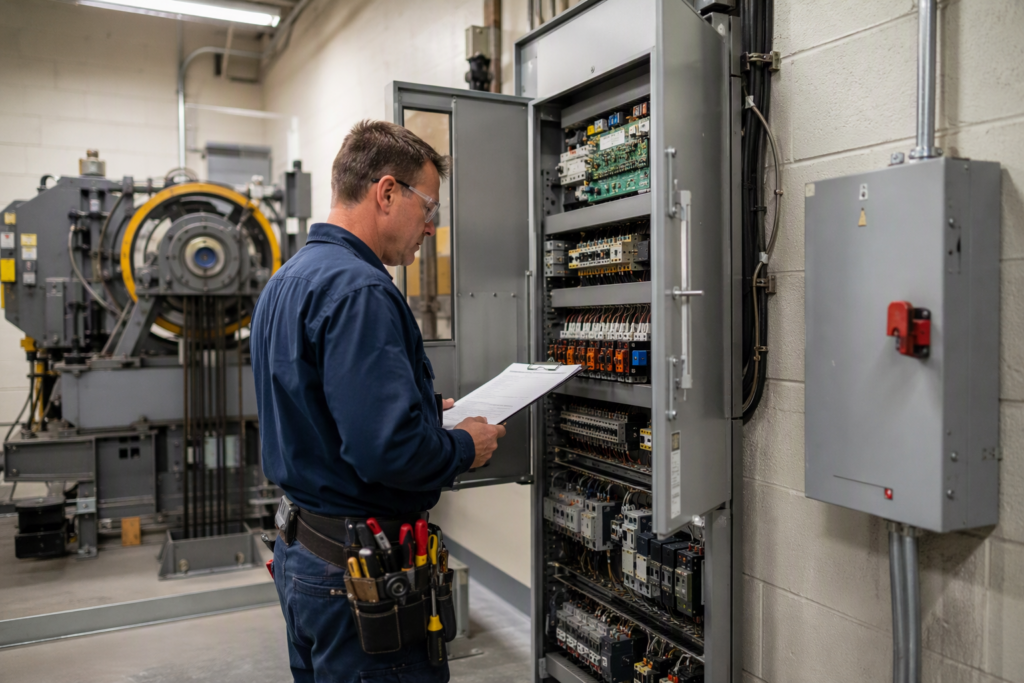
- Condition assessment and scope development: The elevator contractor conducts a thorough inspection of the existing installation, documents current code compliance gaps, and develops a detailed scope of work and specification.
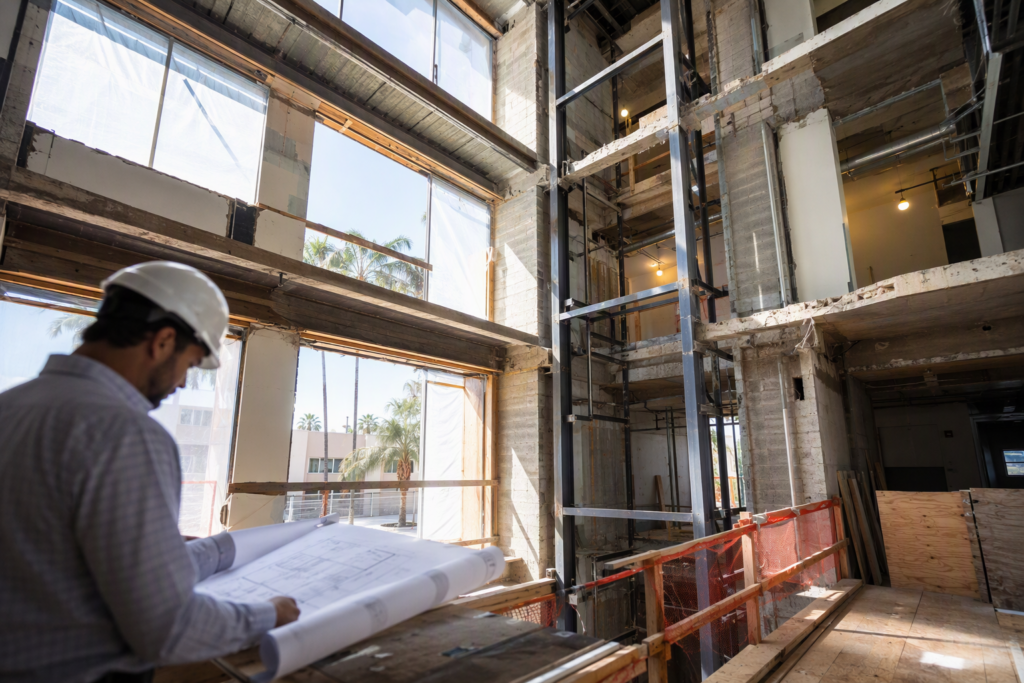
- Engineering and submittal preparation: For major alterations, engineering drawings and submittals are prepared for AHJ plan review.
- Permit application: Permits are submitted to ADOSH and/or the local AHJ. Approval timelines vary by jurisdiction.
- Equipment procurement: Modernization equipment is ordered. Lead times for controllers, drive systems, and other major components vary by manufacturer and market conditions.
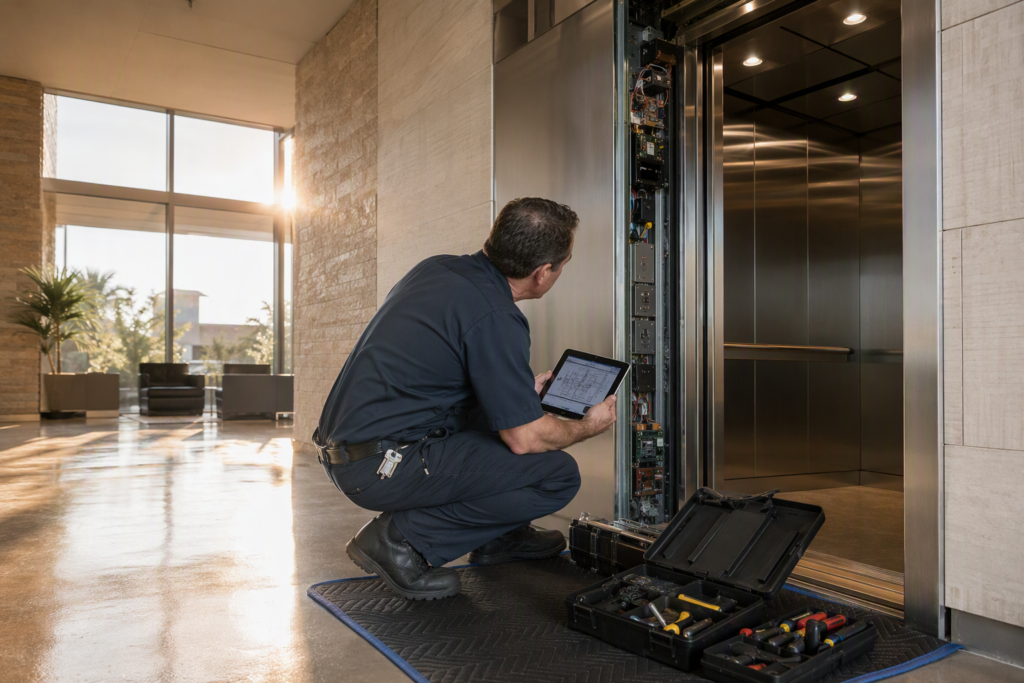
- Installation: The elevator is taken out of service for the duration of installation work. Multi-elevator buildings can stagger outages to maintain building access.
- Testing and adjustment: Installed equipment is tested, adjusted, and verified against code requirements.
- AHJ inspection: ADOSH or the local AHJ conducts the acceptance inspection.
- Return to service: Upon successful inspection and certificate issuance, the elevator is returned to service.
Building owners with single-elevator buildings should plan for the full outage period carefully, including ADA-compliant temporary access accommodations for occupants and visitors with disabilities.
12. Are there financing programs specifically designed for ADA compliance upgrades in commercial buildings?
Yes — several financing channels are specifically relevant to ADA compliance capital projects, including SBA loan programs, Community Development Financial Institution (CDFI) loans, and some state and local economic development programs, all of which can fund elevator accessibility upgrades.
The SBA 504 and 7(a) programs, discussed above, are broadly applicable to ADA compliance projects as fixed-asset and facility improvement financing. CDFIs operate in Arizona markets and are specifically mandated to serve underserved communities and small businesses, sometimes with more flexible underwriting than conventional commercial lenders.
Additionally, the IRS’s combination of Section 44 (credit) and Section 190 (deduction) can be used together in the same tax year for the same project, subject to IRS rules on coordination. A qualifying small business can take the Section 44 credit on a portion of expenditures and the Section 190 deduction on the remainder, effectively reducing net after-tax cost significantly. This makes ADA-driven elevator modernization more financially accessible than the gross project cost suggests.
13. What energy savings can commercial building owners realistically expect from elevator modernization?
The energy savings achievable through elevator modernization depend on the existing system type and the replacement technology chosen, with drive system upgrades — particularly from hydraulic to machine-room-less traction with regenerative drives — typically delivering the most substantial reductions in elevator-related energy consumption.
Older hydraulic elevator systems consume electricity on both up and down travel, with heat exchangers required to manage hydraulic fluid temperature, adding further electrical load. Modern machine-room-less (MRL) traction systems with regenerative drives return electrical energy to the building’s power grid during descent, substantially reducing net energy consumption. LED lighting upgrades within the cab and hoistway also contribute to reduced energy load, though the contribution is smaller than drive system changes.
Building owners pursuing Section 179D deductions or utility rebates will need certified energy modeling or measured performance data to substantiate claims. Arizona Elevator Solutions can provide equipment specifications and documentation that building owners can use as inputs for energy modeling performed by a qualified energy engineer.
14. Can historic commercial buildings in Arizona access special financing for elevator modernization?
Historic commercial buildings in Arizona may have access to federal Historic Tax Credits (HTC) for rehabilitation expenditures, and elevator modernization performed as part of a certified historic rehabilitation may qualify as a rehabilitation expenditure under IRS and National Park Service guidelines.
The federal Historic Tax Credit provides a credit equal to a percentage of qualified rehabilitation expenditures for certified historic structures undergoing a certified rehabilitation. When an elevator modernization is part of a broader certified historic rehabilitation project, the elevator costs may be included in the basis for the credit calculation, subject to the requirement that the rehabilitation meet the Secretary of the Interior’s Standards for Rehabilitation.
Arizona also has a State Historic Preservation Office (SHPO) that administers the state’s historic preservation programs and can provide guidance on Arizona-specific historic preservation incentives that may complement the federal HTC. Building owners with historic properties in Phoenix, Tucson, Scottsdale, or Mesa should consult with their state historic preservation office and a tax advisor familiar with historic rehabilitation credits before finalizing modernization scope, as alterations to historic structures are subject to specific design review requirements.
15. How does elevator modernization affect commercial property value and tenant retention?
Modernized elevator systems contribute to higher tenant satisfaction, reduced vacancy risk, and improved building appraisal outcomes by eliminating the reliability, safety, and accessibility deficiencies that drive tenant complaints, lease non-renewals, and ADA-related liability exposure.
Commercial tenants — particularly those in professional services, healthcare, and retail sectors — increasingly cite elevator reliability and accessibility as factors in lease decisions. An aging elevator with frequent outages, outdated aesthetics, and accessibility deficiencies is a tangible competitive disadvantage in Arizona’s active commercial real estate markets. Modernization addresses all of these factors simultaneously.
From a valuation perspective, capital improvements that reduce operating risk, improve compliance, and extend equipment useful life are generally reflected positively in income-approach appraisals by reducing the deferred maintenance discount applied by appraisers and investors. Building owners planning a near-term sale or refinancing should consider the timing of modernization relative to those events.
16. What questions should Arizona building owners ask when evaluating elevator modernization proposals?
Building owners should ask prospective elevator contractors about their experience with Arizona AHJ permitting, their proposed scope’s alignment with the current adopted ASME code edition, their documentation capabilities for tax incentive and utility rebate support, and the manufacturer warranty terms on proposed equipment.
Specifically, useful questions include:
- Which edition of ASME A17.1 and A17.3 does this scope address, and has it been verified with the local AHJ?
- Is the proposed controller and drive system from a manufacturer with established parts availability and a track record in Arizona’s climate?
- What permits will be required, and who is responsible for obtaining them?
- What documentation will be provided for Section 179D, utility rebate, or ADA tax incentive purposes?
- What is the manufacturer warranty on major components, and what does the contractor’s workmanship warranty cover?
- How will building access be managed during the outage period, including ADA-compliant interim access?
- What is the realistic timeline from contract to final inspection, given current lead times?
A well-prepared building owner who asks these questions at the proposal stage will receive more accurate, complete proposals and be better positioned to compare options fairly.
17. Does Arizona have any state-level programs or incentives specifically for elevator modernization?
Arizona does not currently operate a dedicated state-level elevator modernization grant or incentive program, but building owners can access state-administered economic development incentives and may benefit from Arizona’s lack of a state income tax surcharge on eligible federal deductions in certain scenarios.
The Arizona Commerce Authority (ACA) administers various economic development programs for commercial property improvement and business infrastructure, some of which may be applicable to building system upgrades in qualifying contexts. Building owners in enterprise zones or designated opportunity zones within Arizona markets may have access to additional financing tools.
Additionally, Arizona’s conformity with federal tax treatment of Section 179 expensing and depreciation means that accelerated federal deductions for modernization equipment generally flow through to the Arizona state income tax return without an addback, preserving the full state tax benefit of federal incentive structures. Building owners should confirm current Arizona tax conformity status with a state tax advisor, as conformity elections can change with legislative action.
18. What are the risks of deferring elevator modernization in Arizona commercial buildings?
Deferring elevator modernization in Arizona exposes building owners to escalating risks including ADOSH citations and shutdown orders, ADA litigation, increasing maintenance costs for obsolete components, tenant loss, and the compounding cost of emergency repairs on failing equipment.
From an OSHA and ADOSH perspective, elevator safety violations can result in elevator shutdown orders that immediately render the affected floors inaccessible, potentially triggering lease default clauses or ADA-related legal claims from occupants with disabilities who lose access to their spaces. Emergency repairs to obsolete systems are typically more expensive than planned modernization components because they require sourcing discontinued parts, expedited freight, and premium labor for urgent response.
The longer modernization is deferred, the wider the gap between the installed system and current code requirements grows — meaning that a project eventually forced by equipment failure or citation will likely require a broader compliance scope than a proactively planned modernization would have. This deferred compliance premium effectively eliminates the short-term savings from deferral while forfeiting the tax incentive and utility rebate benefits that a planned project would have captured.
19. How can building owners verify that an elevator contractor is qualified to perform modernization work in Arizona?
Arizona building owners should verify that a prospective elevator modernization contractor holds a current Arizona contractor’s license in the appropriate classification, carries required insurance coverage, and demonstrates documented experience obtaining ADOSH permits and passing ADOSH acceptance inspections on comparable projects.
The Arizona Registrar of Contractors (ROC) licenses elevator contractors and maintains a publicly searchable database of licensed contractors and their complaint history. Building owners can verify a contractor’s license status, classification, and any disciplinary history through the ROC’s online portal before executing a contract.
In addition to licensure, building owners should request evidence of current general liability and workers’ compensation insurance coverage, as elevator modernization work involves significant liability exposure. Requesting references from comparable Arizona commercial modernization projects — and following up with those references — provides practical insight into a contractor’s performance on permitting, timeline management, and inspection outcomes.
20. How should Arizona building owners get started with planning a commercial elevator modernization project?
The recommended starting point is a comprehensive elevator condition assessment performed by a qualified elevator service company, which establishes current equipment condition, identifies code compliance gaps, quantifies energy performance baseline, and provides the technical foundation for accurate scope development and incentive planning.
The assessment-to-project process follows these steps:
- Schedule a comprehensive elevator condition assessment with a qualified Arizona elevator service company to document current equipment age, condition, and code compliance status.
- Identify code compliance gaps relative to the current ASME A17.3 edition adopted by the local Arizona AHJ, and identify ADA accessibility deficiencies through the assessment report.
- Engage a CPA or tax attorney to review the assessment findings and identify which federal incentives (Sections 44, 179, 179D, 190, HTC) apply to the anticipated modernization scope.
- Contact applicable Arizona utilities (APS, TEP, or other serving utility) to obtain current rebate program information and pre-approval requirements for energy-efficient equipment upgrades.
- Solicit competitive modernization proposals from qualified licensed Arizona elevator contractors, ensuring each proposal addresses the same verified scope so that bids are comparable.
- Evaluate financing options — including equipment loans, capital leases, SBA 504/7(a) loans, and manufacturer financing — in consultation with the building’s lender and financial advisor.
- Execute contracts and initiate the permitting process with ADOSH and the local AHJ before equipment is ordered.
- Coordinate building access planning for the outage period, including ADA-compliant interim access accommodations.
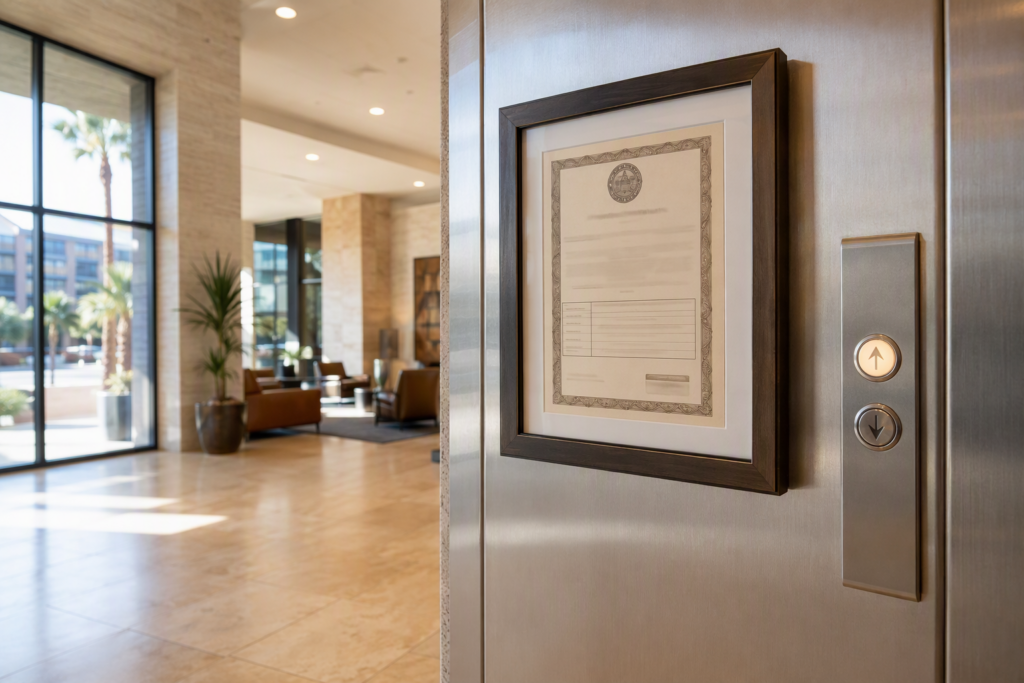
- Complete installation, testing, and AHJ inspection to return the elevator to service with a current operating certificate.
- Assemble documentation for incentive claims, including utility rebate applications, tax basis documentation, and ADA compliance records, in coordination with the CPA and tax attorney.
Building owners in Phoenix, Scottsdale, Mesa, and Tucson who are considering elevator modernization are encouraged to begin with a professional assessment that creates a clear, documented baseline for all subsequent decisions. Arizona Elevator Solutions provides comprehensive elevator condition assessments for commercial buildings throughout these Arizona markets, giving building owners the technical foundation they need to plan confidently and capture every available incentive.
Need elevator service you can rely on? Arizona Elevator Solutions is ready to help.