Elevator Requirements and Compliance Obligations for Healthcare Facilities in Arizona
Hospitals, medical office buildings, outpatient surgery centers, assisted living facilities, and skilled nursing homes across Phoenix, Tucson, Scottsdale, and Mesa face a uniquely demanding set of elevator compliance obligations. Unlike standard commercial buildings, healthcare environments carry patients, medical equipment, and emergency personnel — which means elevator failures are not merely inconvenient; they can directly affect patient outcomes. This guide covers every layer of Arizona elevator compliance that healthcare facility managers, engineers, and administrators need to understand in 2026.
What Federal Elevator Codes Apply to Healthcare Facilities in Arizona?
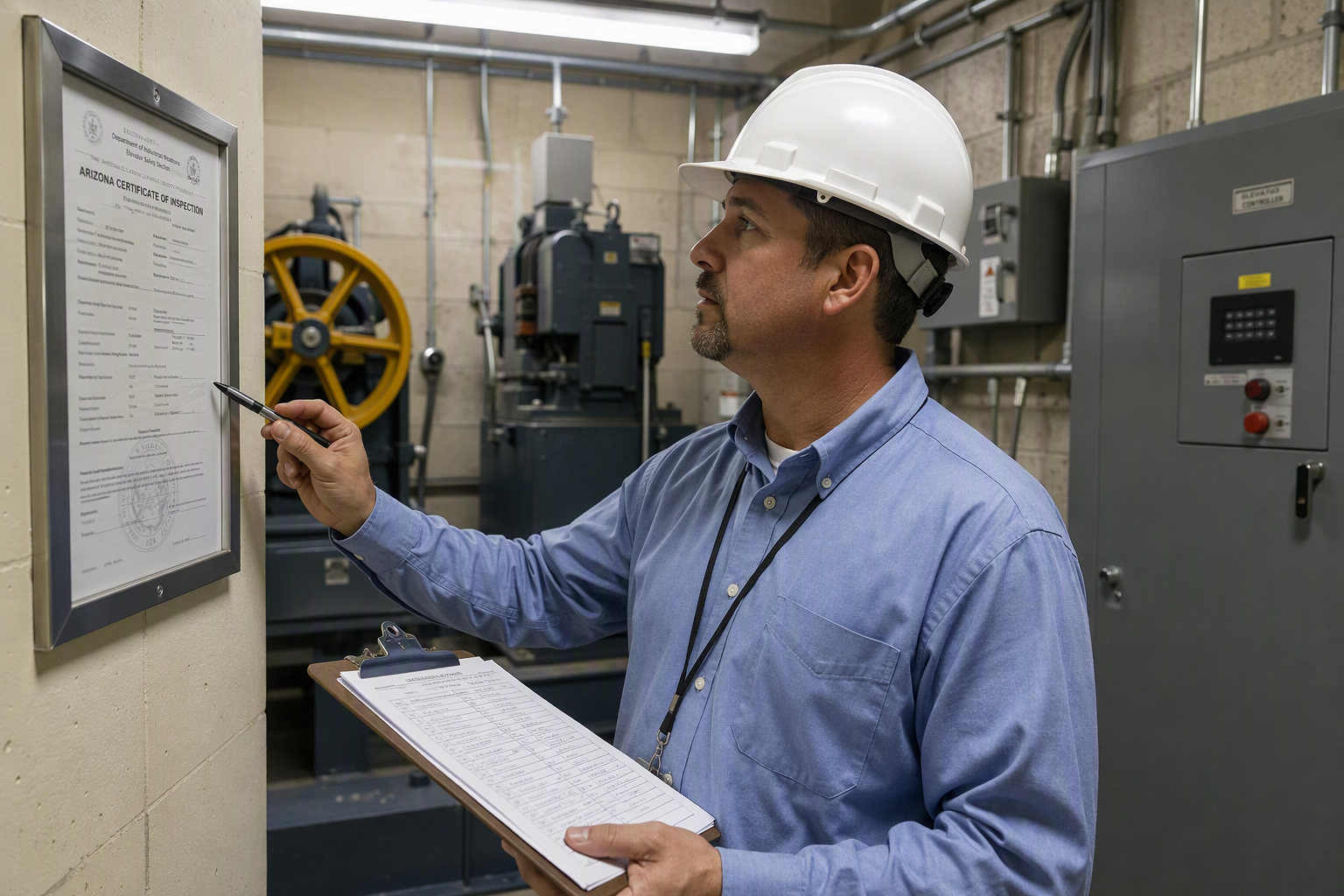
Two federal frameworks anchor elevator compliance for every healthcare facility in Arizona:
- ASME A17.1 Safety Code for Elevators and Escalators — This is the primary safety code governing the design, construction, installation, inspection, testing, and maintenance of elevators. Arizona has adopted ASME A17.1 as its foundational elevator safety standard. Healthcare facilities must ensure every elevator — passenger, freight, and service — meets ASME A17.1 requirements. The companion standard, ASME A17.3 Safety Code for Existing Elevators and Escalators, applies to existing installations that undergo major alteration or periodic compliance review.
- Americans with Disabilities Act (ADA) — The ADA mandates that elevators in multi-story healthcare facilities be accessible to individuals with disabilities. This includes specific requirements for cab dimensions, door width, control panel height, Braille signage, audible signals, and leveling accuracy. ADA Title III obligations apply to hospitals, medical offices, and outpatient centers open to the public.
Arizona Elevator Solutions helps healthcare operators in Phoenix, Tucson, Scottsdale, and Mesa map every unit to the applicable code edition so compliance gaps are identified before an inspection — not during one.
Who Enforces Elevator Safety in Arizona Healthcare Buildings?
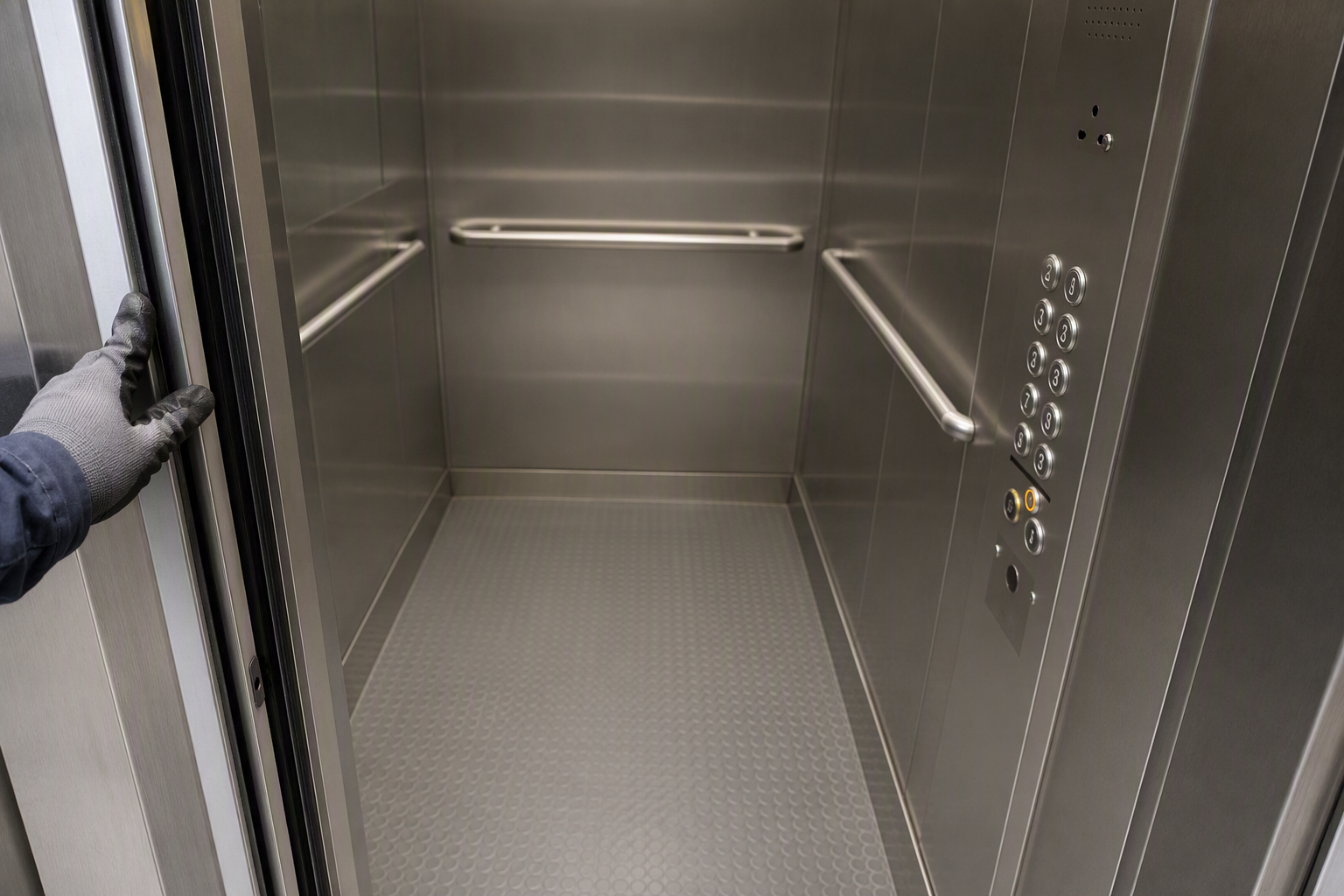
In Arizona, elevator safety is regulated at the state level by the Arizona Elevator Safety Unit, which operates under the Arizona Department of Occupational Safety and Health (ADOSH). The Elevator Safety Unit issues permits, licenses elevator contractors, and oversees mandatory periodic inspections. Healthcare facilities are not exempt from these requirements — in fact, the critical-use nature of medical elevators often draws heightened scrutiny during inspections.
Local Authorities Having Jurisdiction (AHJ), such as city building departments in Phoenix, Tucson, Scottsdale, and Mesa, may impose additional plan review and permitting requirements when elevators are installed, altered, or modernized in healthcare occupancies.
What Are the Inspection and Testing Requirements for Healthcare Elevators in Arizona?
Under Arizona’s adoption of ASME A17.1 and A17.3, elevators must undergo:
- Periodic inspections by a licensed elevator inspector at intervals established by the Arizona Elevator Safety Unit. The inspection frequency is tied to elevator type and usage classification.
- Annual safety tests that confirm proper operation of safeties, buffers, governors, and related components.
- Five-year full-load tests (or oil buffer tests for hydraulic units) to verify structural and mechanical integrity under rated load conditions.
Healthcare facilities typically operate elevators at high daily cycle counts, accelerating wear on mechanical and hydraulic components. Facilities in Phoenix and Tucson metro areas should maintain detailed maintenance logs as inspectors review these records as part of every formal inspection.
What ADA Requirements Must Healthcare Elevator Cabs Meet?
The ADA sets specific dimensions and features that elevator cabs in healthcare facilities must meet. Key requirements include:
- Minimum cab interior dimensions sufficient to accommodate a wheelchair user and an attendant
- Door clear opening width adequate for wheelchair and gurney passage
- Hall call and car operating panel controls within accessible reach ranges
- Raised and Braille characters on control buttons and floor designations
- Audible signals and visual indicators at each floor stop
- Automatic leveling within a tolerance that allows smooth wheelchair and stretcher transfer
In healthcare settings, ADA compliance intersects with patient care. An elevator that fails to level precisely can create a hazard when moving patients on stretchers or in wheelchairs. Arizona Elevator Solutions conducts ADA compliance assessments specifically calibrated to the patient-handling realities of healthcare environments across Mesa, Scottsdale, Phoenix, and Tucson.
Are There Healthcare-Specific Elevator Requirements Beyond Standard Commercial Buildings?
Yes. Healthcare occupancies carry functional requirements that exceed those of a typical commercial office building. Key healthcare-specific elevator obligations include:
- Stretcher capacity: Hospitals and facilities that transport patients on stretchers need elevators sized to accommodate a fully extended stretcher plus an attending medical team. Cab depth and door dimensions must be evaluated against the facility’s actual patient-transport equipment.
- Fire service operation (Phase I and Phase II): ASME A17.1 requires that elevators serving healthcare facilities be equipped with firefighters’ emergency operation. Phase I automatically returns cars to a designated floor upon smoke detector activation. Phase II allows firefighters to operate the car manually. These systems must be tested and documented at each periodic inspection.
- Hospital emergency power: Elevators in hospitals and emergency care facilities often fall under emergency power requirements, ensuring at least one elevator remains operational during a utility outage. Coordination with the facility’s electrical engineers and the local AHJ is necessary to identify which units must be connected to emergency circuits.
- Infection control considerations: While not a code requirement per se, cab finishes, ventilation, and maintenance protocols in healthcare elevators must align with the facility’s infection prevention program. Stainless steel interiors, antimicrobial surfaces, and enhanced HVAC are common in clinical settings.
What Permits Are Required When Installing or Modernizing a Healthcare Elevator in Arizona?
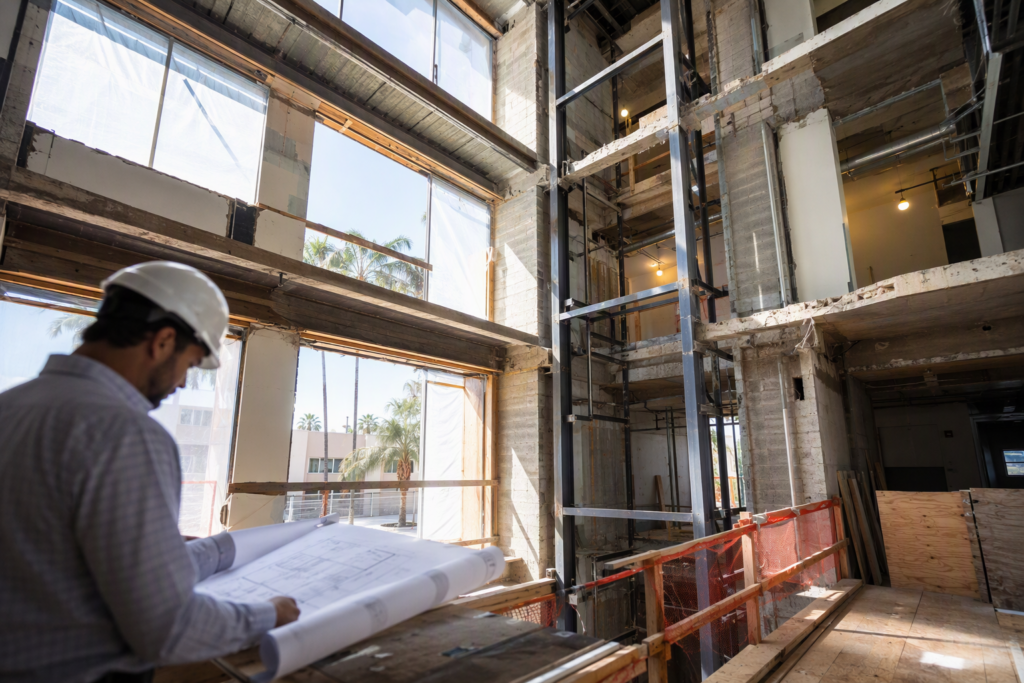
Before any new installation or major modernization project begins, the facility must obtain:
- An installation or alteration permit from the Arizona Elevator Safety Unit. No work may commence without this permit.
- A building permit from the local AHJ (city of Phoenix, Tucson, Scottsdale, or Mesa building department, as applicable), which typically includes plan review for structural, electrical, and fire-protection tie-ins.
- A final inspection and certificate of operation issued by a licensed Arizona elevator inspector after installation or modernization is complete and all tests are passed.
Healthcare facility projects often involve additional review by the state health department or accreditation bodies such as The Joint Commission, which may audit life-safety systems including vertical transportation during facility surveys. Facilities should ensure their elevator contractor coordinates documentation with these review processes.
What Is the Role of Elevator Maintenance Contracts in Healthcare Compliance?
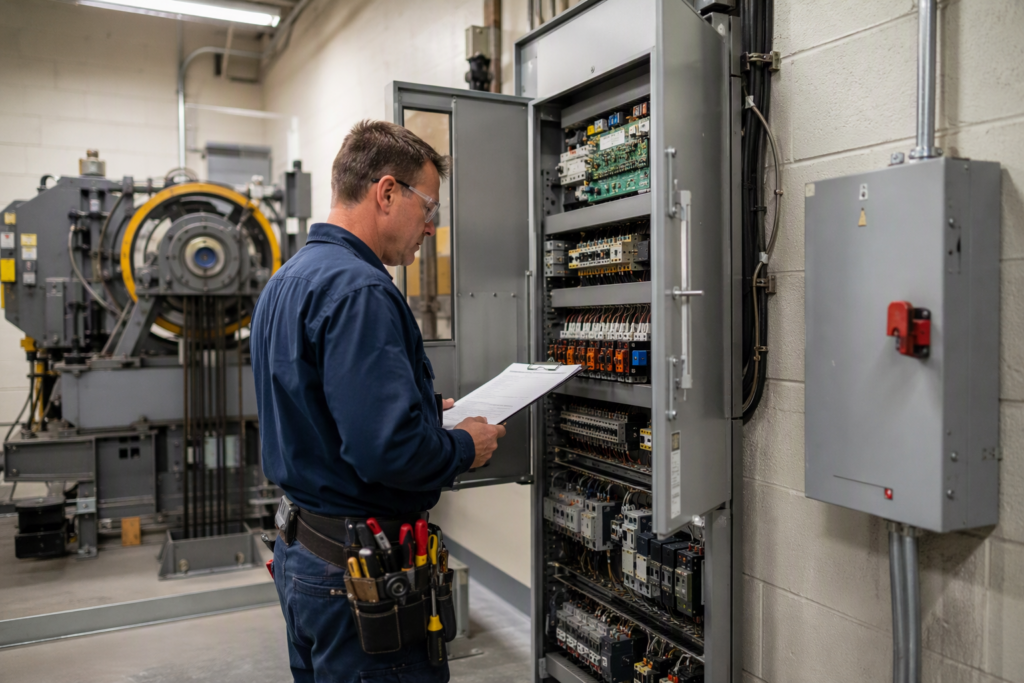
A comprehensive maintenance contract is not simply a convenience for healthcare facilities — it is a core compliance tool. ASME A17.1 places maintenance obligations on equipment owners, and Arizona inspectors will review maintenance logs during periodic inspections. A lapse in documented maintenance can result in violations, fines, or elevator shutdowns that disrupt patient care.
Effective healthcare elevator maintenance contracts should address:
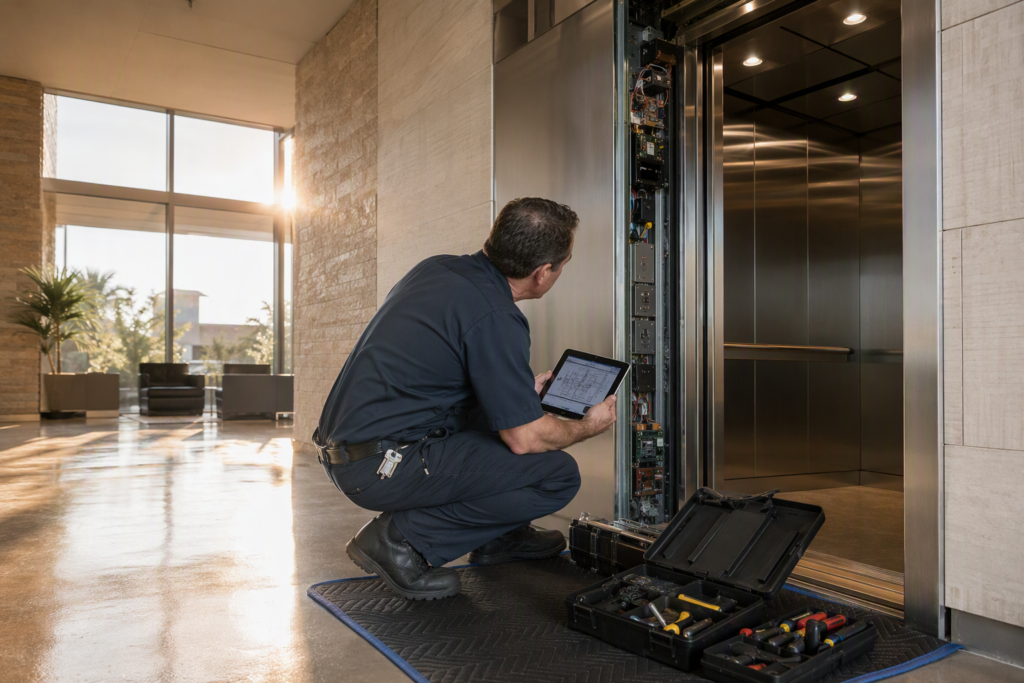
- Scheduled lubrication, adjustment, and safety component inspection at code-compliant intervals
- Testing of fire service Phase I and Phase II operation
- Hydraulic fluid integrity checks (for hydraulic units) to guard against fluid leaks that trigger environmental and code concerns
- Documentation and recordkeeping practices that satisfy Arizona Elevator Safety Unit inspection requirements
- Response protocols for entrapment or out-of-service situations that reflect the critical nature of healthcare operations
Arizona Elevator Solutions provides maintenance programs structured specifically for the compliance documentation demands that Arizona healthcare facilities face.
What Happens If a Healthcare Elevator Fails an Arizona Inspection?
When an Arizona elevator inspector identifies a violation, the facility owner receives a written notice of the deficiency. Depending on the severity:
- The elevator may be placed out of service immediately if a condition is deemed an imminent hazard to safety.
- For non-imminent violations, a correction deadline is assigned, and the facility must demonstrate compliance through a follow-up inspection or documented repair.
- Failure to correct within the timeframe can result in civil penalties under Arizona statutes governing elevator safety.
- The facility must coordinate with a licensed Arizona elevator contractor to complete required repairs before the elevator is returned to service.
- A re-inspection by a licensed inspector must confirm all violations have been resolved and a valid certificate of operation is reinstated.
For hospitals and healthcare facilities where a single elevator may serve an entire wing or department, an unexpected shutdown can have significant operational consequences. Proactive compliance is always preferable to reactive repair.
How Should Healthcare Facilities Handle Elevator Entrapment Incidents?
Under OSHA general duty obligations and ASME A17.1 requirements, healthcare facility operators must have a documented response procedure for elevator entrapment. Recommended protocol:
- Contact the elevator service provider immediately to dispatch a licensed technician for passenger release.
- Communicate with trapped passengers via the elevator’s emergency two-way communication system, which is required under ASME A17.1 for all passenger elevators.
- Do not attempt self-rescue — untrained personnel should never attempt to open doors or move the car manually.
- Notify facility security and administration so patient care continuity plans can be activated if the unit serves a clinical area.
- Document the incident including time, duration, cause, and corrective action taken, and retain records for inspection review.
Questions Your Inspector Will Ask
Arizona elevator inspectors conducting periodic inspections at healthcare facilities commonly examine the following areas. Facility managers and compliance officers should be prepared to answer each:
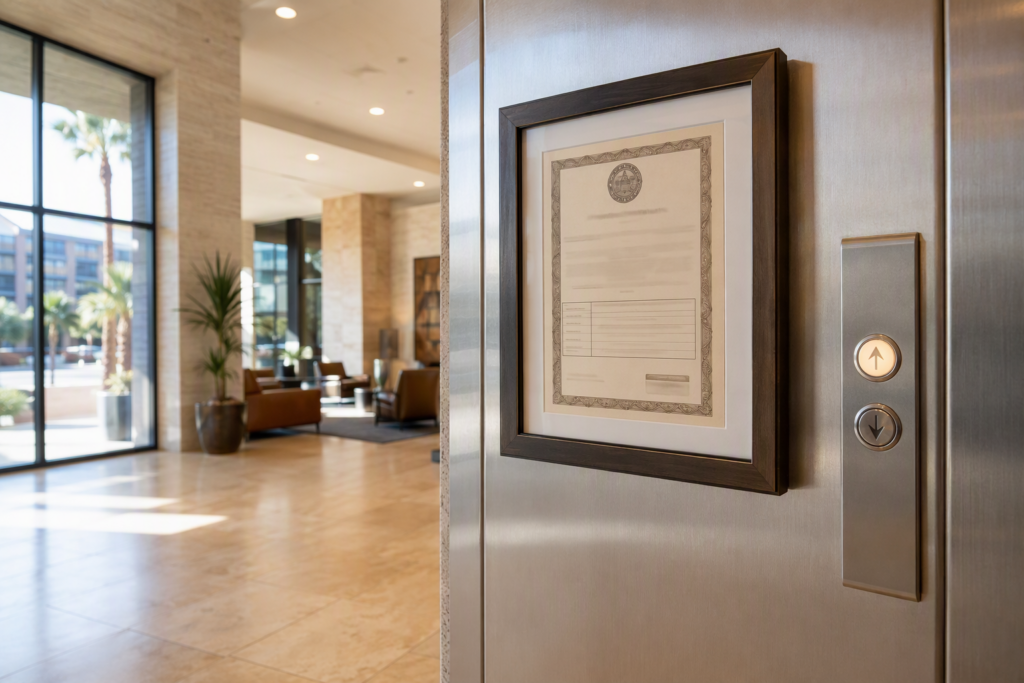
- Is the current certificate of operation posted in the elevator cab? Arizona requires a valid certificate to be displayed at all times.
- Are maintenance logs current, complete, and accessible on-site? Inspectors review documentation to verify that required maintenance intervals have been followed.
- Has the annual safety test been completed by a licensed contractor, and is the test report on file?
- Is fire service Phase I and Phase II operation functioning correctly, and when was it last tested?
- Does the two-way emergency communication system connect to a location with continuous staff coverage? In healthcare facilities, this is particularly scrutinized.
- Have any alterations been made to the elevator without an alteration permit from the Arizona Elevator Safety Unit?
- Are all ADA-required features intact, including Braille signage, audible signals, and leveling accuracy?
- For hydraulic units, has the hydraulic fluid system been inspected for integrity and environmental compliance?
How Does Arizona Elevator Solutions Support Healthcare Compliance in Phoenix, Tucson, Scottsdale, and Mesa?
Arizona Elevator Solutions works with hospitals, medical office buildings, outpatient centers, assisted living facilities, and skilled nursing homes throughout Arizona to manage the full compliance lifecycle — from initial permitting and installation through periodic inspection preparation, modernization, and ongoing maintenance. The team understands the operational sensitivity of healthcare environments and structures its service approach around minimizing disruption to patient care while maintaining strict adherence to ASME A17.1, ADA, and Arizona Elevator Safety Unit requirements.
Facilities in the Phoenix metro, Tucson, Scottsdale, and Mesa markets can request a free elevator assessment to identify current compliance status, upcoming inspection obligations, and any modernization needs before they become enforcement issues.
Summary: Key Compliance Obligations for Healthcare Elevators in Arizona
- Comply with ASME A17.1 Safety Code for Elevators and Escalators and ASME A17.3 for existing units
- Meet ADA accessibility requirements for cab dimensions, controls, and leveling
- Register with and obtain permits from the Arizona Elevator Safety Unit for all installations and alterations
- Maintain current certificates of operation posted in every cab
- Complete periodic inspections and annual safety tests at required intervals
- Ensure fire service Phase I and Phase II operation is functional and tested
- Maintain detailed maintenance logs available for inspector review
- Address healthcare-specific needs including stretcher capacity and emergency power coordination
- Have a documented entrapment response procedure aligned with OSHA general duty obligations
Need elevator service you can rely on? Arizona Elevator Solutions is ready to help.