Arizona Elevator Solutions Business Hours and Service FAQ

Whether a building owner is scheduling a routine maintenance visit, arranging a state-required annual inspection, or dealing with an unexpected outage, knowing when and how to reach a certified elevator service provider is critical. This FAQ hub covers business hours, service scheduling, Arizona compliance timelines, and everything in between for elevator owners and facility managers operating in the Phoenix metro area, Tucson, Scottsdale, and Mesa.
What are Arizona Elevator Solutions’ business hours?

Contact Arizona Elevator Solutions directly by phone or through the company’s website to confirm current business hours for scheduling installations, maintenance visits, inspections, and consultations in Phoenix, Tucson, Scottsdale, and Mesa.
Business hours can vary depending on the type of service requested — routine maintenance scheduling, consultation calls, and administrative inquiries may be handled during standard weekday office hours, while time-sensitive service needs may have different availability windows. The most reliable way to confirm current hours for a specific service type is to call the company directly. Facility managers are encouraged to establish a service relationship with Arizona Elevator Solutions before an emergency arises so that the contact process is already in place.
Does Arizona Elevator Solutions offer emergency elevator service?
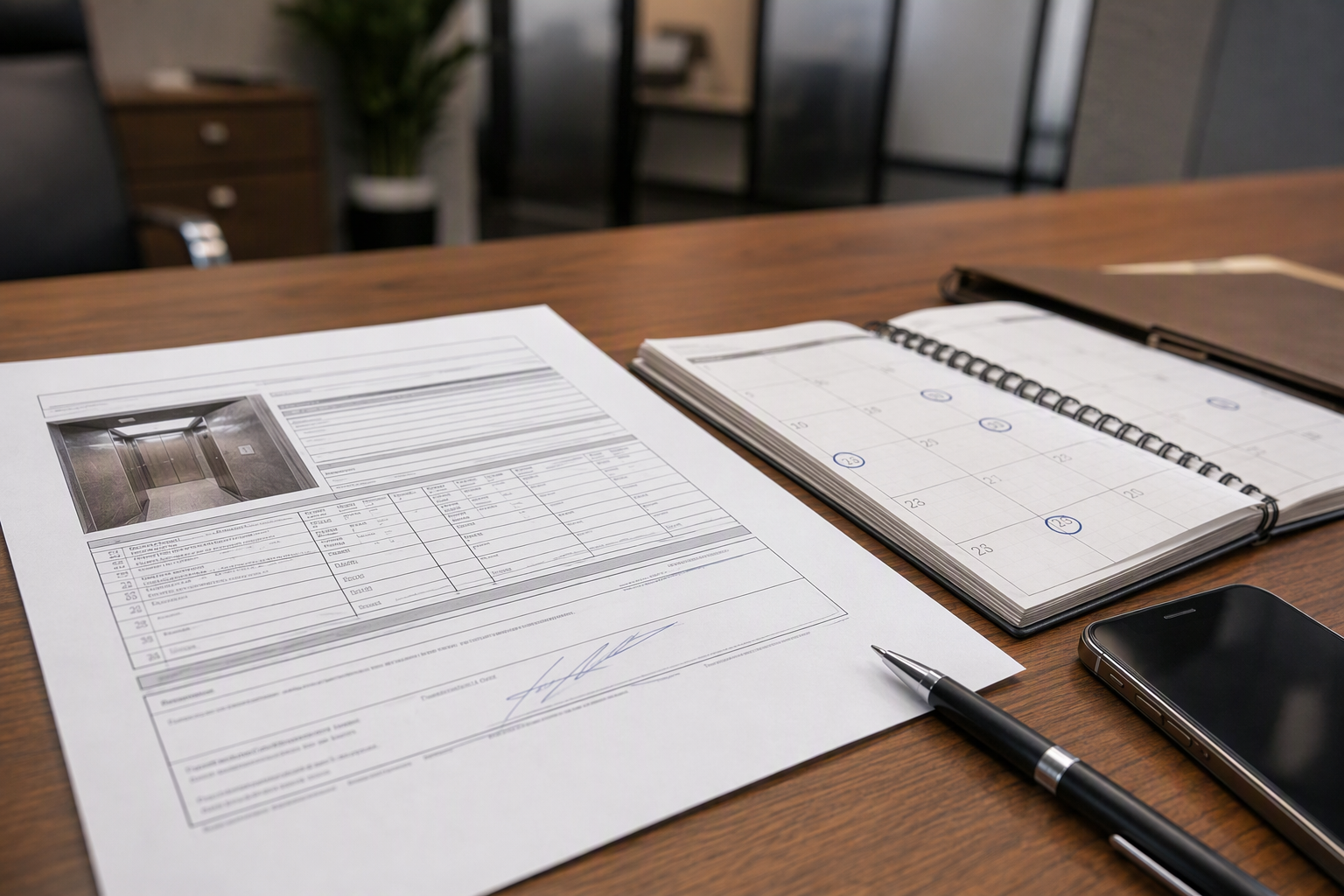
Building owners and facility managers should contact Arizona Elevator Solutions directly to learn about service options available outside standard business hours.
Elevator outages do not limit themselves to convenient scheduling windows. A malfunctioning elevator in a multi-story commercial building, a hospital, or a residential high-rise represents a compliance issue, an accessibility concern under the Americans with Disabilities Act (ADA), and a potential safety hazard. Under A.R.S. §§ 23-491 through 23-491.16, Arizona building owners bear direct legal responsibility for maintaining conveyances in a safe and operational condition. Owners are also required to notify the Industrial Commission of Arizona’s Elevator Division within 24 hours of any accident that injures a person or disables a conveyance — making rapid access to a qualified service provider a compliance necessity, not merely a convenience.
Facility managers should document the company’s contact number in building emergency plans and post it in the elevator machine room for immediate access by on-site personnel.
How far in advance should a maintenance or inspection visit be scheduled?
Scheduling lead times vary by service type, but proactive planning is strongly recommended given Arizona’s strict annual inspection deadlines and the 90-day advance notice requirement before any installation, relocation, or alteration.
Under Arizona Administrative Code R20-5-502 through R20-5-515, every conveyance must hold a valid annual certificate of inspection issued by the state — and that certificate must be kept at the same location as the conveyance and made available on request. A lapsed certificate means the conveyance is operating without legal authorization. Owners who wait until the final weeks of their certificate’s validity period risk inspection backlogs and potential shutdown notices.
For installation or alteration projects, Arizona law requires that owners notify the Industrial Commission of Arizona’s Elevator Division at least 90 days before beginning work. Arizona Elevator Solutions recommends building that notification window into any construction or renovation schedule from the very start of project planning.
Which cities does Arizona Elevator Solutions serve?
Arizona Elevator Solutions serves customers in Phoenix, Tucson, Scottsdale, and Mesa, Arizona.
Each of these markets has its own local considerations. Within the City of Phoenix, the Phoenix Elevator Section of the Planning and Development Department inspects elevators, escalators, moving walks, dumbwaiters, and chairlifts — making it the authority having jurisdiction (AHJ) for equipment inside city limits. For conveyances located outside Phoenix, the Industrial Commission of Arizona’s Elevator Division assumes that regulatory role under A.R.S. § 23-491. Navigating these overlapping jurisdictions correctly is essential to obtaining a valid certificate of inspection, and Arizona Elevator Solutions is familiar with the requirements of each market it serves.
What types of elevator services can be scheduled during business hours?
During business hours, customers can schedule consultations, routine preventive maintenance, annual state inspection coordination, new equipment installation, modernization projects, and code compliance assessments.
The scope of services available from a certified elevator contractor is broader than many building owners realize. Beyond basic repair calls, a qualified provider can assess whether an existing conveyance complies with Arizona’s adopted code — the ASME A17.1/CSA B44, 2019 edition, which applies to equipment installed, repaired, or altered on or after January 1, 2023. For platform lifts and stairway chairlifts installed, repaired, or altered on or after that same date, the applicable standard is ASME A18.1-2020. A thorough service relationship covers all of these touchpoints, reducing the likelihood of compliance gaps that result in shutdown orders or failed inspections.
What should a building owner do immediately after an elevator malfunction or accident?
Arizona law mandates specific steps following an elevator accident or disabling event, and owners must act quickly to meet notification deadlines.
- Ensure the safety of all occupants — if anyone is trapped, contact local emergency services immediately.
- Take the elevator out of service to prevent additional use until the cause of the malfunction is determined.
- Notify the Industrial Commission of Arizona’s Elevator Division within 24 hours of any accident that injures a person or disables a conveyance, as required under A.R.S. §§ 23-491 through 23-491.16.
- Contact a licensed elevator contractor — such as Arizona Elevator Solutions — to assess the equipment and document the condition for the required state report.
- Do not return the conveyance to service until it has been inspected and cleared by an authorized inspector and the appropriate authority having jurisdiction has been notified.
- Retain all inspection records, service reports, and correspondence with the state in the building’s compliance file.
Who regulates elevator safety in Arizona, and what is the current regulatory structure?
As of September 12, 2026, elevator safety in Arizona is administered by the Industrial Commission of Arizona’s Elevator Division, which replaced the former ADOSH Elevator Safety Section under Laws 2026, Ch. 73.
This regulatory transition is important for building owners to understand when communicating with state agencies, submitting notifications, or verifying inspection certificates. The governing statute is A.R.S. §§ 23-491 through 23-491.16, with implementing rules found in Arizona Administrative Code R20-5-502 through R20-5-515. Within the City of Phoenix, the Phoenix Elevator Section of the Planning and Development Department also plays an inspection role for equipment located inside city limits.
Contractor licensing is a separate layer: the Arizona Registrar of Contractors issues R-12 (residential) and C-12 (commercial) elevator license classifications to companies authorized to install and repair elevators, dumbwaiters, escalators, and moving walks. The Registrar of Contractors does not, however, issue the annual certificate of inspection — that authority rests with the state’s Elevator Division.
What is Arizona’s annual elevator inspection requirement?
Every conveyance operating in Arizona must be inspected before it first goes into service, after any modification or alteration, and annually thereafter — and no conveyance may operate without a valid state-issued annual certificate of inspection.
The certificate must be kept at the same location as the conveyance and made available for inspection on request. Additionally, the state serial number or certificate must be posted in or close to the conveyance in an easily accessible location. The state serial number itself is found on a tag fixed to the controller or mainline disconnect of every Arizona-registered conveyance.
Building owners may choose to coordinate their annual inspection through Arizona Elevator Solutions, which can help ensure that the conveyance is in the proper condition prior to the inspector’s visit — reducing the likelihood of a failed inspection and the compliance complications that follow.
Can a private inspector be used for Arizona’s annual elevator inspection?
Yes — Arizona owners may hire a private elevator inspector authorized by the Industrial Commission of Arizona to perform initial or annual inspections, provided that inspector meets specific registration and independence requirements.
Arizona private elevator inspectors must register with the commission annually and demonstrate at least eight hours of approved continuing education per registration period. Critically, a private elevator inspector may not inspect a conveyance owned, operated, or last serviced by the inspector, a company the inspector owns, or the inspector’s employer. This conflict-of-interest prohibition ensures objectivity in the inspection process. It also means that the elevator service company maintaining a building’s equipment and the inspector performing the annual certification must be independent parties. Using a private inspector does not relieve the building owner or operator of any of their legal obligations under A.R.S. §§ 23-491 through 23-491.16.
What code standard applies to elevators installed or modified in Arizona in 2026?
Equipment installed, repaired, or altered on or after January 1, 2023 must comply with the ASME A17.1/CSA B44, 2019 edition, which became effective in Arizona on January 9, 2023.
The ASME A17.1 Safety Code for Elevators and Escalators is the primary technical standard governing design, construction, operation, inspection, testing, maintenance, alteration, and repair of elevators and related equipment. For platform lifts and stairway chairlifts installed, repaired, or altered on or after January 1, 2023, the applicable standard is ASME A18.1-2020. Older conveyances lawfully installed before these effective dates may remain in service unless the state’s elevator chief determines that continued use poses a hazard to life, health, or property — a determination that can be triggered by a failed inspection or a reported incident.
How does the ADA affect elevator availability and scheduling in commercial buildings?
The Americans with Disabilities Act requires that accessible routes — including elevators — remain operational in covered facilities, making elevator downtime a civil rights compliance issue in addition to a maintenance concern.
Title III of the ADA requires places of public accommodation to maintain accessible features in operable condition. A prolonged elevator outage in a multi-story building that lacks an accessible alternative route can expose building owners to ADA complaints and legal liability. For this reason, preventive maintenance scheduling — not just reactive repair — is an essential component of ADA compliance strategy. Facility managers in Phoenix, Tucson, Scottsdale, and Mesa should ensure their maintenance agreements provide for regular service intervals that minimize unplanned outages.
What is the difference between routine maintenance and a state-required inspection?
Routine maintenance is an ongoing service performed by the building’s elevator contractor to keep equipment operating safely and efficiently, while a state-required inspection is a formal evaluation by an authorized inspector that results in — or denies — the issuance of an annual certificate of inspection.
| Service Type | Performed By | Regulatory Requirement | Outcome | Frequency |
|---|---|---|---|---|
| Preventive Maintenance | Licensed elevator contractor (R-12 / C-12) | Recommended; supports compliance with ASME A17.1-2019 | Reduces downtime; prepares equipment for inspection | Per maintenance agreement schedule |
| Annual State Inspection | ICA-authorized inspector (state or private) | Mandatory under A.R.S. § 23-491; no operation without valid certificate | Certificate of inspection issued (pass) or deficiencies noted (fail) | Annual minimum; also required before first use and after alterations |
| Pre-Alteration Notification | Owner / contractor submits to ICA Elevator Division | Required 90 days before installation, relocation, or alteration | State records the planned work; inspection scheduled post-completion | Each qualifying project |
| Accident / Incident Notification | Owner notifies ICA Elevator Division | Required within 24 hours of injury or disabling event | State review; equipment may not return to service until cleared | As incidents occur |
| Modernization / Code Upgrade | Licensed elevator contractor (R-12 / C-12) | Triggers ASME A17.1-2019 compliance requirements for altered equipment | Updated equipment; new inspection required before return to service | Project-based |
Well-maintained equipment consistently performs better during formal state inspections. Arizona Elevator Solutions recommends aligning preventive maintenance schedules with the calendar period leading up to a conveyance’s annual inspection due date, so that any deficiencies can be identified and corrected before the inspector arrives — rather than after a failed certificate renewal.
What should building owners look for when choosing an elevator service company in Arizona?
Building owners should verify that any elevator service company holds the appropriate Arizona Registrar of Contractors license classification and has demonstrable familiarity with Arizona’s regulatory structure, including the Industrial Commission of Arizona’s Elevator Division requirements.
Key factors to evaluate include whether the contractor is licensed under the R-12 or C-12 classification issued by the Arizona Registrar of Contractors, whether the company understands the distinction between the Phoenix Elevator Section’s jurisdiction inside Phoenix and the ICA Elevator Division’s authority elsewhere in the state, and whether the company’s service documentation supports the record-keeping obligations Arizona law places on building owners. Contractors who are unfamiliar with Arizona-specific requirements — such as the 90-day advance notification for alterations, the 24-hour accident reporting obligation, or the AZFS (Arizona Firefighters Service) key requirement for conveyances with firefighters’ emergency operation — may expose clients to unintentional compliance violations.
What is the Arizona Firefighters Service (AZFS) key requirement?
Arizona conveyances equipped with firefighters’ emergency operation must use the Arizona Firefighters Service (AZFS) key — a state-specific requirement that distinguishes Arizona from many other jurisdictions using different key standards.
Firefighters’ emergency operation allows first responders to take direct control of elevator movement during a fire or other emergency. The AZFS key requirement ensures that fire departments operating throughout Arizona carry a standardized key that will function in any Arizona-compliant elevator equipped with this feature. During installation, modernization, or alteration work on any qualifying conveyance, the contractor must verify that the installed equipment is compatible with the AZFS key. Building owners who are unsure whether their conveyance complies should raise this question during their next service visit or annual inspection coordination call.
How should facility managers prepare a building’s elevator records for an inspection?
Proper record preparation streamlines the inspection process, reduces the risk of administrative deficiencies, and demonstrates good-faith compliance with Arizona’s documentation requirements.
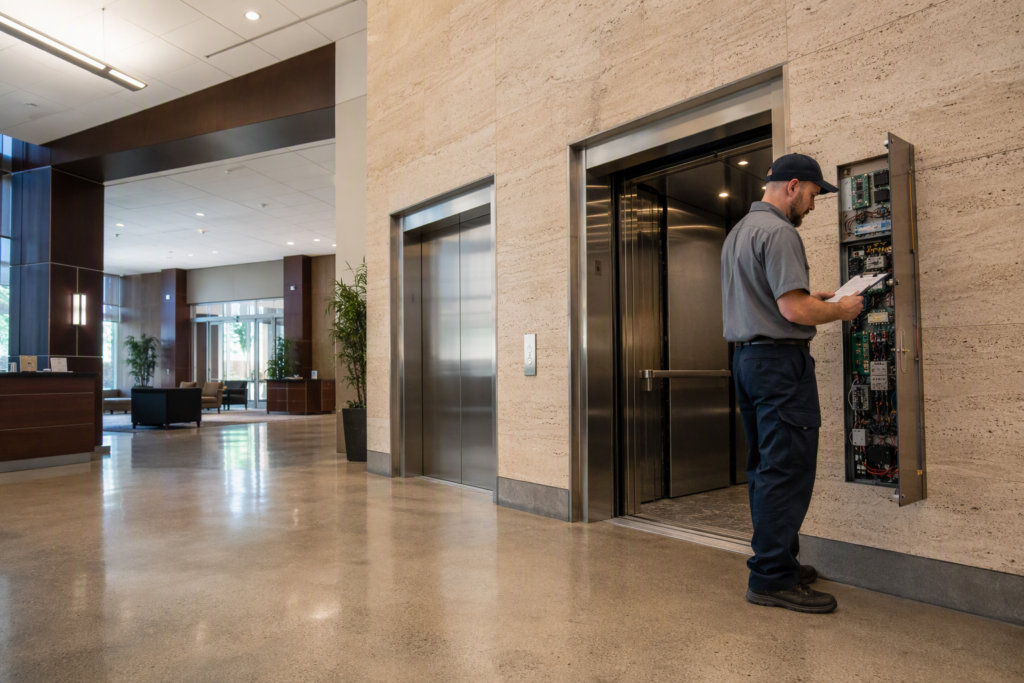
Prior to an annual inspection, facility managers should confirm that the current certificate of inspection is on file at the building location, that the state serial number tag or certificate is visibly posted in or near the conveyance, and that maintenance records are organized and accessible. The state serial number is assigned to each Arizona conveyance and appears on a tag fixed to the controller or mainline disconnect — inspectors will verify this. Any prior inspection reports noting deficiencies should be accompanied by documentation of corrective action taken. Having this documentation organized in advance demonstrates compliance diligence and reduces the time inspectors spend on administrative verification.
What happens if an elevator in Arizona fails its annual inspection?
A conveyance that fails its annual inspection may be taken out of service by the state until the identified deficiencies are corrected and a re-inspection confirms compliance — meaning a failed inspection directly affects building operations and tenant access.
Under A.R.S. §§ 23-491 through 23-491.16, no conveyance may operate in Arizona without a valid certificate of inspection. A failed inspection interrupts that certification, and the building owner bears the burden of arranging corrective repairs through a licensed elevator contractor, scheduling a re-inspection, and ensuring the conveyance does not operate in the interim. Older lawfully installed conveyances may remain in use unless the state’s elevator chief determines the use constitutes a hazard — but that protection does not extend to equipment that has failed an inspection on current safety grounds. Proactive maintenance through a provider such as Arizona Elevator Solutions significantly reduces the likelihood of inspection failures by identifying and resolving deficiencies in advance.
What is involved in elevator modernization, and when should it be considered?
Elevator modernization involves replacing or upgrading major components — such as controls, drives, doors, or cab finishes — to improve safety, energy efficiency, ADA accessibility, and code compliance, and it triggers a re-inspection requirement under Arizona law.
Any repair or alteration performed on or after January 1, 2023 must conform to the ASME A17.1/CSA B44, 2019 edition. This means that modernization projects are not simply aesthetic upgrades — they carry real code compliance implications that must be managed carefully. Additionally, owners must notify the Industrial Commission of Arizona’s Elevator Division at least 90 days before beginning any alteration. The conveyance must then pass an inspection before returning to service following the completed work. Facility managers considering modernization should begin conversations with their elevator contractor well in advance of any planned construction timeline to account for these regulatory lead times.
How does OSHA interact with elevator safety in Arizona workplaces?
The Occupational Safety and Health Administration (OSHA) sets workplace safety standards that apply to elevator-related work environments, including machine rooms, construction hoists, and situations where employees may be exposed to elevator equipment hazards.
While the Industrial Commission of Arizona’s Elevator Division governs conveyance safety for building occupants, OSHA standards govern the safety of workers who install, maintain, inspect, and repair elevator equipment. Employers in Arizona are responsible for ensuring that elevator maintenance and service work is performed in compliance with applicable OSHA standards, including those addressing lockout/tagout procedures, fall protection, and confined space entry. Building owners who engage elevator service contractors should confirm that those contractors maintain appropriate worker safety practices — a factor that also reflects on the overall quality and professionalism of the service provider.
What questions should a building owner ask when calling to schedule elevator service?
A well-prepared phone call to an elevator service provider results in faster scheduling, more accurate service preparation, and fewer delays during the visit itself.
Building owners and facility managers calling Arizona Elevator Solutions or any elevator contractor should be prepared to provide the following information: the conveyance’s Arizona state serial number (found on the tag at the controller or mainline disconnect), the current certificate of inspection expiration date, the nature of the service needed (routine maintenance, inspection coordination, repair, or modernization consultation), the building address and jurisdiction (City of Phoenix or outside Phoenix, since the AHJ differs), and any known history of prior deficiencies or recent unusual behavior of the equipment. Having this information ready at the time of the call allows the service coordinator to route the request appropriately and prepare the responding technician with the correct tools and documentation for the visit.
Why is choosing a locally experienced Arizona elevator contractor important?
Arizona’s regulatory structure — including the dual-jurisdiction model between the City of Phoenix Elevator Section and the Industrial Commission of Arizona’s Elevator Division, the AZFS key requirement, and the state’s adopted edition of ASME A17.1 — creates compliance nuances that only a contractor with direct Arizona experience can reliably navigate.
A contractor unfamiliar with the distinction between Phoenix’s local inspection authority and the ICA Elevator Division’s statewide role may submit notifications to the wrong agency, causing delays in receiving a certificate of inspection. Similarly, contractors who are not familiar with Arizona’s adopted ASME A17.1-2019 edition may apply incorrect standards to repair or modernization work, creating liability for both the contractor and the building owner. Arizona Elevator Solutions focuses exclusively on the Arizona market — Phoenix, Tucson, Scottsdale, and Mesa — giving the company direct, working familiarity with the agencies, inspection processes, and local authority requirements that affect every service call it handles.
Contact Arizona Elevator Solutions for a free elevator assessment at 480-557-7600.
Need elevator service you can rely on? Arizona Elevator Solutions is ready to help.