An elevator service contract — sometimes called a full maintenance agreement or a preventive maintenance contract — is the primary tool building owners use to keep conveyances operating safely, legally, and efficiently. In Arizona, state law requires annual inspection and a valid certificate before any elevator may operate. A well-structured service contract bridges routine mechanical care with the regulatory milestones that keep a building out of legal jeopardy. The 20 questions and answers below cover the full landscape: what contracts include, what Arizona law requires, how federal codes interact with state rules, what gets excluded, and how to evaluate a provider.
What does a standard elevator service contract cover?

A standard elevator service contract covers scheduled preventive maintenance, lubrication of moving components, adjustment of brakes and door operators, safety device testing, and documentation support for annual state inspection compliance.
Preventive maintenance is the core deliverable of any service agreement. During each scheduled visit, trained elevator mechanics examine and service the machine room equipment — motor, controller, governor — as well as the hoistway components: guide rails, safeties, buffers, and counterweight. Door systems receive particular attention because door malfunctions are among the most common causes of entrapments and injuries. Lubrication is applied to sheaves, guide shoes, and door tracks according to the manufacturer’s specifications and the intervals established by the ASME A17.1 Safety Code for Elevators and Escalators.
Service contracts also typically include callback response — sending a mechanic when the elevator stops unexpectedly between maintenance visits. The scope of callback coverage (unlimited versus capped hours, parts included versus billed separately) varies significantly between contract tiers, so owners should read this section of any agreement carefully.
What does Arizona law require for annual elevator inspections?
Arizona law requires that every conveyance receive an annual inspection and hold a valid certificate of inspection issued under A.R.S. §§ 23-491 through 23-491.16 before it may legally operate.
Under Arizona statute, no conveyance may operate without that annual certificate in place. The Industrial Commission of Arizona’s Elevator Division — formerly called the ADOSH Elevator Safety Section until September 12, 2026 — administers this requirement statewide. Equipment located inside the City of Phoenix falls under the City of Phoenix Elevator Section (Planning and Development Department), which performs its own inspections for elevators, escalators, moving walks, dumbwaiters, and chair lifts within city limits; the state handles equipment outside Phoenix.
Arizona also requires that every conveyance be inspected before it first goes into service and after any modification or alteration. A service contract from a qualified maintenance provider helps owners stay ahead of these milestones by tracking inspection due dates and ensuring the elevator is mechanically ready before the inspector arrives.
Who may perform the annual inspection in Arizona?
Annual inspections may be performed by the Industrial Commission of Arizona’s Elevator Division directly or by a private elevator inspector authorized by the commission — but that private inspector must be independent from the company that last serviced the equipment.
Arizona law specifies that a private elevator inspector may not inspect a conveyance owned, operated, or last serviced by the inspector, a company the inspector owns, or the inspector’s employer. This independence requirement protects building owners and the public from conflicts of interest. Private inspectors must register with the commission every year and demonstrate at least eight hours of approved continuing education to maintain that authorization.
Importantly, using a private inspector does not relieve the owner or operator of their legal obligations under Arizona law. The responsibility for maintaining a valid certificate rests with the building owner, not the inspector or the maintenance contractor. A good service contract identifies inspection coordination as a deliverable — tracking due dates, preparing inspection documentation, and ensuring deficiencies noted by the inspector are corrected promptly.
What is the ASME A17.1 code and how does it apply to Arizona elevators?
ASME A17.1 is the Safety Code for Elevators and Escalators published by the American Society of Mechanical Engineers; Arizona has adopted the 2019 edition as the governing technical standard for equipment installed, repaired, or altered on or after January 1, 2023.
The ASME A17.1-2019 establishes minimum requirements for design, construction, operation, inspection, testing, maintenance, alteration, and repair of elevators and related conveyances. When a service contract references “code-required testing,” those tests — including periodic governor and safety tests, oil buffer tests, and firefighters’ service tests — are defined in ASME A17.1.
Arizona’s adoption is codified in Arizona Administrative Code R20-5-502 through R20-5-515. Equipment lawfully installed before January 1, 2023, may remain in service under the edition applicable at the time of installation unless the state’s elevator chief determines continued operation poses a hazard to life, health, or property. Service contracts for older equipment should address how the contractor handles code-compliance gaps discovered during maintenance.
What periodic safety tests must be included in a service contract?
ASME A17.1-2019 mandates periodic tests — including safety and governor tests, brake tests, and firefighters’ emergency operation tests — that must be performed and documented at specified intervals, and a comprehensive service contract schedules and records all of these.
These tests are not the same as the annual inspection. Many are performed by the maintenance contractor and witnessed or reviewed by the inspector. The table below summarizes key test types referenced in ASME A17.1 and their general purpose, so owners understand what their contract should encompass.
| Test Type | Governing Standard | General Purpose | Who Typically Performs |
|---|---|---|---|
| Safety and Governor Test | ASME A17.1-2019 | Verifies that the governor-triggered safety clamps will stop and hold a loaded car | Maintenance contractor (witnessed by inspector) |
| Brake Test | ASME A17.1-2019 | Confirms the machine brake holds a rated load | Maintenance contractor |
| Oil Buffer Test | ASME A17.1-2019 | Ensures hydraulic buffers compress and return within code limits | Maintenance contractor |
| Firefighters’ Emergency Operation Test | ASME A17.1-2019 | Verifies Phase I recall and Phase II in-car operation function correctly | Maintenance contractor / AHJ |
| Door Reopening Device Test | ASME A17.1-2019 | Confirms infrared or mechanical door protection prevents entrapment | Maintenance contractor |
| Standby Power Test | ASME A17.1-2019 | Verifies automatic transfer to backup power and controlled lowering to a floor | Maintenance contractor / building engineer |
Arizona building owners — particularly those operating in Phoenix, Scottsdale, Tucson, and Mesa — should confirm that their service contract lists each required periodic test, specifies the interval, and commits to providing written test records that satisfy the inspector and the Industrial Commission of Arizona’s Elevator Division.
What does the Arizona Firefighters Service (AZFS) key requirement mean for maintenance contracts?
Arizona conveyances equipped with firefighters’ emergency operation must use the Arizona Firefighters Service (AZFS) key, and maintenance contracts must include inspection and testing of this system to keep the elevator legally operational.
The AZFS key is Arizona-specific and differs from key switches used in other jurisdictions. Maintenance providers working in Arizona must stock and test for the correct key type. During Phase I and Phase II testing required by ASME A17.1-2019, the technician verifies that the AZFS key actuates recall correctly, that the elevator returns to the designated level, and that in-car firefighters’ service operates as designed. If a building undergoes a fire alarm system upgrade, the service contractor should be notified because changes to smoke detectors or pull-station wiring can affect Phase I recall operation.
What certificates and posting requirements must building owners maintain?
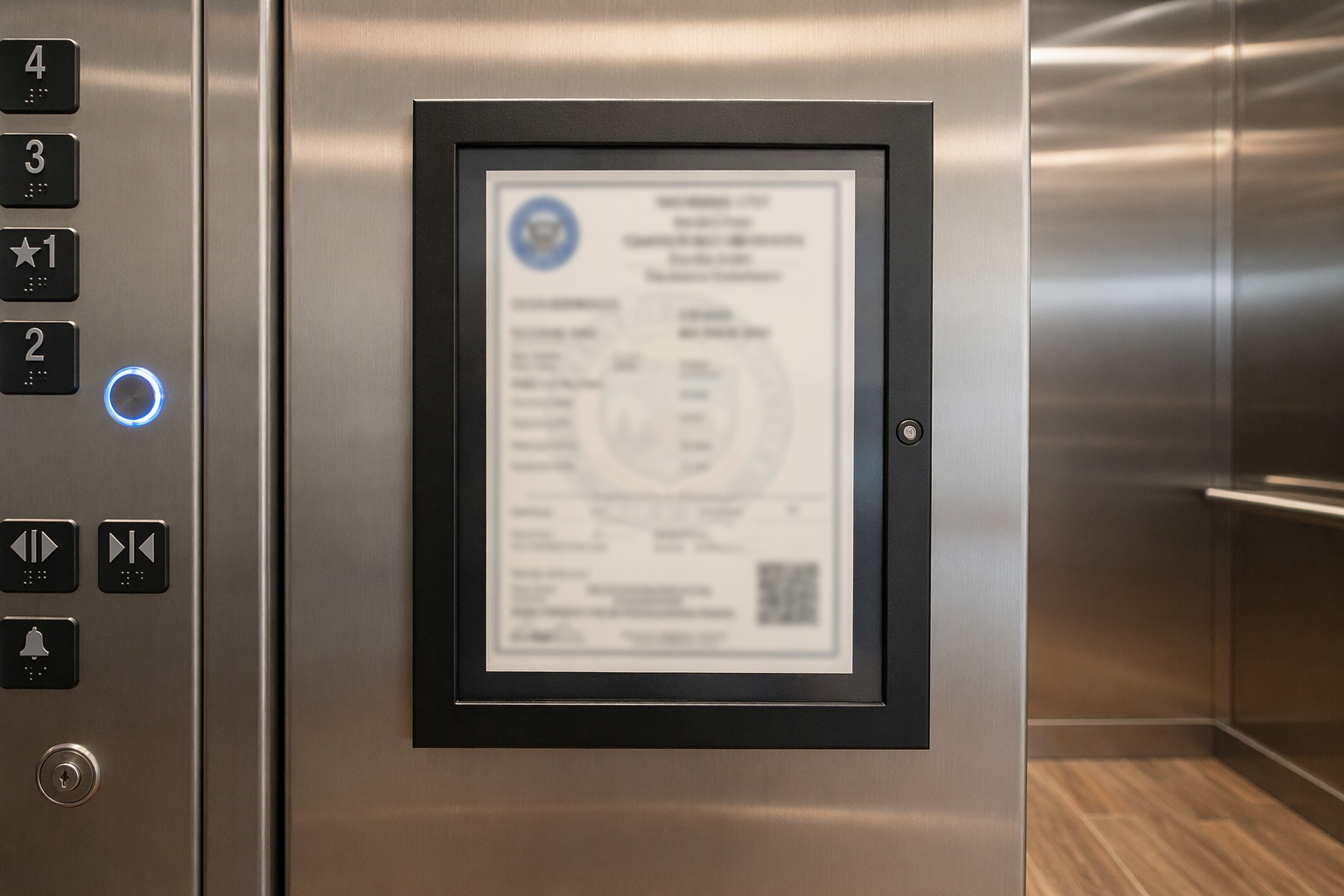
Arizona owners must keep the state certificate of inspection at the same location as the conveyance, make it available on request, and ensure the state serial number or certificate is posted in or close to the conveyance in an easily accessible location.
Every Arizona conveyance receives a state serial number on a tag fixed to the controller or mainline disconnect. This serial number links the physical equipment to inspection records held by the Industrial Commission of Arizona’s Elevator Division. Posting compliance is straightforward but frequently overlooked — a certificate that has expired or is stored in a management office rather than displayed at the elevator can result in a violation finding during an inspection.
Service contracts offered by experienced providers like Arizona Elevator Solutions typically include certificate tracking as part of the agreement, alerting owners well in advance of expiration and ensuring that renewed certificates are posted correctly after each annual inspection cycle.
What notification requirements do Arizona building owners have?
Arizona law requires owners to notify the state at least 90 days before installing, relocating, or altering a conveyance, and within 24 hours of any accident that injures a person or disables a conveyance.
These two notification obligations carry very different urgency levels. The 90-day advance notice for installation or alteration gives the Industrial Commission of Arizona’s Elevator Division time to review plans, assign a state serial number, and schedule an initial inspection before the new equipment goes into service. Failure to provide this notice can delay a certificate of inspection and prevent legal operation of a new or modified elevator.
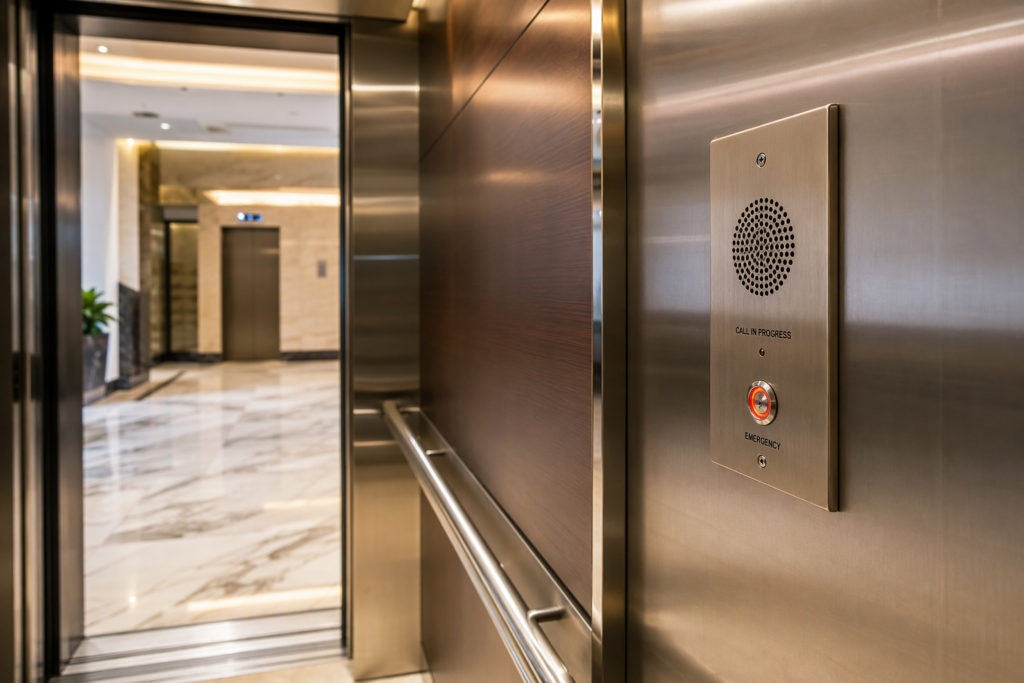
The 24-hour accident notification is critical for safety and legal compliance. If an elevator entrapment results in an injury, or if a mechanical failure disables the conveyance, the owner — not the contractor — bears responsibility for filing timely notice. A service contract should specify the escalation procedure: who the contractor contacts, what documentation they provide, and how quickly they respond to disable or secure equipment following a reportable event.
What is the difference between full maintenance and oil-and-grease contracts?
Full maintenance contracts bundle preventive care, parts, and callback labor into a single agreement, while oil-and-grease contracts cover only lubrication and basic adjustments — leaving parts and major repair costs to the building owner.
The table below outlines the typical scope differences so owners can evaluate which tier is appropriate for their equipment age, usage level, and budget.
| Contract Element | Oil-and-Grease (Basic) | Preventive Maintenance | Full Maintenance |
|---|---|---|---|
| Scheduled visits | Typically quarterly | Monthly or quarterly | Monthly |
| Lubrication and adjustments | Yes | Yes | Yes |
| Safety device testing | Limited | Yes | Yes |
| Callback labor included | No | Often capped | Yes (typically unlimited) |
| Parts included | No | Minor parts only | Yes (most wear parts) |
| Inspection coordination | Rarely | Sometimes | Yes |
| Code-required periodic tests | Owner arranges | Contractor performs | Contractor performs and documents |
| Best suited for | Low-use, newer equipment | Mid-age commercial equipment | High-use, older, or mission-critical equipment |
Does a service contract cover ADA compliance requirements?
A service contract does not typically include ADA retrofit upgrades, but routine maintenance preserves the operational features — leveling accuracy, door timing, control reach ranges — that the ADA requires to remain functional.
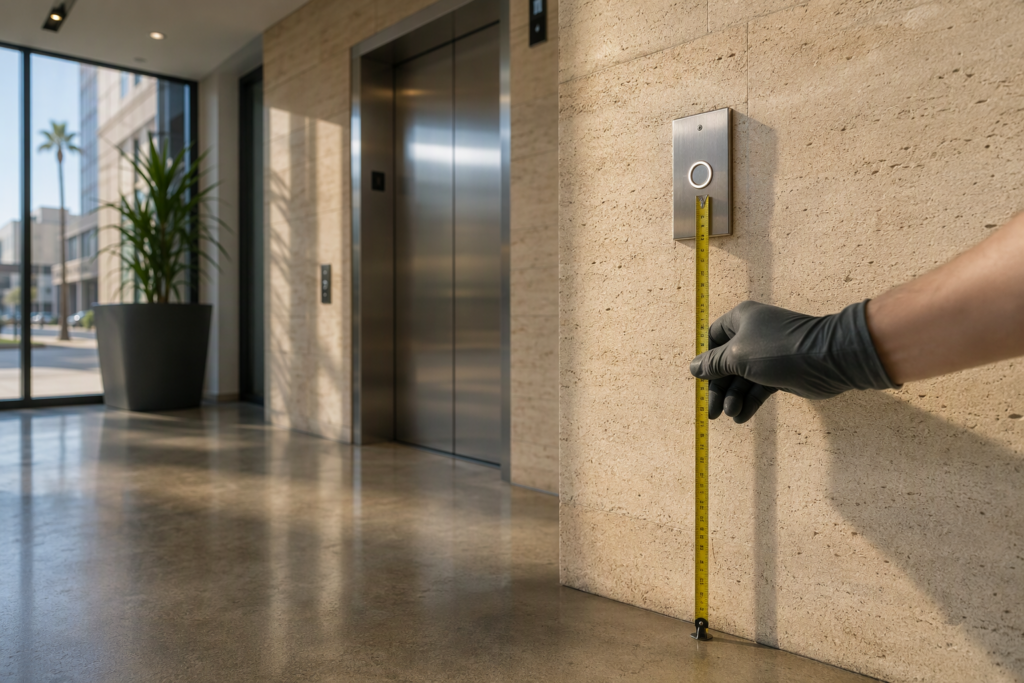
The Americans with Disabilities Act establishes accessibility standards for elevator controls, leveling, door dwell time, and audible signals. These features must work correctly for a building to meet its ADA obligations. Poor leveling — where the car floor stops more than half an inch above or below the landing — creates a tripping hazard and an ADA violation. Door timing that is too fast can prevent wheelchair users from safely boarding.
Preventive maintenance directly preserves these functional parameters. A service contract that includes leveling adjustment, door speed and dwell-time calibration, and audible/visual signal verification helps building owners in Phoenix, Scottsdale, Tucson, and Mesa protect their ADA compliance without requiring separate remediation work.
What is excluded from most elevator service contracts?
Most service contracts exclude damage from vandalism, misuse, floods, or fires; major modernization components; cab interior cosmetic repairs; and work required because of code-mandated upgrades on existing equipment.
Owners should read exclusions carefully. Common exclusions include: replacement of obsolete or discontinued parts no longer available from the manufacturer; structural repairs to the building hoistway, pit, or machine room; electrical supply upgrades required to bring equipment to current code; and repairs caused by third-party contractors working near elevator systems. Some contracts also exclude hydraulic oil disposal and cylinder replacement on older hydraulic elevators — a significant cost item for aging equipment in Arizona’s commercial building stock.
When evaluating proposals, ask each vendor to provide a written list of excluded components and scenarios, then compare those lists directly. This is often where the real cost difference between contract tiers emerges.
How do service contracts address older elevators installed before the 2023 Arizona code adoption?
Arizona law allows lawfully installed older conveyances to remain in service unless the Industrial Commission of Arizona’s elevator chief determines continued operation poses a hazard — but owners still need a valid annual certificate, and service contracts must address the applicable legacy code requirements.
Equipment installed before January 1, 2023, is not automatically required to be rebuilt to meet ASME A17.1-2019. However, any repair or alteration performed on or after that date must comply with the 2019 edition. This means that a component replacement triggered during routine maintenance could require upgrades to surrounding systems to bring them into conformance. Experienced maintenance providers document the edition applicable to each component so that repair decisions do not inadvertently trigger broader upgrade obligations.
Arizona Elevator Solutions works with building owners in Mesa, Tucson, Scottsdale, and Phoenix to evaluate older equipment, identify components approaching end of life, and structure service agreements that account for the legacy code environment while maintaining annual certificate eligibility.
What should a building owner do immediately after an elevator accident or entrapment?
- Ensure the safety of all persons involved — call emergency services if anyone is injured or trapped.
- Take the elevator out of service by locking the car at a floor or placing it on independent service to prevent further use.
- Contact the elevator maintenance contractor to dispatch a mechanic and secure the equipment.
- Notify the Industrial Commission of Arizona’s Elevator Division within 24 hours as required by Arizona law under A.R.S. §§ 23-491 through 23-491.16.
- Preserve any electronic controller logs, surveillance footage, and written maintenance records — do not reset or clear controller fault codes before the state inspector reviews them.
- Obtain written documentation from the maintenance contractor describing the mechanical condition found at the time of the incident response.
- Do not return the elevator to service until the contractor has completed repairs and the appropriate authority has cleared resumption of operation.
How does contractor licensing affect service contract validity in Arizona?
Arizona elevator contractors must hold an R-12 or C-12 license from the Arizona Registrar of Contractors to legally install and repair elevators, dumbwaiters, escalators, and moving walks — and owners should verify this license before signing any service contract.
The Arizona Registrar of Contractors issues R-12 (residential) and C-12 (commercial) elevator license classifications. These licenses govern the contractual and legal authority of the firm performing the work. It is important to understand that the ROC license authorizes the contractor but does not issue the annual certificate of inspection — that certificate comes from the Industrial Commission of Arizona’s Elevator Division (or the City of Phoenix Elevator Section for equipment within Phoenix city limits). Both credentials serve distinct functions and both matter.
Owners should request the ROC license number from any prospective maintenance contractor and verify it on the Arizona Registrar of Contractors public database. Signing a service contract with an unlicensed firm does not transfer the owner’s legal liability for maintaining a code-compliant, certificate-bearing elevator.
What records should a service contract require the contractor to maintain?
A service contract should obligate the contractor to maintain a written maintenance log for each conveyance, documenting every visit, test performed, adjustment made, and part replaced, available for review by the owner and the state inspector.
ASME A17.1-2019 establishes requirements for maintenance records, and Arizona inspectors expect to find documentation that substantiates the elevator has been maintained according to the code. A maintenance log that is incomplete, stored only on a technician’s handheld device without owner access, or that cannot be produced during an inspection can complicate certificate renewal.
Best practice is for the service contract to specify: (a) the format and retention period for maintenance logs, (b) the owner’s right to receive copies of all test reports, (c) documentation of any deficiencies found and their resolution, and (d) written notification to the owner when any safety device is found to be out of adjustment or non-functional. Arizona Elevator Solutions provides clients in Phoenix, Scottsdale, Mesa, and Tucson with accessible maintenance documentation as a standard component of service agreements.
What happens if an elevator fails its annual inspection in Arizona?
If an elevator fails its annual inspection, it may not legally operate until the cited deficiencies are corrected and re-inspected; the building owner is responsible for taking the unit out of service and completing repairs promptly.
The Industrial Commission of Arizona’s Elevator Division (or the City of Phoenix Elevator Section, within Phoenix) issues a written list of deficiencies when an elevator does not pass inspection. The elevator must be removed from service until those items are resolved and the inspector confirms compliance. Operating an elevator without a valid certificate of inspection violates A.R.S. §§ 23-491 through 23-491.16 and exposes the owner to enforcement action.
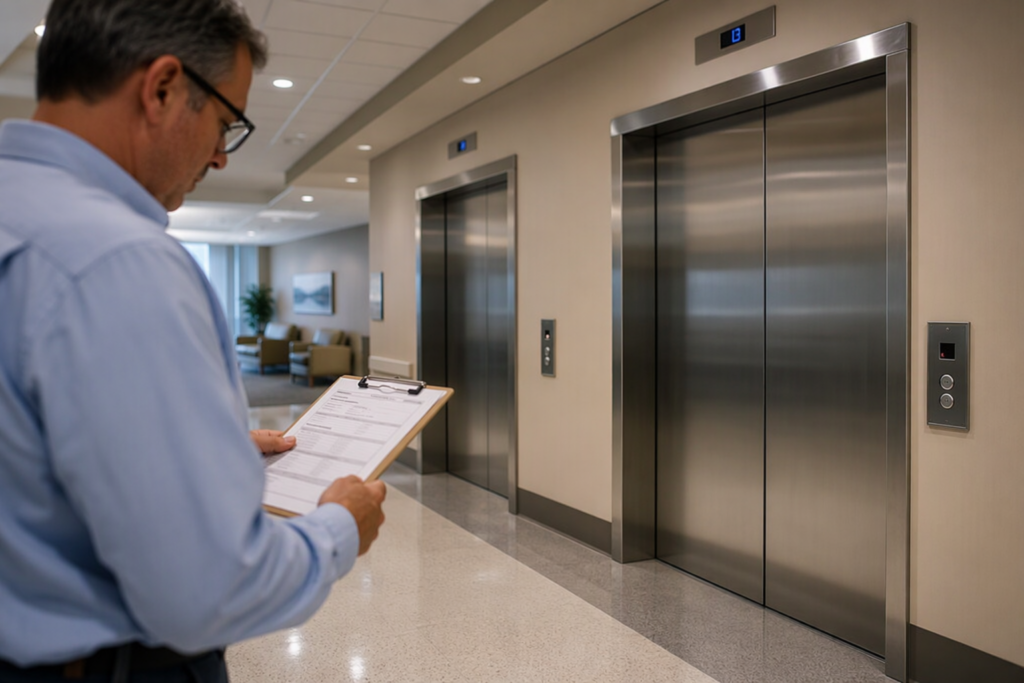
A proactive service contract reduces this risk substantially. When a contractor performs thorough preventive maintenance and pre-inspection walkthroughs, most inspection deficiencies are caught and corrected before the official visit. Owners should ask prospective contractors whether a pre-inspection audit is included in the service agreement.
How do platform lifts and stairway chairlifts differ from elevators in Arizona service requirements?
Arizona platform lifts and stairway chairlifts installed, repaired, or altered on or after January 1, 2023, must comply with ASME A18.1-2020, and they require the same annual inspection and certificate process as elevators under Arizona law.
The ASME A18.1 Safety Standard for Platform Lifts and Stairway Chairlifts governs these conveyances separately from ASME A17.1. Service contracts for buildings that use platform lifts or chairlifts to meet ADA accessibility requirements should explicitly name the ASME A18.1-2020 standard and confirm that the technicians are familiar with the specific maintenance requirements of that code, which differ from those applicable to traction or hydraulic elevators.
What should building owners in Phoenix look for that differs from other Arizona markets?
Building owners in Phoenix must work with the City of Phoenix Elevator Section rather than the state Elevator Division for inspections, meaning their service contractor must be familiar with City of Phoenix inspection procedures and scheduling.
The City of Phoenix Elevator Section (Planning and Development Department) inspects elevators, escalators, moving walks, dumbwaiters, and chair lifts within city limits. This is a local authority jurisdiction (AHJ) separate from the statewide Industrial Commission of Arizona’s Elevator Division. The underlying technical code — ASME A17.1-2019 — is the same, but inspection scheduling, deficiency correction timelines, and certificate-posting procedures may differ between the city and state processes. Contractors serving Phoenix clients should demonstrate familiarity with both authority structures.
Arizona Elevator Solutions serves the Phoenix market with knowledge of both the City of Phoenix Elevator Section requirements and the statewide framework administered by the Industrial Commission of Arizona’s Elevator Division.
How often should preventive maintenance visits occur under a service contract?
Maintenance visit frequency should be determined by equipment type, age, usage level, and manufacturer recommendations, with ASME A17.1-2019 establishing the minimum maintenance standards that dictate what must be checked — not prescribing a universal visit interval.
High-use commercial elevators in office towers or multi-family residential buildings in Phoenix or Scottsdale typically warrant monthly maintenance visits. Lower-use elevators in small commercial buildings or residential settings in Mesa or Tucson may be adequately served by quarterly visits, provided all required tests and adjustments are completed within the intervals the code and manufacturer specify. The service contract should state the visit frequency and what tasks are performed at each visit level, rather than leaving frequency to the contractor’s discretion.
What questions should a building owner ask before signing an elevator service contract?
Owners should ask about the contractor’s ROC license classification, the scope and exclusions of the contract, how periodic code-required tests are scheduled and documented, the process for inspection coordination, and what happens if deficiencies are found during an inspection.
A thorough pre-contract evaluation checklist should include:
- Is the company licensed under the Arizona Registrar of Contractors R-12 or C-12 classification?
- Does the contract specifically list all ASME A17.1-2019 required periodic tests and their intervals?
- Who is responsible for scheduling and coordinating the annual state inspection?
- Are inspection fees and re-inspection fees included or billed separately?
- What parts and repair labor are excluded?
- How does the contractor handle 24-hour accident notification obligations?
- In what format and location are maintenance records kept, and can the owner access them at any time?
- Does the contract include a pre-inspection audit before the annual state inspection?
- What is the escalation path if a safety device is found out of specification between scheduled visits?
- For Phoenix properties: does the contractor have experience working with the City of Phoenix Elevator Section?
Arizona Elevator Solutions advises prospective clients in Phoenix, Scottsdale, Tucson, and Mesa to request written answers to each of these questions before executing any long-term service agreement, ensuring the contract aligns with both ASME A17.1-2019 requirements and the specific regulatory environment administered by the Industrial Commission of Arizona’s Elevator Division.
Contact Arizona Elevator Solutions for a free elevator assessment at 480-557-7600.
Need elevator service you can rely on? Arizona Elevator Solutions is ready to help.