24 Hour Elevator Repair Service: Complete FAQ Guide for Building Owners & Facility Managers
If your elevator has stopped working, trapped a passenger, or triggered a safety shutdown, you need answers fast. This guide covers every question building owners, property managers, and facilities directors ask about emergency elevator repair — including costs, response times, compliance requirements, and what to expect from a qualified 24-hour service provider in Arizona.
What Is 24-Hour Elevator Repair Service?
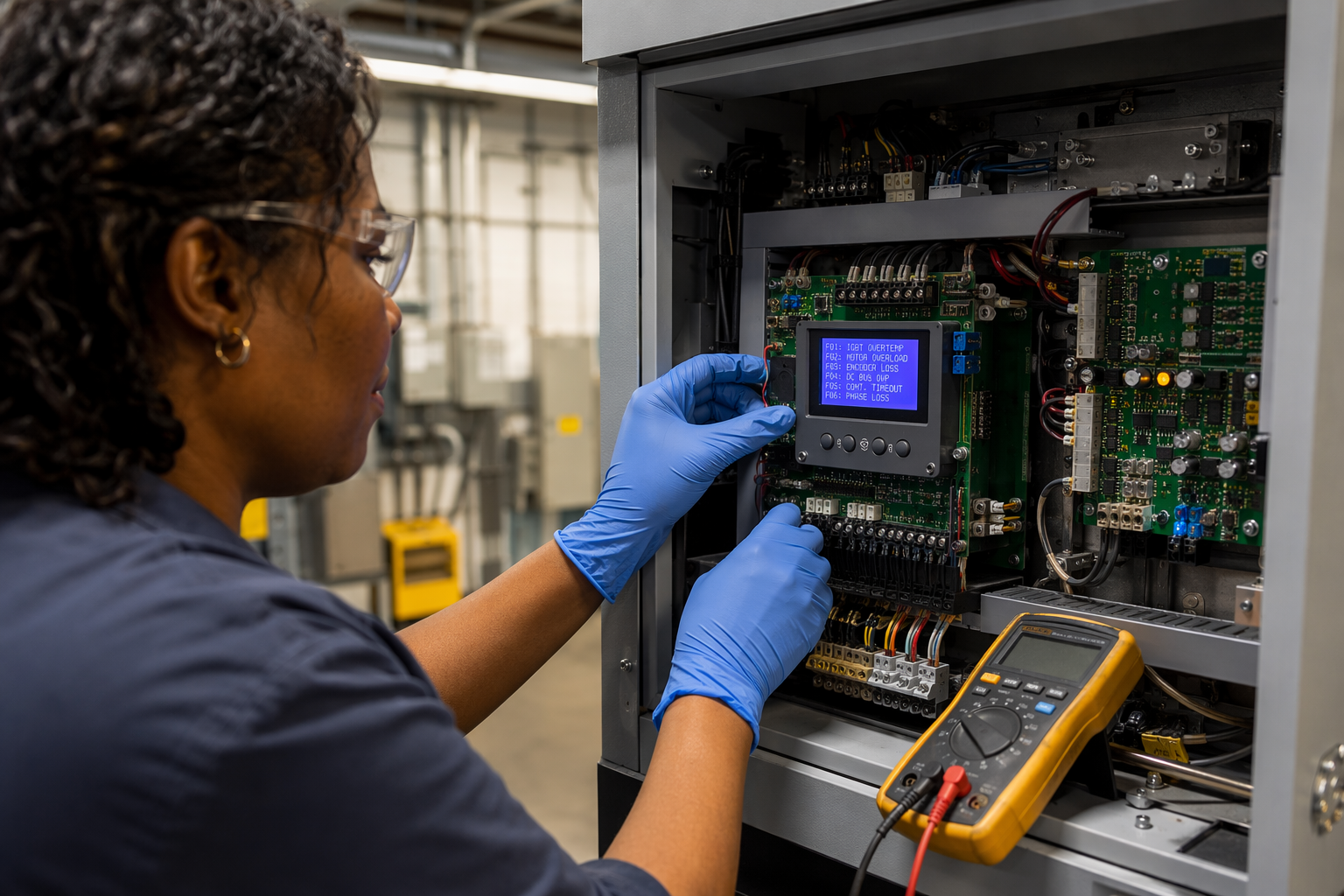
24-hour elevator repair service is a continuous emergency response program where IUEC-certified technicians are dispatched at any hour to diagnose and repair elevator failures, entrapments, or safety-code violations that cannot wait until the next business day.
Unlike scheduled maintenance, emergency elevator repair is triggered by an unplanned event — a door that won’t close, a cab stuck between floors, a drive system failure, or an alarm that will not reset. In commercial and multi-family residential buildings, a non-operational elevator is not just an inconvenience; it is a potential ADA compliance violation and a serious liability issue.
Arizona Elevator Solutions maintains a 24/7/365 emergency dispatch center serving Phoenix, Tucson, Scottsdale, and Mesa. Our on-call technicians carry the most common replacement parts — door operators, safety relays, drive boards, and buffer components — so the majority of emergency calls are resolved in a single visit.
Why Does Elevator Repair Need to Be Available Around the Clock?

Elevators are legally classified as “common carriers” under building codes, and their failure directly impacts life-safety systems, ADA accessibility obligations, and building certificate-of-occupancy compliance — all of which make round-the-clock repair coverage a regulatory and operational necessity.
Consider the cascading consequences of a downed elevator. Under the Americans with Disabilities Act (ADA), multi-story buildings must provide accessible routes to all floors. A failed elevator in a building without an accessible alternative route can trigger ADA complaints within hours. For hospitals, assisted living facilities, and hotels, the stakes are even higher — a non-functional elevator can be a direct threat to life safety.
From a legal standpoint, most commercial elevator service contracts in Arizona include a response-time clause. State elevator safety regulations require that passenger entrapments be resolved promptly, and buildings that leave entrapments unaddressed can face enforcement action from the Arizona Division of Occupational Safety and Health (ADOSH).
How Quickly Should a 24-Hour Elevator Technician Arrive On-Site?
Industry best practice and most professional service agreements define emergency response for passenger entrapments at under 1 hour and standard equipment failures at 2–4 hours; anything beyond 4 hours for an active entrapment is considered a service failure by ASME and IUEC standards.
Response time benchmarks vary by emergency type. The table below shows standard industry response-time targets for 2026:
| Emergency Type | Industry Target Response | Arizona Elevator Solutions Target | Regulatory Reference |
|---|---|---|---|
| Passenger Entrapment | Under 60 minutes | Under 60 minutes | ASME A17.1 Rule 2.27 |
| Safety Device Failure (e.g., governor, buffer) | 2–4 hours | 2–3 hours | ASME A17.1 Section 2.19 |
| Drive System / Motor Failure | 2–4 hours | 2–4 hours | ASME A17.1 Section 2.24 |
| Door Operator / Gate Failure | 4–8 hours | 3–6 hours | ASME A17.1 Rule 2.11 |
| Control Board / Electrical Fault | 4–8 hours | 4–8 hours | ASME A17.1 Section 3.26 |
| Non-Emergency Safety Deficiency | Next business day | Same day if possible | AZ State Elevator Code §R4-9 |
When evaluating service providers, always ask for their documented average emergency response time backed by dispatch records — not just a marketing promise.
What Are the Most Common Reasons Elevators Fail After Hours?
The most frequent after-hours elevator failures involve door operator malfunctions, control board faults, hydraulic fluid leaks, and safety relay trips — all of which can occur at any time and often go unnoticed until the first rider of the evening shift or overnight staff attempts to use the elevator.
After-hours failures are more common than most building managers realize because elevators experience their heaviest usage loads during peak business hours, and the resulting heat and mechanical stress often causes components to fail hours later — exactly when maintenance staff have gone home. The most common culprits we see in Phoenix and Tucson markets include:
- Door operator motor failures — doors refuse to open or close, triggering safety lockout
- Hydraulic oil overheating — especially in Arizona summers where ambient temperatures regularly exceed 110°F
- Control board EPROM errors — triggered by power surges from Arizona’s monsoon season lightning events
- Governor overspeed trips — mechanical safety devices that require a manual reset by a certified technician
- Pit flooding — rare but possible during monsoon events, triggering wet-pit safety switches
How Much Does Emergency 24-Hour Elevator Repair Cost in Arizona?
Emergency elevator repair in Arizona typically ranges from $350–$600 for after-hours labor (minimum call-out fee) plus parts, with complex repairs involving drive units, control boards, or hydraulic cylinders ranging from $1,500 to $8,000+ depending on component availability and equipment age.
Pricing is influenced by several variables specific to Arizona’s market conditions in 2026:
- After-hours premium: Most certified contractors charge a 1.5x–2x labor rate for calls between 6 PM and 6 AM, weekends, and holidays
- Parts availability: Older elevators (pre-1990) using obsolete components may require expedited shipping, adding $200–$500 to part costs
- Hydraulic oil costs: Arizona’s environmental regulations affect hydraulic oil disposal, adding $75–$150 to hydraulic repairs
- Full-service contract holders: Buildings with a comprehensive maintenance agreement typically pay $0 in emergency labor fees, as these are bundled into the contract
The most cost-effective strategy for Phoenix and Scottsdale building owners is a comprehensive elevator maintenance contract that includes 24-hour emergency coverage. This eliminates unpredictable emergency labor costs and ensures priority dispatch over non-contract callers.
Is Emergency Elevator Repair Different from Routine Maintenance?
Yes — emergency elevator repair is reactive, triggered by an unplanned failure or safety event, while routine maintenance is a proactive, scheduled program required by ASME A17.1 to prevent failures from occurring in the first place.
ASME A17.1, the Safety Code for Elevators and Escalators, mandates that all elevators receive periodic maintenance at intervals defined by the equipment type and usage classification. In Arizona, these intervals are enforced through annual third-party inspections by ADOSH-licensed inspectors. Skipping or delaying routine maintenance statistically increases emergency repair incidents by 40–60%, according to 2025 industry data from the National Elevator Industry Inc. (NEII).
Think of it this way: routine maintenance is a scheduled oil change; emergency repair is a roadside tow. You can have both in your service plan, but the goal is to do enough preventive work that the emergency calls become rare events.
What Qualifications Should a 24-Hour Elevator Repair Technician Have?
A qualified 24-hour elevator repair technician must hold IUEC (International Union of Elevator Constructors) certification or equivalent state-recognized credentials, carry a current Arizona ADOSH elevator mechanic license, and demonstrate documented competency on the specific elevator type they are repairing.
In Arizona, performing elevator work without a valid ADOSH elevator mechanic license is a Class 1 misdemeanor under Arizona Revised Statutes. When verifying a technician’s credentials, request:
- ADOSH elevator mechanic license number (verifiable at azica.gov)
- IUEC journeyman card or equivalent certification documentation
- Manufacturer-specific training certificates for proprietary systems (Otis, KONE, Schindler, ThyssenKrupp)
- Proof of general liability insurance and workers’ compensation coverage
All Arizona Elevator Solutions technicians hold current ADOSH licenses, carry IUEC journeyman status, and complete annual manufacturer training updates to stay current with modern elevator control systems.
What Happens During a Passenger Entrapment Emergency?
During a passenger entrapment, the responding technician’s first priority is safe extraction — communicating with trapped passengers, stabilizing the car, and opening doors at a landing in compliance with ASME A17.1 Rule 2.27 — before diagnosing the underlying fault.
The step-by-step protocol followed by certified technicians includes:
- Establish communication — confirm number of passengers, check for medical distress via intercom or phone
- Identify car position — determine if the car is level with a landing or stuck between floors
- Isolate power safely — disconnect drive power while maintaining lighting and communication
- Manually lower or raise the car to the nearest landing using hand-lowering valve (hydraulic) or manual brake release (traction)
- Extract passengers safely — never through a hatch unless fire department protocols require it
- Document the event — entrapments must be logged per ASME A17.1 Appendix requirements
- Diagnose and repair the fault — or place the unit out-of-service with proper signage pending full repair
Building staff should never attempt to self-rescue trapped passengers by forcing doors open from the outside. This creates serious injury risk and potential code violations.
Does Arizona Have Specific Regulations for Emergency Elevator Response?
Yes — Arizona enforces ASME A17.1 as the state elevator safety code, administered through ADOSH, which requires that entrapments be addressed immediately and that elevators with active safety violations be taken out of service until repairs are completed and reinspected.
Arizona’s elevator safety program operates under Arizona Administrative Code Title 4, Chapter 9 (R4-9), which adopts ASME A17.1 by reference with Arizona-specific amendments. Key state-specific requirements include:
- Annual third-party inspections by ADOSH-licensed inspectors are mandatory for all commercial elevators
- Certificates of inspection must be posted in the elevator cab or machine room
- Violations classified as “imminent danger” require immediate shutdown — no grace period
- Building owners must retain repair records for a minimum of 5 years
- Elevator contractors must be registered with ADOSH and maintain active insurance
Can a Building Legally Operate an Elevator With a Known Safety Deficiency?
No — under ASME A17.1 and Arizona Administrative Code R4-9, any elevator with a documented safety deficiency that creates imminent danger must be taken out of service immediately; operating such an elevator exposes the building owner to civil liability, ADOSH fines, and potential criminal negligence charges.
The gray area that trips up many property managers is the difference between a “deficiency” and a “violation.” A minor deficiency (such as worn cab interior panels or a burned-out light) may allow continued operation under a corrective action timeline. However, safety-critical deficiencies — failed door interlocks, compromised governor systems, oil leaks in the pit exceeding allowed volumes — require immediate shutdown under Arizona code.
When in doubt, a certified inspection by a licensed elevator technician will clarify exactly which category any observed problem falls into. Do not rely on the judgment of maintenance staff who are not elevator-licensed.
How Do I Know If My Elevator Emergency Is Code-Critical or Can Wait Until Morning?
Call a 24-hour elevator technician immediately if: a passenger is trapped, the elevator moves with doors open, the car stops between floors repeatedly, you smell burning from the machine room, or the elevator displays erratic behavior after a power surge — these are all code-critical emergencies under ASME A17.1.
Use this quick triage framework:
| Symptom | Action Required | Code Reference |
|---|---|---|
| Passenger trapped in cab | Call 911 + Emergency Elevator Tech immediately | ASME A17.1 Rule 2.27.3 |
| Elevator moves with doors open | Shut down immediately + call emergency tech | ASME A17.1 Rule 2.12.1 |
| Burning smell from machine room | Shut down + call emergency tech + fire dept if smoke | ASME A17.1 Section 2.7 |
| Car stopping between floors repeatedly | Take out of service + call emergency tech | ASME A17.1 Rule 2.19.4 |
| Doors not closing / reopening randomly | Call emergency tech — safety interlock may be failing | ASME A17.1 Rule 2.11.2 |
| Slow operation / unusual noise | Schedule next-day inspection | Routine maintenance item |
| Interior light out / button not illuminating | Schedule next-day inspection | Non-critical deficiency |
What Should Building Staff Do While Waiting for an Emergency Elevator Technician?
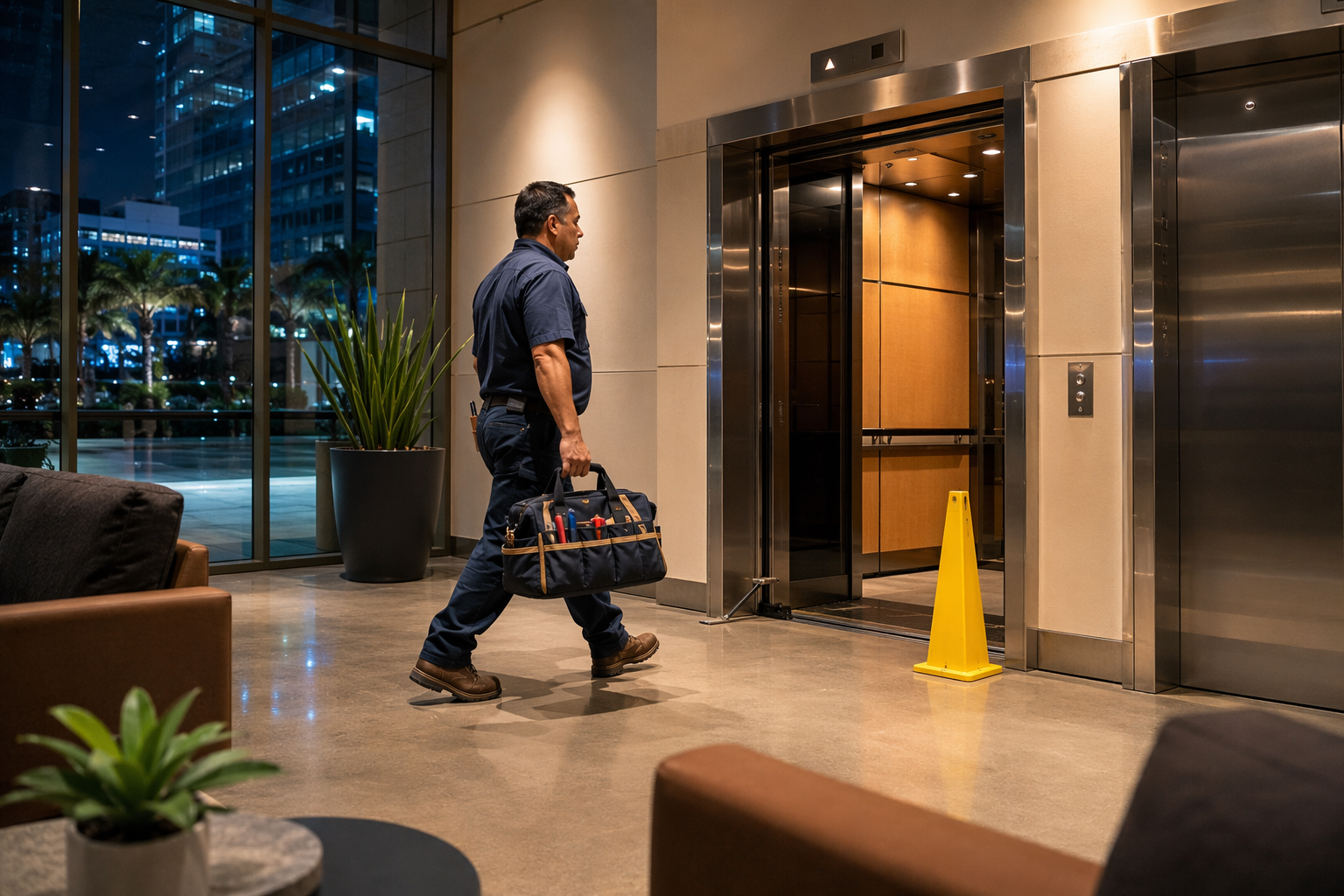
While waiting for a technician, building staff should secure the elevator landing doors, post clear out-of-service signage, maintain continuous communication with any trapped passengers, activate emergency lighting if needed, and provide the responding technician with access to the machine room and pit immediately upon arrival.
Practical steps for facility managers and front desk staff in Phoenix and Tucson commercial buildings:
- Place physical barriers (cones, stanchions) at all elevator landing doors on each floor
- Print or post an “Elevator Out of Service” notice at each call button station
- For entrapments: stay on the intercom with trapped passengers every 2–3 minutes to reassure them and monitor for medical distress
- Do NOT attempt to force doors open, insert keys, or activate emergency stop switches unless trained to do so
- Have the elevator’s serial number, manufacturer, model, and last inspection date ready for the responding technician
- Clear the machine room and pit access of any stored items that would delay technician access
How Does 24-Hour Service Affect My Elevator Maintenance Contract Cost?
Adding 24-hour emergency coverage to an elevator maintenance contract typically increases the base contract cost by 15–30%, but eliminates unpredictable after-hours labor charges that can easily reach $1,000–$3,000 per emergency call — making it financially advantageous for any building with more than one elevator or high after-hours occupancy.
There are three common contract structures in the Arizona market as of 2026:
- Oil and Grease Contract (Basic): Covers lubrication and minor adjustments only. Emergency calls billed separately at full after-hours rates. Lowest monthly cost but highest risk exposure.
- Comprehensive Maintenance Contract: Covers all labor for repairs, callbacks, and emergency response. Parts billed separately above a defined threshold. Mid-range monthly cost.
- Full Coverage (All-Inclusive) Contract: Covers all labor and parts for covered failures, including 24-hour emergency response. Highest monthly cost but completely predictable annual elevator budget.
For multi-unit residential buildings, hotels, and medical facilities in Scottsdale and Mesa, a full-coverage contract with 24/7 emergency provisions is almost always the most cost-effective option when total annual cost of ownership is calculated.
Can I Switch Elevator Service Providers in an Emergency?
Yes — you can call any licensed Arizona elevator contractor for emergency service regardless of who holds your current maintenance contract; however, review your existing contract carefully, as some agreements include liquidated damages clauses or exclusivity provisions that could create financial penalties for engaging a competing contractor.
In practice, building owners in Phoenix and Tucson do call Arizona Elevator Solutions for emergency coverage even when they have an existing contract with another provider — typically because their current contractor has slow response times or does not offer true 24-hour coverage. We handle these situations professionally and will always recommend that you resolve any contractual questions with your current provider.
If you are experiencing a passenger entrapment or immediate life-safety emergency, call the most qualified available technician first and address contractual questions afterward. No legitimate elevator contractor will penalize you for protecting life safety.
How Does Arizona’s Desert Climate Affect Emergency Elevator Repair Needs?
Arizona’s extreme heat, monsoon-season electrical storms, and high dust conditions create elevator failure patterns that differ significantly from national averages — hydraulic overheating, control board surge damage, and dust contamination of mechanical components are disproportionately common emergency repair causes in the Phoenix and Tucson metro areas.
After 15 years of working on elevators across the Sonoran Desert, I can tell you that Arizona elevators fail in ways that technicians from other states are often not prepared for. Specific Arizona-driven failure factors include:
- Summer heat: Hydraulic oil viscosity breaks down faster in machine rooms that regularly exceed 120°F; manufacturers rate most hydraulic fluid to 95°F ambient — a temperature Phoenix exceeds for 100+ days per year
- Monsoon surges: July–September lightning activity generates power surges that destroy elevator control boards at a rate our team sees spike 60–70% during monsoon season
- Caliche dust: Fine particulate infiltration clogs encoder sensors, door operator rollers, and safety switch contacts — especially in ground-floor pits of buildings near desert-adjacent lots
- Thermal cycling: Extreme day/night temperature swings cause accelerated fatigue in hydraulic hoses, electrical conduit seals, and rubber buffer components
What Is the Difference Between an Emergency Elevator Repair and an Emergency Modernization?
Emergency repair restores an existing system to safe operating condition; emergency modernization replaces obsolete or failed components that are no longer repairable due to parts discontinuation, and it typically takes 2–8 weeks rather than hours, requiring a temporary out-of-service plan for the building.
This distinction matters because occasionally a building manager calls for “emergency repair” on an elevator where the control system, motor-generator set, or relay logic panel has failed — and the honest answer from a qualified technician is that the failed component is obsolete and cannot be repaired, only replaced through a modernization project.
Signs that an “emergency repair” may escalate to an emergency modernization include:
- Equipment manufactured before 1985 experiencing control or drive failures
- Relay logic control panels where spare relays are no longer available
- Ward Leonard motor-generator drive systems with armature failures
- Hydraulic units with cylinder scoring or corrosion beyond repair limits
In these cases, the responsible action is an honest assessment, a temporary out-of-service plan, and an expedited modernization proposal — not an attempt to patch an unfixable system.
How Do I Choose the Right 24-Hour Elevator Repair Provider in Phoenix, Tucson, Scottsdale, or Mesa?
Choose a 24-hour elevator repair provider in Arizona by verifying ADOSH contractor registration, confirming actual 24-hour dispatch capability (not an answering service), checking documented average response times, reviewing Better Business Bureau standing, and confirming the contractor carries manufacturer authorization for your specific elevator brand.
A practical vendor evaluation checklist for Arizona building owners:
- ✅ Registered with ADOSH as a licensed elevator contractor
- ✅ All technicians hold individual ADOSH elevator mechanic licenses
- ✅ Live dispatcher available 24/7/365 — not a voicemail or answering service
- ✅ Local parts inventory — not dependent solely on overnight shipping
- ✅ Documented average response time under 2 hours for entrapments
- ✅ Experience with your specific elevator brand and model
- ✅ Certificate of Insurance with minimum $2M general liability coverage
- ✅ References from comparable building types (commercial, residential, medical, hospitality)
Arizona Elevator Solutions meets all of these criteria and serves buildings across Phoenix, Scottsdale, Mesa, and Tucson with a team of IUEC-certified, ADOSH-licensed technicians and a stocked parts warehouse.
What Documentation Should I Receive After an Emergency Elevator Repair?
After every emergency repair, you are legally entitled to — and should demand — a written service report documenting the failure cause, the specific repair performed, any ASME A17.1 code sections addressed, parts replaced (with serial numbers if applicable), and a technician’s signature with their ADOSH license number.
This documentation is critical for several reasons:
- ADOSH requires building owners to maintain repair records for a minimum of 5 years under Arizona Administrative Code R4-9
- Insurance carriers may deny claims if repair documentation is incomplete or unsigned by a licensed technician
- Documentation creates a service history that helps predict future failures and justify capital replacement planning
- If a code compliance question arises during your next annual inspection, repair documentation demonstrates due diligence
If a contractor performs emergency elevator work and leaves without providing written documentation, consider that a red flag. Reputable firms provide complete reports within 24 hours of every service call.
How Often Should Buildings Test Their Emergency Elevator Communication Systems?
Under ASME A17.1 Rule 2.27.1 (2019 edition, enforced in Arizona as of 2026), elevator emergency communication systems — two-way intercoms and emergency telephones — must be tested monthly by building staff and documented, with a full system test by a licensed technician at every annual inspection.
This is one of the most frequently overlooked compliance items in Arizona buildings. The emergency telephone or intercom is the only communication link during a passenger entrapment when a technician has not yet arrived. System failures during an entrapment can convert a minor incident into a serious medical emergency if a passenger in distress cannot call for help.
Best practice is to include emergency communication system testing on your monthly facilities checklist. Test every car’s intercom individually, document the test date and result, and report any failures to your elevator service contractor for same-week repair. Under ADA Section 4.10.14, the two-way emergency communication device must also be usable by people who are deaf or hard of hearing — an often-overlooked compliance requirement.
What Are the Long-Term Benefits of Maintaining a 24-Hour Elevator Service Agreement?
A 24-hour elevator service agreement reduces total elevator lifecycle costs by 20–35% compared to time-and-materials emergency billing, ensures consistent regulatory compliance, minimizes liability exposure, and extends equipment service life by an average of 5–7 years through coordinated preventive and emergency maintenance programs.
Beyond the numbers, the operational benefit of a service agreement is certainty. When your elevator fails at 11 PM on a Friday during a hotel full-house event, you are not scrambling through Google searching for whoever answers the phone first. You have a documented service relationship with a known provider, a guaranteed response time, and a technician who already knows your equipment.
Arizona Elevator Solutions structures its service agreements to scale with building size and elevator usage classification, from single-car residential buildings to large commercial properties with multiple traction and hydraulic units across Phoenix, Scottsdale, Mesa, and Tucson. All agreements include 24-hour emergency dispatch, priority parts sourcing, and annual compliance documentation packages aligned with ADOSH inspection requirements.
Is Your Elevator Ready for Its Next Emergency?
Don’t wait for a failure at midnight to find out whether your service provider is truly available around the clock. Arizona Elevator Solutions offers a free elevator assessment for building owners across Phoenix, Tucson, Scottsdale, and Mesa — including a review of your current service agreement, compliance documentation audit, and an honest evaluation of your equipment’s emergency risk profile.
Contact Arizona Elevator Solutions for a free elevator assessment: 480-319-7157
Available 24 hours a day, 7 days a week, 365 days a year. ADOSH-licensed. IUEC-certified. Locally based in Arizona.