Who Should I Contact for Elevator Entrapment Rescue Procedure?
Elevator entrapments are more common than most building owners realize. In my 15+ years servicing elevators across Phoenix, Tucson, Scottsdale, and Mesa, I’ve responded to hundreds of these calls. The single biggest mistake I see is confusion about who to call first — and in what order. This guide eliminates that confusion entirely, covering every angle from the first phone call to post-rescue compliance documentation.
Who is the first person to call when someone is trapped in an elevator?

Call 911 immediately — they are always the first contact in any elevator entrapment emergency.
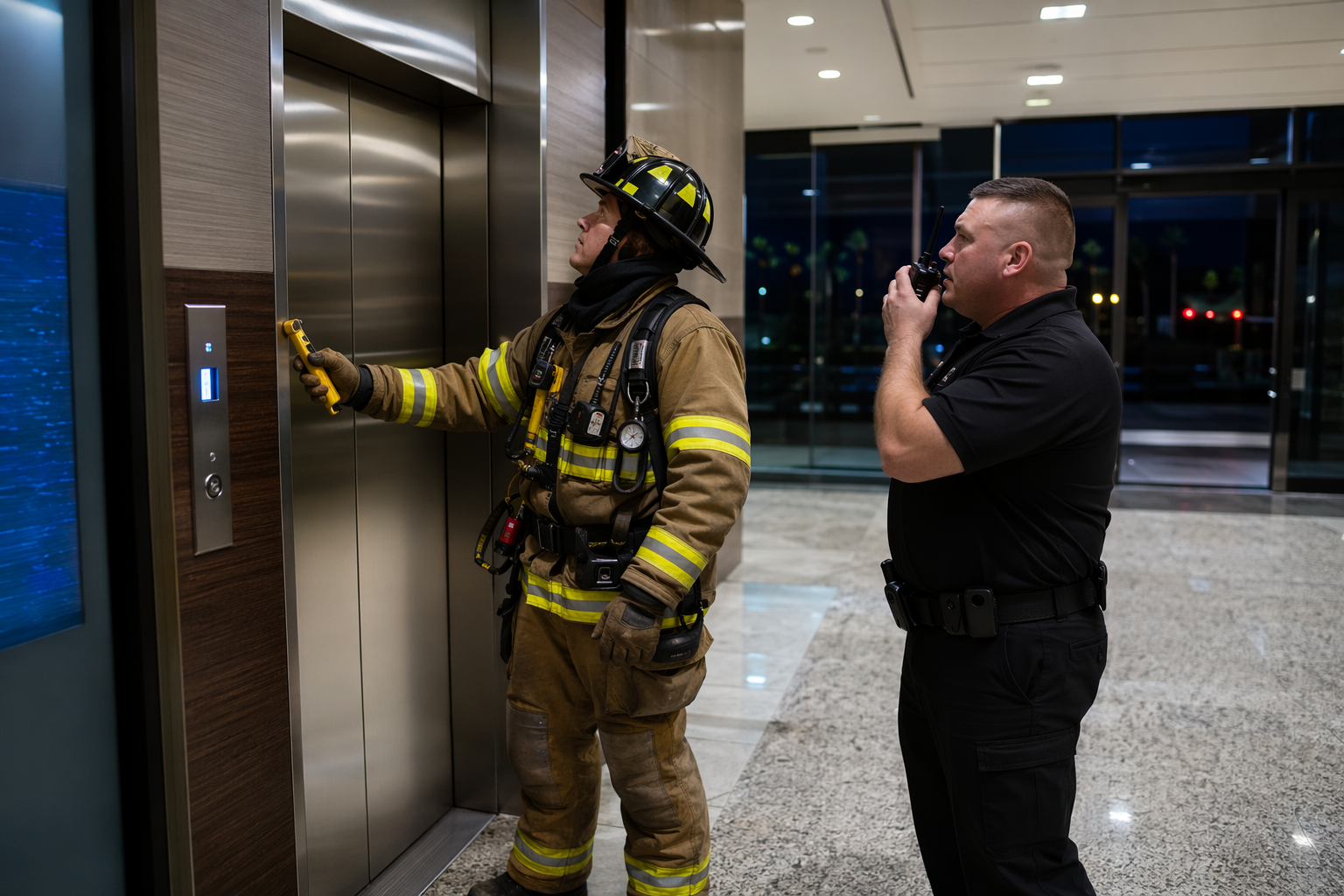
Emergency dispatchers will send firefighters trained in basic elevator rescue techniques. In Arizona, municipal fire departments in Phoenix, Tucson, Scottsdale, and Mesa are equipped with elevator emergency keys and basic hoistway entry procedures. Their primary role is passenger safety and medical assessment — not mechanical repair.
While waiting for emergency services, the building’s designated emergency contact (typically a property manager or security officer) should also be notified simultaneously. Under ASME A17.1-2019 Safety Code for Elevators and Escalators, Section 2.27.3, every elevator must have an emergency operations communication device allowing trapped passengers to speak directly with a qualified person or monitoring station. That two-way communication system is your second lifeline while 911 is en route.
What is the correct order of contacts during an elevator entrapment?
The correct sequence is: (1) Call 911, (2) Notify building management, (3) Contact your certified elevator service company, and (4) Notify your elevator monitoring service if one is active.
This sequence isn’t arbitrary — it’s structured around life safety first, then mechanical resolution, then compliance. Fire and rescue personnel handle the human element. Your elevator contractor handles the equipment. This division of responsibility is codified in ASME A17.1 and reinforced by Arizona’s elevator safety regulations under the Arizona Division of Occupational Safety and Health (ADOSH).
Building managers in Phoenix and Scottsdale frequently ask me whether they should attempt to manually release the elevator themselves. The answer is an unequivocal no. Manual lowering or raising of a stalled cab without trained personnel risks injuring trapped passengers and can worsen mechanical damage. Leave mechanical intervention to certified technicians.
What role does a certified elevator technician play in the rescue procedure?
A certified elevator technician performs the mechanical rescue — safely moving the cab to a landing, opening doors, inspecting the equipment, and clearing the unit for return to service.
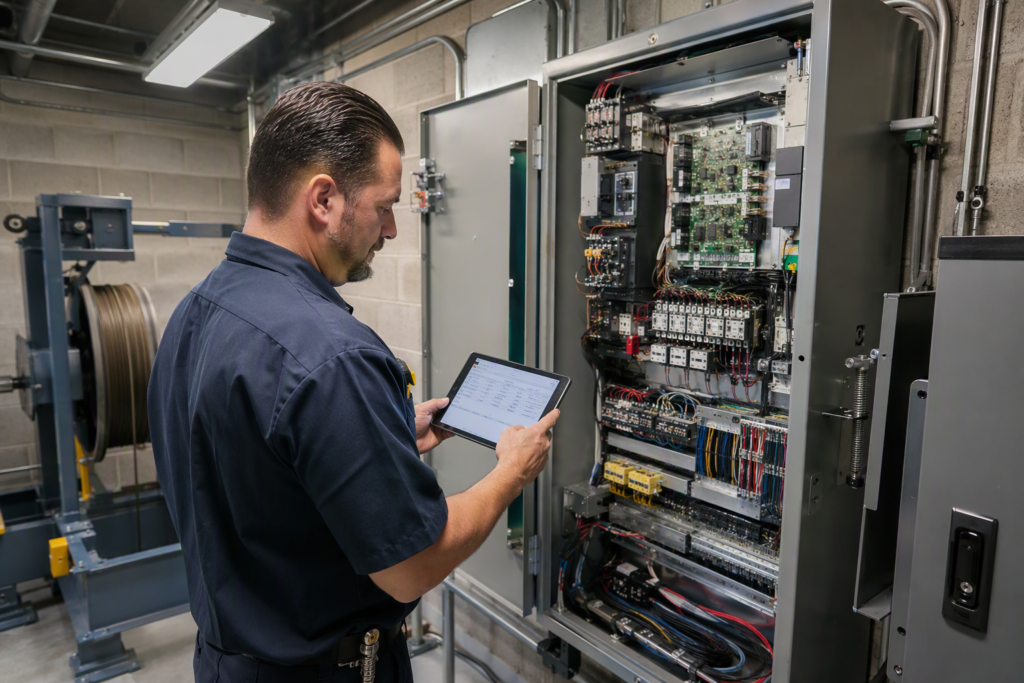
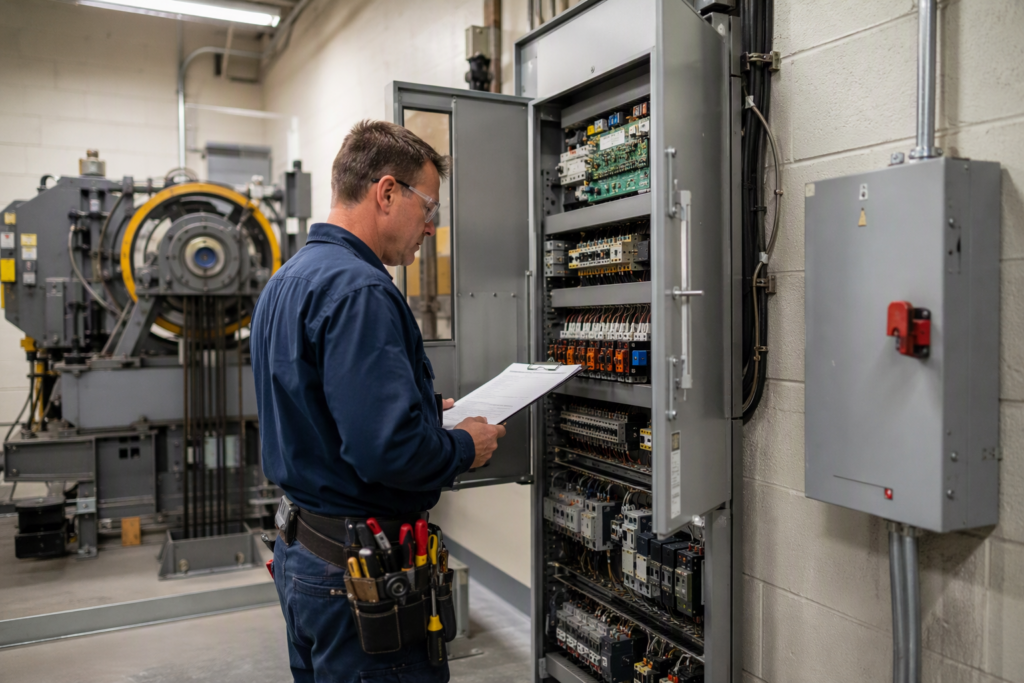
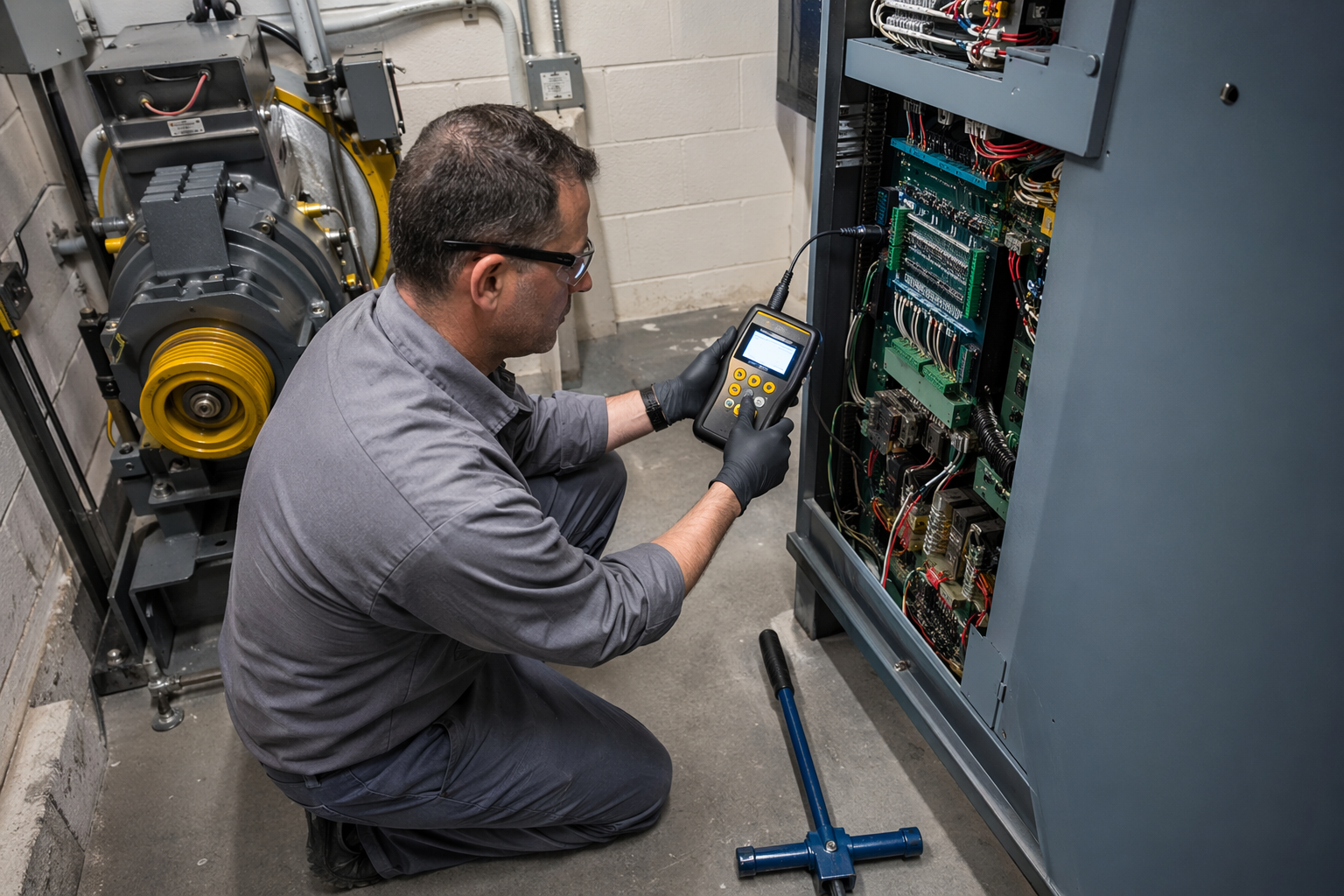
When Arizona Elevator Solutions responds to an entrapment call, our technicians follow a structured diagnostic and rescue protocol. We assess whether the cab has stalled between floors or is level with a landing, inspect drive system faults, manually operate the car using emergency procedures, and ensure all door interlocks are functioning before allowing the elevator to return to service.
Under ASME A17.1, Rule 8.6, the elevator must be inspected and cleared by a qualified elevator mechanic before being returned to passenger service after any entrapment. This isn’t optional — it’s a code mandate. Bypassing this step creates serious liability exposure for building owners and management companies.
Does Arizona have specific regulations governing elevator entrapment response?
Yes — Arizona enforces elevator safety through ADOSH, which adopts ASME A17.1 as its governing standard, and requires licensed contractors to perform all rescue and post-incident inspections.
The Arizona Administrative Code Title 8, Chapter 5 (R8-5-501 through R8-5-504) establishes requirements for elevator installation, maintenance, and inspection. ADOSH oversees compliance and can issue citations for buildings that fail to maintain proper emergency response procedures or that allow unqualified personnel to perform mechanical rescues.
In 2026, Arizona continues to enforce mandatory annual inspections for most commercial elevator installations. Buildings that experience an entrapment without subsequent documentation and inspection by a licensed contractor risk failing their next ADOSH inspection. All entrapment incidents must also be logged in the elevator’s maintenance record, which inspectors review during annual visits.
For properties in Phoenix, Tucson, Mesa, and Scottsdale, Arizona Elevator Solutions maintains full ADOSH licensing and can provide post-entrapment documentation packages that satisfy inspection requirements and protect building owners from liability.
What should trapped passengers do while waiting for rescue?
Trapped passengers should stay calm, use the in-car emergency phone or alarm button, avoid forcing doors open, and remain inside the cab until professional rescue personnel arrive.
This is critical: attempting to exit an elevator between floors is one of the most dangerous actions a passenger can take. Falls into the hoistway cause fatalities every year across the United States. ASME A17.1, Section 2.27.1, mandates that all elevators carry a sign instructing passengers on emergency procedures — typically directing them to use the alarm and phone, and to wait for assistance.
From a building management perspective, training your staff to communicate calmly with trapped passengers via the two-way intercom system dramatically reduces panic and the likelihood of passengers attempting self-rescue. A script as simple as “Help is on the way, the elevator is safe, please stay inside” can prevent tragedy.
What equipment must be available in every elevator for entrapment emergencies?
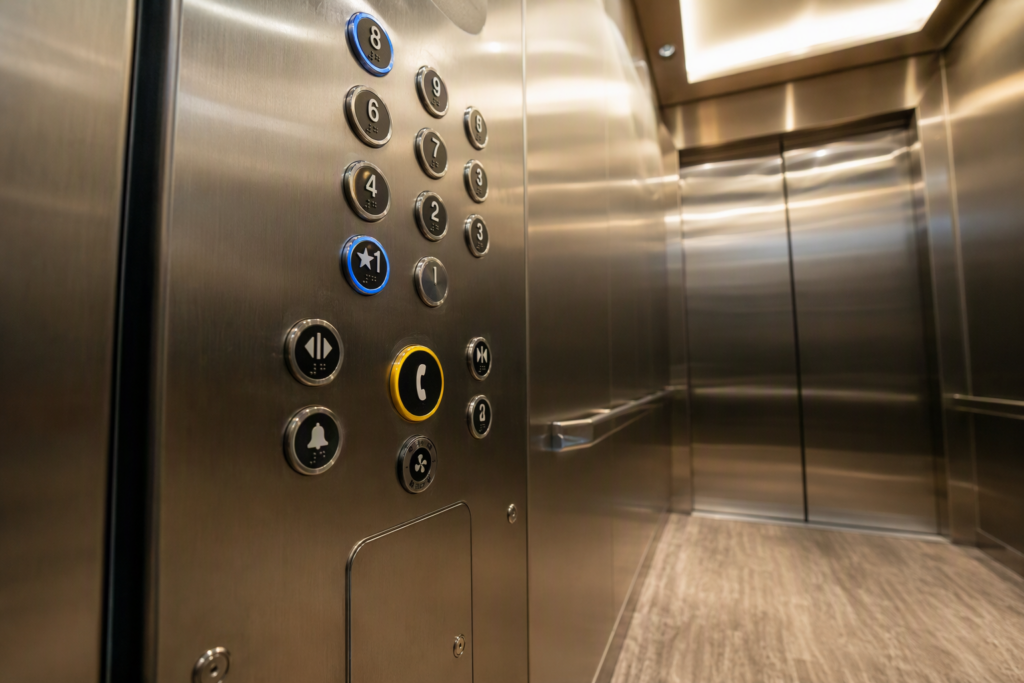
Per ASME A17.1, every elevator must have a two-way communication device, an emergency lighting system, an alarm button, and ventilation adequate to sustain passengers for a minimum rescue window.
| Equipment Item | ASME A17.1 Reference | Required Standard | Common Failure Mode | Inspection Frequency |
|---|---|---|---|---|
| Two-Way Communication Device | Section 2.27.1.1 | Must connect to staffed location or monitoring center | Dead phone line, disconnected monitoring | Monthly test recommended |
| Emergency Lighting | Section 2.27.2 | Minimum 1 foot-candle for 4 hours on battery backup | Dead backup battery | Annual battery test |
| Alarm Bell / Button | Section 2.26.2.4 | Audible outside hoistway at all landings | Disconnected wiring, silent alarm | Semi-annual test |
| Car Ventilation | Section 2.14.1.2 | Minimum 3.5% of floor area in vent openings | Blocked vents, no airflow | Annual inspection |
| Emergency Stop Switch | Section 2.26.2.3 | Must halt all motion immediately | Bypassed or non-functional switch | Quarterly test |
| Capacity Plate | Section 2.16.3 | Must display weight and person capacity | Missing or illegible plate | Annual inspection |
How quickly should a certified elevator technician respond to an entrapment call?
Industry best practice — and the expectation set by most service contracts — is a response time of 2 hours or less for entrapment emergencies, with many urban-area providers targeting under 60 minutes.
Response time is one of the most important factors to evaluate when selecting an elevator service contractor. In the Phoenix metro area, including Scottsdale and Mesa, traffic and geography can extend response times significantly if your contractor is dispatching from outside the region. Arizona Elevator Solutions maintains local dispatch in the Phoenix-Tucson corridor specifically to minimize response windows.
When reviewing your elevator service contract, look for explicit language defining emergency response time — ideally 24/7/365 availability with a contractual response window. A contract that only guarantees business-hours response is insufficient for a building occupied evenings or weekends. In Arizona’s extreme summer heat, a passenger trapped in an elevator cab without air conditioning can face heat-related illness within 30 to 45 minutes, making rapid response a genuine life-safety issue.
Who is legally liable when a building does not have a proper entrapment response plan?
Building owners and property managers bear primary legal liability when inadequate emergency response protocols result in passenger injury during an entrapment event.
Arizona premises liability law places a duty of care on property owners to maintain safe conditions for lawful visitors. An elevator without functioning emergency communication, without a documented response plan, or maintained by unlicensed personnel creates significant negligence exposure. Courts have consistently held that failure to follow ASME A17.1 standards constitutes evidence of negligence per se.
From a practical standpoint, your insurance carrier will also scrutinize your maintenance records and emergency response documentation after any entrapment claim. Buildings with current service contracts, documented inspections, and ADOSH-compliant records are in a dramatically stronger position than those operating with sporadic or undocumented maintenance. This is why having a year-round service agreement with a licensed contractor like Arizona Elevator Solutions is not just a maintenance decision — it’s a risk management strategy.
What is the difference between firefighter rescue and elevator technician rescue?
Firefighters perform life-safety extraction to get passengers out safely, while elevator technicians perform the mechanical rescue, fault diagnosis, and equipment clearance required before the elevator returns to service.
These are complementary, not competing, roles. Fire departments in Phoenix, Tucson, Mesa, and Scottsdale train regularly on elevator emergency procedures — they can use Phase I and Phase II emergency keys, manually operate doors at certain landing conditions, and assess passenger medical status. What they are not authorized or equipped to do is diagnose drive faults, repair mechanical failures, or certify that the elevator is safe for resumed operation.
A well-coordinated entrapment response has both teams operating simultaneously: fire rescue focused on the passengers, elevator technician focused on the equipment. This parallel response minimizes total incident duration and ensures a complete resolution rather than just an extraction with the unit tagged out of service indefinitely.
How does ADA compliance affect elevator entrapment procedures?
Under the Americans with Disabilities Act (ADA), elevators serving mobility-impaired users must have accessible emergency communication systems, and entrapment protocols must account for passengers who may be unable to self-evacuate via stairs.
This is an area where many building operators fall short. The ADA Standards for Accessible Design, Section 407.4.9, require that elevator communication systems be usable by individuals with hearing or speech impairments. Text-based TTY capability or visual signal systems may be required depending on your building’s occupancy and construction date.
During an entrapment involving a mobility-impaired passenger, the rescue protocol must also address the fact that evacuation via stairway is not viable — which is precisely why elevator-based rescue (rather than evacuation to a stairwell) is typically the correct approach. Ensure your emergency response plan explicitly addresses passengers who use wheelchairs or other mobility aids, and verify that your elevator contractor has experience executing rescues involving such passengers.
What should a building’s written elevator emergency response plan include?
A compliant emergency response plan must include: primary and backup emergency contact numbers, a passenger communication script, escalation timelines, documentation procedures, and staff training records.
Based on my experience conducting emergency preparedness reviews across commercial properties in Phoenix and Scottsdale, most buildings have some version of a plan — but it’s often outdated, incomplete, or unknown to current staff. Here’s what a complete plan must contain:
- Emergency contact list: 911, elevator service contractor (with 24/7 number), building management, and property owner
- Communication script: Pre-approved language for staff to use with trapped passengers via intercom
- Escalation timeline: Who gets called if the elevator contractor doesn’t respond within the contractual window
- Location of elevator keys and shut-off procedures accessible only to qualified personnel
- Post-incident documentation checklist: Incident report, maintenance log entry, ADOSH notification if required
- Annual staff training record showing that building personnel have been trained on the plan
Arizona Elevator Solutions provides emergency response plan templates and staff training sessions as part of our full-service maintenance agreements — an often-overlooked benefit that reduces liability exposure significantly.
How often should elevator emergency systems be tested?
Emergency communication devices must be tested monthly, emergency lighting batteries annually, and all emergency systems are evaluated during the mandatory annual ADOSH inspection.
ASME A17.1, Section 8.6.9, establishes testing requirements for emergency systems. However, the code sets minimums — best practice in a high-use building is more frequent testing. I recommend the following schedule for commercial properties in the Arizona market:
- Monthly: Two-way communication device test (logged)
- Quarterly: Emergency stop switch function test
- Semi-annually: Alarm bell audibility verification at all landings
- Annually: Full emergency lighting battery test, ventilation verification, complete ASME A17.1 Category 1 test
- Every 5 years: Category 5 test (full-load, full-speed safety system test) per ASME A17.1
What happens after the entrapment rescue — what are the required next steps?
After rescue, the elevator must be inspected by a licensed technician, the incident must be documented in the maintenance log, and ADOSH must be notified if the entrapment resulted from a reportable equipment failure.
Post-rescue procedures are where many building operators make costly mistakes. The elevator cannot simply be returned to service once passengers are out — ASME A17.1, Rule 8.6, requires a qualified elevator mechanic to inspect and clear the unit. This inspection should identify the root cause of the stall (power failure, drive fault, door interlock failure, overload, etc.) and document corrective action taken.
Arizona’s ADOSH reporting requirements should be reviewed with your elevator contractor. Certain equipment failures — particularly those involving safety devices — may require notification to the state. Your service contractor should be familiar with these thresholds and guide you through the reporting process. Arizona Elevator Solutions provides complete post-incident documentation as a standard component of all emergency service calls.
What does elevator entrapment rescue service typically cost in Arizona?
Emergency entrapment response in Arizona typically costs between $250 and $800 depending on time of day, entrapment complexity, and whether repair work is required — though buildings with service contracts often have these calls covered or discounted.
Here’s a realistic cost breakdown based on 2026 market conditions in the Phoenix-Tucson corridor:
- Standard business hours emergency call: $250–$400 (labor + diagnostics)
- After-hours / weekend / holiday response: $400–$800 (premium labor rates)
- Entrapment requiring mechanical repair: $800–$2,500+ depending on parts
- Full-service maintenance contract with entrapment coverage: Typically absorbs emergency labor costs, reducing out-of-pocket exposure significantly
For buildings experiencing repeated entrapments, the cumulative cost of emergency calls often exceeds the annual cost of a comprehensive maintenance agreement within 6 to 12 months. This is a conversation worth having with your elevator service provider before the next emergency occurs.
Can building staff manually release elevator passengers without a technician?
No — unless the car is level with a landing and properly trained personnel follow the specific manual door release procedure, building staff should never attempt to manually extract passengers from an elevator.
This is one of the most dangerous misconceptions I encounter. Building staff sometimes have access to emergency keys that allow landing door operation, and well-meaning individuals may attempt to use these to open doors and assist passengers. The critical risk: if the car is not precisely level with the landing, a passenger attempting to exit faces a fall gap that can cause serious injury or death.
ASME A17.1, Section 2.27.3.4, specifies that manual rescue procedures may only be performed by qualified personnel — defined as individuals with specific training in the elevator system’s emergency operation. This typically means a licensed elevator mechanic or, in the case of firefighters, personnel trained under NFPA 13E (Recommended Practice for Fire Department Operations in Properties Protected by Sprinkler and Standpipe Systems) and local fire department elevator operation curricula.
How do I choose the right elevator service company for emergency response coverage in Arizona?
Select an Arizona-licensed elevator contractor with 24/7 dispatch, a documented emergency response time guarantee, IUEC-certified technicians, and local presence in your city — not a national company dispatching from out of state.
When evaluating elevator service companies for emergency response capability, ask these specific questions:
- What is your contractual emergency response time, and is it in writing?
- Do you dispatch from within the Phoenix/Tucson metro area, or from a regional hub outside Arizona?
- Are your technicians IUEC-certified and licensed under Arizona ADOSH?
- Do you provide post-entrapment documentation that satisfies ADOSH inspection requirements?
- Is 24/7/365 emergency response included in your maintenance contract or billed separately?
- Can you provide references from commercial properties in Phoenix, Scottsdale, Mesa, or Tucson?
National elevator companies often subcontract emergency calls or dispatch technicians from distant locations, extending response times unacceptably in an entrapment situation. Local, Arizona-based contractors maintain faster response windows and deeper familiarity with ADOSH requirements specific to the state.
What should I do if my elevator monitoring service does not respond during an entrapment?
If your monitoring service fails to respond within 5 minutes of an alarm activation, immediately call 911 and your elevator service contractor directly — do not wait for the monitoring center to escalate.
Elevator monitoring service failures are more common than the industry likes to admit. Monitoring centers can experience technical outages, staffing gaps, or communication failures. Your emergency response plan must include a direct-call path to 911 and your elevator contractor that does not depend on the monitoring center functioning correctly.
Review your monitoring contract annually. Ensure it specifies maximum alarm response times, escalation procedures if the primary monitoring agent cannot reach the building, and documented testing protocols. Many building managers I’ve worked with in Mesa and Tucson were surprised to discover their monitoring contracts contained response time guarantees that had never been tested or enforced.
Are there special entrapment considerations for hydraulic elevators versus traction elevators?
Yes — hydraulic elevators can typically be lowered to the bottom landing manually using the hydraulic lowering valve, while traction elevators require hand-lowering via the brake and drive system, each requiring different technician tools and training.
This distinction matters because the rescue procedure — and therefore the skill set required of the responding technician — differs significantly by elevator type. Hydraulic elevators, common in low-rise commercial buildings across the Phoenix suburbs, have a manual lowering valve that a trained technician can operate to gently lower the cab to the lowest landing using gravity and controlled hydraulic release. This is typically faster and simpler than traction elevator rescue.
Traction elevators (cable-driven systems common in mid-rise and high-rise buildings in downtown Phoenix and Scottsdale) require the technician to manually control the machine room brake and motor to carefully position the cab at a landing. This demands precise skill and direct machine room access. Verify that your elevator contractor has technicians trained and equipped for the specific elevator type(s) in your building.
How can building owners prevent elevator entrapments from occurring in the first place?
Preventive maintenance — specifically adherence to a monthly maintenance schedule, proactive component replacement, and annual Category 1 testing — reduces entrapment incidents by up to 70% compared to reactive-only service models.
In my 15+ years of experience, the elevators I see entrapping passengers most frequently share common characteristics: inconsistent maintenance, aging door operator components, worn drive system parts, and deferred safety device inspections. The most common causes of entrapments I respond to in the Arizona market are:
- Door operator failures (worn rollers, misaligned tracks) — approximately 40% of entrapments
- Drive system faults (drive board failures, motor issues) — approximately 25%
- Safety device activations (overspeed governor, safety brake) — approximately 20%
- Power supply issues — approximately 10%
- Overload or misuse — approximately 5%
A proactive maintenance program that inspects door components monthly, tests safety devices annually, and replaces wear components on a predictive rather than reactive schedule dramatically reduces entrapment frequency. For Arizona buildings in the Phoenix, Scottsdale, Mesa, and Tucson markets, Arizona Elevator Solutions offers comprehensive preventive maintenance programs designed around ASME A17.1 compliance and local environmental factors — including the dust and temperature extremes that accelerate component wear in the desert Southwest.
What documentation should be maintained for elevator emergency events in Arizona?
Arizona buildings must maintain a written maintenance log for each elevator, documenting all entrapment incidents, corrective actions, and inspector findings — retained for a minimum of 5 years and available for ADOSH review upon request.
Documentation is your legal protection. In the event of a personal injury claim arising from an entrapment, your maintenance records are the primary evidence of whether you met your duty of care. A complete entrapment incident record should include:
- Date, time, and duration of entrapment
- Number of passengers involved
- Nature of malfunction (root cause as determined by technician)
- Names and certifications of responding technicians
- Corrective action taken and parts replaced
- Time elevator was returned to service
- Any ADOSH notification made
- Post-incident inspection results
Keep these records in both physical and digital formats, backed up offsite. Arizona Elevator Solutions provides standardized incident documentation for every emergency service call as part of our service protocol — giving building operators a ready-made compliance record without additional administrative burden.
Need elevator service you can rely on? Arizona Elevator Solutions is ready to help.