Elevator Code Violation Penalties: Costs, Consequences, and Compliance in 2026
Elevator code violations carry consequences that extend well beyond a written notice. Building owners, property managers, and facilities directors who receive a violation face a cascade of financial, legal, and operational risks that compound quickly. Understanding what drives these penalties — and how to resolve them before an inspector does — is essential for any property that relies on vertical transportation.
What Are Elevator Code Violation Penalties?
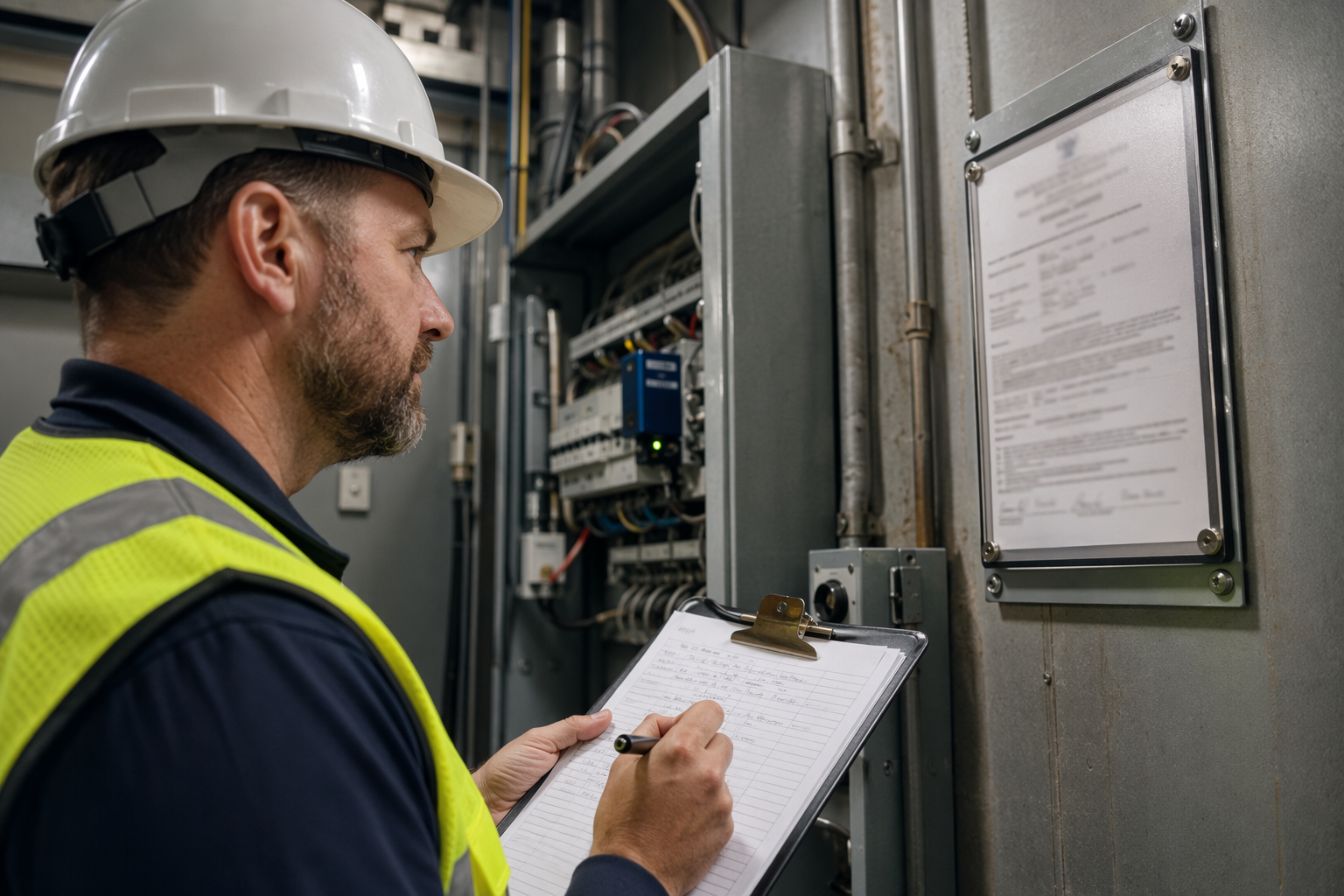
Elevator code violation penalties are enforcement actions taken by a state or municipal authority when a conveyance is found to be out of compliance with the applicable safety standard. In most U.S. jurisdictions, the governing technical standard is the ASME A17.1 Safety Code for Elevators and Escalators, which establishes minimum requirements for design, installation, operation, inspection, and maintenance. Where workplace conveyances are involved, OSHA standards may also apply. Accessibility failures on units serving the public trigger obligations under the Americans with Disabilities Act (ADA).
Penalties generally fall into four categories:
- Administrative fines — Monetary penalties assessed per violation, often accruing daily until corrected.
- Shutdown orders — Authorities can order an elevator taken out of service until all deficiencies are remediated and re-inspected.
- Civil liability exposure — An unresolved violation that contributes to an injury can dramatically increase a building owner’s exposure in litigation.
- Insurance consequences — Carriers may deny claims or cancel policies when a loss occurs on equipment with a documented, unresolved violation.
What Does ASME A17.1 Require for Inspections?

The ASME A17.1 Safety Code for Elevators and Escalators establishes two primary inspection categories: periodic inspections and periodic tests. Periodic inspections verify the ongoing condition and operation of the elevator, while periodic tests — which include safety devices such as governors, safeties, and buffers — are required on defined intervals that vary by device type and use category. Most jurisdictions adopt ASME A17.1 by reference and then layer on their own enforcement protocols, so the specific inspection calendar an Arizona building must follow is set by the Arizona Department of Occupational Safety and Health (ADOSH) and local municipal authority having jurisdiction (AHJ).
Failure to complete a required inspection or test on time is itself a violation. An elevator that operates beyond its inspection certificate expiration date is not merely overdue — it is, in the eyes of enforcement authorities, an unlawfully operated conveyance.
How Are Elevator Fines Calculated?
Fine structures vary significantly by jurisdiction. Rather than cite unsourced averages, the key cost drivers that any building owner should understand qualitatively are:
- Violation severity classification — Most states classify violations as imminent hazard, serious, or non-serious. Imminent hazard violations (e.g., a failed safety device, a door that does not prevent movement) command the highest fines and almost always trigger immediate shutdown.
- Duration of non-compliance — Many authorities assess fines on a per-day basis. A violation that goes uncorrected for weeks multiplies the base fine substantially.
- Repeat violations — A property that receives the same citation in successive inspection cycles typically faces enhanced penalties, often a multiple of the original fine.
- Number of units affected — A portfolio owner with multiple non-compliant elevators in a single property may face stacked violations.
- Willful non-compliance — Where an authority can demonstrate the building owner was aware of a deficiency and chose not to correct it, penalties escalate significantly under both state elevator codes and, where applicable, OSHA willful violation classifications.
What Happens When an Elevator Fails Inspection in Arizona?
When an Arizona elevator fails its required inspection, the sequence of enforcement actions typically follows a structured path. Arizona Elevator Solutions works with building owners navigating exactly this process.
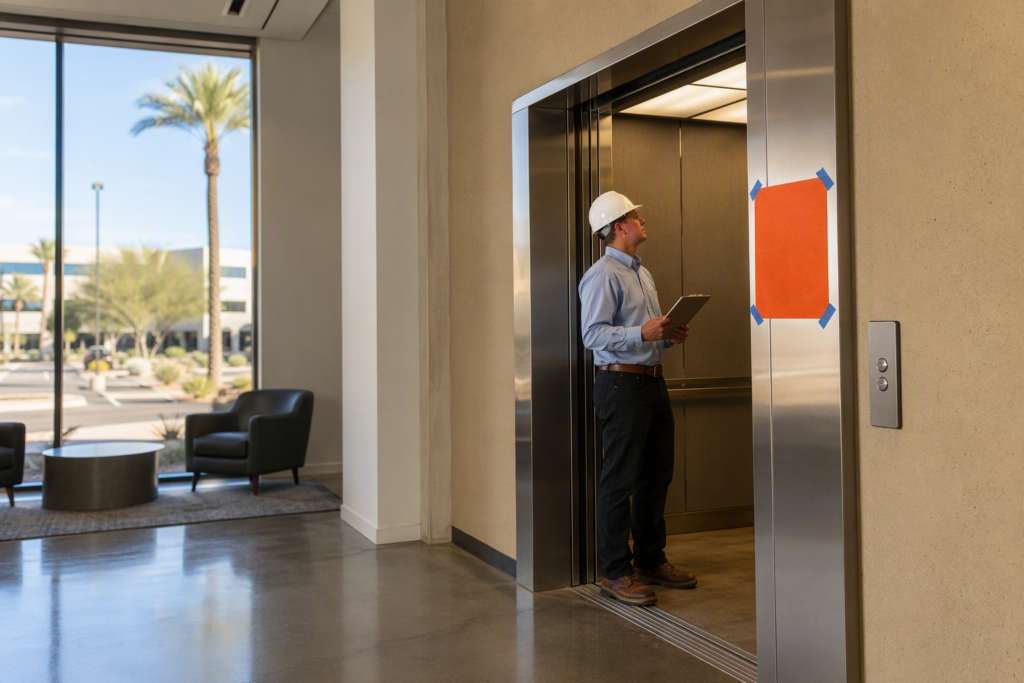
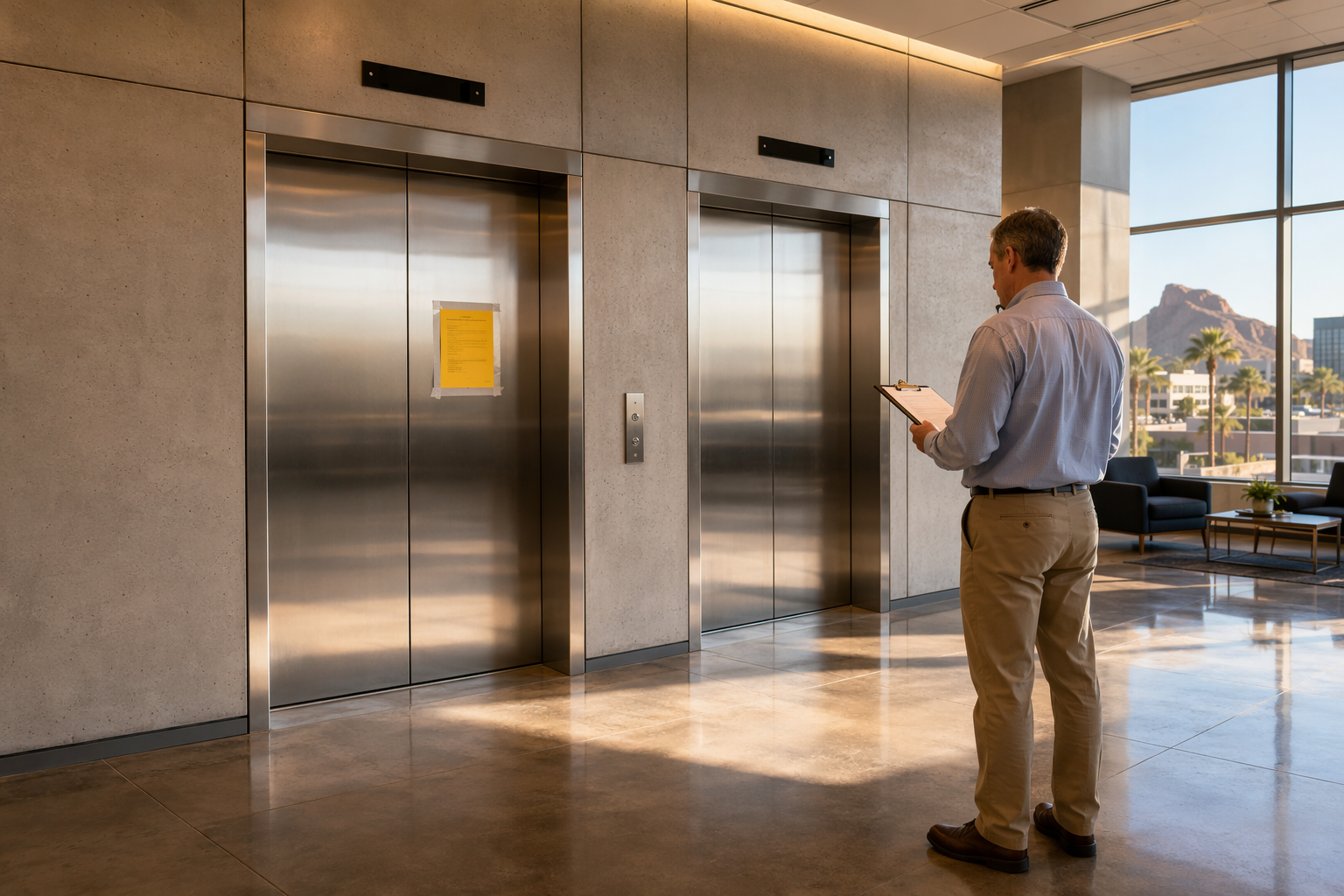
- Inspector issues a written deficiency notice — The notice identifies each violation by code section reference and assigns a correction deadline.
- Immediate shutdown order (if warranted) — For imminent hazard violations, the elevator may be tagged out of service on the spot, before the building owner has an opportunity to schedule repairs.
- Correction period begins — The building owner must engage a licensed elevator contractor to perform the remediation work within the deadline specified.
- Work completion documentation — The contractor completes a repair or alteration record, signed and submitted to the AHJ per ASME A17.1 documentation requirements.
- Re-inspection request — The building owner or contractor contacts the authority to schedule a follow-up inspection to verify the deficiency has been corrected.
- Certificate reinstatement — Upon a passing re-inspection, the elevator receives an updated operating certificate and may legally return to service.
- Fine resolution — Any outstanding monetary penalties must be paid or formally appealed before the matter is closed.
Which Violations Most Commonly Lead to Shutdown Orders?
Not every deficiency results in an elevator being taken out of service. Authorities generally reserve shutdown authority for violations that pose an immediate risk of injury. The categories of violations most likely to trigger an immediate shutdown include:
- Door interlock failures — a door that allows car movement while open or not fully closed is among the most serious deficiencies under ASME A17.1.
- Governor and safety device failures — these are the last line of defense against an uncontrolled descent.
- Pit flooding or structural compromise — water intrusion can disable electrical systems and create electrocution hazards.
- Machine room access and temperature violations — overheating equipment rooms create fire and equipment failure risks.
- Emergency lighting and communication system failures — passengers stranded without working emergency communication are at risk.
- Overloaded or out-of-tolerance brake systems.
How Do ADA Violations Differ from Safety Code Violations?
The Americans with Disabilities Act imposes a parallel compliance obligation that operates independently of state elevator safety codes. ADA violations related to elevators typically involve inaccessible controls, missing or non-compliant Braille signage, door timing that does not accommodate users with mobility impairments, or an elevator that is chronically out of service in a building where it is the only accessible route.
ADA enforcement can originate from a private lawsuit, a complaint filed with the U.S. Department of Justice, or a complaint to the U.S. Access Board. Civil penalties for ADA violations — separate from any state elevator fine — can be substantial and, unlike state safety code fines, are not capped by the same administrative structures. A building that faces simultaneous state code violations and ADA complaints from the same elevator failure is managing two distinct legal exposures at once.
What Are the Insurance Consequences of an Elevator Violation?
Commercial property and general liability insurance policies typically contain provisions requiring the insured to maintain their property in compliance with applicable law. An elevator operating under a documented, unresolved violation notice may be considered non-compliant at the time of a loss. Insurers may use this finding to:
- Deny the claim on the grounds that the loss arose from a known, uncorrected hazard.
- Assert a coverage exclusion for violations of law or ordinance.
- Cancel or non-renew the policy at the next available opportunity.
- Increase premiums substantially at renewal for properties with a violation history.
Beyond the insurance relationship, a documented violation that precedes an injury creates a significant evidentiary problem in litigation. Plaintiffs’ attorneys routinely subpoena inspection records and violation histories as part of discovery in elevator injury cases.
How Long Does a Building Owner Have to Correct a Violation?
Correction timelines are set by the issuing authority and vary based on the severity classification of the violation:
- Imminent hazard violations require correction before the elevator returns to service — effectively immediately, as the unit is typically shut down concurrent with the citation.
- Serious violations are commonly assigned correction windows measured in days to a few weeks, depending on jurisdiction.
- Non-serious or administrative violations may carry correction windows of 30 to 90 days in many jurisdictions.
Building owners who cannot meet a correction deadline may apply for an extension in many jurisdictions, but extensions are not guaranteed and typically require documented evidence that the owner has engaged a contractor and is actively pursuing compliance. Extensions are rarely granted for imminent hazard classifications.
Can Elevator Code Violations Result in Criminal Liability?
In most circumstances, elevator code violations are treated as civil or administrative matters, not criminal ones. However, willful disregard for documented safety deficiencies that results in a serious injury or death can elevate exposure to criminal negligence or manslaughter charges under state law. Several high-profile elevator fatality cases in the United States have resulted in criminal prosecutions of building owners and management companies. This is an extreme outcome, but it illustrates that the legal risk profile of chronic non-compliance is not limited to fines and civil suits.
What Are the 2025–2026 Trends in Elevator Code Enforcement?
Elevator enforcement is evolving in several qualitative directions that building owners should monitor heading into 2026:
- Increased use of digital inspection records — Many state and local authorities are moving toward electronic inspection platforms that make violation histories more transparent and more easily accessible to insurers, buyers, and the public.
- Remote monitoring as a compliance tool — Building owners are increasingly adopting IoT-connected elevator monitoring systems that flag developing deficiencies before an inspection. Jurisdictions are beginning to discuss how continuous monitoring data interacts with periodic inspection requirements under updated ASME A17.1 editions.
- Heightened ADA scrutiny — Accessibility complaints involving elevators have drawn increased federal and state attention, particularly in healthcare facilities, transit hubs, and multi-family residential buildings.
- Modernization-driven enforcement — As aging elevator fleets in commercial and residential buildings reach end-of-useful-life, enforcement authorities are increasingly focused on compelling modernization rather than simply issuing repair orders for equipment that cannot reliably be maintained to code.
- Post-pandemic inspection backlogs resolving — Jurisdictions that accumulated inspection backlogs are now current, meaning properties that may have operated with lapsed certificates during that period are now receiving first-time enforcement actions.
What Is the Difference Between a Violation and a Deficiency?
These terms are sometimes used interchangeably but carry distinct meanings in a formal compliance context. A deficiency is a condition identified during an inspection that does not meet the applicable standard — it is the technical finding. A violation is the formal legal determination made by the authority having jurisdiction based on that deficiency. Not every deficiency automatically results in a formal violation citation; inspectors exercise some discretion, particularly for minor or administrative items. However, any deficiency that affects safety or accessibility is virtually certain to generate a formal violation with an associated correction order.
How Can a Building Owner Avoid Elevator Code Violation Penalties?
The most effective penalty avoidance strategy is a structured, documented maintenance and inspection program that identifies and corrects deficiencies before a regulatory inspector finds them. Key elements of a proactive compliance program include:
- Maintaining a current maintenance contract with a qualified elevator service provider.
- Tracking inspection certificate expiration dates for every unit in the portfolio.
- Conducting internal pre-inspection walkthroughs before scheduled regulatory inspections.
- Keeping complete maintenance logs, repair records, and test documentation organized and accessible — these are the first documents an inspector reviews.
- Budgeting for modernization on aging units rather than deferring repairs that repeatedly generate the same citations.
- Understanding which ADA requirements apply to newly installed or significantly altered equipment in the building.
Arizona Elevator Solutions provides data-driven assessment services designed to help building owners understand their compliance posture before enforcement action occurs. By systematically evaluating equipment condition against current code requirements, a thorough assessment surfaces issues that would otherwise appear first on an inspector’s citation form.
What Should a Building Owner Do Immediately After Receiving a Violation Notice?
- Read the notice in full — Identify every cited code section, the severity classification assigned, and the stated correction deadline.
- Do not ignore the deadline — The correction window begins running from the date on the notice, not from when it is first reviewed.
- Contact a licensed elevator contractor promptly — Demand for qualified service providers can be high; early contact improves scheduling options.
- Notify your insurance carrier — Proactive disclosure of a pending violation and your remediation plan is generally preferable to a carrier learning of the violation through a claim.
- Notify your legal counsel if litigation risk is present — If a prior incident may be connected to the cited deficiency, attorney-client privilege considerations become relevant immediately.
- Compile all prior maintenance and inspection documentation — This establishes the good-faith compliance history that can mitigate fine amounts in many jurisdictions.
- Request a compliance extension in writing if the deadline cannot be met — Document all steps taken toward correction and submit a formal extension request before the deadline expires.
- Schedule re-inspection as soon as work is complete — Do not allow the unit to remain out of service or under citation any longer than necessary after remediation.
Does Arizona Have Specific Elevator Enforcement Provisions?
Arizona elevator safety is administered through the state’s occupational safety framework, with the Arizona Division of Occupational Safety and Health (ADOSH) holding enforcement authority for many conveyance types. Local municipalities — including Phoenix, Tucson, Scottsdale, and Mesa — may operate as independent AHJs with their own inspection programs and fee schedules. Building owners operating in Arizona should confirm which authority has jurisdiction over each of their properties, as overlapping or dual jurisdiction is possible in some contexts. Arizona adopts ASME standards by reference, making the ASME A17.1 Safety Code for Elevators and Escalators the core technical benchmark for compliance statewide.
How Does Arizona Elevator Solutions Support Code Compliance?
Arizona Elevator Solutions approaches elevator compliance as a data and documentation discipline. Rather than reacting to violation notices, the company’s assessment process evaluates equipment condition, maintenance records, and inspection history against current code requirements to identify where a property’s risk exposure is concentrated. This methodology allows building owners and facility managers to make informed decisions about maintenance priorities, repair timelines, and modernization investments before an enforcement action creates urgency — and the costs that come with it.
The company serves commercial, residential, healthcare, and institutional clients across Arizona, working across elevator types and vintages to bring equipment into and keep it in documented compliance.
Summary: Key Points on Elevator Code Violation Penalties
| Penalty Type | Trigger | Governing Authority / Standard |
|---|---|---|
| Administrative fines (daily accrual) | Unresolved violation past correction deadline | State / local AHJ; ASME A17.1 |
| Immediate shutdown order | Imminent hazard classification | State / local AHJ; ASME A17.1 |
| ADA civil penalties and litigation | Accessibility non-compliance | Americans with Disabilities Act |
| OSHA workplace safety penalties | Workplace conveyance violations | OSHA |
| Insurance claim denial / policy cancellation | Loss occurring during documented violation | Policy terms; state insurance law |
| Enhanced civil liability | Injury preceded by known, unresolved deficiency | State tort law |
Note: Fine amounts vary by jurisdiction and violation classification. No universal figures are presented here because authoritative, jurisdiction-specific schedules should be confirmed directly with the applicable AHJ.
Get Ahead of Violations Before an Inspector Does
Elevator code violation penalties are predictable, preventable, and far more costly than the compliance measures that avoid them. Whether a property is facing an active violation notice, a lapsed inspection certificate, or simply an aging fleet that has not been systematically evaluated against current code requirements, a professional assessment is the most efficient starting point.
Contact Arizona Elevator Solutions for a free elevator assessment: 480-319-7157
Need elevator service you can rely on? Arizona Elevator Solutions is ready to help.