Best Elevator Maintenance Company Phoenix: Complete FAQ Guide
Finding a reliable elevator maintenance company in Phoenix requires understanding what separates a qualified service provider from a substandard one. This comprehensive guide answers the most important questions property owners, facility managers, and building operators ask when evaluating elevator maintenance services in the Phoenix metro area and across Arizona.
What makes an elevator maintenance company the best choice in Phoenix?
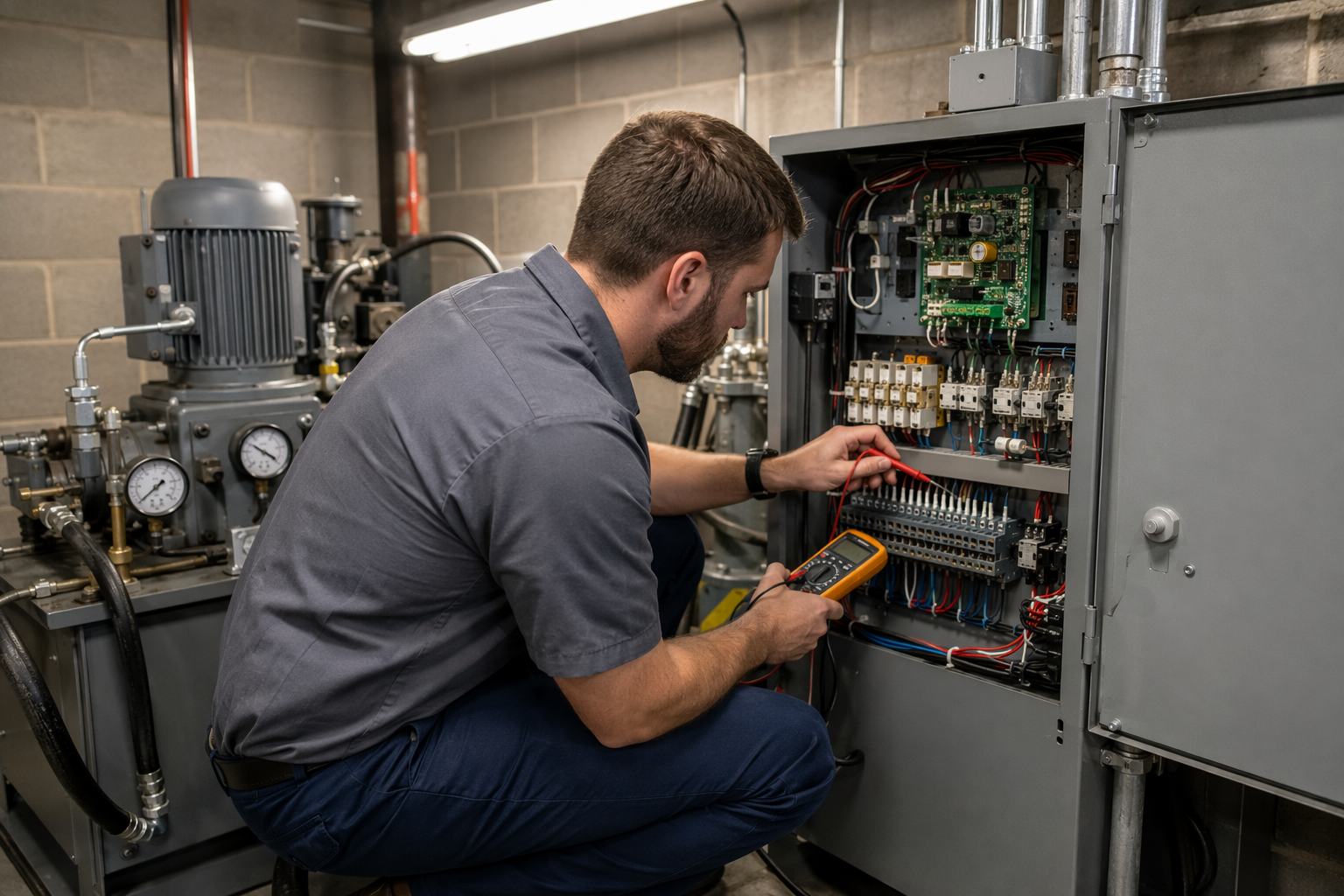
The best elevator maintenance company in Phoenix combines verified technical certification, demonstrable code compliance knowledge, and a structured preventive maintenance program tailored to Arizona’s specific climate and regulatory environment.
Phoenix’s extreme heat, desert dust, and wide temperature swings create maintenance demands that differ significantly from other U.S. markets. An elevator service provider operating in this environment must understand how ambient temperatures exceeding 110°F affect hydraulic fluid viscosity, motor cooling systems, and control electronics. Companies that apply a one-size-fits-all maintenance protocol without accounting for these regional factors are more likely to allow avoidable failures.
Beyond environmental expertise, the strongest indicator of quality is adherence to the ASME A17.1 Safety Code for Elevators and Escalators, which sets the national standard for elevator construction, installation, operation, inspection, testing, and maintenance. A company that can demonstrate fluency with this code — and with Arizona’s administrative enforcement framework — provides a measurably higher level of protection for building owners and occupants.
How often should elevators be inspected in Arizona?
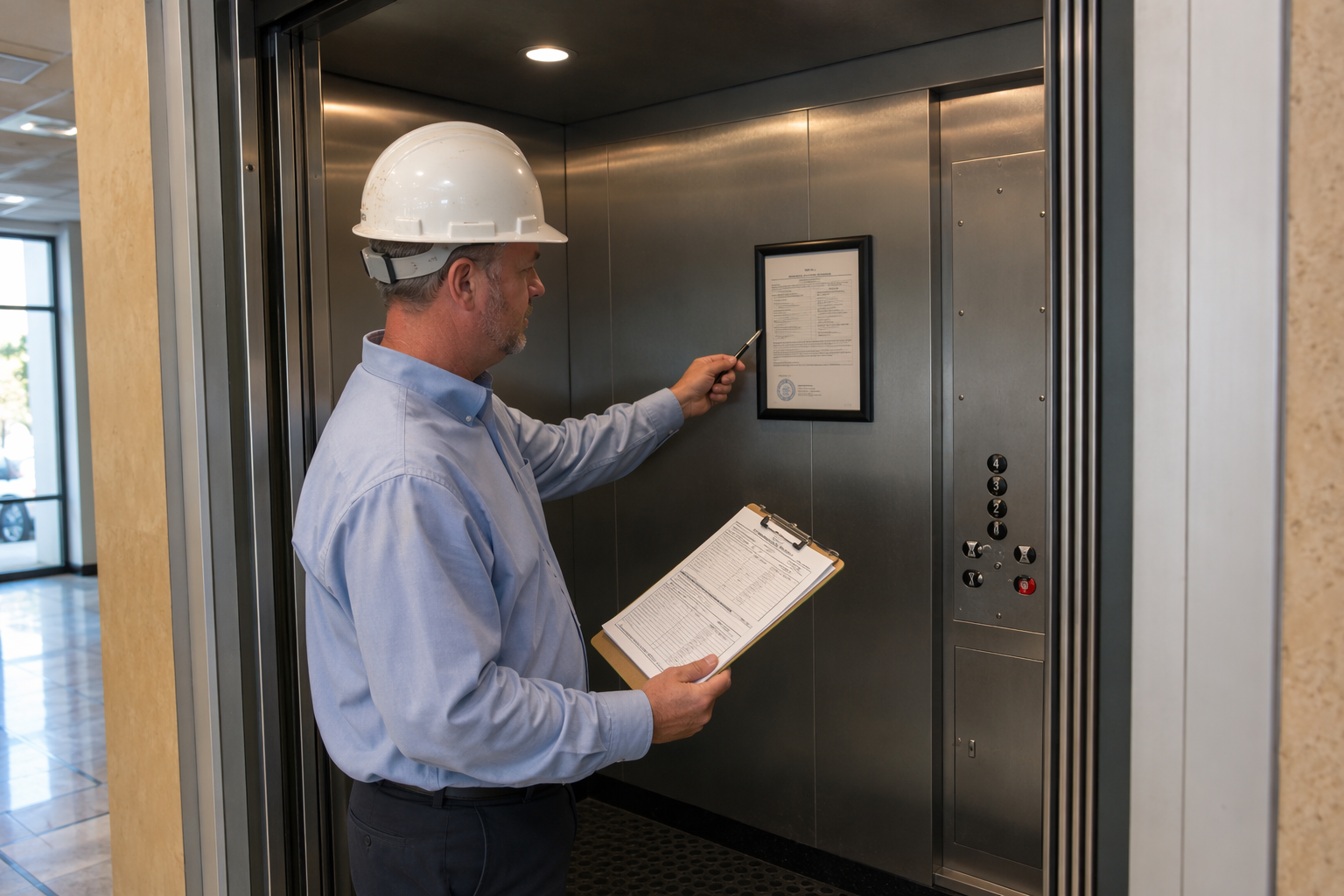
Arizona requires periodic inspections of elevators and related conveyances, with frequency determined by equipment type and use, as governed by the Arizona Department of Occupational Safety and Health (OSHA-aligned) and state administrative rules.
Under the framework informed by ASME A17.1, routine inspections are typically required annually for most traction and hydraulic elevators, with more frequent safety tests mandated at defined intervals — for example, Category 5 full-load safety tests. These tests verify that safety mechanisms such as the governor, safeties, and buffers function under real operating conditions.
Beyond mandatory state inspections, industry best practice calls for a monthly or quarterly preventive maintenance visit from a qualified technician. High-traffic commercial buildings in Phoenix — particularly those housing medical facilities, hotels, or retail centers — benefit from more frequent scheduled service to account for accelerated component wear.
What is ASME A17.1 and why does it matter for elevator maintenance?
ASME A17.1 is the nationally adopted Safety Code for Elevators and Escalators that defines the minimum requirements for elevator design, construction, installation, operation, inspection, testing, maintenance, and repair across the United States.
This code is not merely a suggestion. When a state or municipality adopts ASME A17.1 — as Arizona has done through its building and safety administrative framework — compliance becomes a legal obligation. The code specifies maintenance record-keeping requirements, mandates that maintenance be performed only by qualified personnel, and defines testing procedures that must be documented and made available to inspectors.
For building owners in Phoenix, Scottsdale, Mesa, and Tucson, selecting a maintenance company that does not fully implement ASME A17.1 requirements exposes the property to failed inspections, citations, and potential liability in the event of an incident. Arizona Elevator Solutions structures its maintenance programs around current ASME A17.1 standards to help clients avoid these risks.
What does a standard elevator maintenance contract include?
A standard elevator maintenance contract should include scheduled preventive maintenance visits, lubrication and adjustment of mechanical components, safety device testing, code compliance documentation, and a defined protocol for handling service calls.
At minimum, a well-structured maintenance agreement covers the following service elements:
- Lubrication: Guide rails, door operators, hoist ropes or hydraulic components, depending on equipment type
- Adjustment: Door timing, leveling accuracy, safety switches, and control parameters
- Inspection of wear components: Sheaves, brake linings, buffers, limit switches, and electrical contacts
- Safety device testing: Governor, safeties, overspeed protection, and emergency lighting per ASME A17.1
- Documentation: Maintenance logs, test records, and inspection certificates required by Arizona authorities
- Callback service: A defined process for responding to entrapments, door malfunctions, or operational failures
Contracts that exclude documentation, safety testing, or specific component categories often appear less expensive upfront but create significant compliance and liability exposure over time. Property managers in Phoenix should review contract scope carefully before signing.
What is the difference between full-service and oil-and-grease elevator maintenance contracts?
A full-service contract covers virtually all labor and parts required to maintain and repair the elevator, while an oil-and-grease (or basic lubrication) contract covers only routine lubrication and minor adjustments, leaving repair costs to the building owner.
The distinction matters significantly in Phoenix’s commercial real estate market, where elevator downtime in a multi-tenant office building or hotel carries tangible financial consequences. Full-service agreements provide cost predictability and typically result in more proactive parts replacement because the service company is motivated to prevent costly repairs they would bear under contract.
Oil-and-grease contracts may be appropriate for low-traffic residential elevators or newer equipment still covered by manufacturer warranties, but they shift repair cost risk entirely to the building owner. Facility managers should weigh the age of the equipment, usage intensity, and available capital budget when selecting a contract type.
How do Phoenix’s extreme temperatures affect elevator maintenance requirements?
Phoenix’s summer temperatures, regularly exceeding 110°F, accelerate degradation of hydraulic fluid, electrical insulation, and rubber seals, making climate-specific maintenance protocols essential for elevator reliability in this market.
Hydraulic elevators are particularly vulnerable. Hydraulic fluid viscosity changes with temperature; fluid that performs correctly at 70°F may be too thin at 110°F, reducing system efficiency and increasing pump wear. A qualified maintenance company in Phoenix should monitor fluid condition more frequently during summer months and ensure that hydraulic unit cooling systems are fully operational before peak heat season.
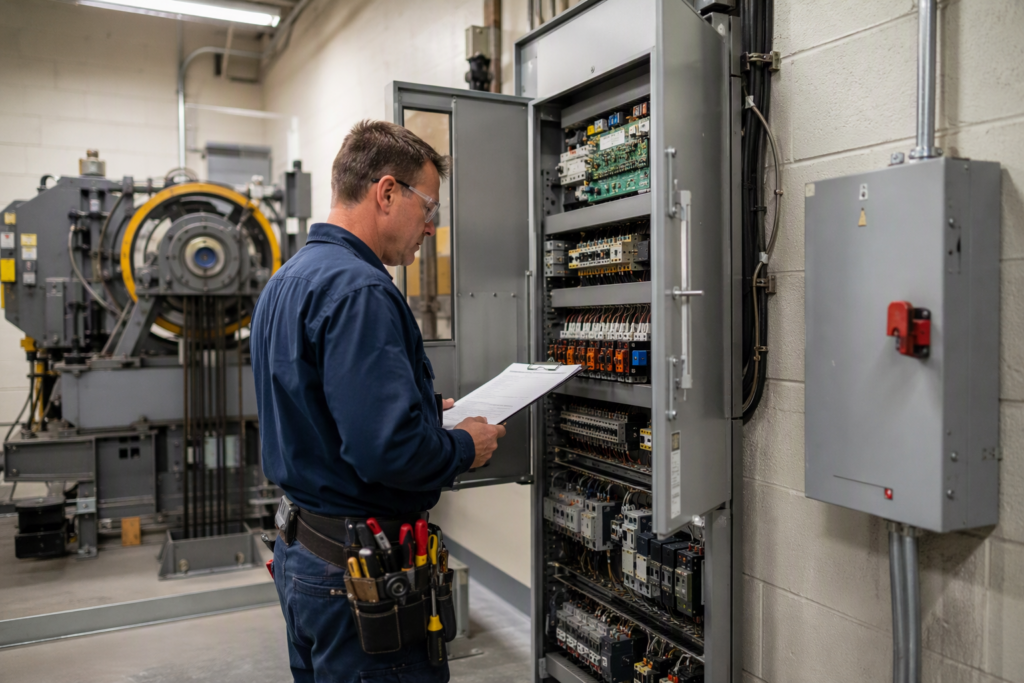
Motor room environments present a separate challenge. Machine rooms in Phoenix buildings can reach temperatures that exceed the rated operating range of control electronics, relay boards, and solid-state drives. Preventive maintenance in this market must include verification of machine room ventilation, cooling equipment condition, and ambient temperature compliance with manufacturer specifications and the requirements of ASME A17.1.
Desert dust infiltration is a third climate-specific concern. Particulate accumulation in hoistways, on sheaves, and inside control panels accelerates wear and can cause nuisance trips on photoelectric door sensors. A maintenance program designed for Phoenix conditions should include hoistway cleaning as a standard line item.
What ADA requirements apply to elevator maintenance and modernization in Phoenix?
The Americans with Disabilities Act, enforced through standards available at ADA.gov, requires that elevators in most commercial buildings remain accessible and in working order, with specific requirements for door timing, cab dimensions, controls, and auditory and visual signals.
From a maintenance perspective, ADA compliance means that elevator doors must reopen reliably when an obstruction is detected, cab floor leveling must be accurate enough to prevent a trip hazard at thresholds, control buttons must be illuminated and tactile, and audible announcements must be functional in buildings where they are required. A maintenance technician who signs off on equipment that fails any of these elements is exposing the building owner to both regulatory liability and civil exposure.
Modernization projects that upgrade older elevator equipment frequently trigger an obligation to bring the cab, controls, and hoistway entrance into full ADA compliance, even when the scope of work does not inherently require it. Property owners in Phoenix, Scottsdale, Mesa, and Tucson should confirm that any modernization contractor — including Arizona Elevator Solutions — provides a clear accounting of which ADA elements are affected by the planned scope of work.
How should a building owner evaluate and compare elevator maintenance companies in Phoenix?
Evaluating elevator maintenance companies requires examining technician credentials, code compliance processes, documentation practices, local references, and contract terms — not price alone.
| Evaluation Criterion | What to Look For | Red Flag |
|---|---|---|
| Code Knowledge | Demonstrates fluency with ASME A17.1 and Arizona administrative rules | Cannot cite specific code sections relevant to your equipment |
| Technician Qualifications | Certified elevator mechanics with documented training | Uses unlicensed or unverified subcontractors |
| Maintenance Documentation | Provides written logs, test records, and inspection certificates | No written records or refuses to share documentation with owner |
| Contract Scope Clarity | Lists specific inclusions and exclusions clearly | Vague language that excludes most repairs without notice |
| Climate-Specific Protocol | Addresses hydraulic fluid monitoring, machine room cooling, dust management | Uses a generic national maintenance template without local adaptation |
| References | Can provide verifiable local references in Phoenix metro area | References are out of state or unverifiable |
| Inspection Support | Accompanies or coordinates with state inspector; resolves violations promptly | Leaves building owner to manage inspection process alone |
| ADA Awareness | Identifies ADA-relevant maintenance items proactively | Does not address accessibility compliance in service scope |
What are the most common elevator failures in Phoenix commercial buildings?
The most common elevator failures in Phoenix commercial buildings include door malfunctions, hydraulic system issues driven by heat, leveling errors, and control system faults caused by temperature-related electrical degradation.
Door-related service calls consistently account for a large proportion of elevator callbacks in commercial settings. In Phoenix, photoelectric door sensors accumulate desert dust, reducing reliability. Door operator mechanisms also experience accelerated wear in high-traffic lobbies. Regular cleaning and adjustment of door systems is among the highest-return preventive maintenance activities available to Phoenix building managers.
Hydraulic unit failures — including pump motor overheating, seal degradation causing oil leaks, and hydraulic fluid contamination — are more prevalent in Phoenix than in cooler climates. Proactive fluid sampling and cooling system maintenance before summer significantly reduces the risk of mid-season failures that can leave a building without elevator service for days while parts are sourced.
Control system issues, including nuisance faults, erratic floor leveling, and intermittent door reversals, often trace to heat stress on solid-state components or corroded terminal connections. These issues are frequently misdiagnosed without access to current wiring diagrams and control system documentation, underscoring the importance of using a service company that maintains current equipment records for every unit in its portfolio.
What should a building owner do immediately if an elevator traps a passenger?
If a passenger is trapped in an elevator, building staff should follow a clear, immediate protocol that prioritizes passenger safety and avoids attempts to manually rescue occupants without qualified assistance.
- Contact emergency services: Call 911 if the passenger reports a medical emergency, distress, or if the situation cannot be resolved quickly.
- Communicate with the passenger: Use the elevator intercom or speak through the hoistway door to reassure the occupant, advise them to remain calm, and confirm they are uninjured.
- Do not attempt an unauthorized rescue: Untrained building staff attempting to manually open elevator doors or move the car can create fall hazards and may worsen the situation.
- Contact the elevator maintenance company: Call the service provider on your maintenance contract — qualified technicians are trained and equipped to perform a safe passenger rescue.
- Record the incident details: Note the time, floor location, number of passengers, and any observable symptoms or equipment behavior for your maintenance and incident log.
- Do not return the elevator to service: After the passenger is safely released, the elevator should remain out of service until a qualified technician has diagnosed and corrected the cause of the entrapment.
- File required reports: Depending on the nature of the incident, Arizona regulations and OSHA standards may require documentation and reporting of the event.
How is elevator modernization different from elevator maintenance?
Elevator modernization involves replacing major components — such as controls, drives, doors, or cab interiors — to improve performance, efficiency, and code compliance, while maintenance preserves the function of existing components through inspection, adjustment, lubrication, and repair.
Modernization is typically considered when an elevator reaches an age or condition where maintenance costs become disproportionate to its reliability, when the equipment can no longer be maintained in compliance with current editions of ASME A17.1, or when a building owner seeks to improve energy efficiency, reduce callback frequency, or upgrade the passenger experience.
In Phoenix, hydraulic elevator conversions — replacing older oil hydraulic systems with newer submersible pump units or MRL (machine-room-less) configurations — have become a common modernization pathway for mid-rise commercial buildings. These projects require full permitting through Arizona’s building and safety authority and must be performed by a contractor holding the appropriate state license.
Arizona Elevator Solutions provides both ongoing maintenance services and modernization consulting for property owners across Phoenix, Scottsdale, Mesa, and Tucson who are evaluating the appropriate time and scope for a modernization investment.
What permits and certifications are required to operate an elevator in Phoenix?
Operating an elevator in Phoenix requires a valid Certificate of Operation issued following a satisfactory periodic inspection by a qualified elevator inspector, with the certificate posted in or near the elevator cab as required by Arizona state administrative rules.
New installations and major alterations require a permit from the appropriate authority having jurisdiction (AHJ) before work begins. The permit process involves plan review, installation inspection, and a final acceptance inspection before the elevator is placed in service. These requirements are rooted in ASME A17.1 and enforced through Arizona’s state elevator safety program.
Building owners who allow an elevator to operate with an expired or suspended Certificate of Operation face regulatory penalties and significantly increased liability exposure. Maintaining a current certificate requires timely scheduling of periodic inspections and prompt correction of any deficiencies cited by the inspector — functions that a qualified maintenance company should actively support.
How does elevator maintenance affect building insurance and liability?
Documented, code-compliant elevator maintenance directly influences a building owner’s liability exposure and can affect insurance underwriting decisions, with gaps in maintenance records being a significant factor in post-incident litigation.
In the event of a passenger injury, plaintiffs’ counsel routinely requests complete maintenance logs, inspection records, and callback histories. A building owner who cannot produce these records — or whose records reveal deferred maintenance, uncorrected violations, or gaps in service — faces a substantially more difficult defense position. Conversely, a thorough, well-documented maintenance history demonstrates a standard of care that supports the owner’s defense.
Some commercial property insurers conduct elevator risk assessments as part of the underwriting process and may offer more favorable terms to buildings with current ASME-compliant maintenance programs and clean inspection histories. Building owners in Phoenix should consult with their insurance broker about how maintenance documentation interacts with their specific policy terms.
What types of elevators require maintenance services in Phoenix commercial buildings?
Phoenix commercial buildings commonly house hydraulic elevators, electric traction elevators, and machine-room-less (MRL) traction elevators, each requiring maintenance protocols specific to its drive system and configuration.
Hydraulic elevators use a fluid-driven piston to raise and lower the cab. They are common in low-rise and mid-rise buildings and require particular attention to hydraulic unit condition, fluid quality, cylinder integrity, and underground piping (where applicable) in Phoenix’s clay-heavy soil environment.
Electric traction elevators use a motor-driven sheave and wire ropes to move the cab. High-rise and mid-rise buildings in downtown Phoenix, Scottsdale, and Mesa predominantly use traction systems. These require regular rope inspection, sheave groove measurement, brake adjustment, and motor/drive maintenance.
MRL traction elevators eliminate the traditional machine room by placing the drive equipment in the hoistway or overhead space. They are increasingly common in new Phoenix construction and require technicians trained on specific OEM platforms, as access and adjustment procedures differ significantly from conventional traction units.
Less common but present in the Phoenix market are residential inclined platform lifts, vertical platform lifts, and dumbwaiters, all of which fall under ASME A17.1 jurisdiction and require documented maintenance programs.
How can a building manager reduce elevator downtime in Phoenix?
Reducing elevator downtime in Phoenix begins with a proactive preventive maintenance program that addresses climate-specific wear patterns before they cause service interruptions.
Key strategies include scheduling hydraulic system inspections and fluid evaluations before summer heat season, verifying machine room cooling capacity annually, implementing a door maintenance protocol that includes monthly sensor cleaning and door operator lubrication, and maintaining a current parts inventory for high-wear components specific to the equipment models in service.
Digital monitoring technology — including remote diagnostics and fault logging systems available on many modern elevator controllers — allows maintenance companies to identify developing issues before they result in entrapments or service outages. Building managers should ask prospective maintenance providers whether they offer or support remote monitoring capabilities for the specific equipment in their portfolio.
Selecting a maintenance company with deep familiarity with the Phoenix market, such as Arizona Elevator Solutions, reduces the risk of extended downtime caused by technicians who lack experience with local equipment conditions, supplier relationships, or Arizona code requirements.
What questions should a property owner ask before signing an elevator maintenance contract in Phoenix?
Before signing a maintenance contract, property owners should ask direct questions about technician qualifications, included services, documentation practices, parts sourcing, and how the company handles inspection violations and emergency situations.
Recommended due-diligence questions include:
- Are your technicians certified elevator mechanics, and can you provide documentation of their qualifications?
- Does this contract include all ASME A17.1 required safety tests, or are they billed separately?
- What documentation will I receive after each maintenance visit?
- How do you handle parts that need to be ordered — is there a markup, and what are typical lead times?
- Will you accompany or coordinate with the state inspector at my annual inspection?
- How do you address inspection violations — is that work included in the contract or billed separately?
- Do you have local references for similar building types in Phoenix, Scottsdale, Mesa, or Tucson?
- What is your protocol for a passenger entrapment?
- How do you account for Phoenix’s heat and dust conditions in your maintenance program?
How does elevator maintenance cost compare to elevator repair or replacement in Phoenix?
Consistent preventive maintenance represents a substantially lower long-term cost compared to reactive repair or full elevator replacement, with deferred maintenance being one of the most significant cost multipliers in elevator asset management.
While specific pricing varies based on equipment type, age, number of stops, and contract terms — and Arizona Elevator Solutions does not publish standard rate schedules in this guide — the financial logic of maintenance investment is well-established in the elevator industry. Components that fail catastrophically due to lack of lubrication or adjustment typically cost far more to replace than they would have to service proactively. Full elevator replacement projects, including cab, drive system, controls, and modernized entrances, represent a capital investment that most building owners seek to defer through effective maintenance.
When evaluating bids from Phoenix elevator maintenance companies, building owners should calculate the total cost of each option — including what is excluded from the proposed scope — rather than comparing base contract prices alone. The least expensive contract that excludes safety testing, documentation, or key components may generate significantly higher total annual costs once billable service calls and inspection-related repairs are included.
What role does elevator maintenance play in building resale and tenant retention in Phoenix?
Well-maintained elevators with current inspection certificates and documented service histories are a positive factor in commercial building valuations, lease renewals, and tenant satisfaction in the Phoenix market.
Commercial real estate due diligence in Phoenix routinely includes review of elevator maintenance records as part of the property condition assessment (PCA) process. Buyers and their engineers evaluate the age of equipment, quality of maintenance documentation, outstanding violations, and estimated remaining useful life. A building with gaps in maintenance history, overdue inspections, or deferred repairs typically receives a lower valuation or a purchase price adjustment to reflect the anticipated capital requirement.
For occupied buildings, elevator reliability directly affects tenant satisfaction and lease renewal decisions — particularly in medical office, hospitality, and multi-family residential properties where elevator access is not optional. Property managers in Phoenix, Scottsdale, Mesa, and Tucson consistently identify elevator performance as among the top operational concerns raised by tenants in multi-story buildings.
How does Arizona Elevator Solutions approach elevator maintenance in Phoenix?
Arizona Elevator Solutions provides structured, code-compliant elevator maintenance services for commercial and residential properties across Phoenix, Scottsdale, Mesa, and Tucson, with maintenance programs built around the requirements of ASME A17.1 and adapted to Arizona’s specific climate and regulatory environment.
The company serves property owners, facility managers, building operators, and HOAs across the Phoenix metro area and Southern Arizona, offering preventive maintenance contracts, repair services, code compliance consulting, and modernization support. Arizona Elevator Solutions’ approach emphasizes thorough documentation, proactive communication with building managers, and direct coordination with Arizona’s elevator inspection authority on behalf of its clients.
For building owners who are evaluating their current maintenance provider or entering a new management arrangement for a Phoenix property, Arizona Elevator Solutions offers a free elevator assessment to evaluate the condition of the equipment, identify any code compliance concerns, and recommend an appropriate maintenance program scope.
What are the consequences of neglecting elevator maintenance in Arizona?
Neglecting elevator maintenance in Arizona can result in failed state inspections, suspension of the elevator’s Certificate of Operation, regulatory fines, passenger safety incidents, and significantly increased legal liability for the building owner.
From a regulatory standpoint, Arizona’s elevator safety enforcement framework — informed by OSHA guidelines and aligned with ASME A17.1 — provides inspectors with the authority to order an elevator out of service when violations pose a risk to public safety. A building with a shut-down elevator faces immediate operational disruption, ADA accessibility compliance failures (for buildings where elevators are required for accessibility under ADA), and the cost of expedited repair work to restore service.
Beyond regulatory risk, deferred maintenance accelerates component wear, shortens the useful life of the equipment, and increases the probability of an incident that triggers legal action. Arizona building owners who treat elevator maintenance as a discretionary expense rather than a compliance and risk management obligation consistently incur higher total lifecycle costs than those who invest in consistent, qualified preventive maintenance.
Ready to Work With a Trusted Phoenix Elevator Maintenance Company?
Arizona Elevator Solutions serves commercial and residential property owners across Phoenix, Scottsdale, Mesa, and Tucson with ASME A17.1-compliant maintenance programs, expert repair services, and code compliance support tailored to Arizona’s unique climate and regulatory environment.
Contact Arizona Elevator Solutions for a free elevator assessment. A qualified representative will evaluate your equipment condition, identify any compliance concerns, and recommend a maintenance program designed for your specific building and elevator type.
Call us today: 480-557-7600
Need elevator service you can rely on? Arizona Elevator Solutions is ready to help.