Who Should I Contact When an Elevator Breaks Down — and How Fast Can It Be Repaired?
After 15+ years of responding to elevator breakdowns across Phoenix, Scottsdale, Tucson, and Mesa, I can tell you that the two questions building managers ask most urgently are always the same: Who do I call? and How long will this take? This hub page answers both questions — and every related question in between — so you are never caught unprepared when your elevator goes down.
Who Should I Contact First When My Elevator Breaks Down?
Call a licensed, IUEC-certified elevator service company that offers 24/7 emergency dispatch — not a general building maintenance contractor.
Elevator systems are governed by ASME A17.1 Safety Code for Elevators and Escalators and Arizona state statutes that require all repair work to be performed by qualified elevator mechanics. General maintenance staff are not legally permitted to perform mechanical or electrical repairs on elevator equipment in Arizona. Calling the wrong contractor wastes critical time and can create liability exposure for the building owner.
If a passenger is trapped inside the elevator, your first call should be to 911 so emergency responders can coordinate a safe extraction. Simultaneously, contact your elevator service provider’s emergency line. Arizona Elevator Solutions maintains a 24/7 emergency response line specifically for this scenario, serving Phoenix, Scottsdale, Mesa, and Tucson.
How Quickly Can a Broken Elevator Be Repaired?

Most standard elevator repairs are completed within 2–8 hours; complex repairs involving specialty parts typically take 1–5 business days.
Repair speed depends on three factors: the nature of the fault, parts availability, and your service provider’s response time. Based on industry data and my own field experience, here is a realistic breakdown:
| Repair Type | Typical Repair Time | Common Cause | Parts Usually Stocked? |
|---|---|---|---|
| Door sensor reset / adjustment | 30–90 minutes | Debris, misalignment | Yes |
| Safety relay or contact replacement | 1–3 hours | Worn contacts, power surge | Yes |
| Motor controller fault | 2–6 hours | Circuit board failure | Usually |
| Hydraulic fluid leak (minor) | 2–5 hours | Aging seals, heat stress | Yes |
| Traction sheave or hoist rope replacement | 1–3 business days | Wear, age | Order required |
| Hydraulic pump motor replacement | 2–5 business days | Motor burnout | Order required |
| Full controller modernization | 3–10 business days | Obsolete controls, code compliance | Custom order |
Arizona’s extreme heat — regularly exceeding 110°F in summer — accelerates hydraulic seal degradation and motor overheating, which is why Phoenix and Scottsdale building managers tend to see more heat-related breakdowns than the national average. Partnering with a local provider who stocks Arizona-climate-appropriate parts matters enormously.
What Are the Steps I Should Take Immediately When My Elevator Stops Working?
Follow a clear, sequential protocol to ensure passenger safety and regulatory compliance before any repair work begins.
- Determine if anyone is trapped. Use the elevator’s emergency intercom or phone system to communicate with the cab. If a passenger is confirmed trapped, call 911 immediately.
- Do NOT attempt to open elevator doors manually unless you are trained to do so. Forced entry by untrained personnel is a leading cause of elevator-related injuries and violates ASME A17.1 safety protocols.
- Post “Out of Service” signage on every floor landing to prevent additional passengers from attempting to use the elevator.
- Shut off the elevator at the machine room disconnect switch only if you have been trained in this procedure and no one is trapped inside.
- Call your licensed elevator service provider’s emergency line. Provide the building address, elevator ID number (usually posted in the cab), the nature of the fault, and whether anyone is inside.
- Document the incident. Note the exact time the elevator stopped, the floor it is on, any error codes displayed, and the names of witnesses. This documentation is required for Arizona state incident reporting if an injury occurred.
- Notify your property manager, risk management team, and insurance carrier if the outage extends beyond two hours or if a passenger was trapped.
- Await the certified technician’s arrival and provide full access to the machine room. Do not allow unauthorized personnel to attempt repairs.
Does Arizona Have Specific Laws About Who Can Repair Elevators?
Yes — Arizona law requires elevator repair work to be performed by licensed elevator contractors using certified elevator mechanics under Arizona Revised Statutes and the adopted ASME A17.1 code.
Arizona’s Department of Occupational Safety and Health (ADOSH) enforces elevator safety regulations in the state, operating under authority delegated by federal OSHA standards. All elevator installations, alterations, and repairs must be performed by or under the direct supervision of a licensed elevator mechanic. As of 2026, Arizona has adopted ASME A17.1-2019 as its reference safety standard for elevator equipment.
Building owners who allow unlicensed personnel to perform elevator repairs face civil penalties, increased liability exposure in personal injury lawsuits, and potential forced elevator shutdown by ADOSH inspectors. Always request the contractor’s Arizona elevator contractor license number before authorizing any repair work.
How Much Does Emergency Elevator Repair Cost in Arizona?
Emergency elevator repair in Arizona typically ranges from $300–$600 for minor repairs to $5,000–$25,000+ for major component replacements, with after-hours emergency rates usually running 1.5–2x standard labor rates.
Cost drivers include: the type of elevator (hydraulic vs. traction), age of the unit, parts availability, and whether the work is performed during standard business hours or as an after-hours emergency call. Arizona’s heat environment can create accelerated wear on hydraulic systems, meaning hydraulic elevator owners in Phoenix and Mesa often encounter more frequent seal and fluid repairs than owners in cooler climates.
A preventive maintenance agreement almost always reduces emergency repair costs significantly. Buildings that invest in monthly or quarterly maintenance typically spend 30–50% less annually on emergency repairs compared to buildings on no maintenance program. Ask Arizona Elevator Solutions about maintenance agreement pricing — it is almost always the smarter long-term investment.
What Information Should I Give the Elevator Repair Company When I Call?
Provide the building address, elevator unit ID, the specific symptom or error code, floor location of the cab, and whether anyone is trapped — this dramatically reduces the technician’s diagnostic time.
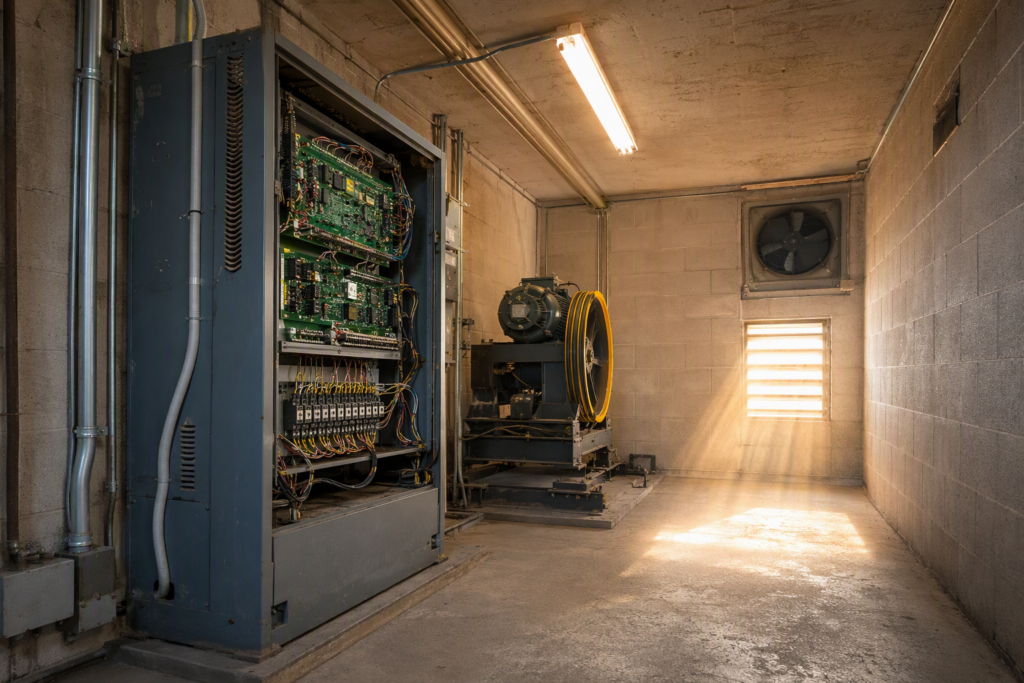
The more specific you are, the faster the repair. If your elevator control panel displays a fault code, write it down and read it to the dispatcher. Many modern controllers display alphanumeric fault codes that allow a technician to pre-select parts before even arriving on site. Also locate your elevator’s data plate (usually inside the machine room) and have the make, model, and serial number ready — this is critical for obsolete or proprietary systems common in buildings constructed before 1990.
What Is the Difference Between a Hydraulic Elevator Repair and a Traction Elevator Repair?
Hydraulic elevators use a fluid-driven piston system and are more susceptible to heat-related failures; traction elevators use cables and counterweights and generally require more complex mechanical repairs when they fail.
In Arizona’s desert climate, hydraulic elevators face unique stress. Hydraulic fluid viscosity changes with temperature, and when machine rooms are not properly climate-controlled, summertime temperatures in Phoenix and Tucson can push fluid temperatures well beyond manufacturer tolerances. This accelerates seal wear and can cause slow or erratic cab movement — both of which are safety concerns under ASME A17.1.
Traction elevator repairs often involve the hoist machine, ropes, sheaves, safety devices, or the controller. These systems are typically found in mid-rise and high-rise buildings. Traction system repairs generally require more specialized tooling and certified rigging competency. Both types require licensed elevator mechanics; neither is a DIY or general maintenance task.
How Do I Know If My Elevator Needs Repair Versus Modernization?
If your elevator requires the same repair more than twice within 12 months, or if parts are no longer manufactured, modernization is almost always more cost-effective than continued repair.
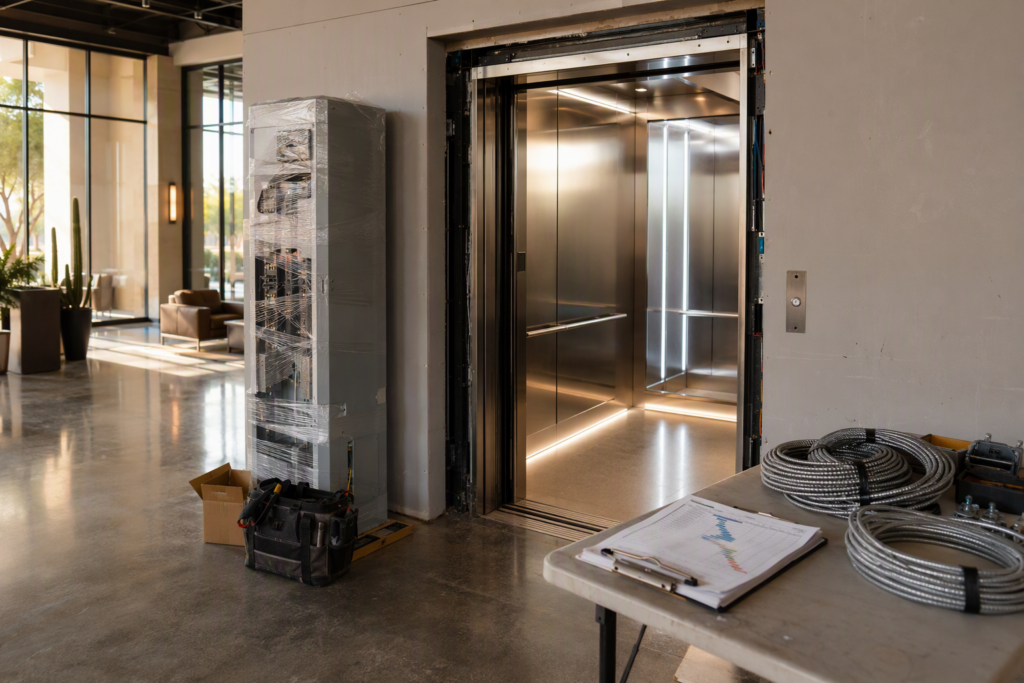
A modernization assessment evaluates your elevator’s controller, drive system, cab finishes, door operator, and safety devices against current ASME A17.1 Safety Code for Elevators and Escalators and ADA accessibility requirements. Buildings in Arizona that installed elevators before 1995 are likely running on obsolete controller technology for which replacement circuit boards are difficult or impossible to source.
The rule of thumb I use after 15+ years in the field: if your annual repair costs exceed 30% of the estimated modernization cost, it is time to modernize. Arizona Elevator Solutions offers comprehensive modernization assessments for building owners across Phoenix, Scottsdale, Mesa, and Tucson who are weighing this decision.
How Do Elevator Technicians Diagnose a Breakdown?
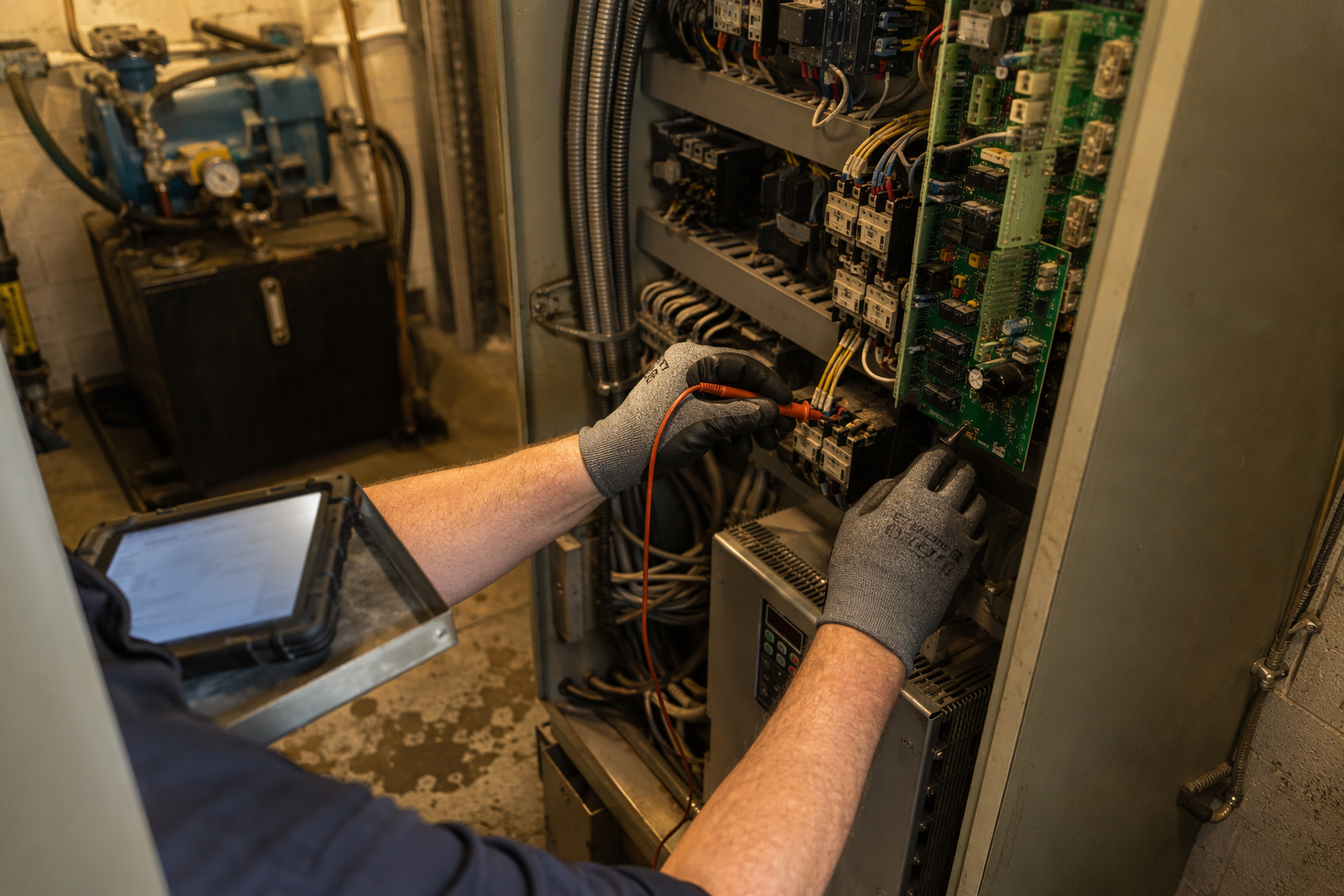
Certified technicians use a structured diagnostic sequence — reviewing fault logs, testing safety circuits, inspecting mechanical components, and measuring electrical inputs — to isolate the root cause before any parts are replaced.
Modern elevator controllers store fault history logs that record every safety circuit interruption, door cycle, and drive fault. Reading these logs is typically the first step and can compress diagnostic time from hours to minutes. From there, technicians work through a systematic check of the safety string — the series of safety contacts that must all be closed for the elevator to operate — before moving to the drive system and mechanical components.
Skipping straight to parts replacement without proper diagnosis is one of the most expensive mistakes a building manager can make. Always ask your technician to explain the root cause diagnosis before authorizing parts replacement.
Are Elevator Companies Required to Be Available 24/7 for Emergency Repairs in Arizona?
Arizona does not mandate 24/7 availability by statute, but ASME A17.1 and standard service contracts typically require a response to entrapments within 30–60 minutes, making 24/7 availability a practical and ethical necessity.
When evaluating elevator service providers, 24/7 emergency response capability is non-negotiable. An elevator company that cannot dispatch a technician at 2 AM on a Saturday is not a viable service partner for any occupied building. Verify that your service provider maintains actual on-call technicians — not just an answering service that routes calls to voicemail after hours.
What Qualifications Should I Look for in an Elevator Repair Company?
Look for IUEC certification, an Arizona elevator contractor license, ASME QEI-1 inspection credentials, liability insurance of at least $2 million, and verifiable local references from similar building types.
The International Union of Elevator Constructors (IUEC) certifies elevator mechanics through a rigorous apprenticeship and examination program. ASME QEI-1 certification applies to elevator inspectors. When requesting proposals from elevator companies, ask for: the Arizona contractor license number, proof of general liability and workers’ compensation insurance, a list of local references, and documentation of technician training and certifications. Do not accept verbal assurances — request documents.
How Often Should Elevator Maintenance Be Performed to Prevent Breakdowns?
Monthly preventive maintenance is the industry standard for most commercial elevators, with quarterly or semi-annual maintenance appropriate only for low-use residential or small commercial applications.
ASME A17.1 does not specify a maintenance frequency — it specifies that maintenance must be performed. However, the industry standard and most service contracts define monthly maintenance visits as the baseline for commercial elevators. Each visit should include lubrication of all specified points, adjustment of door operations, testing of safety devices, inspection of ropes or hydraulic components, and a review of fault logs.
In Arizona’s climate, I recommend quarterly hydraulic fluid sampling for hydraulic elevators to detect contamination or viscosity breakdown before it causes a failure. This is a best practice that Arizona Elevator Solutions incorporates into all of our maintenance agreements for the Phoenix metro and Tucson markets.
What Happens If My Elevator Fails an Arizona State Inspection?
A failed state inspection results in an immediate out-of-service order — the elevator cannot legally operate until all cited deficiencies are corrected and a re-inspection is passed.
Arizona conducts periodic elevator inspections through ADOSH. When an inspector issues a violation, you typically receive a written citation detailing each deficiency and a correction deadline. Common violations include: expired or missing annual inspection certificates, inoperative emergency lighting, non-compliant door re-opening devices, and safety device test failures. Correction timelines vary from immediate shutdown (for imminent hazard violations) to 30–90 days for less critical items.
Operating an elevator after a shutdown order is a serious legal violation that exposes building owners to significant fines and civil liability. If you receive a failed inspection notice, contact a licensed elevator company immediately to schedule corrective repairs and the required re-inspection.
Can Elevator Repairs Be Done After Hours or on Weekends to Minimize Building Disruption?
Yes — scheduled maintenance and planned repairs can almost always be arranged for evenings, weekends, or low-traffic periods to minimize disruption to building occupants.
For planned work such as component replacements, modernization phases, or code-required upgrades, experienced elevator companies will coordinate with building management to schedule work during off-peak hours. This is standard practice for occupied commercial buildings, hospitals, hotels, and multi-tenant residential properties in Phoenix and Scottsdale. Emergency repairs, by nature, happen whenever the failure occurs — which is another reason 24/7 availability matters.
Does ADA Compliance Affect Elevator Repair or Upgrade Requirements?
Yes — any significant alteration to an elevator triggers ADA compliance review, and existing elevators in public accommodations must meet ADA standards for controls, signage, and cab dimensions under Title III of the ADA.
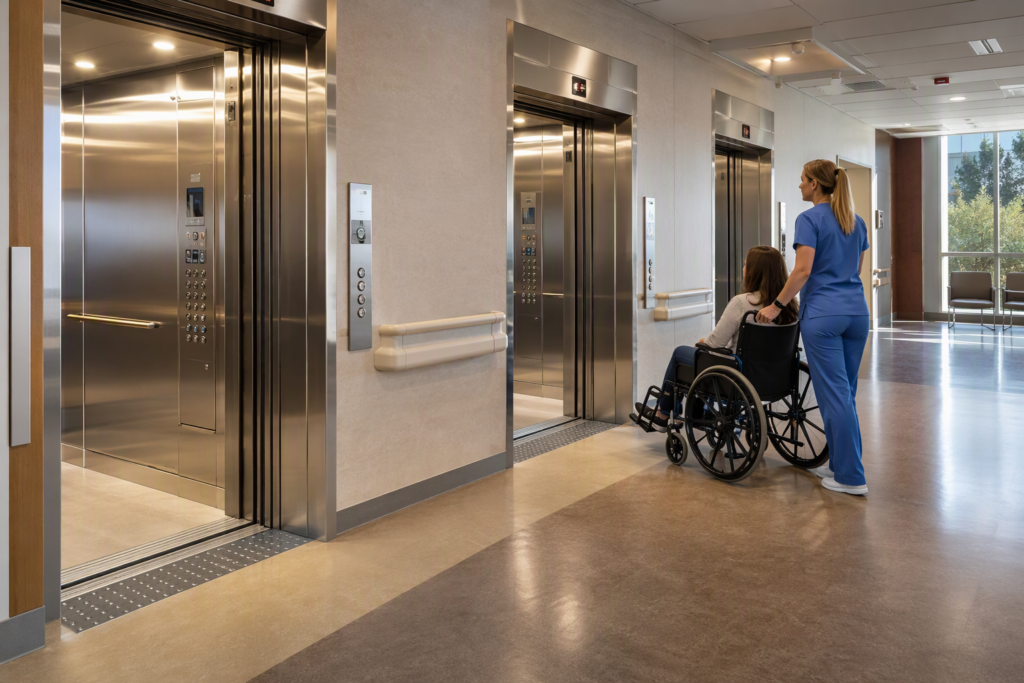
Under ADA requirements, elevator controls must be mounted at accessible heights (15–48 inches above the floor), buttons must have raised characters and Braille, and the cab must provide adequate maneuvering space for wheelchair users. When a building undergoes renovation or when an elevator controller is modernized, the work typically triggers a full ADA compliance review of the elevator system.
ADA compliance is not optional — it is a federal civil rights requirement. Buildings that have not audited their elevators for ADA compliance since original installation may be unknowingly out of compliance and exposed to legal risk.
How Do I Compare Elevator Repair Companies in Phoenix, Scottsdale, Mesa, or Tucson?
Compare companies on license verification, technician certifications, response time guarantees, parts inventory, local references, and contract transparency — never on price alone.
The lowest bid for elevator repair or maintenance is almost never the best value. Elevator systems are life-safety equipment. A company that wins your business by undercutting competitors may be cutting corners on technician training, parts quality, or maintenance thoroughness. Request itemized proposals from at least three companies, verify each contractor’s Arizona license, and call references from buildings similar to yours in size and use type. Ask each reference specifically about emergency response times — that is where companies differentiate most dramatically.
What Is the Average Lifespan of an Elevator, and When Does Age Affect Repair Feasibility?
A well-maintained elevator has a mechanical lifespan of 20–25 years for most components, with controller technology typically requiring modernization after 15–20 years due to parts obsolescence.
In 2026, any elevator installed before 2006 is approaching or past the point where original controller parts are difficult to source. Elevators installed before 1996 are almost certainly running on controllers for which circuit boards, relays, and proprietary components are no longer manufactured. This makes each repair more expensive and more time-consuming, as technicians must source refurbished or custom-fabricated parts.
Age alone does not determine when to repair versus modernize — but age combined with repair frequency and parts availability creates a clear financial case. A 30-year-old elevator with three repairs in the past 18 months is almost always a modernization candidate.
What Causes Most Elevator Breakdowns in Arizona?
In Arizona’s climate, the leading causes of elevator failures are heat-related hydraulic system stress, door mechanism wear, and power quality issues — all of which are preventable with proper maintenance.
Door-related faults account for approximately 70% of all elevator service calls nationally, and Arizona is no exception. Door operators, rollers, sills, and safety edges all accumulate debris and wear faster in high-use environments. In the Phoenix metro, summer heat adds hydraulic seal degradation, motor overheating, and control board failures caused by machine rooms that exceed design temperature limits. Power surges during monsoon season also generate a spike in controller faults every July through September.
These failure patterns are entirely predictable — and preventable — with a properly executed monthly maintenance program that accounts for Arizona-specific conditions.
What Should a Service Contract With an Elevator Company Include?
A comprehensive elevator service contract should include monthly maintenance visits, 24/7 emergency response with guaranteed response times, parts and labor coverage definitions, annual safety testing, and clear exclusions in plain language.
The most important clause to scrutinize in any elevator service agreement is the parts coverage section. Some contracts cover only labor, leaving the building owner to pay full retail price for any parts needed. Others offer comprehensive coverage that includes most parts replacements. Understand exactly what is and is not covered before signing. Also verify: Is the 24/7 emergency response an actual technician dispatch, or just a call center? What is the contractual response time guarantee? What constitutes a callback vs. a separate service charge?
When you review a contract with Arizona Elevator Solutions, our team walks you through every clause so you understand exactly what you are getting — no hidden fees, no vague exclusions.
Is There a Difference Between an Elevator Repair Company and an Elevator Inspection Company?
Yes — in Arizona, elevator inspections must be performed by a QEI-certified independent inspector or an ADOSH inspector, not by the company that performs the maintenance and repairs, to ensure impartiality.
This separation of roles is a critical safeguard. The same company that maintains your elevator has a financial interest in identifying (and billing for) repair work. An independent inspection by a ASME QEI-1 certified inspector provides an unbiased assessment of your elevator’s safety and code compliance. Arizona building owners should ensure their elevators receive both regular maintenance from a qualified service company AND periodic independent inspection as required by ADOSH regulations.
How Do I Get My Elevator Back in Service After a Shutdown?
To return an elevator to service after a shutdown, all cited deficiencies must be corrected by a licensed elevator company, verified by documentation, and re-inspected by an authorized inspector before the elevator can legally resume operation.
The return-to-service process typically involves: (1) completing all required repairs with a licensed elevator contractor, (2) obtaining a repair completion certificate or documentation from the contractor, (3) scheduling a re-inspection with ADOSH or a licensed third-party inspector, (4) receiving written clearance from the inspector, and (5) posting the updated inspection certificate in the elevator cab. Operating the elevator before receiving written clearance is a statutory violation in Arizona.
If you are dealing with a shutdown or failed inspection anywhere in the Phoenix, Scottsdale, Mesa, or Tucson area, contact Arizona Elevator Solutions immediately — our team has extensive experience navigating the Arizona re-inspection process efficiently to minimize your elevator’s downtime.
Summary: Key Numbers Every Arizona Building Manager Should Know
| Metric | Benchmark / Standard |
|---|---|
| Emergency response time (entrapment) | 30–60 minutes (ASME A17.1 best practice) |
| Standard repair time (minor) | 2–4 hours |
| Standard repair time (major parts) | 1–5 business days |
| Recommended maintenance frequency | Monthly (commercial elevators) |
| ADA control mounting height | 15–48 inches above floor |
| Average elevator mechanical lifespan | 20–25 years |
| Controller modernization trigger (age) | 15–20 years |
| Repair vs. modernize cost threshold | Annual repairs >30% of modernization cost |
| Arizona adopted safety code (2026) | ASME A17.1-2019 |
| Recommended liability insurance minimum | $2 million per occurrence |
Get Your Elevator Running Again — Fast
Whether you are facing an emergency breakdown, a failed inspection, aging equipment, or simply want to establish a maintenance program that prevents the next crisis, the right call is a licensed, experienced, locally accountable team that knows Arizona’s climate and Arizona’s code requirements inside and out.
Contact Arizona Elevator Solutions for a free elevator assessment. We serve Phoenix, Scottsdale, Mesa, and Tucson with 24/7 emergency response, IUEC-certified technicians, and transparent service agreements built around your building’s specific needs.
Call us now: 480-319-7157