Best Elevator Maintenance Company Scottsdale: Complete FAQ Guide
After 15 years of working on elevator systems across the Phoenix metro area, I’ve seen firsthand what separates a truly excellent elevator maintenance company from one that simply keeps the doors opening and closing. In Scottsdale specifically — a market packed with high-rise luxury condos, medical office buildings, resort hotels, and Class A commercial towers — the stakes for elevator reliability are exceptionally high. This guide answers every question building managers, property owners, and facility directors ask when evaluating elevator maintenance providers in Scottsdale.
What makes a elevator maintenance company the best choice in Scottsdale, AZ?
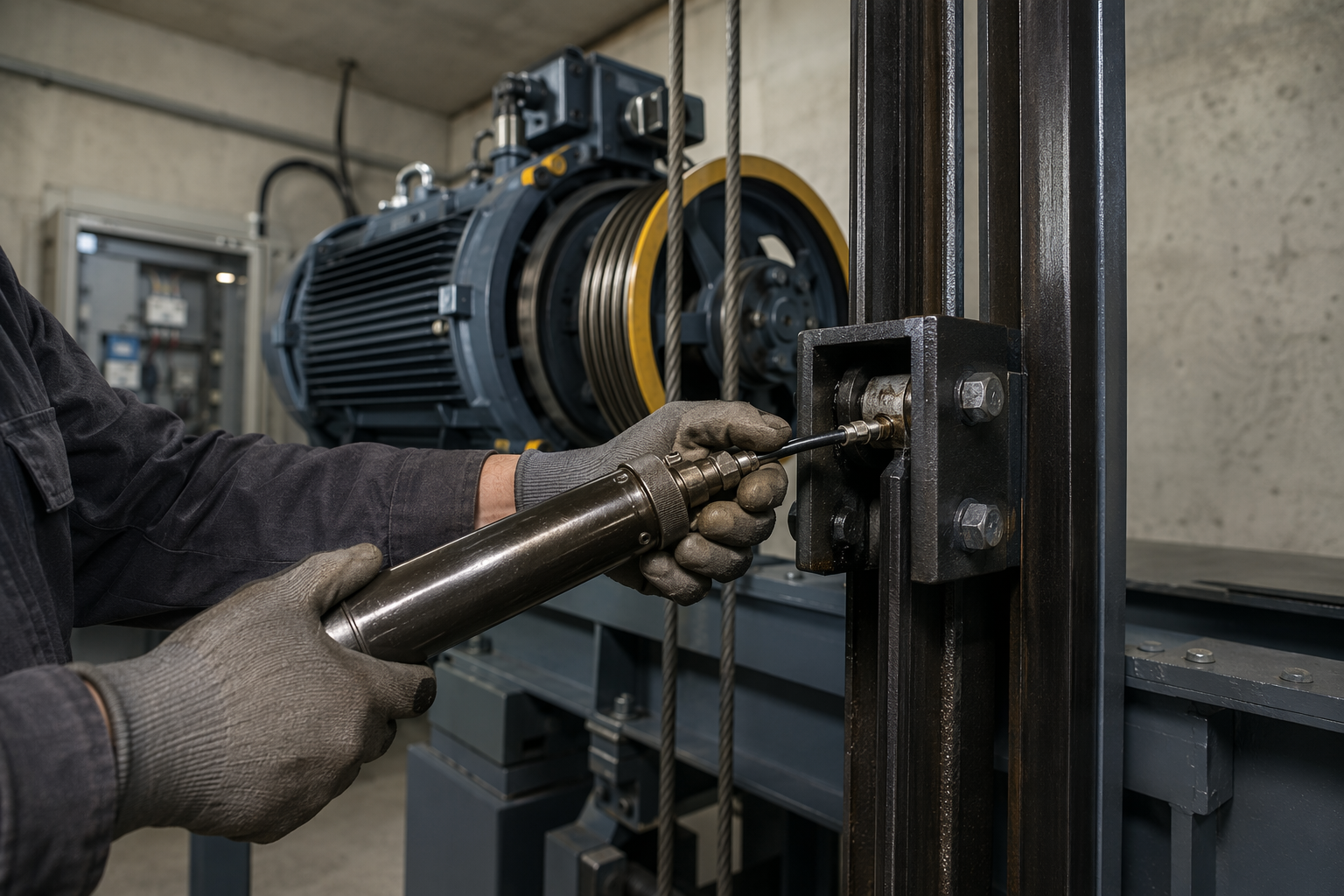
The best elevator maintenance company in Scottsdale combines full ASME A17.1 certification, Arizona state licensure, local technician presence, transparent pricing, and a documented response time under two hours for emergencies.
Scottsdale’s building stock is unique. You have everything from low-rise luxury retail on Fashion Square to 10-story medical office complexes near the Mayo Clinic campus, mixed-use high-rises in Old Town, and sprawling resort properties running 3–5 elevator banks simultaneously. A qualified maintenance partner needs familiarity with all of it. That means technicians who know Otis, KONE, ThyssenKrupp, Schindler, and Mitsubishi equipment equally well, and who carry the right parts inventory to avoid multi-day delays. Proximity matters too — a company headquartered in Phoenix proper but with technicians physically based in or near Scottsdale can realistically meet a 90-minute emergency response window, which a distant provider simply cannot promise.
How often should elevator maintenance be performed in Scottsdale buildings?
Elevators in commercial Scottsdale buildings should receive a full preventive maintenance visit at minimum every 30 days, while low-traffic residential elevators require at least quarterly service under Arizona state guidelines.
This cadence isn’t arbitrary. ASME A17.1/CSA B44, the Safety Code for Elevators and Escalators, sets the foundational maintenance framework adopted by Arizona’s Elevator Safety Program. Monthly visits for high-traffic elevators cover lubrication of guide rails and hoistway equipment, inspection of safety circuits, door operator adjustments, and controller diagnostics. Skipping even one cycle in a hot Arizona climate accelerates wear — extreme heat stresses hydraulic fluids, warps door sills, and degrades rubber components faster than in temperate states. In 2026, Arizona’s Occupational Safety and Health Division (ADOSH) has been intensifying random audits of maintenance logs, so documented compliance isn’t optional.
What does elevator maintenance typically cost in Scottsdale in 2026?
Elevator maintenance contracts in Scottsdale currently range from $250–$650 per elevator per month depending on equipment type, building usage, and contract tier, with full-service agreements averaging $450/month for a mid-rise commercial elevator.
Cost varies significantly by contract type. A basic “oil and grease” contract covers lubrication and minor adjustments but excludes parts and callbacks — these run $250–$300/month and look cheap until a motor capacitor fails and you’re handed a $1,800 parts bill. A full-maintenance contract bundles labor, parts, callbacks, and annual testing, and typically lands between $400–$650/month. For Scottsdale property managers overseeing luxury assets, the full-maintenance model almost always produces better ROI when you factor in avoided downtime and tenant satisfaction. Below is a benchmark comparison to help you evaluate proposals.
| Contract Type | Monthly Cost (Per Elevator) | Parts Included | Callbacks Included | Best For |
|---|---|---|---|---|
| Oil & Grease Only | $250–$300 | No | No | Very low-traffic residential |
| Comprehensive (Parts Excluded) | $300–$400 | No | Yes | Low-mid traffic commercial |
| Full-Maintenance | $400–$550 | Yes (most) | Yes | Mid-rise commercial, medical |
| Premium Full-Maintenance | $550–$650+ | Yes (all) | Priority 24/7 | Luxury high-rise, resort, hospital |
What certifications should an elevator maintenance company in Scottsdale hold?
A qualified Scottsdale elevator company must hold IUEC (International Union of Elevator Constructors) technician certification, a valid Arizona Elevator Contractor License issued by ADOSH, and carry general liability insurance of at least $1 million per occurrence.
Beyond baseline licensing, look for manufacturers’ certified technician designations — for example, Otis-certified, KONE-certified, or ThyssenKrupp-certified status signals the company has completed proprietary training on specific equipment. This matters enormously when your building runs a newer variable-frequency drive (VFD) traction system that requires software-level diagnostics. An uncertified technician using generic tools can actually trigger controller faults that void manufacturer warranties. Always ask for proof of current certification, not just a claim on a website.
What is ASME A17.1 and why does it matter for Scottsdale elevator maintenance?
ASME A17.1 is the North American safety code for elevators and escalators — Arizona has adopted it as the legal standard, meaning any maintenance company operating in Scottsdale must perform work that demonstrably complies with its requirements or face citation and permit suspension.
ASME A17.1/CSA B44 governs everything from governor rope tension specifications and car safeties to door reopening device performance and emergency lighting standards. Arizona’s elevator safety program, administered through ADOSH, enforces these codes during mandatory annual inspections. The 2022 edition of A17.1 (still the operative edition in 2026 for most jurisdictions) introduced updated requirements for remote monitoring connectivity and two-way communication redundancy — changes that directly affect how maintenance companies must configure modern elevator systems. A maintenance provider who cannot cite which edition their practices align with is a red flag.
Are Scottsdale elevators required to comply with ADA standards?
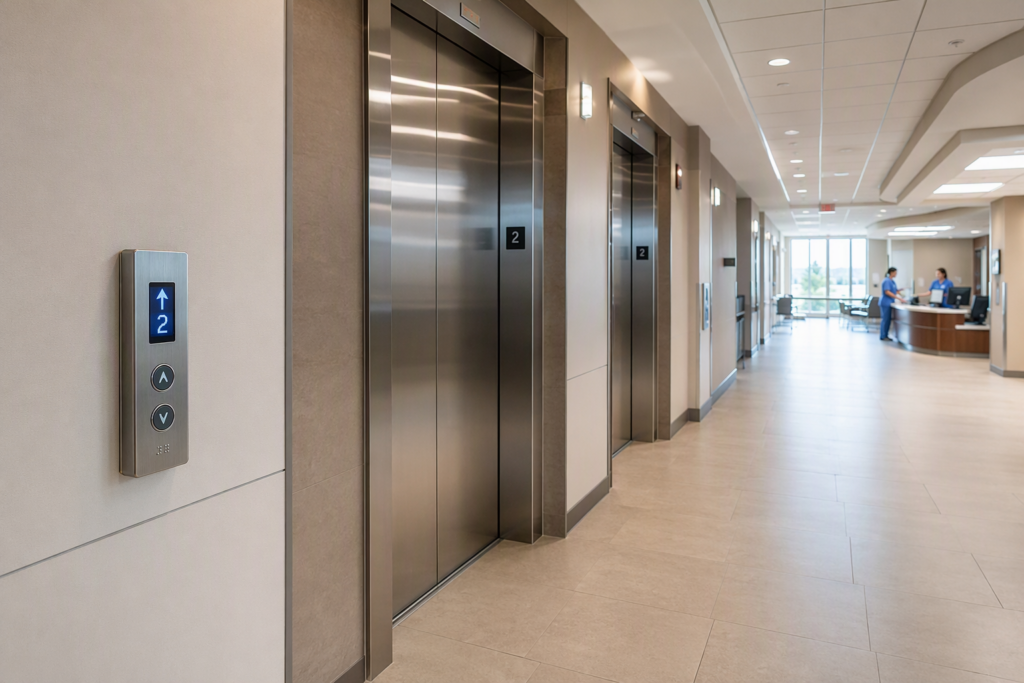
Yes — all elevators serving the public in Scottsdale commercial buildings must comply with ADA Title III regulations, which include specific requirements for car dimensions, door timing, tactile controls, and audible floor announcements.
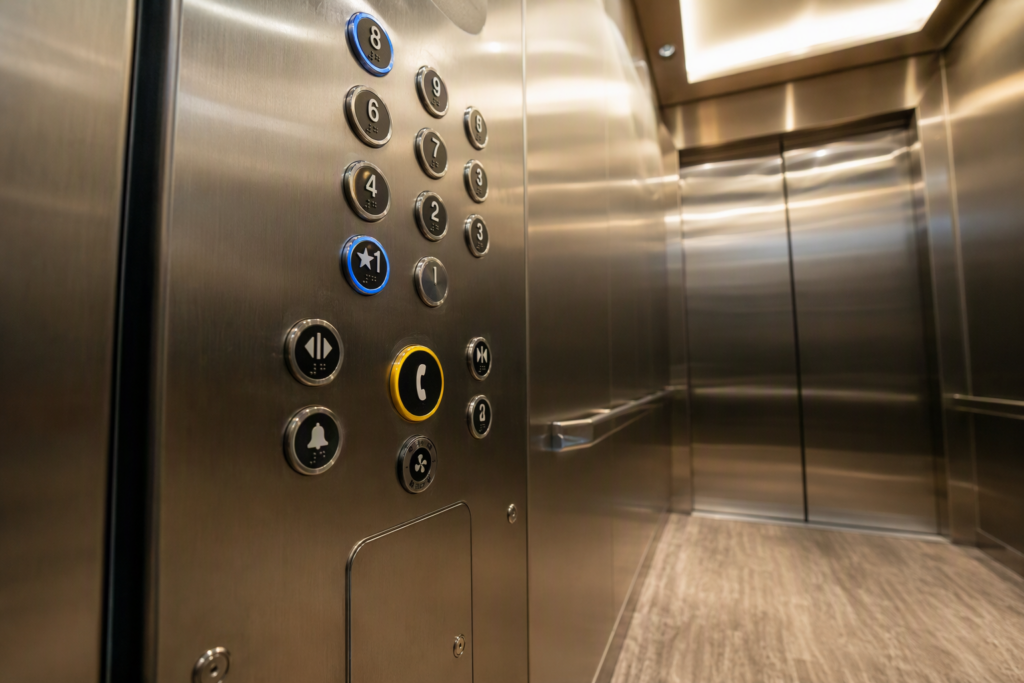
ADA compliance for elevators under the 2010 ADA Standards for Accessible Design requires elevator car dimensions of at least 51 inches wide by 80 inches deep, door clear width of at least 36 inches, and door dwell times sufficient for users with mobility devices. Tactile and Braille markings on control panels, visible and audible floor indicators, and emergency two-way communication accessible to individuals who are deaf or hard of hearing are also mandated. Maintenance companies should audit these features at every visit and flag non-compliance immediately — ADA complaints and lawsuits against Scottsdale commercial properties have increased 22% since 2022, and a building owner’s best defense is documented, proactive maintenance.
What should I look for when comparing elevator maintenance companies in Scottsdale?
When comparing Scottsdale elevator maintenance companies, prioritize local technician availability, documented emergency response times, full-maintenance contract options, manufacturer certifications, transparent pricing with no hidden surcharges, and verifiable Arizona state licensure.
The most common mistake I see property managers make is selecting a provider based on the lowest monthly rate without reading the exclusions list. National elevator companies operating in Scottsdale often lock buildings into 5–7 year contracts with automatic renewal clauses, proprietary parts requirements, and escalation clauses that raise rates 3–5% annually. Independent certified providers — like Arizona Elevator Solutions — typically offer 1–3 year terms with clearer renewal conditions. Ask every prospective vendor these five questions before signing: (1) What is your documented average emergency response time in Scottsdale? (2) Which parts categories are excluded from your full-maintenance contract? (3) Do your technicians hold current IUEC certification? (4) Can you provide three local Scottsdale references? (5) What is your callback resolution rate within 24 hours?
How quickly should an elevator maintenance company respond to emergencies in Scottsdale?
Industry best practice — and the standard Arizona Elevator Solutions holds itself to — is a 90-minute or less on-site emergency response for entrapments and safety shutdowns in Scottsdale, with phone acknowledgment within 15 minutes of the initial call.
Entrapment situations are the most urgent scenario. Arizona administrative code requires that a means of two-way communication be continuously monitored, but the speed of physical response depends entirely on your maintenance provider’s logistics. A company maintaining a Scottsdale-area parts van stocked with commonly failed components — door operators, controller boards, hydraulic pump components — can resolve most emergencies within 2–3 hours of arrival. A company dispatching from a warehouse in the West Valley cannot. When evaluating providers, ask specifically for their Scottsdale dispatch location and average after-hours response data, not just a marketing promise.
What happens during a routine elevator maintenance visit?
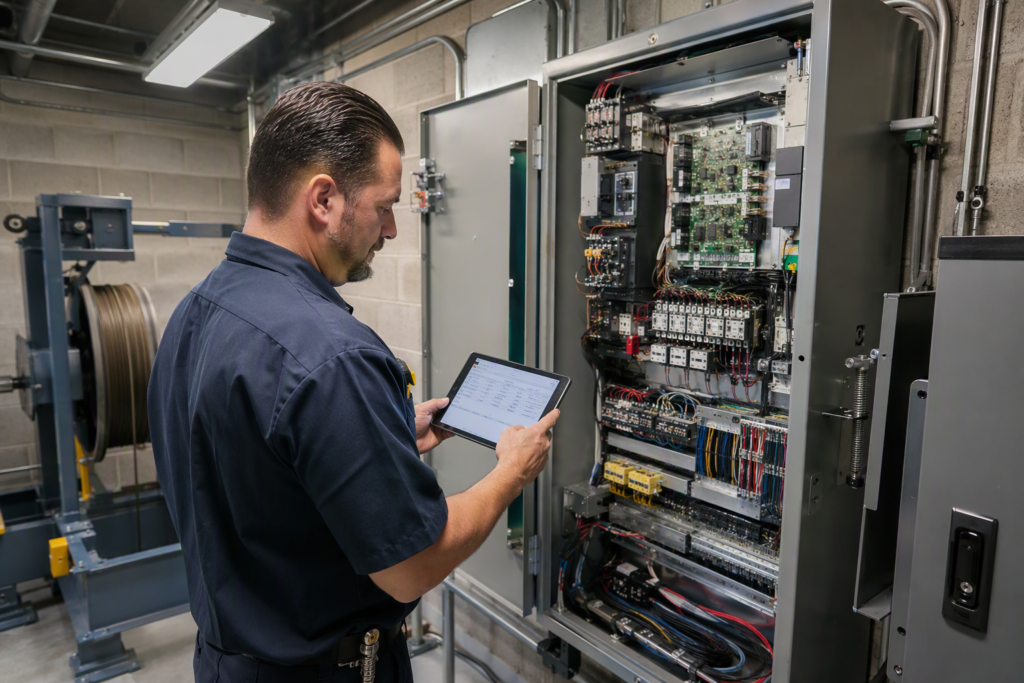
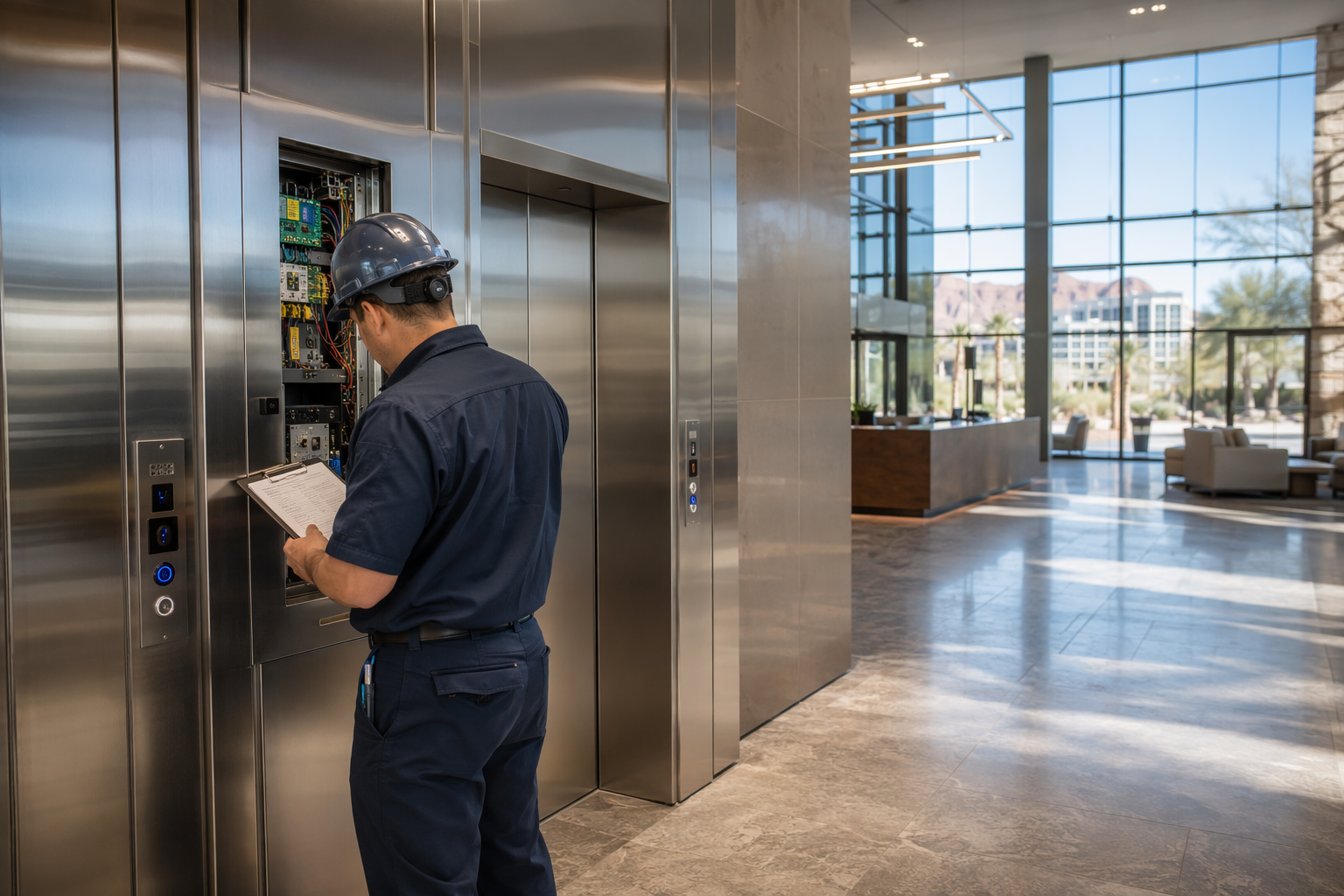
A routine elevator maintenance visit covers safety system testing, mechanical lubrication, electrical inspection, door operation adjustment, controller diagnostics, and documentation of any deficiencies requiring follow-up repair — typically requiring 2–4 hours per elevator.
Here is the standard protocol our IUEC-certified technicians at Arizona Elevator Solutions follow during a monthly preventive maintenance visit:
- Review the maintenance logbook and any callback notes from the prior cycle.
- Perform a full operational test run — ride the car through all floors, note leveling accuracy, door timing, and any unusual sounds or vibrations.
- Enter the machine room and inspect motor brushes (on DC systems), check VFD parameters on AC drives, verify oil levels in the machine unit, and test brake drop clearance.
- Inspect the hoistway via the pit — check buffers, pit lighting, stop switch, sump pump, and rope/chain condition.
- Lubricate guide rails, guide shoes, and all manufacturer-specified lubrication points using the correct viscosity for Arizona ambient temperatures.
- Test governor operation and verify overspeed device reset.
- Adjust door operator — check cam and roller condition, door close force (must not exceed 30 lbf per ASME A17.1), reopening device sensitivity, and sill clearance.
- Verify all emergency features: lighting, phone communication, ARO (Automatic Rescue Operation) if equipped.
- Run controller diagnostics and document any active or stored fault codes.
- Complete and sign the maintenance log, note any deficiencies, and issue a written summary to the building contact.
How often are elevators required to be inspected by the state of Arizona?
Arizona requires a full third-party safety inspection by a licensed Arizona elevator inspector every 12 months, with a periodic inspection certificate posted in the elevator car at all times as required by ADOSH.
The annual inspection is separate from routine maintenance visits — it is performed by an independent inspector authorized by Arizona’s ADOSH Elevator Safety Program, not by your maintenance company. The inspector checks compliance with the currently adopted edition of ASME A17.1, tests safety devices under load conditions, verifies emergency operation, and issues or denies the certificate of operation. Buildings that fail inspection must address deficiencies before the certificate is renewed, during which time the elevator may be legally required to be taken out of service. Your maintenance company’s job is to keep the elevator in a state of continuous readiness so the annual inspection is a non-event, not a scramble.
What are the most common elevator problems in Scottsdale’s climate?
Scottsdale’s extreme heat — regularly exceeding 110°F in summer — accelerates hydraulic fluid degradation, causes thermal expansion issues in door sills and guide rails, stresses electronic controllers, and shortens the service life of rubber components by 30–40% compared to national averages.
In over 15 years of Scottsdale-area work, the calls I get most frequently in summer are: (1) hydraulic elevators drifting or leveling poorly due to fluid viscosity breakdown above 100°F ambient pit temperatures, (2) door contact failures caused by thermally expanded aluminum sill channels binding on their frames, (3) controller overheating trips when machine room HVAC fails — a machine room should be maintained below 90°F per ASME A17.1 recommendations, and (4) rope stretch on traction elevators requiring more frequent re-tensioning. Any maintenance provider working in Scottsdale should have climate-specific protocols built into their service schedules — not just generic national-standard practices.
What is the difference between a traction elevator and a hydraulic elevator maintenance program?
Traction elevator maintenance focuses on wire rope inspection, counterweight balance, machine room equipment, and brake systems, while hydraulic elevator maintenance centers on fluid condition, cylinder integrity, power unit components, and underground piping monitoring.
In Scottsdale’s commercial building stock, mid-rise buildings over 5 stories predominantly use geared or gearless traction systems, while 2–5 story buildings often use hydraulic elevators. Each type has distinct maintenance cost profiles. Traction elevators generally have lower fluid-related costs but higher long-term rope replacement costs (a full rope replacement runs $8,000–$18,000 depending on the system). Hydraulic elevators require periodic fluid changes — typically every 3–5 years depending on usage and contamination — and underground cylinder inspections per ASME A17.1 Rule 3.18 to prevent corrosion-related failures. In Arizona, single-bottom hydraulic cylinders installed before 1990 must be monitored for corrosion and may require PVC liner installation or full cylinder replacement.
How do I verify an elevator maintenance company is licensed in Arizona?
You can verify an elevator contractor’s Arizona license status through the Arizona Industrial Commission (ADOSH) elevator contractor registration database, which lists current licensees, license numbers, and any disciplinary actions.
This step is non-negotiable. Unlicensed elevator contractors operating in Arizona face significant penalties, but the real risk falls on the building owner — if an unlicensed technician causes an injury or fails an inspection, your liability exposure is dramatically higher. Before signing any contract, ask the vendor for their Arizona elevator contractor license number and verify it directly on the ADOSH portal. Also verify that the lead technicians assigned to your property hold current IUEC Local 140 certification, which covers the Phoenix/Scottsdale metro area. Arizona Elevator Solutions maintains full current licensure and can provide verification documentation upon request.
Can I switch elevator maintenance companies mid-contract in Scottsdale?
Switching elevator maintenance companies mid-contract is possible but requires careful review of your current agreement’s termination clauses, proprietary access provisions, and any equipment exclusivity restrictions that national providers frequently embed in their standard contracts.
The most significant switching barrier is proprietary equipment lock-in. Some national elevator OEM service divisions configure their modern controllers to require manufacturer-specific diagnostic tools and access codes, effectively preventing independent maintainers from performing certain adjustments or repairs. Before switching, have your new provider assess whether your elevator’s controller is open-architecture or proprietary. If proprietary, factor the cost of a controller upgrade into your switching analysis. On the contract side, look specifically for automatic renewal clauses (often 30–90 day notice windows before a renewal date), liquidated damages provisions, and any language about removing “enhancements” installed during the service period. Many buildings in Scottsdale successfully switch providers annually — the process just requires informed preparation.
What is a full-maintenance elevator contract and is it worth it in Scottsdale?
A full-maintenance elevator contract covers all labor, most or all parts, callbacks, and annual testing under a single monthly fee — and for the majority of Scottsdale commercial buildings running elevators more than 8 hours per day, the financial predictability and comprehensive coverage make it the clearly superior choice.
Run the math: a single major component failure — a door operator assembly, a hydraulic pump unit, a controller board — typically costs $2,500–$12,000 in parts alone, plus labor and expedited shipping if the part isn’t stocked locally. One major failure annually eliminates the cost savings from a cheaper “parts-excluded” contract over 3–5 years. For Scottsdale’s luxury residential towers, medical buildings, and high-occupancy commercial properties where elevator downtime directly affects tenant retention and lease negotiations, full-maintenance contracts eliminate financial unpredictability. Arizona Elevator Solutions structures its full-maintenance agreements to include a clearly defined parts exclusion list (major structural components and vandalism damage) so clients know exactly what is and isn’t covered before they sign.
How long does elevator maintenance take, and what is the typical downtime?
A routine monthly maintenance visit on a standard commercial elevator takes 2–4 hours per unit, during which the elevator is typically out of service, so scheduling for early morning or low-traffic periods minimizes tenant disruption.
For multi-elevator buildings, competent providers stagger maintenance visits to keep at least one bank operational at all times. In a three-elevator building, a skilled team can typically complete all three units in a single morning shift while maintaining service continuity. More complex interventions — annual load testing, rope replacement, controller modernization — require advance scheduling and formal out-of-service notices to building occupants, typically 2–5 business days depending on scope. Annual state inspection stoppages are usually brief (2–4 hours) if the elevator is in good maintenance condition. Buildings with deferred maintenance often face extended downtime during annual inspections when the inspector identifies deficiencies requiring immediate correction before re-certification.
What are the penalties for non-compliant elevator maintenance in Arizona?
Arizona building owners operating elevators without a valid certificate of inspection can face ADOSH fines starting at $1,000 per day per elevator, mandatory shutdown orders, and personal injury liability exposure that is significantly amplified when maintenance records show negligence.
Beyond direct fines, the secondary consequences are often more severe. A lawsuit following an elevator injury in a Scottsdale building will center on the maintenance history — were inspections documented? Were known deficiencies corrected promptly? Was the maintenance provider licensed? Courts have consistently held that building owners bear ultimate responsibility for elevator safety, and gaps in maintenance documentation are treated as evidence of negligence. Arizona’s comparative fault system means even partial negligence can result in substantial damage awards. A documented, consistent maintenance program with a licensed provider is your primary legal protection, not just a compliance checkbox.
What questions should I ask before hiring an elevator maintenance company in Scottsdale?
Before hiring any Scottsdale elevator maintenance company, ask about their documented local response time, IUEC technician credentials, Arizona contractor license number, contract term flexibility, parts coverage scope, manufacturer-specific certifications, and references from comparable Scottsdale properties.
Beyond those fundamentals, dig into operational specifics: Do their technicians carry commonly needed parts in service vehicles, or do they order and wait? What is their callback resolution rate — meaning, what percentage of callbacks are resolved on the first return visit? Do they provide a dedicated account technician who builds familiarity with your specific equipment, or do they rotate anonymous crew members? Can they provide digital maintenance logs accessible to your facility team? What is their process when a deficiency is found — do they notify you in writing the same day? The answers to these questions reveal far more about actual service quality than any marketing brochure.
Does elevator maintenance affect building insurance rates in Scottsdale?
Yes — documented elevator maintenance programs with a licensed provider directly affect commercial property insurance rates in Arizona, with many carriers offering 5–15% premium reductions for buildings with verified full-maintenance contracts and clean inspection histories.
Insurance underwriters for commercial properties in Scottsdale increasingly request elevator maintenance records during policy renewals. Buildings with annual inspection certificates, consistent monthly maintenance logs, and zero entrapment incidents over a rolling three-year period are classified as lower risk, resulting in favorable premium adjustments. Conversely, a lapse in certification, an unresolved deficiency notice, or a documented entrapment can trigger premium increases of 10–25% and potentially affect coverage eligibility altogether. Your elevator maintenance provider should be able to furnish insurance-ready documentation packages on request — including maintenance logs, inspection certificates, and any corrective action reports — as a standard service deliverable.
Why should Scottsdale building owners choose Arizona Elevator Solutions over national elevator companies?
Arizona Elevator Solutions offers Scottsdale property owners the combination of local market expertise, no-proprietary-lock-in service agreements, IUEC-certified technicians based in the Phoenix metro area, 90-minute emergency response, and pricing transparency that the major national OEM service divisions routinely fail to match.
National elevator companies maintain significant brand recognition, but that recognition comes with trade-offs: rigid long-term contracts, centralized dispatch centers that add response time, and a business model that profits from parts escalation and proprietary access barriers. Arizona Elevator Solutions operates exclusively in the Phoenix metro — Scottsdale, Phoenix, Mesa, and Tucson — which means every resource, every parts inventory decision, and every technician deployment is calibrated to the Arizona market specifically. Our clients in Scottsdale include luxury residential towers, Class A office properties, medical office buildings, and resort properties — environments that demand zero compromise on reliability. We don’t compete with our clients’ equipment the way OEM service divisions do. Our only business is keeping your elevator safe, compliant, and running.
Need elevator service you can rely on? Arizona Elevator Solutions is ready to help.