After 15 years of responding to elevator emergencies across Phoenix, Tucson, Scottsdale, and Mesa, I’ve seen firsthand what happens when a building doesn’t have its emergency contact chain clearly defined. People panic, 911 gets flooded with non-life-threatening entrapment calls, and response times suffer. This guide covers everything you need to know about elevator emergency phone numbers — who to call, what the law requires, and how to set up a compliant system for your building.
Who is the first person I should contact during an elevator emergency?

Your first call depends on whether a person is in immediate danger — if someone is medically distressed or trapped in a high-risk situation, call 911 first; otherwise, contact your elevator service company’s 24/7 emergency dispatch line directly.
Here’s the practical breakdown most building managers don’t realize: fire departments and police are trained for entrapment rescue, but they are not trained elevator technicians. Calling 911 for a simple mechanical fault or door malfunction often results in a longer wait and potential equipment damage from forced entry. Your elevator service provider has the tools, access codes, and technical knowledge to resolve most malfunctions in under 30 minutes without damaging the cab or hoist system.
That said, always call 911 if the trapped passenger reports chest pain, difficulty breathing, extreme heat exposure, or any medical emergency. In Arizona’s summer months — where Phoenix temperatures exceed 110°F — heat buildup inside a stalled cab can become dangerous within 20–30 minutes, especially in older equipment without ventilation systems.
Keep both numbers posted in your building’s maintenance office, at every elevator lobby, and programmed into your property management software. Arizona Elevator Solutions provides clients with a laminated emergency contact card for every elevator bank upon completion of a service agreement.
What is the legal requirement for an emergency telephone inside an elevator?
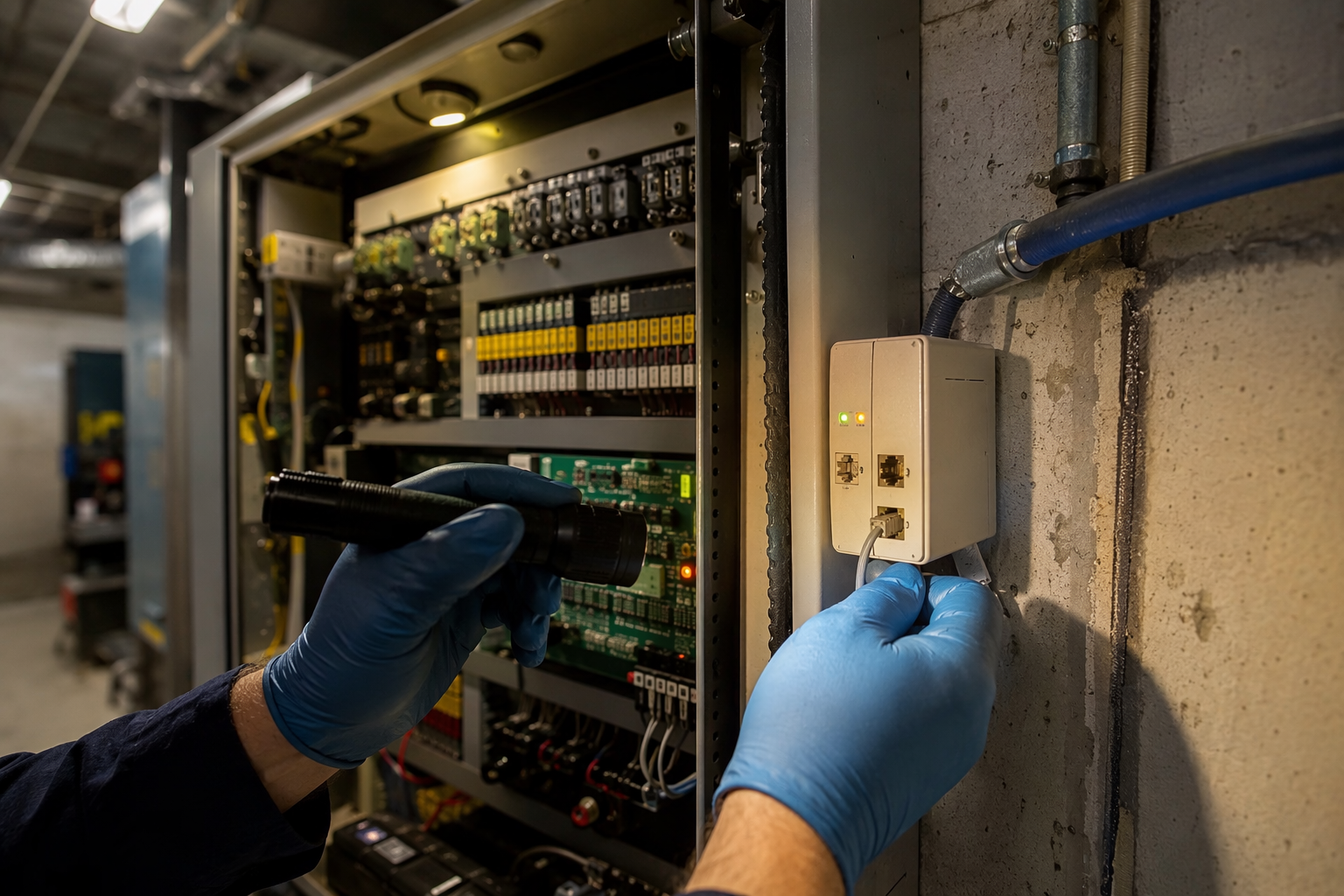
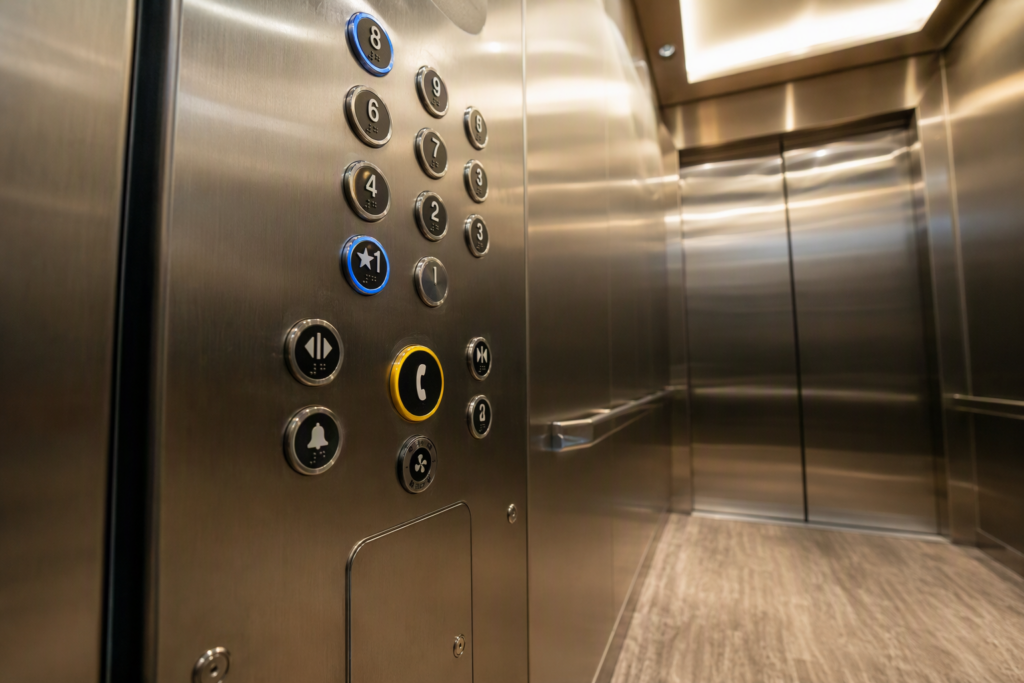
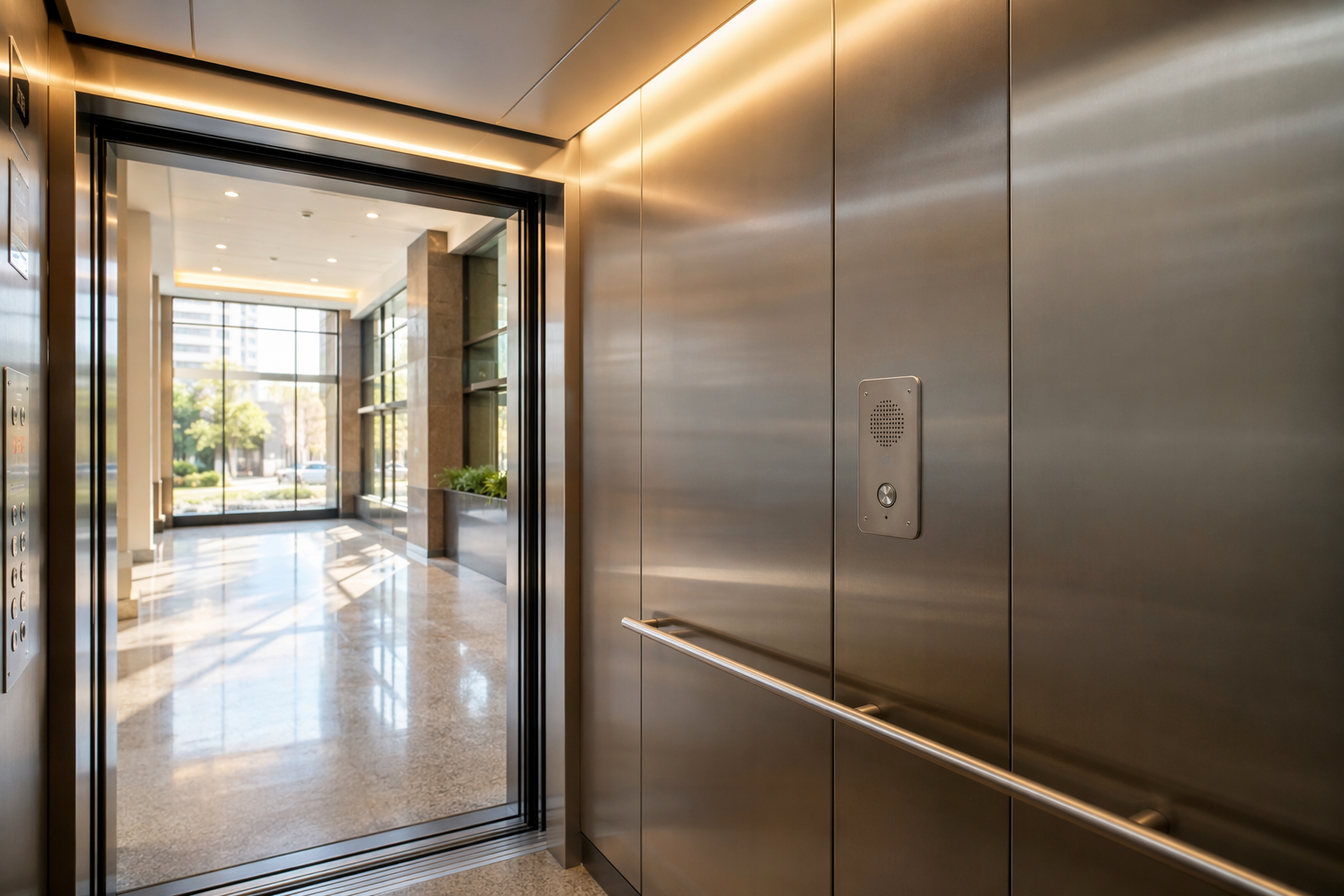
Under ASME A17.1 Safety Code for Elevators and Escalators, every elevator must contain a two-way voice communication device inside the cab that connects to a location staffed by a trained respondent 24 hours a day, 7 days a week.
Specifically, Section 2.27.1.1.1 of ASME A17.1-2019 (still the governing standard adopted by Arizona in 2026) requires that the emergency communication device must:
- Operate without the user needing to hold a handset
- Connect to a location outside the hoistway that is staffed 24/7
- Function on a dedicated or monitored line — not a voicemail system
- Include a visual or audible signal confirming connection has been made
Arizona adopts the ASME A17.1 standard through the Arizona Revised Statutes Title 23 and enforces compliance through the Arizona Division of Occupational Safety and Health (ADOSH). Non-compliance can result in fines, mandatory elevator shutdowns, and civil liability in the event of passenger injury.
What happens if an elevator’s emergency phone is not working?
A non-functional emergency phone is a code violation under ASME A17.1 and must be treated as an out-of-service condition — meaning the elevator should be taken offline until the communication device is repaired.
In my experience, a broken emergency phone is one of the most commonly cited deficiencies during annual elevator inspections in Arizona. Building owners often don’t realize the phone line was disconnected when the building switched phone carriers, or the analog line was decommissioned during a VoIP upgrade. This is an extremely common problem in commercial buildings that upgraded their phone systems between 2020 and 2024.
The regulatory consequence is serious: under Arizona law, an inspector who discovers a non-functional emergency phone can issue an immediate correction notice. If the elevator continues operating with a non-compliant emergency phone, the building owner faces escalating penalties. More critically, if a passenger is entrapped and cannot summon help due to a faulty phone, the liability exposure is significant.
If you suspect your elevator’s emergency phone is not functioning, contact your service provider immediately for testing and repair. Arizona Elevator Solutions offers emergency communication system testing as part of every scheduled maintenance visit in Phoenix, Scottsdale, Mesa, and Tucson.
What should I do immediately if someone is trapped in an elevator?
Follow this step-by-step protocol to ensure passenger safety and proper response coordination.
- Stay calm and communicate with the trapped passenger. Speak through the elevator door and reassure them help is on the way. Ask if anyone is injured or experiencing a medical emergency.
- Call 911 if there is a medical emergency. If the passenger reports chest pain, difficulty breathing, severe anxiety, or heat distress, call emergency services immediately.
- Call your elevator service company’s 24/7 emergency line. Have your elevator ID number, building address, and floor location ready. This speeds dispatch significantly.
- Do not attempt to manually open the elevator doors. Forcing doors open without confirming the cab is level with the landing is extremely dangerous and can cause falls of several feet.
- Keep the passenger informed of the estimated arrival time. Regular communication prevents panic and reduces the risk of passengers attempting self-rescue.
- Locate the elevator machine room key and have it ready for the responding technician. Access delays add significant time to rescue operations.
- Document the time of entrapment, passenger count, and any symptoms reported. This information is required for the incident report and may be needed for insurance or regulatory filings.
- Once the passenger is freed, have a qualified technician inspect the elevator before returning it to service. Running the elevator without a post-incident inspection may violate ASME A17.1 and your service contract terms.
Who is responsible for maintaining the elevator emergency phone number?
The building owner or property manager is legally responsible for maintaining a functioning, monitored emergency contact line in every elevator — not the tenant, not the elevator manufacturer, and not the local fire department.
This is one of the most misunderstood points in elevator compliance. Many property managers assume the elevator manufacturer or the original installation contractor handles ongoing emergency phone monitoring. In reality, once a building certificate of occupancy is issued, all ongoing maintenance obligations — including the emergency communication system — fall to the building owner under ASME A17.1 and Arizona state law.
Building owners typically fulfill this obligation in one of three ways: through a full-service elevator maintenance contract that includes emergency dispatch monitoring, through a third-party telephone answering service specializing in elevator emergency response, or through in-house staffing (only practical for large facilities with 24/7 operations such as hospitals or major hotels).
What is the difference between an elevator service company emergency line and 911?
911 dispatches fire or police for life-safety entrapment rescues, while an elevator service company emergency line dispatches a certified technician who can resolve mechanical malfunctions, perform safe rescues, and return the elevator to service — which 911 responders cannot do.
Think of it this way: a firefighter can pry open an elevator door and get a passenger out safely, but they cannot diagnose why the elevator stopped, reset a safety relay, or inspect the hoisting cables before the elevator returns to service. After a fire department forced-entry rescue, the elevator must still be inspected and cleared by a licensed elevator mechanic before it can be used again.
Elevator service company emergency technicians are trained under the International Union of Elevator Constructors (IUEC) and must hold state certification in Arizona. They carry diagnostic equipment, replacement parts for common failures, and the access credentials needed to safely operate the elevator in manual mode during a rescue.
How do I find my building’s elevator service company emergency phone number?
Your elevator service company’s emergency number should be posted on the service certificate inside the elevator machine room, on your maintenance contract, and ideally posted at each elevator lobby on the building’s emergency contact board.
If you cannot locate it, check these sources in order:
- The elevator machine room door — service stickers are typically affixed here
- Your property management system or building maintenance log
- The Arizona ADOSH elevator inspection records, which list the registered service contractor
- The elevator cab interior — some service companies affix their emergency number on a sticker near the phone panel
- Your building insurance carrier — they typically have the service contractor on file
If your building does not currently have an elevator service agreement that includes 24/7 emergency dispatch, this is a critical compliance gap. Arizona Elevator Solutions serves commercial and residential properties throughout Phoenix, Tucson, Scottsdale, and Mesa with full-service contracts that include 24/7 emergency response.
How quickly should an elevator technician respond to an emergency call?
Industry best practice and most elevator service contracts in Arizona specify a response time of 1–2 hours for standard entrapment, and some premium contracts guarantee 30–60 minute response times in metropolitan areas like Phoenix and Scottsdale.
| Service Level | Typical Response Time | Contract Type | Best For | Typical Annual Cost Range |
|---|---|---|---|---|
| Priority Emergency | 30–60 minutes | Full-service premium | Hospitals, hotels, high-rise residential | $4,500–$12,000/elevator/year |
| Standard Emergency | 1–2 hours | Full-service standard | Commercial office, retail, mid-rise | $2,800–$5,500/elevator/year |
| Basic Emergency | 2–4 hours | Parts & labor / limited | Low-traffic residential buildings | $1,200–$3,000/elevator/year |
| No Contract (on-call) | 4–8+ hours | None | Not recommended — compliance risk | $200–$600/service call + parts |
Response times in Phoenix and Scottsdale are generally faster than in outlying areas due to technician proximity. Buildings in rural areas outside Mesa or Tucson should factor extended response times into their emergency planning and passenger communication protocols.
Are there ADA requirements related to elevator emergency phones?
Yes — under the Americans with Disabilities Act (ADA), elevator emergency communication systems must be accessible to individuals who are deaf or hard of hearing, which typically requires a visual signal confirming call connection and, in many cases, a TTY-compatible or text-based communication option.
ADA Standards for Accessible Design, Section 407.4.9, specifically addresses elevator emergency communication. The requirements include:
- A visual light or display confirming the emergency call has been answered
- The call button must be labeled in Braille
- Communication systems installed after March 15, 2012 must comply with the 2010 ADA Standards
- IP-based or cellular emergency phones must include equivalent visual notification functionality
Many older elevator emergency phone systems — particularly analog units installed before 2010 — do not meet current ADA requirements. A compliance audit should be part of any elevator modernization project. Failure to comply with ADA elevator requirements can result in complaints filed with the U.S. Department of Justice and civil litigation.
Can I use a cellular or VoIP system for the elevator emergency phone?
Yes, cellular and VoIP-based elevator emergency phone systems are permitted and increasingly common in 2026, but they must still meet all ASME A17.1 performance requirements including 24/7 live monitoring, hands-free operation, and call confirmation signaling.
The shift away from analog POTS (Plain Old Telephone Service) lines has created both opportunities and compliance traps for building owners. Cellular emergency phone systems eliminate the need for a dedicated phone line and are not disrupted by building-wide VoIP switchovers. However, they introduce new failure modes: poor cellular coverage in concrete hoistways, battery backup requirements, and carrier network outages.
Key considerations when switching to cellular or VoIP elevator phones:
- Test signal strength inside the hoistway — not just in the lobby
- Ensure battery backup of at least 4 hours per ASME A17.1 requirements
- Verify the monitoring center is notified of the technology change
- Confirm the new system generates a call confirmation signal visible inside the cab
- Update your elevator’s Certificate of Inspection records with the new communication system
How often should elevator emergency phones be tested?
Elevator emergency phones should be tested at minimum monthly by building staff, and must be formally tested and documented during annual elevator inspections required by Arizona state law.
Monthly testing is a basic operational standard — not a regulatory minimum per se, but a best practice that virtually every service contract and risk management consultant recommends. The test procedure is simple: press the emergency call button, confirm the call connects to a live operator within 60 seconds, confirm the operator can hear you clearly, and document the date, time, and result in your elevator maintenance log.
During Arizona’s annual elevator inspection, the inspector will test the emergency phone as part of the standard inspection protocol. A failed emergency phone test during a formal inspection can result in a failed inspection certificate and mandatory shutdown of the elevator until the issue is resolved.
What information should I have ready when I call an elevator emergency line?
When calling an elevator emergency line, have your building address, elevator unit number or cab identifier, approximate floor location, number of passengers trapped, and a brief description of what happened immediately before the malfunction ready to provide to the dispatcher.
Experienced dispatchers will ask for all of this information, but having it ready cuts 2–3 minutes off the call — which matters when someone is trapped. Additional helpful information includes:
- Whether the elevator doors are open, closed, or partially open
- Whether any error codes or unusual sounds were observed
- Whether the elevator moved at all, or stopped between floors
- Any recent maintenance work performed on the elevator
- Whether this is a recurring problem or a first-time occurrence
Who do I contact if my elevator service company is not responding to my emergency call?
If your elevator service company is not responding within a reasonable timeframe, escalate to a secondary certified elevator contractor, contact Arizona ADOSH if the situation involves ongoing passenger entrapment, and if there is any risk to life, call 911 without delay.
This is a scenario I’ve responded to more times than I’d like. A building’s contracted service company goes out of business, changes ownership, or simply fails to staff their emergency line adequately. In those situations, building managers need a backup plan established before the emergency occurs.
Build a backup contact list that includes:
- One alternate certified elevator contractor for your area
- Your local fire department’s non-emergency line for entrapment coordination
- Arizona ADOSH: Arizona Division of Occupational Safety and Health (ADOSH)
- Your building’s liability insurance carrier’s 24-hour claims line
Does my building’s elevator emergency phone need to connect to the fire department directly?
No — ASME A17.1 does not require the elevator emergency phone to connect directly to the fire department; it must connect to a location staffed 24/7 that can coordinate emergency response, which is typically your elevator service company’s monitoring center or a third-party answering service.
This is a common misconception. Building owners sometimes assume they need a direct tie to 911 or the local fire dispatch center. In reality, the code requires a live human response — someone who can communicate with the trapped passenger and contact emergency services if needed. This is why elevator monitoring centers work: they serve as the coordinating layer between a trapped passenger and both the elevator technician and emergency services if the situation escalates.
What should property managers in Phoenix, Scottsdale, Tucson, and Mesa know about local elevator emergency regulations?
Property managers in all four Arizona Elevator Solutions service markets — Phoenix, Scottsdale, Tucson, and Mesa — operate under Arizona state elevator regulations enforced by ADOSH, supplemented by local fire codes and building department requirements that may impose additional obligations beyond state minimums.
Key local considerations for 2026:
- Phoenix: The City of Phoenix Building Safety Division coordinates with ADOSH on elevator inspections. High-rise buildings (over 75 feet) face additional fire safety integration requirements for elevator emergency systems.
- Scottsdale: Scottsdale’s commercial property density and luxury residential market mean a higher proportion of hydraulic and machine-room-less (MRL) elevators, which have specific emergency phone placement requirements.
- Tucson: The University of Arizona and surrounding medical districts have elevated compliance scrutiny. ADA emergency phone compliance is frequently audited in publicly accessible buildings.
- Mesa: Rapid commercial development in Mesa means many new elevator installations, where getting emergency phone systems correctly specified during construction is far cheaper than retrofitting later.
How much does it cost to repair or replace an elevator emergency phone system?
Elevator emergency phone repair costs range from $150–$500 for simple line reconnection or phone unit replacement, while a full system upgrade to a compliant cellular or VoIP unit with monitoring typically costs $800–$2,500 installed per elevator in 2026.
Cost drivers include:
- Whether the existing wiring can be reused (analog to cellular conversions often require new conduit)
- The monitoring service fee — typically $20–$60/month per elevator
- ADA compliance upgrades if the existing unit lacks visual call confirmation
- Whether the hoistway has adequate cellular signal or requires a signal booster
- Labor rates, which vary between Phoenix/Scottsdale (higher) and Tucson/Mesa (slightly lower)
Many building owners don’t realize that emergency phone upgrades can often be bundled into a preventive maintenance agreement, spreading the cost over the contract period. This is a conversation worth having with your elevator service provider before budgeting for the work separately.
What records should I keep related to my elevator emergency phone?
You must maintain a written log of all emergency phone tests, repair work, and annual inspection results related to the emergency communication system — these records must be available on-site for Arizona elevator inspectors upon request.
Recommended record-keeping includes:
- Monthly phone test log with date, tester name, pass/fail result, and operator response time
- Copies of all repair invoices related to the emergency communication system
- Annual inspection certificates showing emergency phone compliance status
- Monitoring service agreements and confirmation that the monitoring center has current building contact information
- Records of any system upgrades, including the previous and new equipment specifications
Keep these records for a minimum of 5 years. In the event of a liability claim following an elevator incident, these records are often the primary evidence in determining whether the building owner met their duty of care.
When should I consider upgrading my elevator’s entire emergency communication system?
Consider a full emergency communication system upgrade when your elevator is more than 20 years old, when your building switches phone systems (especially analog to VoIP), when you receive a failed inspection notice, or when your current system lacks ADA-required visual confirmation features.
The 20-year threshold is significant: most analog emergency phone units have a functional lifespan of 15–25 years, and components become increasingly difficult to source after that point. A proactive upgrade is almost always less expensive than an emergency replacement after a failure during an inspection.
Modernization trigger checklist:
- Elevator installed or last modernized before 2005
- Building recently converted from POTS to VoIP or fiber phone service
- Emergency phone fails monthly test more than once per year
- Monitoring center reports poor audio quality or dropped connections
- No visual call confirmation light present inside the cab
- Emergency phone button label in Braille is worn or missing
How do I set up 24/7 elevator emergency monitoring for my building?
To establish 24/7 elevator emergency monitoring, sign a full-service maintenance agreement with a certified elevator contractor that includes emergency dispatch, or separately contract with a dedicated elevator monitoring center and ensure the connection is tested and documented before going live.
The setup process typically involves:
- Audit your existing emergency phone hardware to determine if it supports the required monitoring connection type (analog, cellular, or VoIP).
- Select a monitoring provider — either through your elevator service contract or a standalone monitoring service — and confirm they provide 24/7/365 live response.
- Program the phone to dial the monitoring center’s dedicated elevator line, not a general customer service line or voicemail.
- Test the complete call flow: press the button in the cab, confirm connection to a live operator, confirm the operator has your building’s address and emergency escalation contacts.
- Document the setup with a signed confirmation from the monitoring provider and file it with your elevator maintenance records.
- Post the monitoring center’s direct callback number in your building’s maintenance office and on the machine room door.
- Schedule the first monthly test and add it to your recurring maintenance calendar.
Why should I choose Arizona Elevator Solutions for elevator emergency services in Phoenix, Scottsdale, Mesa, and Tucson?
Arizona Elevator Solutions combines IUEC-certified technicians, 24/7 emergency dispatch, and deep familiarity with Arizona-specific elevator codes to provide faster, more compliant emergency response than national chains that dispatch from out-of-state call centers.
Here’s what differentiates a locally-specialized provider: when a technician from Arizona Elevator Solutions responds to an emergency in Scottsdale or Mesa, they know the local inspection landscape, the common failure modes in Arizona’s climate (heat-related hydraulic fluid issues, dust contamination in Phoenix, thermal expansion problems common in the desert Southwest), and they have established relationships with ADOSH inspectors that make post-incident compliance navigation smoother.
National elevator contractors often route emergency calls through centralized dispatch centers that may not have a technician closer than 90 minutes away. Arizona Elevator Solutions maintains technician coverage across all four service markets — Phoenix, Tucson, Scottsdale, and Mesa — with the goal of meeting or exceeding the 1-hour emergency response standard for all contract clients.
Our emergency service agreements include:
- 24/7/365 live emergency dispatch — no voicemail, no automated systems
- IUEC-certified technicians dispatched from within your service area
- Emergency phone testing included in every scheduled maintenance visit
- Full ASME A17.1 and ADA compliance documentation provided annually
- Post-incident inspection and return-to-service certification
Need elevator service you can rely on? Arizona Elevator Solutions is ready to help.