Elevator Emergency Phone Number: Complete Guide for Building Owners & Managers
After 15-plus years in the elevator industry — inspecting, servicing, and troubleshooting elevators across Phoenix, Tucson, Scottsdale, and Mesa — I can tell you that the elevator emergency phone is the single most underestimated safety component in any building. It is also the most frequently cited deficiency during Arizona state inspections. This guide answers every question building owners, facility managers, and property managers ask us about elevator emergency phones, including compliance requirements, costs, installation timelines, and what happens when one fails.
What Is an Elevator Emergency Phone and Why Is It Required?
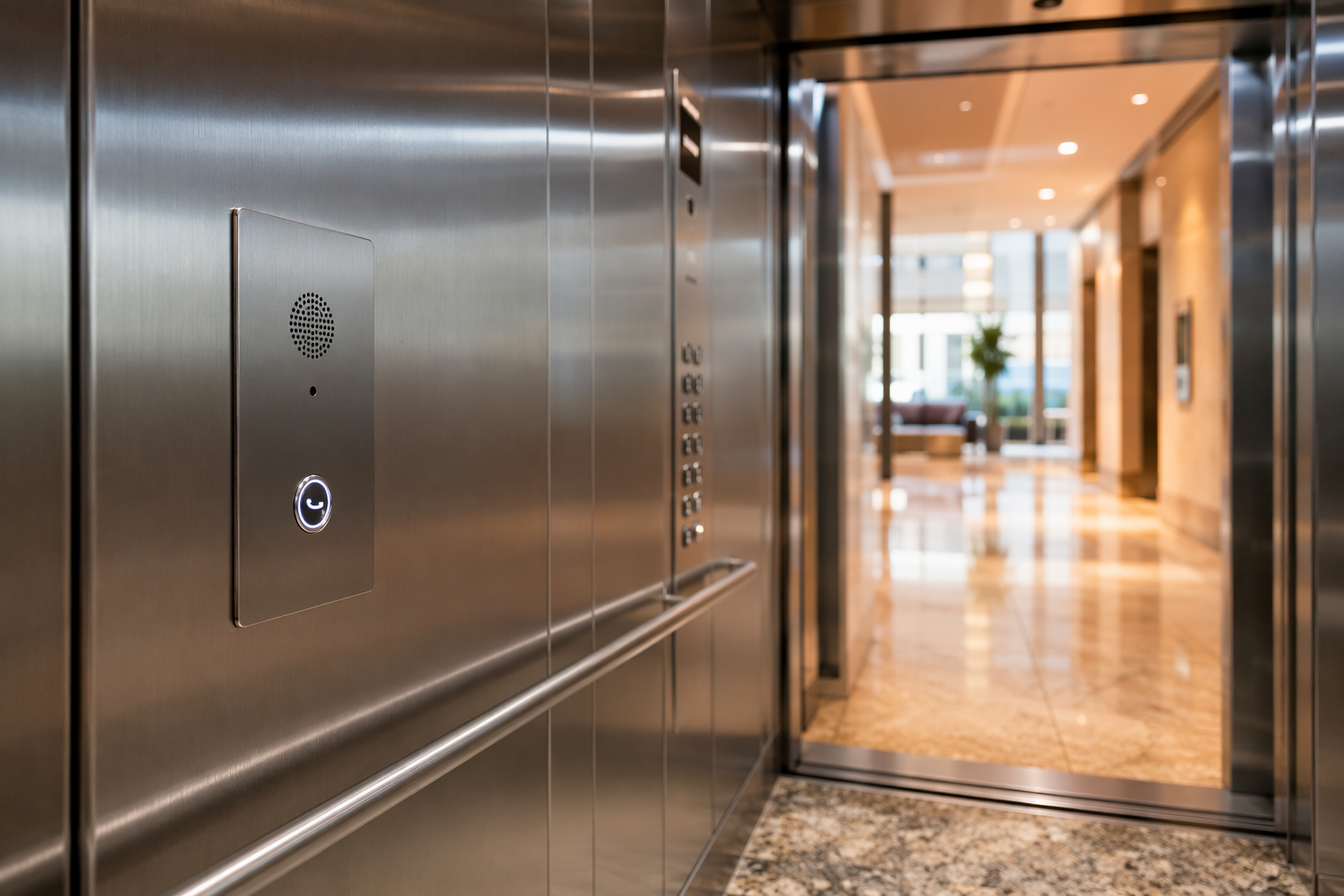
An elevator emergency phone is a two-way, hands-free communication device permanently installed inside an elevator cab that allows a trapped or distressed passenger to reach live emergency assistance without needing to dial or hold a handset.
The requirement originates from ASME A17.1-2022 Safety Code for Elevators and Escalators, Section 2.27.1.1, which mandates that every elevator provide a means of two-way communication between the elevator and a location staffed 24 hours a day, 7 days a week. The ADA further requires that the device be operable without grasping, pinching, or twisting the wrist, making hands-free operation a legal necessity for ADA compliance. In Arizona, the Elevator Safety Act (ARS §23-491 et seq.) enforces these standards through the Industrial Commission of Arizona (ICA).
What Number Does an Elevator Emergency Phone Actually Call?

An elevator emergency phone does not dial 911 by default — it calls a pre-programmed number that connects to either a 24/7 third-party monitoring center, the building’s front desk, or a designated property management line staffed around the clock.
This distinction surprises most building owners. In 2026, the majority of compliant elevator emergency phones are programmed to reach a central monitoring station that can dispatch local emergency services when needed. Some older installations are still wired to call a single phone number — often a maintenance office that goes unmanned after 5 PM — which is a direct ASME A17.1 violation. The “24/7 staffed location” requirement means that if your building’s front desk closes at night, that number cannot be the sole emergency contact. Arizona Elevator Solutions audits these programming configurations during every preventive maintenance visit across Phoenix, Scottsdale, Mesa, and Tucson.
What Are the ASME A17.1 Requirements for Elevator Emergency Phones in 2026?
ASME A17.1-2022 (the edition currently adopted in Arizona as of 2026) requires that elevator emergency communication systems provide hands-free, two-way voice communication, automatically identify the elevator’s location to the answering party, and connect within 60 seconds of activation.
Key code provisions building owners must know include:
- Section 2.27.1.1: Two-way communication required; must connect to a 24/7 staffed location.
- Section 2.27.1.2: The system must automatically identify the building address and elevator number to the receiving party without passenger input.
- Section 2.27.1.4: Phones must function on backup power (battery or generator) for a minimum of one hour during a power outage.
- ADA Standards for Accessible Design, Section 407.4.9: Controls and devices within the elevator must be operable with a closed fist.
Buildings constructed before 1993 that have not undergone modernization may be operating under older code editions — but any modification to the elevator triggers a requirement to bring emergency communication up to current ASME standards.
What Are the ADA Requirements for Elevator Emergency Phones?
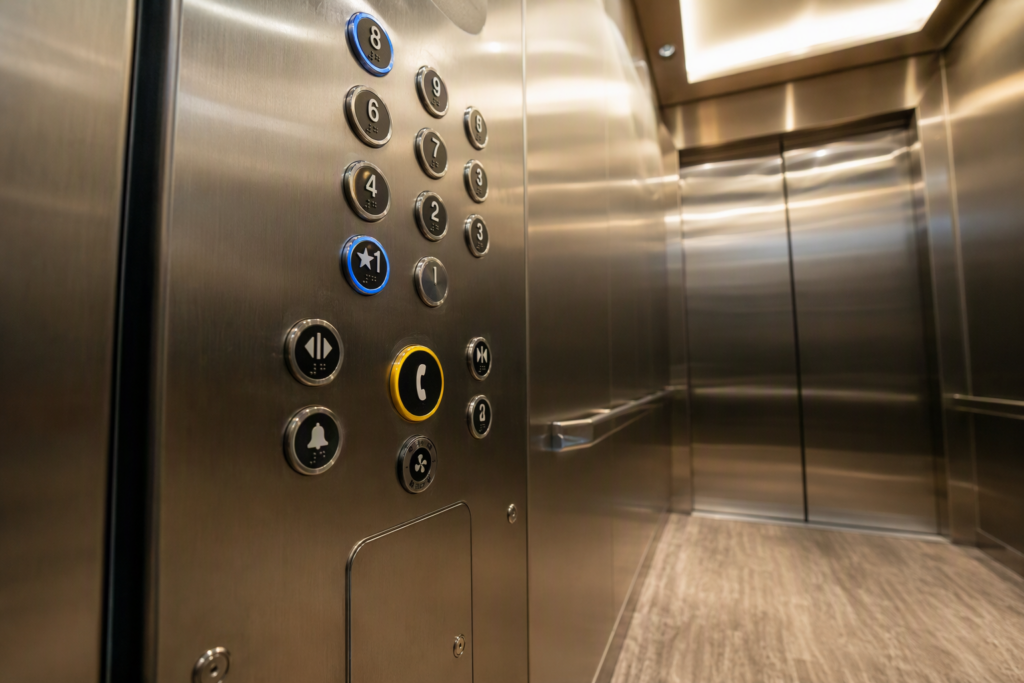
The ADA requires that elevator emergency communication devices be hands-free, require no pinching or grasping to operate, and include visible signals (such as a flashing light or illuminated button) so deaf or hard-of-hearing passengers know their call has been connected.
Specifically, ADA Standards for Accessible Design Section 407.4.9.1 mandates that the emergency communication system be equipped with a visual notification — typically a light on the call button or a separate LED indicator — to confirm the call has been received. This is often overlooked during elevator modernizations. In 2026, the Department of Justice continues to cite elevator communication deficiencies as one of the top 10 ADA violations in commercial buildings. Non-compliance can expose building owners to federal lawsuits with statutory damages up to $75,000 for a first violation and $150,000 for subsequent violations.
How Much Does It Cost to Install or Upgrade an Elevator Emergency Phone?
Installing or upgrading an elevator emergency phone system in Arizona typically costs between $800 and $3,500 per elevator, depending on whether the building requires new wiring, a cellular-based unit, or a VoIP-compatible system.
| System Type | Typical Install Cost (Per Elevator) | Monthly Monitoring Fee | Best For | ASME A17.1 Compliant |
|---|---|---|---|---|
| POTS (Plain Old Telephone Line) | $800 – $1,200 | $30 – $60 | Older buildings with existing phone lines | Yes (if 24/7 staffed) |
| Cellular (4G/LTE) Emergency Phone | $1,200 – $2,200 | $40 – $80 | Buildings without landline infrastructure | Yes |
| VoIP Emergency Phone | $1,500 – $2,500 | $25 – $55 | Modern buildings with IP infrastructure | Yes (requires battery backup) |
| Integrated Monitoring System (Multi-elevator) | $2,500 – $3,500 per cab | $60 – $120/month (all cabs) | Large commercial buildings, hospitals, HOAs | Yes |
| Emergency Phone Inspection/Reprogramming Only | $150 – $400 | N/A | Existing systems needing compliance update | Conditional |
Note: POTS lines are being phased out by major telecom carriers across Arizona. If your elevator still uses a traditional phone line, we strongly recommend transitioning to a cellular or VoIP system before your carrier decommissions the line — a process accelerating rapidly in the Phoenix metro area through 2026.
What Happens During an Elevator Emergency in Arizona — Step by Step?
When an elevator emergency phone is activated in Arizona, the call routes to a 24/7 monitoring center, which identifies the building, confirms the situation, and dispatches either building staff, an elevator technician, or emergency services within minutes.
The sequence, as experienced by a trapped passenger, should look like this:
- Passenger presses the emergency call button (typically marked with a bell or phone icon).
- The system automatically dials the pre-programmed monitoring center number.
- Within 60 seconds (ASME A17.1 requirement), a live operator answers.
- The operator receives automatic caller ID displaying the building address and specific elevator number.
- Operator confirms the passenger’s condition and either contacts building management or dispatches emergency services.
- In Arizona, Phoenix Fire Department and Tucson Fire Department both have protocols for elevator entrapments, typically responding within 8–15 minutes in urban areas.
- A licensed elevator technician is contacted for mechanical release and system evaluation after rescue.
What Is the Difference Between a POTS, Cellular, and VoIP Elevator Emergency Phone?
POTS (Plain Old Telephone System) uses traditional copper landlines; cellular elevator phones use 4G/LTE wireless networks; and VoIP systems transmit voice over internet — each has different reliability profiles, costs, and compliance considerations for Arizona buildings.
POTS lines are the traditional standard but are actively being discontinued by AT&T and other carriers, leaving many Arizona buildings with silent emergency phones that appear functional but are disconnected. Cellular systems are now the most widely recommended upgrade path because they require no landline infrastructure and work throughout the Phoenix and Tucson metro areas with strong 4G coverage. VoIP systems are cost-effective in modern commercial buildings but require battery backup power supplies to remain ASME-compliant during outages — a detail that catches many building engineers off guard during state inspections.
How Often Should Elevator Emergency Phones Be Tested?
Elevator emergency phones must be tested monthly by building staff and annually by a licensed elevator inspector under Arizona Industrial Commission requirements and ASME A17.1 Section 8.6.
Monthly testing by building staff should include pressing the call button and confirming a live answer within 60 seconds, verifying audio clarity in both directions, and logging the test with date, time, and name of the person conducting the test. Annual inspections by a licensed inspector — required to maintain Arizona elevator operating permits — include a more rigorous test of battery backup duration, auto-identification functionality, and compliance with current ADA and ASME standards. Arizona Elevator Solutions provides documented monthly testing checklists to all full-service maintenance clients in Phoenix, Scottsdale, Mesa, and Tucson.
What Happens If My Elevator Emergency Phone Fails Inspection in Arizona?
If an elevator’s emergency phone fails the Arizona Industrial Commission inspection, the elevator will receive a correction order requiring the deficiency to be remedied within a specified timeframe — and continued operation with a failed emergency phone can result in the elevator being red-tagged and taken out of service.
In Arizona, the ICA has authority under ARS §23-491.10 to issue stop-use orders for elevators that present a safety hazard. A non-functional emergency phone qualifies. The typical correction timeline for a phone deficiency is 30 days, but inspectors may grant extensions for parts delays if documented. Buildings that knowingly operate elevators with failed emergency communication systems face civil penalties. After any failed inspection, Arizona Elevator Solutions recommends same-day or next-day emergency repair scheduling to avoid both liability exposure and the reputational impact of an out-of-service elevator in high-traffic buildings.
Does My Arizona Elevator Need a Separate Emergency Phone in the Machine Room?
ASME A17.1 Section 2.7.3 requires a telephone or other two-way communication means in the elevator machine room, but this is a separate requirement from the in-cab emergency phone and serves a different safety purpose.
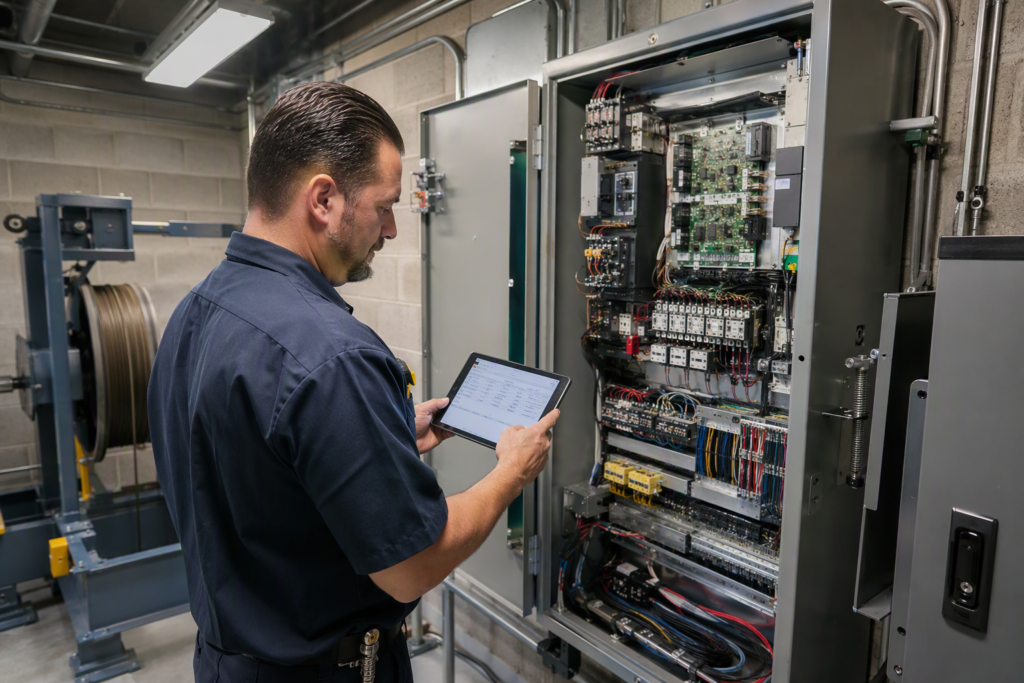
The machine room phone allows elevator technicians trapped or injured in the mechanical space to summon help. It does not need to meet the same 24/7 monitoring requirement as the passenger cab phone, but it must be functional. In Arizona’s extreme heat — where machine rooms in Phoenix and Mesa can reach temperatures exceeding 120°F in summer — the reliability of both the phone and its wiring insulation should be inspected annually. Heat degradation of phone line insulation is a genuine failure mode we see regularly in desert climates.
Can an Elevator Emergency Phone Use a Cell Phone or Text Instead of a Landline?
Dedicated cellular elevator emergency phones are fully ASME A17.1-compliant alternatives to landline systems, but consumer cell phones or text-based-only systems do not meet code requirements because they cannot guarantee hands-free operation, auto-identification, or 60-second connection times.
Some building managers have attempted to repurpose mobile phones or intercom apps as emergency communication tools — these are not code-compliant solutions. A proper cellular elevator emergency phone is a purpose-built, FCC-certified device that auto-dials on button press, transmits building and cab identification data automatically, and operates on a dedicated cellular SIM with priority service agreements. Brands like Kone EcoPhone, Pixel Technologies’ Pixel One, and Stannah’s emergency communication modules are examples of compliant cellular systems installed by Arizona Elevator Solutions throughout the Phoenix metro.
What Should Building Owners in Phoenix and Tucson Know About POTS Line Sunset Deadlines?
Major telecom carriers including AT&T began formally decommissioning copper POTS infrastructure in Arizona markets in 2024–2025, meaning any elevator still relying on a traditional phone line for emergency communication is at immediate risk of silent failure.
The FCC’s 2019 ruling (FCC 19-72) cleared the way for carriers to retire copper networks with appropriate notice, and by 2026, a significant portion of Phoenix and Tucson commercial districts have already lost POTS service or are within 12 months of cutover. A silent elevator emergency phone — one that looks operational but connects to a disconnected line — is arguably more dangerous than a visibly broken one because passengers believe help is coming when no call ever reaches anyone. Arizona Elevator Solutions has conducted emergency phone audits on over 200 elevators in the Phoenix metro since 2024, and POTS disconnection is now the leading cause of emergency phone failures we encounter.
How Long Does It Take to Install a New Elevator Emergency Phone?
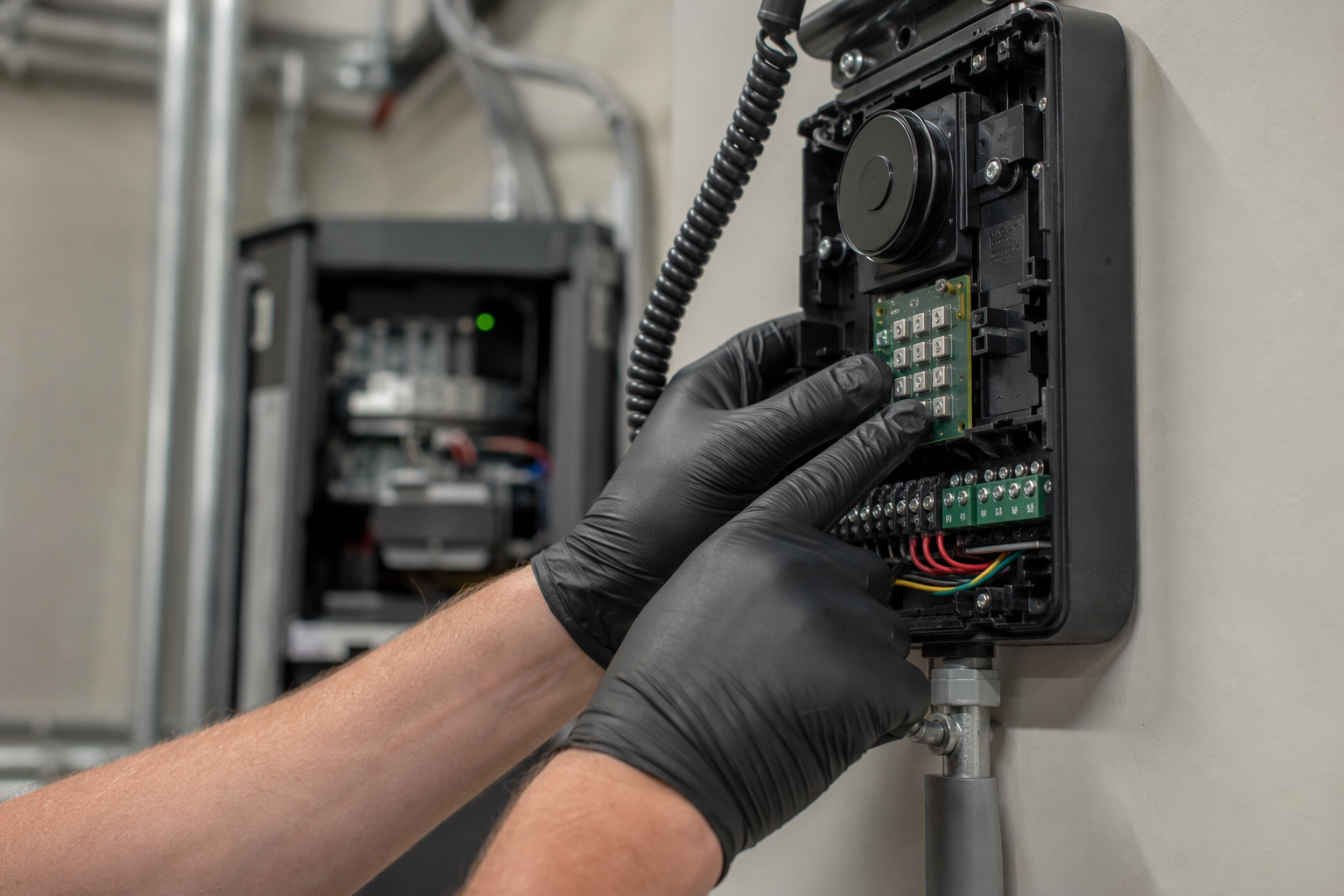
Installing a cellular elevator emergency phone typically takes 2–4 hours per elevator for a straightforward replacement, or 4–8 hours if new wiring or conduit is required, and most buildings can have a compliant system operational the same day as installation.
The fastest path is a direct swap of an existing non-compliant or failed phone unit with a cellular drop-in replacement that uses existing wiring. More complex installations — such as those requiring new conduit runs in older buildings or integration with multi-cab monitoring systems — take longer and may require a brief elevator downtime of 3–6 hours. Arizona Elevator Solutions schedules most emergency phone upgrades during low-traffic hours (early morning or evening) to minimize disruption to building occupants in commercial properties throughout Scottsdale, Mesa, Phoenix, and Tucson.
What Information Should an Elevator Emergency Phone Automatically Transmit?
Per ASME A17.1-2022 Section 2.27.1.2, an elevator emergency phone must automatically transmit the building’s street address and the specific elevator identification number to the monitoring center without any action required from the passenger.
This auto-ID requirement was strengthened in the 2016 and 2019 editions of ASME A17.1 specifically because emergency responders were losing critical time trying to identify which building and which elevator cab required rescue. The monitoring center operator must see this information on their screen the moment the call connects — before they even speak. Older systems that simply ring through without transmitting location data are now non-compliant, even if they provide live audio. During any elevator modernization or maintenance contract renewal, verify that your system’s auto-ID feature is active and accurate.
Are Elevator Emergency Phones Required in Residential Elevators and Home Lifts?
Residential elevators in private single-family homes are generally exempt from ASME A17.1 emergency phone requirements, but elevators in multi-family residential buildings (apartments, condominiums) serving three or more units are subject to the same commercial elevator emergency communication standards.
In Arizona, the ICA regulates elevators in buildings that are publicly accessible or serve multiple dwelling units. A condominium tower in Scottsdale or an apartment complex in Mesa with an elevator is subject to the same emergency phone requirements as an office building. HOA-managed buildings are a frequent area of confusion — and non-compliance — because HOA boards often assume that residential classification exempts them from commercial elevator codes. It does not if the elevator serves common areas accessible to multiple units or the general public. Arizona Elevator Solutions works with numerous HOA properties across the Phoenix metro to bring their elevator emergency communication systems into compliance.
What Is the Penalty for Not Having a Compliant Elevator Emergency Phone in Arizona?
Under ARS §23-491.10, Arizona building owners can face civil penalties of up to $1,000 per day per violation for operating an elevator with a deficient emergency communication system, and the elevator may be ordered out of service until compliance is achieved.
Beyond the statutory penalty, the liability exposure from a personal injury claim involving a passenger trapped in an elevator without working emergency communication is substantial. Arizona courts have consistently held building owners to a high standard of care for elevator safety under premises liability doctrine. In documented cases from 2022–2025, jury awards for elevator entrapment injuries have ranged from $85,000 to over $1.2 million, with non-functional emergency phones cited as a significant factor in negligence findings. The cost of compliance — $800 to $3,500 per elevator — is a fraction of this exposure.
How Do I Choose the Right Elevator Emergency Phone Monitoring Service?
Choose an elevator emergency phone monitoring provider that offers UL-Listed central station monitoring, guaranteed 60-second answer times, automatic caller ID and cab identification, 24/7/365 live operators (not automated systems), and a written service level agreement with documented response protocols.
Key questions to ask any monitoring provider:
- Is your monitoring center UL 827-listed?
- What is your guaranteed maximum answer time, and what happens if it is exceeded?
- Do you have redundant monitoring centers in case of regional outages?
- Can you provide monthly test call logs for our compliance records?
- What is your protocol for escalating to 911 versus building management?
Monitoring fees in Arizona range from $25 to $120 per month depending on the number of elevators and service tier. Arizona Elevator Solutions partners with UL-Listed monitoring providers and can bundle monitoring coordination with standard preventive maintenance contracts for property managers overseeing multiple elevators.
What Are Common Elevator Emergency Phone Problems Found During Arizona Inspections?
The five most common elevator emergency phone deficiencies found during Arizona ICA inspections are: disconnected POTS lines, programming errors sending calls to unstaffed locations, failed battery backup systems, missing auto-identification data, and non-ADA-compliant device controls.
From my experience conducting inspections and maintenance across Phoenix, Scottsdale, Mesa, and Tucson, the single most common failure is also the most invisible: a phone line that was disconnected by the telecom carrier without the building owner’s knowledge. The button still lights up, the speaker still clicks, but no call goes through. Behind that, battery backup failure is rampant in Arizona’s heat — batteries rated for 5-year service life often fail in 2–3 years in desert conditions. Arizona Elevator Solutions recommends battery replacement on a 24-month cycle for emergency phone systems in buildings without climate-controlled machine rooms.
Does Elevator Emergency Phone Compliance Affect My Building’s Insurance in Arizona?
Yes — most commercial property and general liability insurers in Arizona require documented elevator compliance, including emergency phone functionality, as a condition of coverage, and a failed emergency phone can be grounds for claim denial following an elevator-related incident.
In 2026, commercial insurers including those underwriting large property portfolios in the Phoenix and Tucson markets are increasingly requesting copies of ICA inspection certificates and maintenance logs as part of annual policy renewals. A lapse in emergency phone compliance — even one not yet cited by the ICA — may be used to argue contributory negligence in a claim. Building owners should treat elevator emergency phone compliance as a risk management issue, not merely a regulatory checkbox. Maintaining a current maintenance contract with documented monthly test records is the strongest defense in any premises liability case involving an elevator entrapment.
How Do I Get My Elevator Emergency Phone Tested and Certified in Phoenix, Scottsdale, Mesa, or Tucson?
Contact a licensed elevator service company to perform a full emergency phone compliance audit, which should include a live call test to the monitoring center, battery backup duration test, auto-ID verification, ADA control check, and issuance of a written compliance report suitable for ICA inspection records.
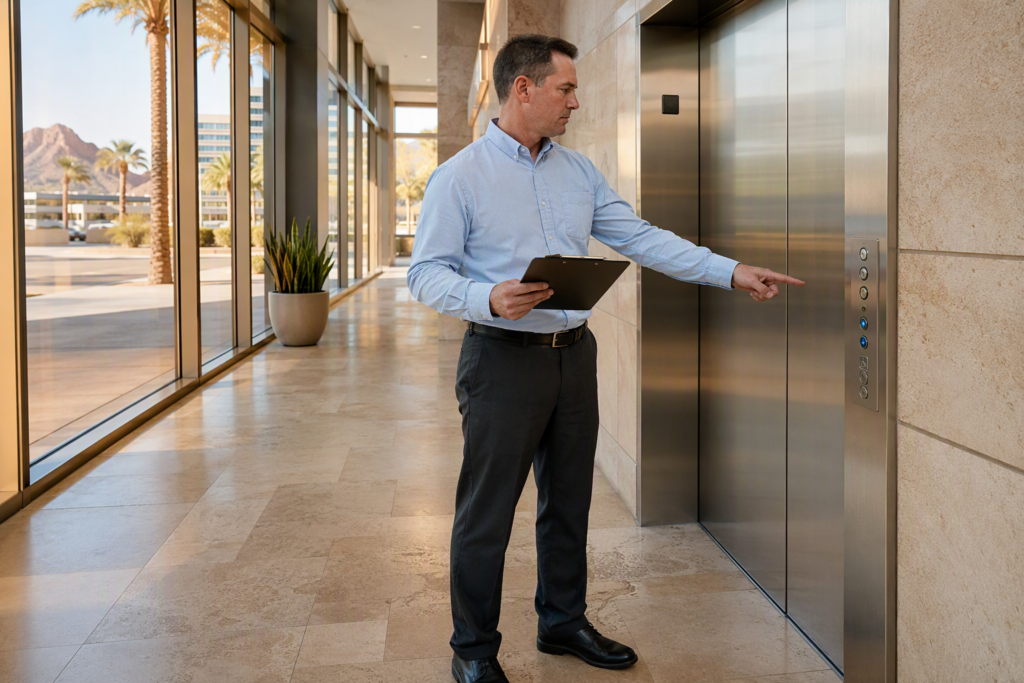
Arizona Elevator Solutions performs emergency phone compliance audits as a standalone service or as part of our comprehensive elevator inspection packages throughout Phoenix, Scottsdale, Mesa, and Tucson. A typical audit takes 45–90 minutes per elevator and includes a written report documenting pass/fail status for each ASME A17.1 and ADA requirement, with specific remediation recommendations and cost estimates for any deficiencies found. We coordinate directly with the ICA on correction order timelines when needed. Emergency phone issues identified during our audits are typically resolved within 5–10 business days for standard replacements, and same-day for critical failures in high-traffic buildings.
Need elevator service you can rely on? Arizona Elevator Solutions is ready to help.