Who Should I Contact for Elevator Maintenance & How Much Does It Cost?
Whether you manage a high-rise in Phoenix, a medical office in Scottsdale, or a mid-rise residential building in Tucson, elevator maintenance is a legal requirement and a safety imperative. After 15 years in the field, I’ve seen firsthand what happens when building owners cut corners on service contracts — unexpected breakdowns, failed inspections, liability exposure, and costly emergency repairs. This comprehensive guide answers every question you should be asking before you sign a maintenance agreement or pick up the phone.
Who Should I Contact for Elevator Maintenance in Arizona?
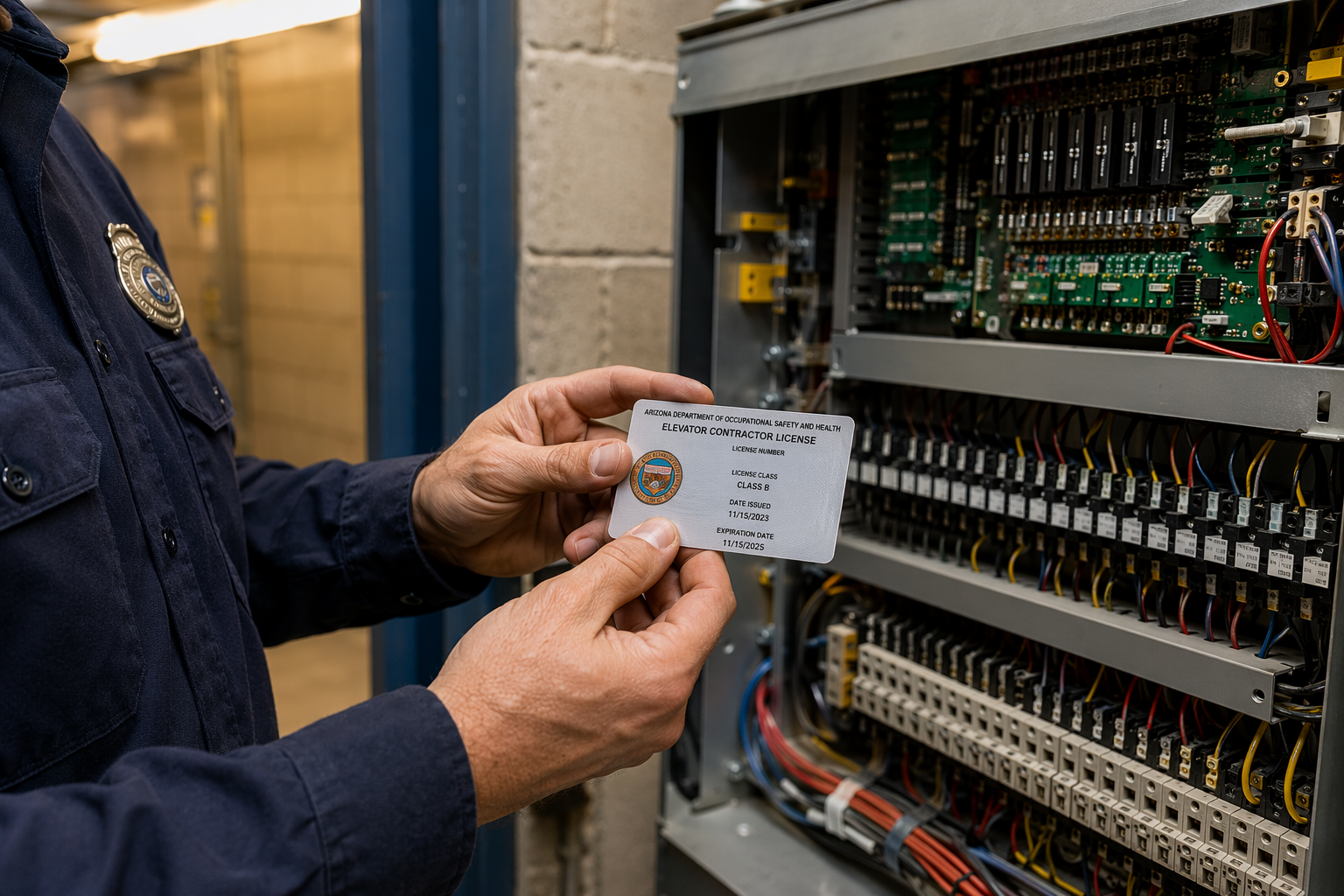
Contact a licensed elevator contractor certified under ASME A17.1 standards and registered with the Arizona Department of Occupational Safety and Health (ADOSH), which is the state authority governing elevator safety.
In Arizona, elevator mechanics must hold a valid state license issued through ADOSH. Any contractor performing maintenance, repairs, or inspections on elevators must be able to produce documentation of licensure upon request. Never hire an unlicensed handyman or general contractor for elevator work — this creates serious legal liability and voids most manufacturer warranties.
When selecting a provider, look for IUEC (International Union of Elevator Constructors) certified technicians, a local physical presence in your service area, a documented safety record, and familiarity with Arizona’s specific regulatory environment. Arizona Elevator Solutions employs IUEC-certified technicians serving Phoenix, Tucson, Scottsdale, and Mesa — all fully licensed and ADOSH-compliant.
How Much Does Elevator Maintenance Cost Per Year in Arizona?
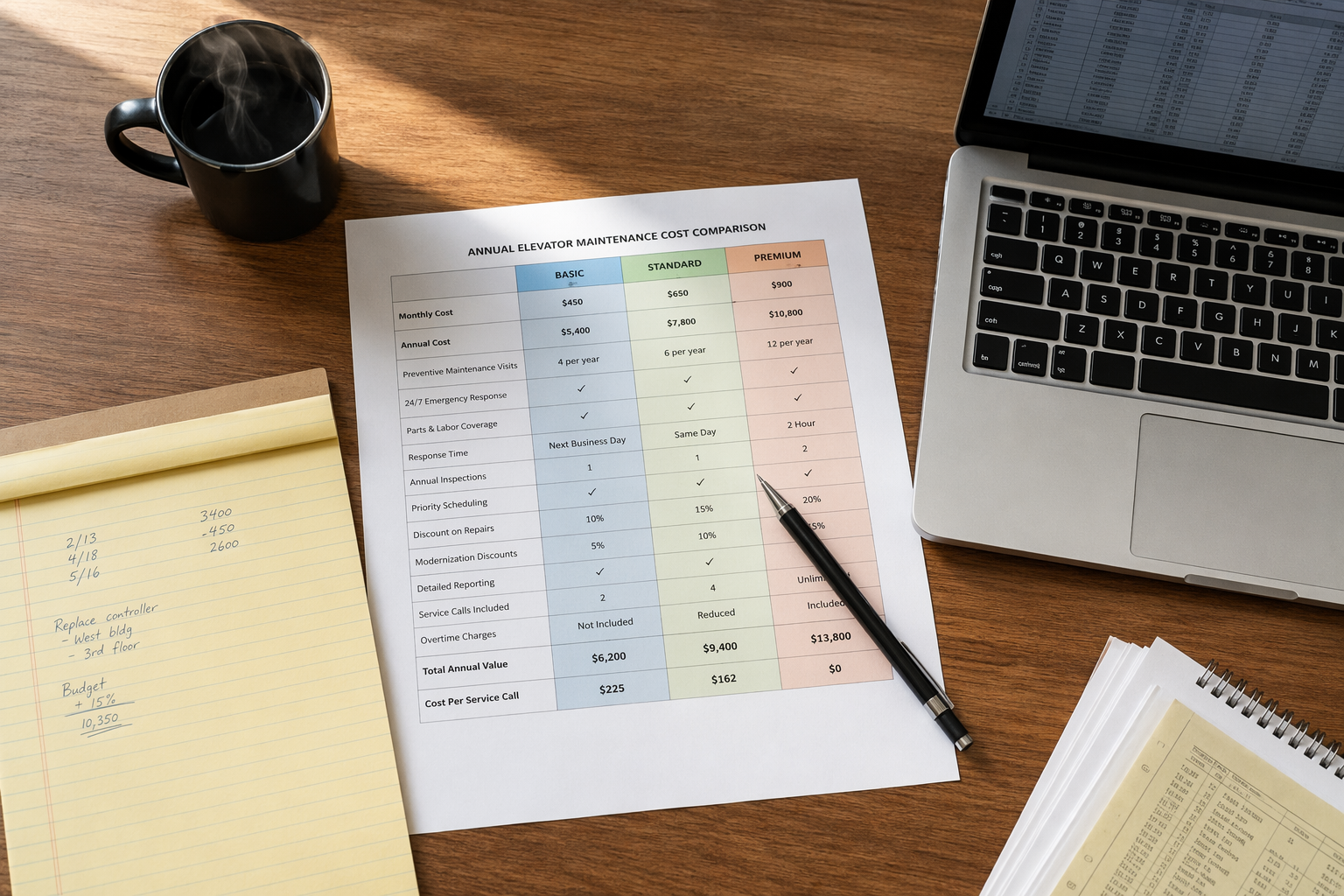
Annual elevator maintenance contracts in Arizona typically range from $3,000 to $12,000 per elevator, depending on elevator type, age, traffic volume, and the scope of services included.
Here is a breakdown of typical annual maintenance costs by elevator type and service tier in the Phoenix metro and surrounding Arizona markets as of 2026:
| Elevator Type | Basic Contract (Lubrication & Inspection Only) | Full-Service Contract (Parts & Labor Included) | Premium Contract (24/7 Emergency + Parts) |
|---|---|---|---|
| Hydraulic (Commercial) | $3,000 – $4,500/yr | $5,000 – $7,500/yr | $8,000 – $10,000/yr |
| Traction (Low-Rise, 2–5 floors) | $3,500 – $5,000/yr | $5,500 – $8,000/yr | $8,500 – $11,000/yr |
| Traction (High-Rise, 6+ floors) | $5,000 – $7,000/yr | $8,000 – $10,500/yr | $10,000 – $14,000/yr |
| MRL (Machine Room-Less) | $4,000 – $5,500/yr | $6,000 – $8,500/yr | $8,500 – $12,000/yr |
| Residential (Home Lift) | $800 – $1,500/yr | $1,500 – $2,800/yr | $2,500 – $4,000/yr |
| Dumbwaiter / Service Lift | $600 – $1,200/yr | $1,200 – $2,200/yr | $2,000 – $3,500/yr |
These figures reflect 2026 market rates in the greater Phoenix, Scottsdale, Mesa, and Tucson areas. High-traffic installations (hospitals, hotels, transit hubs) and older equipment manufactured before 2000 typically fall at the higher end of these ranges due to increased parts wear and longer technician time requirements.
What Is Included in a Standard Elevator Maintenance Contract?
A standard elevator maintenance contract should include scheduled lubrication, safety device testing, ASME A17.1 code compliance checks, door operation adjustments, and emergency callback service — but the specific inclusions vary widely between providers.
The most critical distinction between contract tiers is whether parts and labor are included. “Oil and grease” contracts (basic tier) only cover technician visits for routine lubrication and visual inspection. If a component fails, you pay separately for parts and repair labor, which can add thousands of dollars unexpectedly.
Full-service and premium contracts bundle most or all parts and labor into the monthly fee, providing more predictable budgeting. For commercial building managers in Phoenix and Scottsdale, full-service contracts almost always deliver better long-term value. Always ask specifically: Does the contract cover motor replacement? Controller boards? Door operator components? These are the high-ticket items where disputes most frequently arise.
How Often Should Elevator Maintenance Be Performed?
Commercial elevators should receive professional maintenance visits at minimum every 30 days under ASME A17.1 guidelines, though high-traffic installations may require bi-weekly or even weekly service.
Monthly maintenance is the industry baseline for commercial traction and hydraulic elevators. During each visit, a certified technician should lubricate guide rails, inspect safety devices, test door timers, check hydraulic fluid levels (for hydraulic units), and document any anomalies. Residential elevators and low-traffic installations may qualify for quarterly service schedules, but never less than four visits per year.
Arizona’s extreme heat — regularly exceeding 115°F in Phoenix, Mesa, and surrounding areas — places additional thermal stress on motor windings, hydraulic fluid viscosity, and electronic controllers. This desert-specific factor means Arizona elevators often benefit from more frequent service intervals than those in cooler climates, particularly during June through September.
What Are Arizona’s Legal Requirements for Elevator Inspections?
In Arizona, all public-use elevators must be inspected annually by a Qualified Elevator Inspector (QEI) certified under ASME QEI-1 standards, and certificates must be posted in the elevator cab at all times per ADOSH regulations.
The Arizona Division of Occupational Safety and Health (ADOSH) enforces elevator safety under Arizona Revised Statutes Title 23, Chapter 2. Annual inspections must be performed by a licensed inspector holding ASME QEI-1 certification. Following inspection, a Certificate of Inspection must be issued and visibly displayed in the elevator cab.
Failure to maintain a current inspection certificate can result in ADOSH shutdown orders, civil fines, and significant liability exposure if a passenger incident occurs. As of 2026, ADOSH maintains the authority to order immediate cessation of elevator operation for non-compliant units. Building owners in Phoenix, Tucson, Scottsdale, and Mesa should keep copies of all inspection certificates and maintenance logs on file for a minimum of five years.
What Is the Difference Between Elevator Maintenance and Elevator Repair?
Maintenance is scheduled, preventive work designed to keep an elevator running safely and avoid failures, while repair is reactive work performed after a component has failed or a safety fault has been triggered.
Preventive maintenance visits follow a defined checklist and are scheduled in advance. Emergency repairs, by contrast, are unscheduled, often urgent, and frequently more expensive because they require immediate technician dispatch and expedited parts sourcing. The industry rule of thumb is that every $1 invested in preventive maintenance saves $3 to $5 in emergency repair costs over a five-year period.
Under a well-structured full-service contract, many repairs are absorbed into the contract cost — which is precisely why negotiating the right contract scope upfront matters enormously. Arizona Elevator Solutions structures its service agreements to clearly define what constitutes covered maintenance versus billable repair work, so clients in Phoenix, Tucson, and Mesa face no surprise invoices.
What Factors Cause Elevator Maintenance Costs to Increase?
Elevator age, usage volume, equipment brand, parts availability, Arizona’s extreme heat environment, and the distance of your facility from a service hub are the primary factors that drive maintenance costs above baseline.
Elevators manufactured before 1990 present particular cost challenges because proprietary controller systems may require custom-fabricated or hard-to-source parts. High-traffic installations — retail centers, hospitals, hotels — experience accelerated wear on door operators, rollers, and brake components. Buildings in remote areas outside Phoenix or Tucson may also see travel surcharge costs for service dispatch.
Arizona’s desert climate adds a uniquely local cost driver: hydraulic oil in Phoenix can reach temperatures that degrade viscosity, accelerating pump wear. Controller electronics in non-climate-controlled machine rooms can experience premature failure from thermal cycling. Technicians experienced with Arizona conditions, like the team at Arizona Elevator Solutions, build these local variables into their maintenance protocols rather than applying a one-size-fits-all national template.
Does Elevator Maintenance Need to Comply with ADA Standards?
Yes — elevators in buildings subject to the Americans with Disabilities Act (ADA) must be maintained in operational condition at all times, and any accessibility features (Braille buttons, audio signals, door timing) must meet ADA Section 4.10 standards.
ADA Title III requires that elevator accessibility features remain functional. This includes: tactile Braille floor indicators on buttons, audible floor signals, minimum door opening widths of 36 inches, door reopening devices sensitive to obstruction, and cab interior dimensions accommodating wheelchair users. Maintenance records should specifically confirm these features are tested and functional at each visit.
When an elevator’s accessibility feature fails — even temporarily — the building owner bears liability for ADA non-compliance. Routine maintenance visits should include documented ADA feature verification. If your current maintenance provider does not explicitly test and log ADA compliance items, that is a significant contract deficiency worth addressing immediately.
What Should I Look for When Comparing Elevator Maintenance Companies?
Evaluate licensure status, IUEC technician certification, contract transparency (parts coverage definitions), emergency response time guarantees, local presence, and verifiable references from comparable properties in your area.
The elevator service industry includes a wide range of providers — from large national OEM-affiliated companies to independent local contractors. National companies often offer brand recognition but may use non-union or less experienced technicians for smaller accounts. Independent contractors may offer lower prices but lack 24/7 dispatch infrastructure.
Key questions to ask any prospective provider: What is your guaranteed emergency response time? Are your technicians IUEC-certified? What specifically does your contract exclude? Do you carry $1M+ general liability insurance and workers’ compensation? Can you provide three references from similar property types in Phoenix, Scottsdale, Mesa, or Tucson? Require written answers to all of these before signing any agreement.
What Is the ASME A17.1 Code and Why Does It Matter for Maintenance?
ASME A17.1, the Safety Code for Elevators and Escalators, is the foundational engineering standard that defines every technical requirement for elevator construction, maintenance, testing, and inspection in the United States and Canada.
Published by the American Society of Mechanical Engineers, ASME A17.1 is updated on a three-year cycle — the most current edition in use across Arizona as of 2026 is the 2022 edition. State authorities like ADOSH formally adopt specific editions, so the applicable version varies by jurisdiction within Arizona. Every certified elevator technician is required to perform maintenance in compliance with the edition adopted by the authority having jurisdiction (AHJ) for the installation’s location.
From a building owner’s perspective, ASME A17.1 compliance means your maintenance provider must document specific tests — governor rope testing, safety device tests, pressure relief valve tests for hydraulic units, and more — on defined intervals. Non-compliant maintenance is not just a technical deficiency; it creates direct legal exposure if a passenger injury occurs and documentation cannot demonstrate code-compliant service history.
How Much Does Emergency Elevator Repair Cost in Arizona?
Emergency elevator repair calls in Arizona typically range from $500 to $5,000+ per incident, with after-hours labor rates running 1.5x to 2.5x standard hourly rates and major component replacements (motors, controllers, pumps) adding $3,000 to $25,000 or more.
Standard technician labor rates in the Phoenix and Tucson markets run approximately $95 to $175 per hour during business hours (2026 rates). After-hours emergency dispatch typically triggers a minimum charge of $350 to $600 just for the call, plus hourly labor and parts. A hydraulic pump replacement can run $6,000 to $12,000 in parts and labor. A traction motor replacement commonly reaches $15,000 to $25,000 including controller interface work.
These figures underscore why a well-scoped full-service maintenance contract is almost always the more economical long-term strategy for commercial property managers. One major emergency repair event can easily exceed the annual cost of upgrading from a basic to a full-service maintenance tier.
How Do I Know If My Elevator Needs Modernization Instead of Maintenance?
If your elevator is more than 20 years old, requires repeated emergency repairs, uses obsolete relay-logic controllers, or cannot be brought into ASME A17.1 or ADA compliance through standard maintenance, modernization is likely more cost-effective than continued service contracts.
Elevator modernization typically involves replacing the controller, drive system, fixtures, and cab finishes while retaining the hoistway structure. Partial modernization costs in Arizona range from $40,000 to $100,000+ per elevator depending on scope. Full gut-and-replace projects start around $80,000 and can exceed $200,000 for complex installations.
The break-even analysis is straightforward: if your current maintenance and emergency repair costs on an aging elevator exceed $8,000 to $12,000 annually, and the unit requires repeated callbacks and inspection deferrals, a modernization investment will typically pay for itself in reliability, energy savings, and reduced service costs within seven to ten years. A reputable service provider should be willing to give you an honest assessment rather than simply continuing to collect service contract fees on a unit approaching end-of-life.
What Happens During an Annual Elevator Inspection in Arizona?
During an annual Arizona ADOSH inspection, a QEI-certified inspector tests all safety devices, verifies code compliance with the applicable ASME A17.1 edition, checks emergency communication systems, reviews maintenance records, and issues either a Certificate of Inspection or a notice of required corrections.
The inspection process typically takes two to four hours for a standard commercial elevator. The inspector will test the governor and safeties, verify buffer performance, test the emergency lighting and communication system, check door reopening devices, verify fire service operation, examine the machine room, and review the maintenance logbook. Inspectors frequently identify maintenance deficiencies that were not caught during routine service — this is another reason why thorough preventive maintenance documentation is critical.
If violations are found, the inspector issues a Correction Order with a compliance deadline. Failure to correct violations by the deadline can result in ADOSH ordering the elevator out of service. In Arizona’s competitive commercial real estate markets — especially Phoenix and Scottsdale — an out-of-service elevator can immediately impact tenant satisfaction and lease renewals. Proactive maintenance dramatically reduces the likelihood of inspection-triggered shutdowns.
How Long Does Elevator Maintenance Typically Take Per Visit?
A standard monthly maintenance visit for a commercial elevator typically takes 2 to 4 hours, though older equipment, multi-car installations, or units due for periodic testing can require 4 to 8+ hours per service call.
Time per visit is a meaningful quality indicator: a technician rushing through a maintenance call in under 90 minutes is almost certainly not completing the full ASME A17.1 required checklist. Proper lubrication of all rail surfaces, comprehensive door timing adjustments, safety device testing, and machine room documentation simply cannot be done correctly in a short visit on a complex installation.
Ask prospective providers to share a sample maintenance checklist and the estimated hours per visit for your specific equipment. If the hours seem suspiciously low, that is a warning sign worth investigating before committing to a multi-year contract.
Are Elevator Maintenance Costs Tax-Deductible for Commercial Property Owners?
Yes — elevator maintenance costs for commercial properties are generally fully deductible as ordinary and necessary business expenses under IRS Section 162, while major modernization projects may qualify as capital improvements depreciable under IRS Section 179 or MACRS schedules.
Routine maintenance and service contract fees are typically expensed in the year incurred. However, major component replacements or modernization work that extends the useful life of the elevator may need to be capitalized rather than expensed, following IRS tangible property regulations. Arizona state tax treatment generally conforms to federal treatment for these expenses.
Always consult a qualified CPA or tax advisor for your specific situation, as the correct tax treatment depends on the nature and dollar value of the work performed. Maintaining detailed, itemized invoices from your elevator service provider is essential for accurate tax reporting and audit defense.
What Is the Difference Between a Proprietary and Non-Proprietary Maintenance Contract?
A proprietary maintenance contract locks you into the original equipment manufacturer (OEM) or their authorized dealer for all service and parts, while a non-proprietary contract allows any licensed contractor with the appropriate tools and access to service your elevator.
Some elevator manufacturers design their controllers with software that requires proprietary tools or access codes, effectively forcing building owners into manufacturer service agreements indefinitely. This practice — known as “locking” — is controversial in the industry and is increasingly being challenged by building owners and independent service organizations.
Before purchasing new elevator equipment, ask the manufacturer explicitly whether the controller software and diagnostic tools are accessible by independent licensed contractors. Non-proprietary systems give you the freedom to competitively bid your service contract at each renewal, which is typically the most cost-effective long-term strategy. When evaluating service options in the Phoenix and Tucson markets, Arizona Elevator Solutions can assess whether your existing equipment is proprietary-locked and advise on your options for service independence.
What Are Common Elevator Maintenance Mistakes That Lead to Costly Repairs?
The most costly maintenance mistakes include skipping monthly visits to reduce costs, using non-OEM-equivalent lubricants, ignoring door operator warning signs, deferring periodic safety tests, and failing to maintain adequate maintenance documentation.
In 15 years of field work, I’ve seen the same failure patterns repeat. Door operators account for approximately 70% of all elevator service calls — and most door-related failures could have been prevented with consistent monthly door timing adjustments and roller replacements during routine visits. Hydraulic fluid contamination, neglected in a basic-only contract, leads to valve body wear that costs $4,000 to $8,000 to correct versus a $200 fluid replacement.
Documentation failures are equally costly: when an ADOSH inspector asks for the maintenance log and it contains gaps, the building owner faces immediate compliance scrutiny regardless of the actual physical condition of the elevator. Every maintenance visit should generate a written service record signed by the technician, specifying every task performed, any anomalies noted, and any deferred repairs recommended.
How Do I Switch Elevator Maintenance Providers in Arizona?
To switch providers, review your current contract’s termination clause (typically requiring 30 to 90 days written notice), obtain your maintenance records and inspection certificates from the outgoing provider, secure an independent condition assessment, and execute a new agreement effective at contract expiration.
Switching providers is your legal right as a building owner, but it requires careful management. Some contracts include auto-renewal clauses that extend the agreement if termination notice is not provided within a specific window — often 60 to 90 days before the anniversary date. Missing this window can lock you in for another full contract year.
Request all maintenance records, inspection certificates, and equipment documentation from your outgoing provider before the transition. Some providers are slow to release records — another reason to maintain your own copies throughout the service relationship. A new provider should conduct a thorough condition assessment before assuming the service contract so that any pre-existing issues are documented and appropriately allocated between parties.
Does Building Size or Elevator Traffic Volume Affect Maintenance Pricing?
Yes — high-traffic elevators in commercial, healthcare, and hospitality settings require significantly more frequent parts replacement and technician time, which directly increases both contract pricing and out-of-contract repair frequency.
Industry benchmarks classify elevator usage by starts per day: low-traffic units operate under 100 starts per day; medium-traffic units see 100 to 500 starts daily; high-traffic installations exceed 500 starts per day. A hospital elevator in Phoenix running 800+ starts per day will wear through door rollers, selector tapes, and brake linings significantly faster than a low-rise office building elevator making 150 starts per day.
When requesting maintenance quotes, provide prospective contractors with your best estimate of daily usage. Misrepresenting usage volume — intentionally or unknowingly — can void warranty claims on parts replaced under a full-service contract if the contractor can demonstrate that actual usage exceeded the quoted parameters. Accurate usage data protects both parties and leads to correctly priced, appropriately scoped service agreements.
Why Should I Choose a Local Arizona Elevator Company Over a National Provider?
Local Arizona elevator companies offer faster emergency response times, technicians with specific knowledge of Arizona climate challenges, familiarity with ADOSH regulatory requirements, and greater accountability than national providers who may assign rotating technicians unfamiliar with your equipment.
National elevator companies operate on volume — their model depends on large portfolios managed by technicians covering broad geographic territories. Emergency response times from national providers in secondary markets like Tucson or Mesa can routinely exceed four to six hours, while a locally-based team can typically respond in under two hours. For a hospital, hotel, or multi-tenant office building, that difference is operationally and legally significant.
Arizona Elevator Solutions was built specifically to serve the Phoenix, Scottsdale, Mesa, and Tucson markets with dedicated local technicians who know Arizona’s regulatory environment, understand the thermal challenges of desert elevator operation, and have established relationships with local ADOSH inspectors. When your elevator needs attention, you reach a team that is already in your market — not a national dispatch center routing calls through a queue.
Need elevator service you can rely on? Arizona Elevator Solutions is ready to help.