Elevator Breakdown Immediate Response: Complete FAQ Guide for Arizona Building Owners
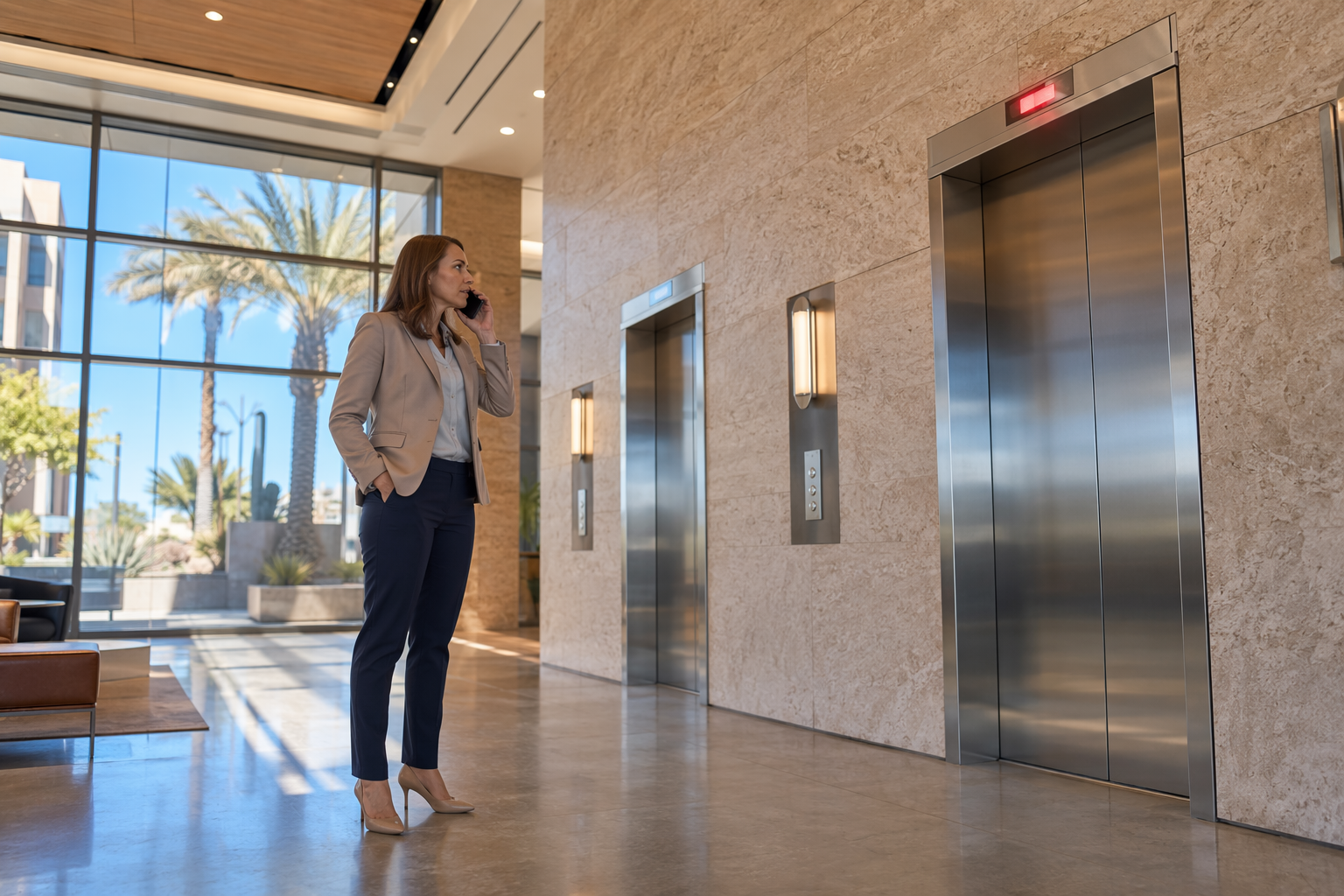
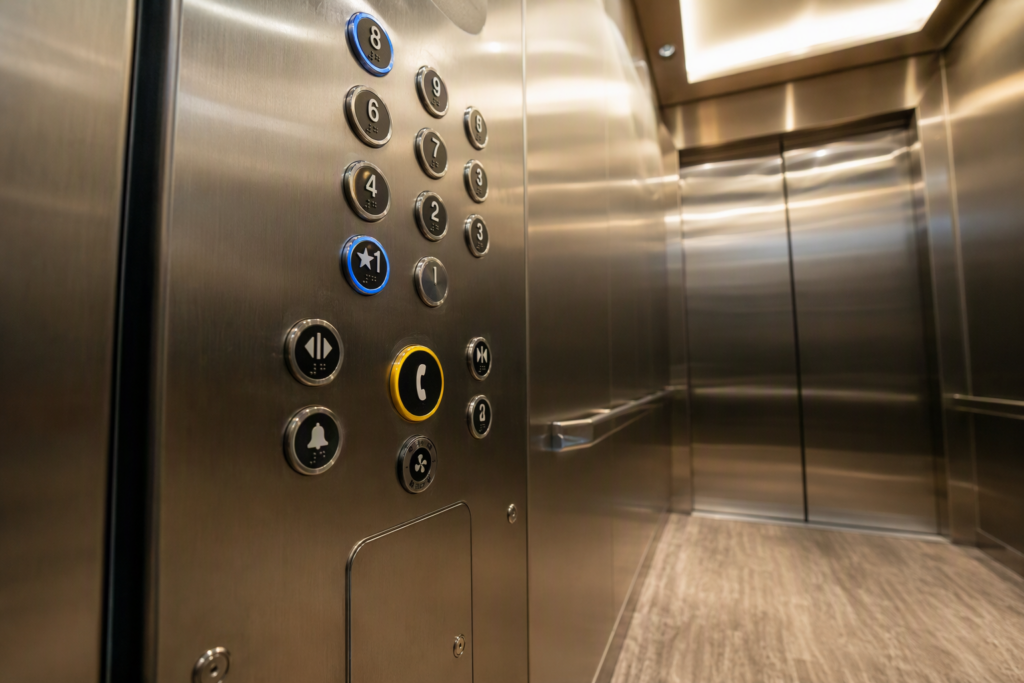
An elevator breakdown can happen without warning — and in the Arizona heat, a stalled cab with trapped passengers can escalate into a medical emergency within minutes. Whether you manage a commercial high-rise in Phoenix, a healthcare facility in Tucson, a luxury resort in Scottsdale, or a multi-family complex in Mesa, knowing exactly what to do in the first 60 seconds of an elevator failure is the difference between a minor inconvenience and a serious liability incident. This guide answers the 20 most critical questions building owners, property managers, and facilities teams ask after an elevator goes down.
What should you do immediately when an elevator breaks down?
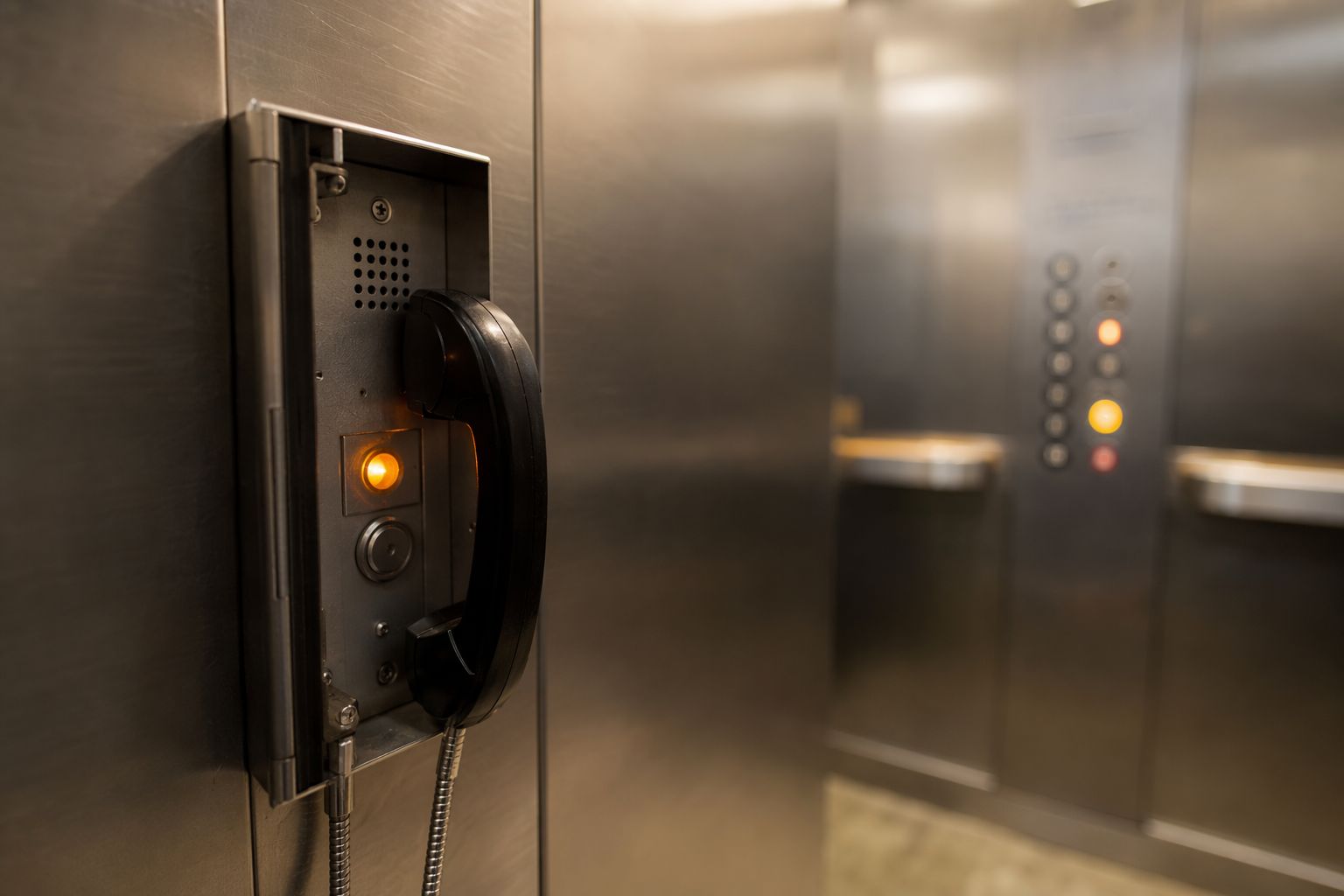
Immediately activate the cab’s emergency phone, instruct passengers to stay calm and remain inside, and call your certified elevator service provider’s 24/7 emergency dispatch line — do not attempt to pry doors open or self-rescue under any circumstances.
The ASME A17.1 Safety Code for Elevators and Escalators requires every elevator cab to be equipped with a means of two-way communication accessible to passengers. In Arizona, that means a functioning emergency phone or intercom that connects to a monitored location 24 hours a day, 7 days a week — not a phone that rings to an unmonitored answering service.
The most dangerous actions during a breakdown are the instinctive ones: forcing doors, attempting to climb out, or panicking passengers into movement. Elevator shafts contain high-voltage components, moving counterweights, and drop hazards. Your job in the first two minutes is containment and communication, not rescue.
- Activate the emergency phone inside the cab — confirm two-way communication is established with a live dispatcher.
- Instruct passengers to stay seated or stand still — movement can shift the car on its safeties if the braking system has engaged.
- Note the floor indicator or last-known floor — relay this to dispatch so the technician knows where to start.
- Call your elevator service company’s 24/7 emergency line — in Arizona, Arizona Elevator Solutions dispatches certified technicians within 60–120 minutes for emergency calls across Phoenix, Tucson, Scottsdale, and Mesa.
- If passengers report a medical emergency, call 911 simultaneously — fire departments in Arizona are trained in elevator rescue protocols under NFPA 101.
- Do not attempt to open hoistway doors from the outside — hoistway door interlocks are safety devices; bypassing them without a key and proper training is a code violation and a life-safety hazard.
- Document the time of failure, reported symptoms, and cab number — this information accelerates diagnosis when the technician arrives.
How fast should emergency elevator response time be?
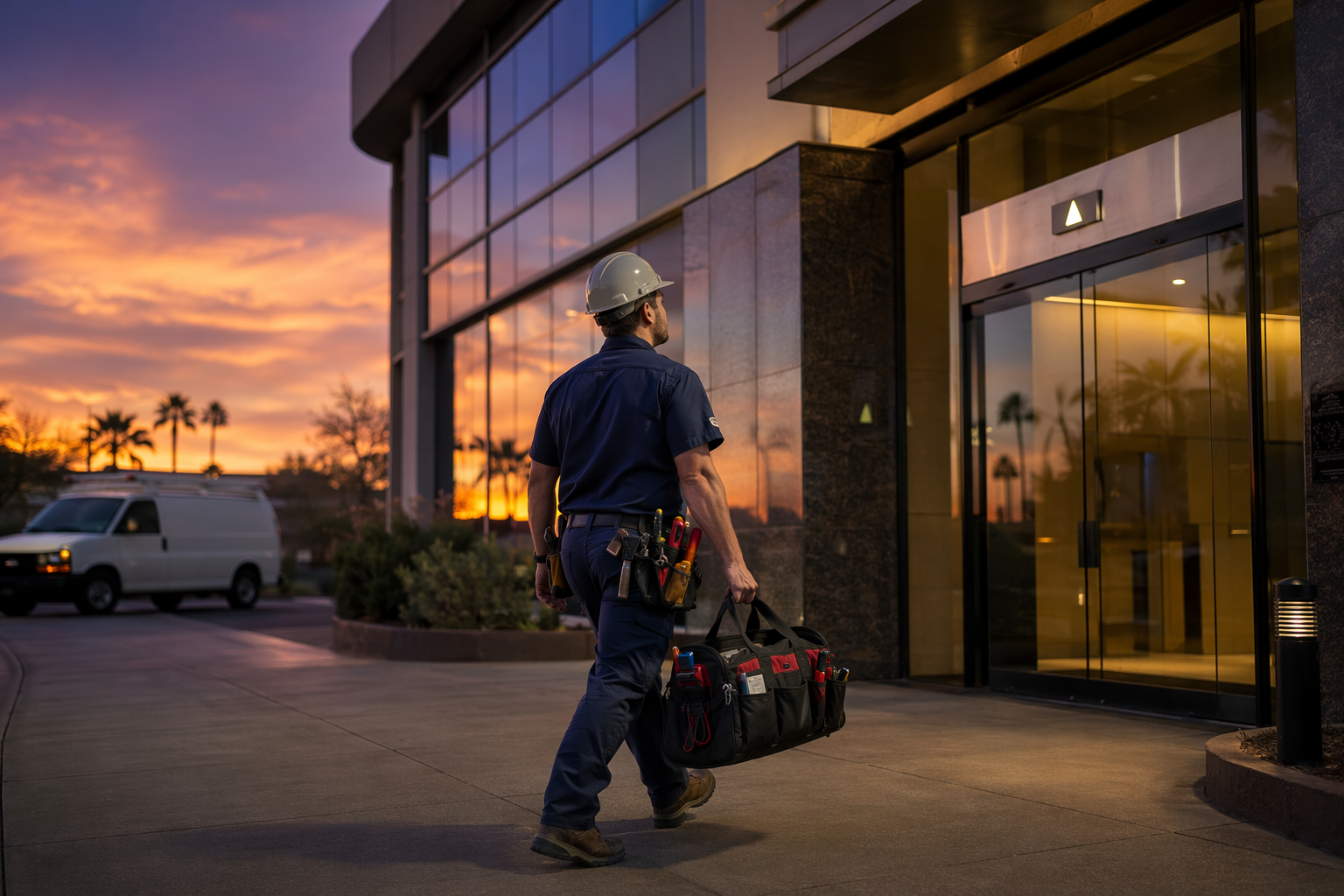
Industry best practice for elevator emergency response — especially with passengers trapped — is technician arrival within 60 to 120 minutes, though your service contract should define maximum response windows in writing.
Arizona does not currently mandate a statutory response time window for elevator breakdowns in the way some other states do, but the Americans with Disabilities Act (ADA) creates an implicit urgency: if an elevator is the only accessible route in a building, its outage constitutes a potential ADA access barrier, and prolonged downtime can expose building owners to civil complaints. In healthcare and senior living settings, response time is a life-safety matter, not just a convenience metric.
For high-rise buildings in Phoenix and Scottsdale where elevators are the only vertical transportation option above the 3rd floor, a 2-hour response window is the absolute maximum acceptable standard. For lower-traffic residential buildings in Mesa or Tucson, a 4-hour window may be contractually acceptable during business hours — but overnight and weekend calls should always carry the same 2-hour maximum.
What causes most elevator breakdowns?
The majority of elevator breakdowns are caused by worn door components, controller malfunctions, hydraulic fluid issues, and deferred preventive maintenance — most of which are predictable and preventable.
After 15-plus years servicing elevators across Arizona, I can tell you that roughly 40% of all emergency calls I’ve responded to trace back to a door system failure: worn cam rollers, misaligned door gibs, or a faulty door operator that causes the elevator to think the door is open when it’s closed. The car won’t move with an unresolved door circuit fault.
Arizona’s extreme heat — routinely exceeding 115°F in Phoenix and Mesa during summer — accelerates wear on hydraulic seals, causes electronic components to overheat, and degrades lubricants faster than national averages suggest. Buildings in Arizona should operate on a more aggressive preventive maintenance schedule than ASME A17.1 minimums to account for this climate factor.
| Cause of Breakdown | Percentage of Emergency Calls (2026 Industry Data) | Preventable With PM? | Typical Repair Time |
|---|---|---|---|
| Door system failure | 38% | Yes | 1–3 hours |
| Controller/electrical fault | 22% | Partially | 2–6 hours |
| Hydraulic fluid/pump issue | 17% | Yes | 2–8 hours |
| Traction rope/sheave wear | 11% | Yes | 4–24 hours |
| Safety/brake component | 7% | Yes | 4–12 hours |
| Vandalism or misuse | 5% | No | 1–4 hours |
Is it safe to stay inside a broken-down elevator?
Yes — in virtually all breakdown scenarios, it is significantly safer to remain inside the elevator cab than to attempt any form of self-rescue.
Modern elevators built and maintained to ASME A17.1 standards include multiple redundant safety systems: electromagnetic brakes, governor-activated safeties, buffer systems, and slack rope devices. When a malfunction occurs, the car is almost always held securely in place by at least one of these systems. The cab is structurally safe. The danger is not inside the cab — it’s in the shaft.
Ventilation in most elevator cabs provides adequate air for several hours. In Arizona, heat is the legitimate concern: a stopped elevator in a non-air-conditioned shaft during a Phoenix summer can become uncomfortably warm within 20–30 minutes. If passengers report extreme heat distress or a medical condition, that escalates the call to a 911 fire department rescue alongside the elevator technician response.
What is the legal requirement for elevator emergency phones in Arizona?
Arizona Revised Statutes and ASME A17.1 Section 2.27.1 require all elevators to have a two-way means of communication that does not require the use of a handset and must connect to a location staffed 24/7.
The Arizona Department of Occupational Safety and Health (ADOSH) enforces elevator safety standards in Arizona, and their requirements align with ASME A17.1. The 2019 edition of A17.1 (currently adopted in Arizona) mandates that the emergency communication device must be operable with one hand and must be usable by a person who is deaf, hard of hearing, or has impaired speech — typically via a visual indicator confirming the call has been received.
Many older buildings in Tucson and Mesa are running on telephone-based emergency systems that route to phone numbers that may no longer be actively monitored. During any scheduled maintenance visit, the first thing a competent technician should verify is that the emergency phone connects to a live, monitored dispatch center — not a voicemail box.
How long can passengers legally be trapped in an elevator?
There is no single national statute specifying a maximum entrapment duration, but ASME A17.1 and ADA obligations create a practical ceiling of 60 minutes as the standard of care in most commercial and public buildings.
From a liability standpoint, any entrapment exceeding 60 minutes in a commercial building in Phoenix or Scottsdale exposes the building owner to negligence claims if it can be shown that a faster response was available and not contracted for. In healthcare facilities regulated under CMS guidelines, entrapment response standards are even stricter and are subject to Joint Commission review.
Arizona does not have a specific elevator entrapment duration statute as of 2026, but ADOSH can cite building owners for failure to maintain an elevator in safe operating condition — which encompasses having an adequate emergency response protocol. Document your service contract response time commitments and verify them annually.
What should building managers do before the elevator technician arrives?
Before the technician arrives, building managers should secure the elevator lobby, maintain passenger communication, gather equipment information, and ensure unobstructed access to the machine room.
- Post a staff member at the elevator lobby to prevent other building occupants from using adjacent elevators if the fault may affect multiple units on a shared controller.
- Maintain voice contact with trapped passengers every 5 minutes via the intercom — reassure them that help is en route with an estimated arrival time.
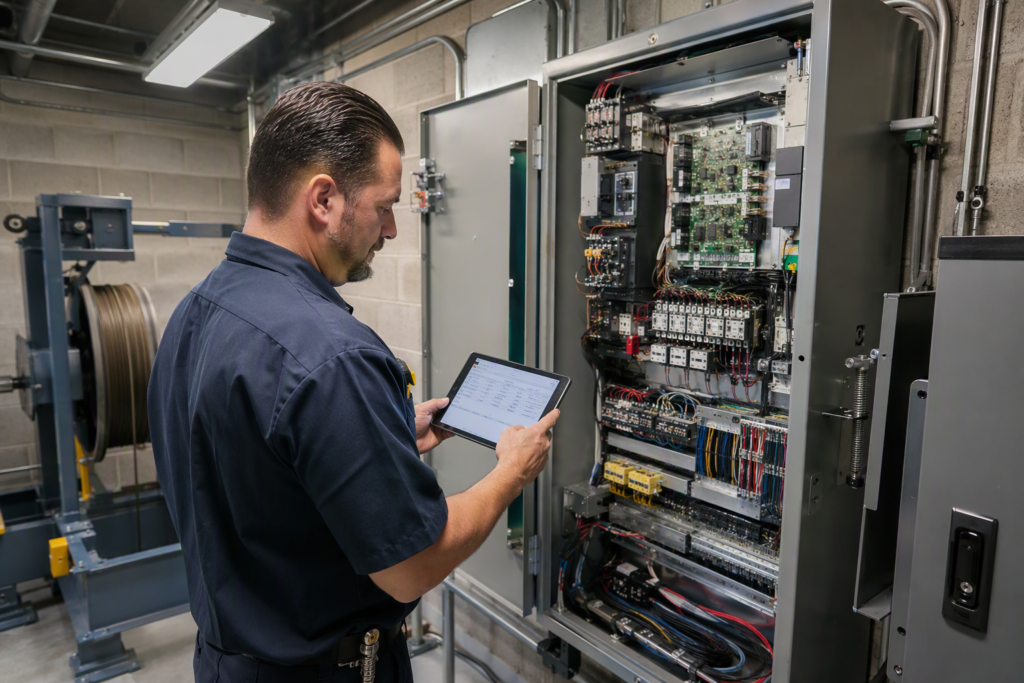
- Locate the elevator’s machine room key and emergency lowering instructions — in hydraulic elevators, there is typically a manual lowering valve that only a trained technician should operate, but you should know where the access key is.
- Clear the machine room of any obstacles — ASME A17.1 requires a minimum 24-inch clear path to all equipment; blocked machine rooms add critical minutes to rescue time.
- Gather the elevator’s unit number, last inspection date, and maintenance provider contact — the technician will need this at arrival.
- Note and document all symptoms: unusual sounds before the breakdown, floor where the car stopped, error codes displayed on the hall call panels if applicable.
- Do not reset the main disconnect or controller breaker unless specifically instructed by a certified technician over the phone — resetting after a safety trip can mask the root cause or create a more dangerous condition.
How much does emergency elevator repair cost in Arizona?
Emergency elevator repair in Arizona typically costs between $350 and $2,500 for after-hours labor alone, with parts costs ranging from minimal for a door roller replacement to $8,000+ for hydraulic pump or controller replacements.
After-hours emergency dispatch rates in the Phoenix metro area generally carry a premium of 1.5x to 2x standard labor rates. If your elevator is under a full-service maintenance contract with a certified provider, emergency response labor is typically covered — making the contract ROI straightforward for any building running an elevator more than 8 hours per day.
Buildings in Tucson and Mesa that operate on “oil and grease” or inspection-only contracts pay the full emergency labor rate out of pocket, which can make a single weekend breakdown cost more than a year of full-service coverage. Arizona Elevator Solutions offers full-service maintenance agreements that include 24/7 emergency response coverage across all four service markets, eliminating surprise emergency billing for covered equipment.
Does a breakdown void elevator safety certifications in Arizona?
A breakdown itself does not void a certificate of operation, but operating a known-faulty elevator after a breakdown without technician clearance is a code violation that can result in ADOSH citation and forced shutdown.
Under Arizona’s elevator safety program administered through ADOSH, every elevator must hold a current Certificate of Operation issued after passing an annual inspection. A breakdown does not automatically invalidate this certificate. However, if the breakdown exposes a condition that renders the elevator unsafe — a failed safety, a tripped overspeed governor, or hydraulic fluid contamination — the elevator must not be returned to service until a certified technician has inspected, repaired, and documented the repair.
Returning an elevator to service after a safety-related shutdown without technician clearance is one of the most serious violations a building owner can commit. Fines under Arizona Revised Statutes can reach $7,000 per day for willful violations in commercial buildings.
What is the difference between a breakdown and a safety shutdown?
A breakdown is an unintended failure that may or may not involve a safety system, while a safety shutdown is a deliberate, code-mandated stop triggered when a monitored parameter — overspeed, door fault, or hydraulic pressure loss — exceeds safe limits.
Safety shutdowns under ASME A17.1 are features, not failures. They are designed to stop the car before a dangerous condition develops. Common safety shutdown triggers include: governor overspeed detection, oil temperature exceeding limits in hydraulic units, Phase II fire service activation, and earthquake sensors in seismic-risk installations.
After a safety shutdown, the elevator must be manually inspected and reset by a certified technician before returning to service — it cannot simply be reset remotely via a building automation system. This distinction matters because some building management systems allow “remote reset” of certain fault codes, which is only appropriate for non-safety-related faults.
What regular maintenance prevents elevator breakdowns?
Monthly preventive maintenance visits that include lubrication, door adjustment, controller inspection, and hydraulic fluid checks — performed by an IUEC-certified technician — reduce emergency breakdown incidents by an estimated 60–70% compared to inspection-only service agreements.
ASME A17.1 does not specify a mandated PM frequency, leaving this to the authority having jurisdiction (AHJ) and the service contract. In Arizona’s climate, the recommended standard for commercial elevators is monthly full-service visits minimum, with additional quarterly checks of hydraulic oil levels, temperature performance, and rope tension on traction units.
The components most frequently neglected in Arizona buildings — and most frequently responsible for emergency calls — are door gibs, car and hall door rollers, and hydraulic packing seals. Each costs $50–$200 to replace proactively. Each can cause a full service outage and trapped-passenger situation if they fail during operation. The ROI calculation is not complicated.
What should you look for in an elevator emergency service contract?
The three non-negotiable elements of an elevator emergency service contract are: a guaranteed maximum response time in writing, 24/7/365 live dispatch coverage, and inclusion of labor costs for emergency calls within the contract fee.
When evaluating elevator service providers in Arizona, request written answers to these specific questions before signing any agreement:
- What is the guaranteed maximum response time for a trapped passenger emergency in Phoenix / Tucson / Scottsdale / Mesa specifically?
- Does the contract include after-hours labor or is emergency response billed separately?
- Are your technicians IUEC-certified and licensed under Arizona’s elevator safety program?
- What is the escalation protocol if a repair requires parts not stocked on the service truck?
- Do you carry the required Certificate of Insurance and Arizona contractor’s license?
Arizona Elevator Solutions provides all service agreements with a written 120-minute maximum emergency response commitment across Phoenix, Tucson, Scottsdale, and Mesa — with no hidden after-hours surcharges for trapped-passenger calls under full-service agreements.
Can building owners be liable if a passenger is injured during an elevator breakdown?
Yes — building owners in Arizona can face significant premises liability if an elevator breakdown causes injury, particularly if deferred maintenance, inadequate emergency communication, or a faulty safety system contributed to the incident.
Arizona follows a comparative fault framework, meaning that a building owner’s liability is proportional to their share of negligence. Failure to maintain current inspection certificates, failure to have a functioning emergency phone, or documented refusal to address known maintenance deficiencies are the three most common factors that elevate building owner liability in elevator injury litigation.
A well-documented maintenance history is your primary legal defense. Every service visit, every parts replacement, every emergency call, and every inspection should be logged and retained for a minimum of 5 years. Arizona Elevator Solutions provides digital service records to all maintenance contract clients, creating a timestamped, audit-ready documentation trail.
How does Arizona’s elevator inspection process work?
In Arizona, elevators must pass an annual inspection conducted by an ADOSH-licensed elevator inspector, after which a Certificate of Operation is issued and must be posted inside the elevator cab.
ADOSH administers Arizona’s elevator safety program under Arizona Revised Statutes Title 23, Chapter 2, Article 9. Commercial elevators, escalators, and moving walks all fall under this program. The inspection covers compliance with the adopted edition of ASME A17.1 and verifies that all safety devices are functional, the emergency phone is operational, and the elevator’s physical condition meets code.
Buildings that fail inspection are issued a correction notice and given a defined timeframe to remediate deficiencies before re-inspection. Operating an elevator without a current Certificate of Operation posted in the cab is a civil violation. Inspectors can be ADOSH employees or licensed third-party inspection agencies — Arizona allows both, which gives building owners some flexibility in scheduling. Annual inspection costs in Arizona typically range from $150 to $400 per unit depending on elevator type.
What is the ADA requirement for elevator availability during a breakdown?
Under the ADA Standards for Accessible Design, buildings required to have an accessible elevator must restore access as promptly as possible during outages, and extended outages may require interim accessible accommodations.
The ADA does not set a specific elevator uptime percentage requirement, but it does require that buildings with elevator-dependent accessible routes not effectively exclude people with disabilities. In 2026, the DOJ has taken an increasingly active position on extended elevator outages in Federally-assisted housing and Title II entities — including public buildings, courthouses, and transit stations. Building owners should treat elevator availability as an ADA compliance issue, not just a convenience matter.
In mixed-use buildings in Phoenix or Scottsdale where a tenant occupying an upper floor has a mobility disability, the building owner may have a reasonable accommodation obligation to provide alternative access arrangements — temporary ramp, lobby-level services — if the elevator is down for more than 24 hours.
What emergency equipment should every Arizona building with an elevator have on hand?
Every building with an elevator should maintain a machine room key, a copy of the elevator’s wiring diagram and maintenance manual, the service company’s 24/7 emergency number, and the AHJ’s contact information — immediately accessible at all times.
In buildings I’ve serviced across the Phoenix metro, one of the most common delays I encounter on emergency calls is a building manager who cannot locate the machine room key, doesn’t know the elevator’s unit number, or has only the main office number for the elevator company — not the 24/7 emergency line. Every minute spent locating this information is a minute a passenger waits in a hot cab.
Post an emergency information card in the maintenance office, the security desk, and photographed on the facility manager’s phone. Include: elevator unit number, machine room location and key location, service company emergency number, local fire department non-emergency line, and the location of the hydraulic emergency lowering valve if applicable. This is a 15-minute setup task that can cut emergency response time by 20 minutes.
How do you restart an elevator safely after a breakdown?
An elevator should only be returned to service by a certified elevator technician after a documented inspection confirming the cause of the failure has been identified and corrected — never by cycling the main disconnect or pressing reset buttons without technician authorization.
When a technician from Arizona Elevator Solutions responds to a breakdown call, the restart process follows a defined protocol before the car is cleared for passenger service:
- Identify the fault code on the elevator controller and document it before any reset.
- Physically inspect the machine room for signs of overheating, fluid leaks, or mechanical failure.
- Inspect the car top and pit for any visible mechanical anomalies, if safe to access.
- Test all safety devices to confirm they are reset and functional after the fault condition is cleared.
- Perform a no-load test run — cycle the car through all floors without passengers to confirm consistent operation.
- Test door operation at every floor to confirm all landing zone sensors and door interlocks are functioning.
- Document the repair with a written service ticket noting fault code, root cause, corrective action, and technician certification number.
- Clear the car for passenger service only after all tests pass — inform the building contact with a verbal and written summary.
What is the typical downtime for an elevator after a major breakdown?
Minor breakdowns like door adjustments or controller resets are resolved in 1–4 hours, while major component failures such as hydraulic pump replacement or traction motor issues can result in 3–14 days of downtime, depending on parts availability.
Parts availability is the single largest variable in post-breakdown downtime in Arizona. For common elevator brands — Otis, Kone, ThyssenKrupp, Schindler — controllers and door components are generally available in Phoenix with 1–3 day lead times. For older or discontinued equipment, the timeline extends significantly. Buildings with elevators older than 20–25 years face the highest risk of extended parts delays, which is a strong argument for proactive modernization planning.
During a major component replacement, building owners with ADA-dependent access must activate their accessibility contingency plan immediately — notify tenants, arrange alternative accommodations, and document all steps taken to minimize access disruption. This documentation is critical if an ADA complaint is filed.
How does the Arizona heat affect elevator reliability?
Arizona’s extreme heat — with Phoenix averaging over 110 days above 100°F per year — accelerates wear on hydraulic seals, overheats machine room components, degrades lubricants, and increases the frequency of thermal-related controller faults compared to national averages.
Machine room temperatures in Arizona buildings without adequate cooling can exceed 130°F during July and August. ASME A17.1 recommends machine room temperatures be maintained between 50°F and 104°F. Above 104°F, electronic controllers experience increased fault rates and reduced component lifespan. Hydraulic oil viscosity changes with temperature, affecting pump performance and seal integrity.
The practical recommendation for Arizona buildings: verify that machine room ventilation or air conditioning is functional before summer, check hydraulic oil levels monthly from May through September, and schedule a pre-summer inspection in April to catch wear items before the high-stress summer season. Arizona Elevator Solutions offers a dedicated summer readiness inspection program for commercial and residential clients across Phoenix, Scottsdale, Tucson, and Mesa — specifically addressing heat-related vulnerability points.
When should a breakdown trigger consideration of full elevator modernization?
When emergency repair costs in a rolling 12-month period exceed 30% of the estimated modernization cost, or when the same component fails twice within 24 months, the economic and safety case for modernization typically outweighs continued reactive repair spending.
Modernization is not just a cost decision — it’s a safety and code compliance decision. Elevators installed before 1998 in Arizona may lack current ASME A17.1 requirements for pit lighting, machine room wiring protection, and car enclosure fire resistance. Repeated breakdowns on aging equipment are often a symptom of a broader obsolescence issue that no amount of reactive repair will permanently resolve.
The 30% rule is a widely-used industry benchmark: if you’re spending $6,000/year in emergency repairs on an elevator whose full modernization costs $20,000, the financial calculation within 3–4 years strongly favors modernization. Add the reduced liability exposure, improved energy efficiency, and ADA compliance improvements that come with modern equipment, and the case becomes even clearer.
How do you choose the right emergency elevator service provider in Arizona?
Choose a provider that is IUEC-certified, licensed under Arizona’s elevator safety program, carries adequate liability insurance, has documented local response times, and provides transparent pricing for emergency calls — not just the lowest monthly maintenance rate.
In Arizona, any elevator service company must hold the appropriate contractor’s license through the Arizona Registrar of Contractors. Before signing a service agreement, verify: the ROC license number is active, the company carries a minimum of $1 million in general liability insurance, their technicians hold current IUEC certifications, and they can provide references from comparable properties in your market — Phoenix commercial, Tucson residential, Scottsdale hospitality, or Mesa industrial.
The lowest-cost maintenance contract almost always translates to the slowest emergency response and the highest out-of-pocket emergency repair billing. The true cost of an elevator service relationship is best evaluated over a 3-year period, factoring in emergency call frequency, average response time, and total parts-and-labor spend. Arizona Elevator Solutions has served commercial and residential clients across the Phoenix metro, Tucson, Scottsdale, and Mesa since our founding, with a documented average emergency response time under 90 minutes across all four markets in 2025–2026.
Need elevator service you can rely on? Arizona Elevator Solutions is ready to help.