Arizona Elevator Union Standards for Healthcare Facilities
Healthcare elevator compliance in Arizona is one of the most demanding operational responsibilities a facility manager can face. Hospitals, outpatient surgery centers, long-term care facilities, and medical office buildings across Phoenix, Tucson, Scottsdale, and Mesa depend on elevators that must operate reliably around the clock — for patients on gurneys, staff with medical equipment, and visitors who may have limited mobility. Understanding the intersection of Arizona elevator law, federal accessibility standards, and healthcare-specific operational demands is the foundation of a sound elevator maintenance program.
What Are the Core Compliance Requirements for Healthcare Elevators in Arizona?
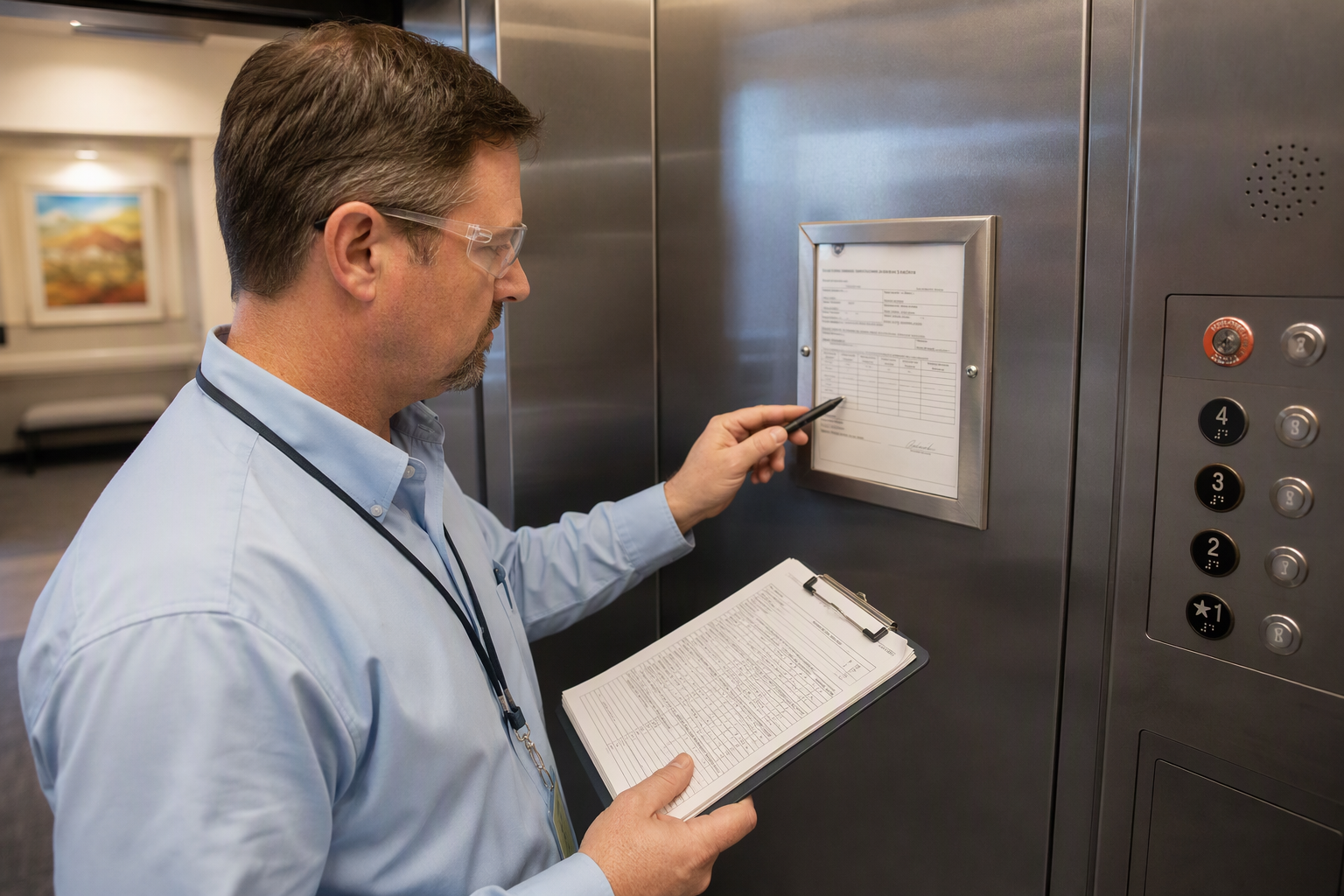
Healthcare elevators in Arizona must satisfy requirements from multiple overlapping frameworks. Under A.R.S. §§ 23-491 through 23-491.16, every conveyance operating in Arizona must hold a valid annual certificate of inspection issued by the state. The Industrial Commission of Arizona’s Elevator Division — formerly called the ADOSH Elevator Safety Section until September 12, 2026 — is the governing regulatory body for all conveyances outside the City of Phoenix. Elevators located within Phoenix city limits are inspected by the City of Phoenix Elevator Section, which operates under the Planning and Development Department.
For equipment installed, repaired, or altered on or after January 1, 2023, Arizona has adopted the ASME A17.1/CSA B44-2019 Safety Code for Elevators and Escalators. Platform lifts and stairway chairlifts installed, repaired, or altered on or after that same date must comply with ASME A18.1-2020. These are the only code editions Arizona has formally adopted as of 2026, and healthcare facility operators should ensure any new installation or alteration specifies compliance with these editions.
Federal Americans with Disabilities Act standards apply to all healthcare facilities as places of public accommodation and employer worksites. ADA requirements govern cab dimensions, door timing, control panel height, audible and visual signals, and Braille designations — all of which are especially critical in environments serving patients with mobility limitations, visual impairments, or post-surgical restrictions.
What Makes Healthcare Elevator Requirements Different from Other Buildings?

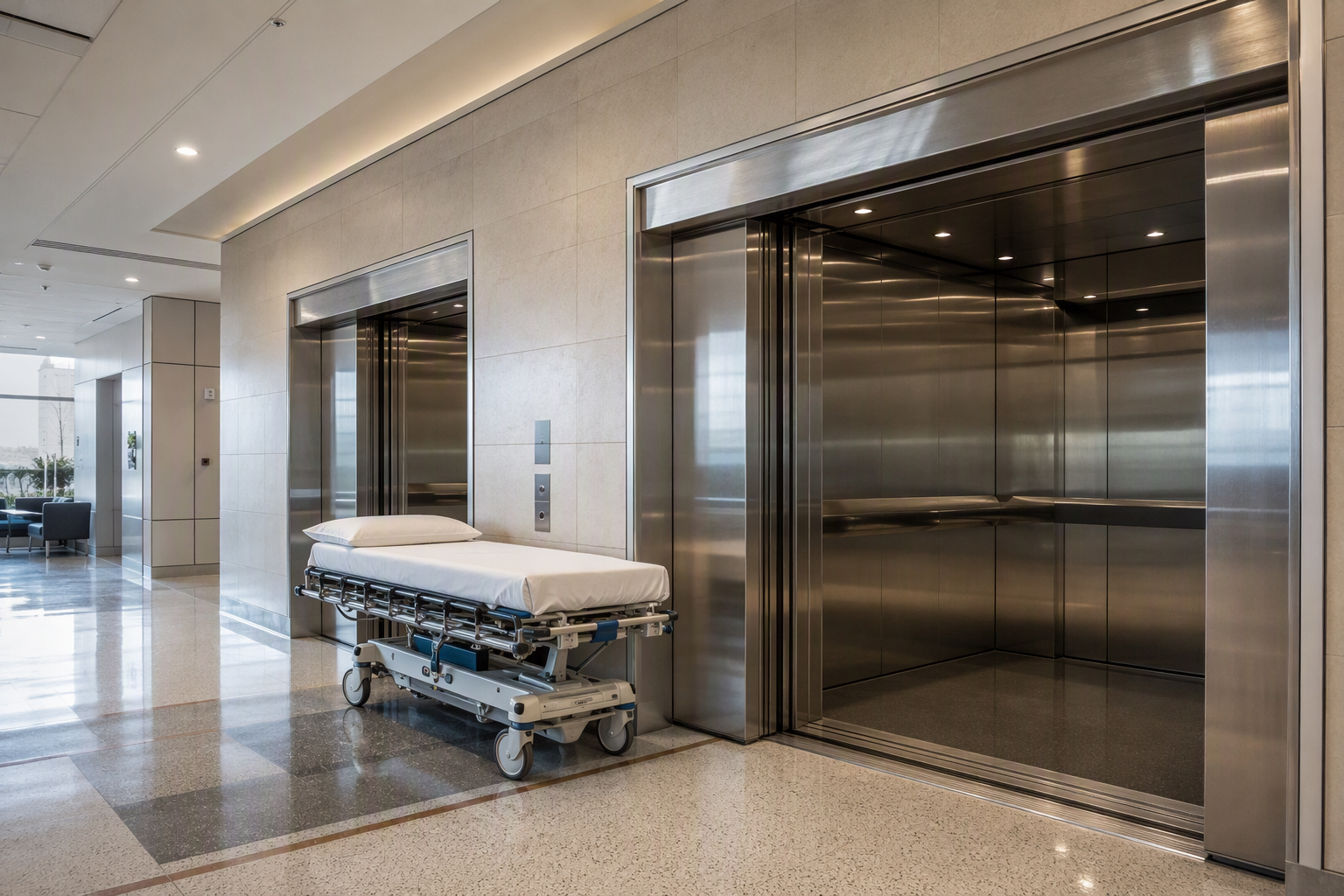
Healthcare environments impose operational demands that go well beyond what a standard commercial elevator faces. Hospitals and surgical centers routinely move patients on stretchers, oversized medical carts, and power-driven wheelchairs. This means cab dimensions, door widths, and weight capacities must be evaluated not only against minimum code thresholds but against the actual patient-handling workflows of the specific facility.
Infection control is another healthcare-specific concern. Interior cab finishes, door frame materials, and control panel surfaces must be cleanable with hospital-grade disinfectants without degrading over time. While elevator codes do not specify cleaning protocols directly, facility managers must coordinate with elevator contractors to confirm that materials specified during modernization or new installation are compatible with the facility’s infection prevention program.
Emergency power is a critical consideration. Healthcare facilities rely on elevators during fire and other emergencies when stairwells may be unusable for patients in beds or on stretchers. Arizona’s adopted ASME A17.1-2019 code addresses firefighters’ emergency operation, and all Arizona conveyances with that feature must use the Arizona Firefighters Service (AZFS) key — a state-specific requirement that applies in every Arizona healthcare setting.
How Does Arizona’s Annual Inspection Requirement Apply to Hospital Elevators?
Arizona law requires every conveyance to be inspected before it first goes into service, after any modification or alteration, and annually thereafter. No conveyance may operate in Arizona without a current certificate of inspection. Facility managers must keep the state certificate at the same location as the conveyance, post the state serial number or certificate in or close to the elevator in an easily accessible location, and make all documentation available on request.
Healthcare facilities that choose to use a private elevator inspector authorized by the Industrial Commission of Arizona should be aware that those inspectors must register with the commission annually and complete at least eight hours of approved continuing education. Critically, a private inspector may not inspect any conveyance owned, operated, or last serviced by the inspector’s own employer or a company the inspector owns. Using a private inspector does not relieve the owner or operator of their legal obligations under Arizona law.
Arizona Elevator Solutions works with healthcare facility managers across the Phoenix metro, Tucson, Scottsdale, and Mesa markets to prepare elevators for both state and local inspections, helping ensure all documentation, signage, and mechanical condition meet the requirements of Arizona Administrative Code R20-5-502 through R20-5-515.
What Should a Healthcare Facility Do After an Elevator Accident or Incident?
- Ensure the safety of any person involved and contact emergency services if there are injuries.
- Take the affected conveyance out of service immediately to prevent further incidents.
- Notify the Industrial Commission of Arizona’s Elevator Division within 24 hours — Arizona law requires reporting any accident that injures a person or disables a conveyance within that window.
- If the facility is within the City of Phoenix, also notify the City of Phoenix Elevator Section as directed by local authority.
- Document all conditions at the time of the incident, including photographs, maintenance records, and inspection certificates.
- Contact a licensed elevator contractor holding an Arizona Registrar of Contractors R-12 or C-12 classification to assess damage and determine what repairs or alterations are needed before the unit returns to service.
- Arrange for a new inspection and certificate before the conveyance is returned to operation, as required following any alteration or modification.
What Contractor Licensing Is Required for Healthcare Elevator Work in Arizona?
The Arizona Registrar of Contractors issues R-12 (residential) and C-12 (commercial) elevator license classifications, which authorize contractors to install and repair elevators, dumbwaiters, escalators, and moving walks. Healthcare facilities should verify that any elevator contractor performing installation, modernization, or repair holds the appropriate ROC classification. The ROC licenses elevator contractors but does not issue the annual certificate of inspection — that function belongs to the Industrial Commission of Arizona’s Elevator Division or, within Phoenix, the City of Phoenix Elevator Section.
Arizona Elevator Solutions holds the contractor licensing required to serve healthcare clients across Arizona and coordinates directly with the relevant authorities having jurisdiction (AHJ) to ensure all permitting, inspection scheduling, and documentation are handled correctly.
How Far in Advance Must Arizona Healthcare Facilities Notify the State Before an Elevator Installation or Alteration?
Arizona owners must notify the Industrial Commission of Arizona’s Elevator Division at least 90 days before installing, relocating, or altering a conveyance. For healthcare facilities planning a new building, a wing expansion, or a modernization project, this timeline must be factored into the overall project schedule well in advance of construction. Failing to notify the state within the required window can delay the issuance of the certificate needed before the elevator goes into service.
Does ADA Apply to All Healthcare Elevator Types, Including Platform Lifts?
Yes. ADA requirements apply to all vertical transportation equipment in healthcare facilities used by patients, visitors, or staff — including platform lifts. In Arizona, platform lifts installed, repaired, or altered on or after January 1, 2023, must comply with ASME A18.1-2020 in addition to ADA accessibility standards. Healthcare facilities should audit platform lifts with the same rigor applied to full-cab elevators, particularly in areas serving patients with limited mobility or post-operative care needs.
What Is the Role of OSHA in Healthcare Elevator Safety?
The federal Occupational Safety and Health Administration (OSHA) has authority over workplace safety conditions, which includes elevator-related hazards that could affect healthcare employees. While OSHA does not replace Arizona’s elevator inspection program, it does address hazards such as elevator machine room access, lockout/tagout procedures during maintenance, and conditions that could injure maintenance workers or healthcare staff. Healthcare employers should ensure their elevator maintenance program satisfies both Arizona’s conveyance safety rules and applicable OSHA general industry standards.
How Should Healthcare Facilities Handle Older Elevators That Predate Current Code Editions?
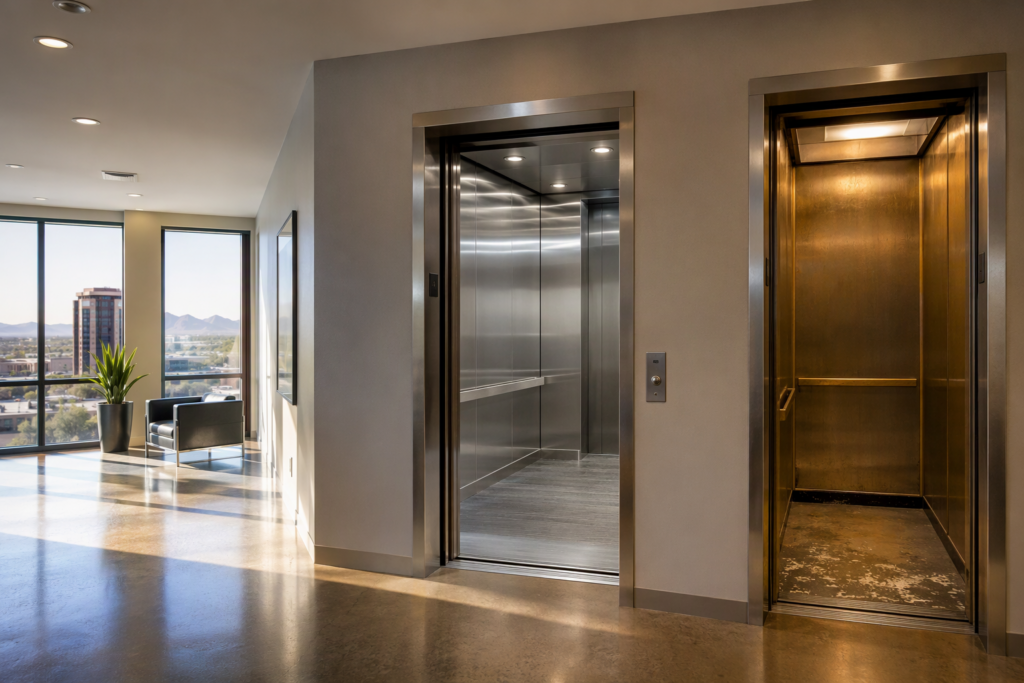
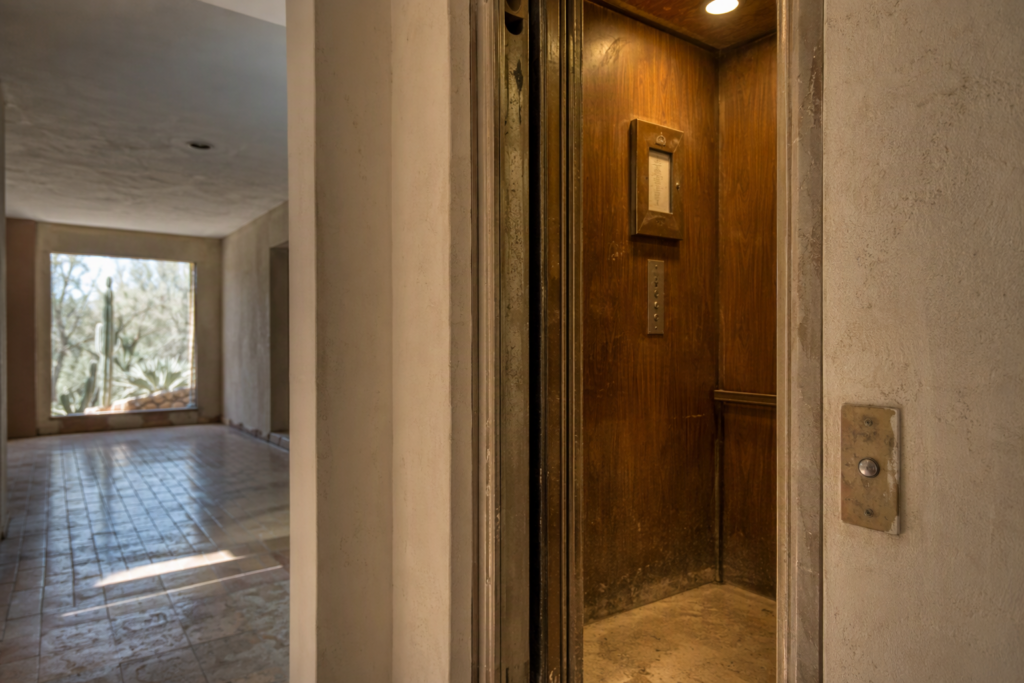
Arizona law allows lawfully installed older conveyances to remain in service unless the state’s elevator chief determines that continued use poses a hazard to life, health, or property. However, “code-compliant when installed” does not mean “adequate for today’s healthcare operations.” Facility managers should evaluate older equipment for ADA compliance gaps, weight capacity relative to current patient-handling needs, and reliability history. Arizona Elevator Solutions can conduct a comprehensive assessment of aging equipment and provide facility managers with a clear picture of modernization options, code considerations, and operational risk factors — without making any decisions for the facility.
Questions Your Inspector Will Ask
- Is the current Arizona certificate of inspection posted in or adjacent to the elevator cab?
- Is the state serial number tag affixed to the controller or mainline disconnect?
- Has the facility notified the Industrial Commission of Arizona of any alterations performed since the last inspection?
- Are maintenance logs current, and do they document all repairs and part replacements?
- Does the elevator’s firefighters’ emergency operation use the Arizona Firefighters Service (AZFS) key?
- Have any incidents or accidents occurred since the last inspection, and were they reported to the state within 24 hours as required?
- Does the facility have documentation showing the contractor who performed the last repair held an Arizona Registrar of Contractors R-12 or C-12 license?
- Are ADA-required features — door timing, cab dimensions, control panel height, audible signals, Braille markings — intact and functional?
- For platform lifts, is there documentation showing compliance with ASME A18.1-2020 for any work performed on or after January 1, 2023?
- Is the machine room secure, properly lit, and free of stored materials unrelated to elevator operation?
What Should Healthcare Facilities in Phoenix Know About Local Elevator Authority?
Healthcare facilities located within Phoenix city limits fall under the jurisdiction of the City of Phoenix Elevator Section, part of the Planning and Development Department, for inspections covering elevators, escalators, moving walks, dumbwaiters, and chairlifts. State authority through the Industrial Commission of Arizona’s Elevator Division applies to facilities outside Phoenix — including those in Tucson, Scottsdale, and Mesa. Facility managers should confirm which AHJ governs their specific location before scheduling inspections or planning alterations, as the correct notification and permitting pathway depends on that determination.
Arizona Elevator Solutions serves healthcare clients throughout the Phoenix metro area, Tucson, Scottsdale, and Mesa, and has familiarity with the procedural requirements of both the City of Phoenix Elevator Section and the Industrial Commission of Arizona’s Elevator Division.
How Can Healthcare Facility Managers Build a Proactive Elevator Compliance Program?
A proactive compliance program for healthcare elevators typically includes several coordinated elements: a scheduled preventive maintenance agreement with a licensed Arizona elevator contractor, a tracking system for annual inspection certificate renewal dates, a documented process for reporting incidents to the state within the 24-hour window required by Arizona law, regular internal audits of ADA feature functionality, and advance planning for any modifications that require the 90-day state notification. Arizona Elevator Solutions can help healthcare facility managers structure a compliance calendar that accounts for Arizona’s regulatory timeline requirements and the specific operational demands of healthcare environments.
Contact Arizona Elevator Solutions for a free elevator assessment at 480-557-7600.
Need elevator service you can rely on? Arizona Elevator Solutions is ready to help.