Arizona Elevator Permit Approval: Complete FAQ Guide for Phoenix, Tucson, Scottsdale & Mesa
Navigating elevator permitting in Arizona requires understanding state-level oversight, local municipal requirements, and the technical documentation standards set by national safety codes. Whether you are installing a new commercial elevator, modernizing an existing unit, or adding a residential lift, the permitting process must be completed correctly before any work begins. This guide answers the most common questions building owners, contractors, and facility managers ask about Arizona elevator permits — covering timelines, required documents, inspections, compliance codes, and practical tips for keeping projects on schedule.
How Long Does It Take to Get an Elevator Permit Approved in Arizona?
Elevator permit approval in Arizona generally takes two to eight weeks, though timelines vary significantly by municipality, project scope, and document completeness.
The Arizona Department of Occupational Safety and Health (ADOSH) oversees elevator safety statewide under the Arizona Elevator Safety Act, but permit processing is handled at the city or county level. Jurisdictions such as Phoenix, Tucson, Scottsdale, and Mesa each operate their own building departments with distinct workflows and staffing levels, which directly affects how quickly a permit moves through review.
Simple residential lift installations in municipalities with fully digitized permitting portals can move through review in as little as two weeks when all documents are submitted correctly on the first attempt. Complex commercial projects — multi-stop traction elevators in high-rise developments, for example — can take six to eight weeks or longer, particularly if plan check comments require revised drawings. Incomplete applications are the single most common cause of permitting delays, which is why working with an experienced contractor who understands local submission standards is critical.
What Documents Are Required to Submit an Elevator Permit Application in Arizona?
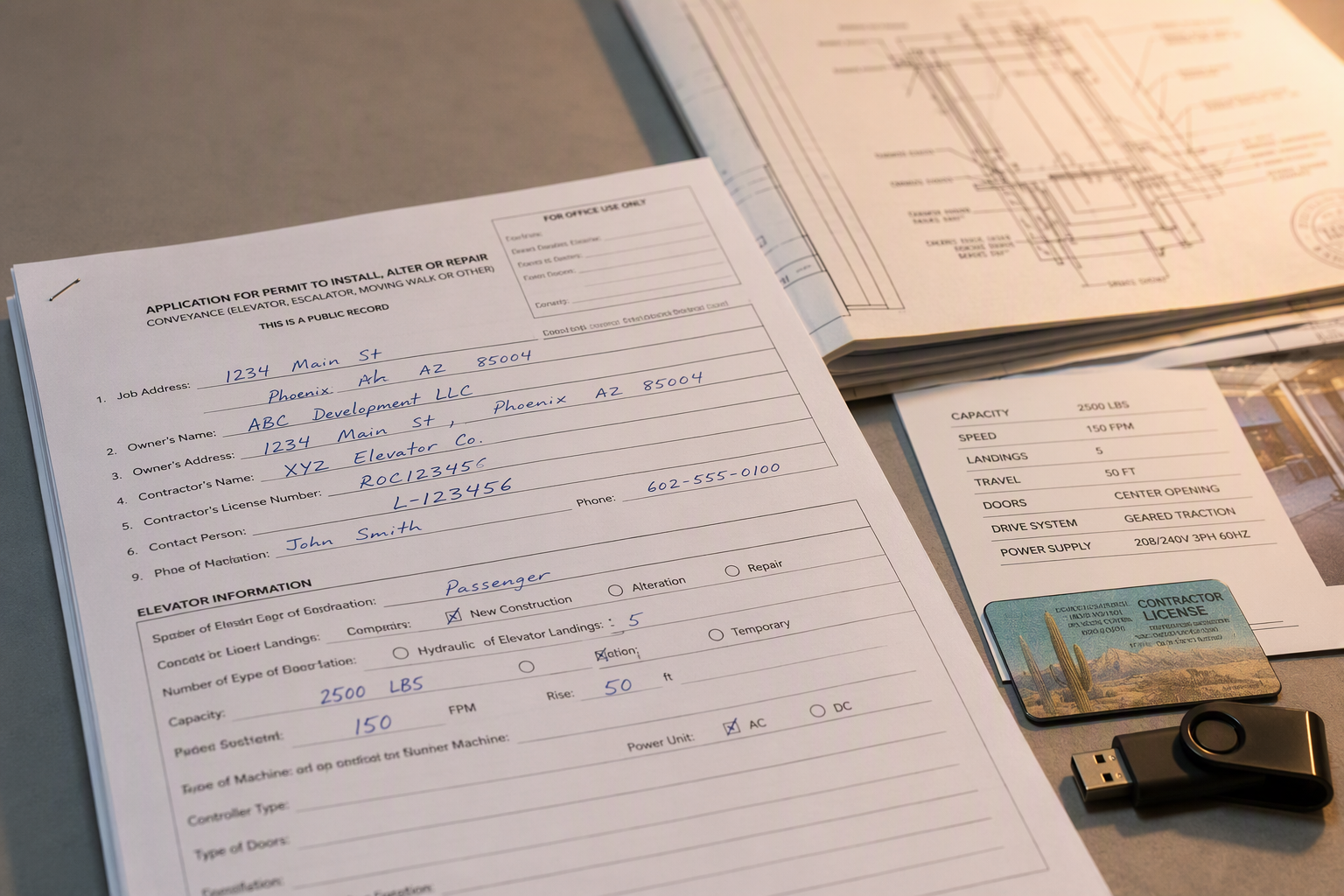
A complete Arizona elevator permit application typically requires engineered construction drawings, equipment specifications, a permit application form, contractor license information, and site plan documentation.
While specific checklists vary by jurisdiction, the following core documents are almost universally required across Phoenix, Tucson, Scottsdale, and Mesa:
- Completed permit application form — obtained from the relevant city building department or online portal.
- Engineered drawings — hoistway plans, pit details, machine room layouts, and elevation drawings stamped by a licensed engineer in Arizona.
- Equipment specifications and manufacturer data sheets — detailing the elevator type, rated capacity, travel speed, and safety components.
- Contractor license verification — Arizona requires elevator work to be performed by licensed elevator contractors; the license number must appear on the application.
- Site plan or floor plan — showing the elevator’s location within the building relative to exits, corridors, and accessible routes.
- Energy compliance documentation — some jurisdictions require compliance with energy codes for new installations.
- Accessibility compliance statement — demonstrating conformance with the Americans with Disabilities Act (ADA) where applicable.
Submitting a complete, well-organized package on the first attempt is the most effective way to minimize review time. Arizona Elevator Solutions assists clients across Phoenix, Tucson, Scottsdale, and Mesa in preparing permit packages that meet local plan check requirements.
Which State Agency Regulates Elevator Permits and Safety in Arizona?
The Arizona Division of Occupational Safety and Health (ADOSH), a division of the Industrial Commission of Arizona, is the primary state authority responsible for elevator safety regulation and inspection oversight.
ADOSH enforces the Arizona Elevator Safety Act and adopts the ASME A17.1 Safety Code for Elevators and Escalators as the technical standard governing elevator design, construction, installation, alteration, and maintenance across the state. Building departments in individual municipalities — Phoenix, Tucson, Scottsdale, Mesa, and others — coordinate with ADOSH but also apply local amendments and procedural requirements.
Understanding this two-tier regulatory structure is important: a permit is issued at the municipal level, but the state inspection and certificate of operation are ADOSH functions. Both must be satisfied before an elevator is legally placed in service.
What Is the ASME A17.1 Code and How Does It Apply to Arizona Elevator Permits?
The ASME A17.1 Safety Code for Elevators and Escalators is the national technical standard adopted by Arizona as the baseline requirement for all elevator installations, alterations, and maintenance statewide.
ASME A17.1 establishes detailed requirements for hoistway construction, car enclosures, doors and gates, safeties and buffers, electrical systems, emergency operations, and accessibility features. Every set of engineered drawings submitted with an Arizona elevator permit application must demonstrate compliance with the applicable edition of ASME A17.1 as adopted by ADOSH.
As of 2026, applicants should verify with ADOSH and their local building department which specific edition of ASME A17.1 is currently enforced, as states periodically adopt updated code editions. Drawings that reference a superseded code edition may be returned for revision during plan check, adding weeks to the approval timeline.
Does ADA Compliance Affect the Elevator Permitting Process in Arizona?
Yes — elevators installed in facilities covered by the Americans with Disabilities Act must meet ADA Standards for Accessible Design, and documentation demonstrating this compliance is typically required as part of the permit application.
ADA requirements for elevators include minimum car dimensions, door clear width, floor-to-floor leveling accuracy, control panel height, tactile signage, and audible signals, among other specifications. For new construction and alterations subject to ADA, these requirements are not optional — they must be incorporated into the design drawings submitted for permit review.
Residential elevators in single-family homes are generally not covered by ADA, but commercial properties, multi-family buildings with more than a threshold number of units, and any facility open to the public must comply. Confirming ADA applicability early in the design phase prevents costly revisions after permit submission.
How Do Permit Requirements Differ Between Phoenix, Tucson, Scottsdale, and Mesa?
Each city operates its own building department with distinct application portals, fee schedules, plan check procedures, and processing timelines, though all ultimately align with Arizona state law and ASME A17.1.
| Factor | Phoenix | Tucson | Scottsdale | Mesa |
|---|---|---|---|---|
| Online Permit Portal Available | Yes (ProjectDox) | Yes (Accela) | Yes (Online Portal) | Yes (Accela) |
| Typical Plan Check Timeframe | 3–6 weeks | 2–5 weeks | 2–4 weeks | 2–5 weeks |
| Expedited Review Available | Yes (fee-based) | Verify with city | Yes (fee-based) | Verify with city |
| State ADOSH Inspection Required | Yes | Yes | Yes | Yes |
| Licensed Elevator Contractor Required | Yes | Yes | Yes | Yes |
| Engineered Drawings Required | Yes | Yes | Yes | Yes |
Note: Timeframes above are general benchmarks. Applicants should always verify current processing times and requirements directly with the relevant building department, as these change based on workload and policy updates.
Arizona Elevator Solutions works with building departments across all four of these markets and can help clients understand the specific procedures and current processing times for their project location.
What Are the Steps to Apply for an Elevator Permit in Arizona?
Applying for an elevator permit in Arizona follows a defined sequence that begins with design and ends with a state inspection and certificate of operation.
- Engage a licensed elevator contractor and engineer. Arizona law requires elevator work to be performed by licensed contractors. A licensed professional engineer must stamp construction drawings for most commercial installations.
- Determine the applicable code edition. Confirm with ADOSH and the local building department which edition of ASME A17.1 and any local amendments are currently enforced.
- Prepare and organize all required documents. Compile engineered drawings, equipment specifications, contractor license information, site plans, and ADA compliance documentation into a complete package.
- Submit the permit application. Use the appropriate city portal (e.g., ProjectDox in Phoenix, Accela in Mesa and Tucson) or submit in person at the building department if required.
- Respond promptly to plan check comments. If the reviewing plan checker issues correction comments, revised drawings or documentation must be resubmitted. Delays in responding extend the overall timeline.
- Receive permit approval and pay applicable fees. Once the application is approved, the permit is issued and work may begin.
- Schedule required inspections during construction. Building departments typically require interim inspections at key milestones (e.g., rough-in, prior to enclosure).
- Request the ADOSH final inspection. Upon installation completion, a state elevator inspector from ADOSH must perform a final acceptance inspection.
- Obtain the certificate of operation. ADOSH issues a certificate of operation following a successful final inspection. The elevator may not be placed in service until this certificate is issued.
What Types of Elevator Work Require a Permit in Arizona?
In Arizona, permits are required for new elevator installations, alterations, modernizations, and certain significant maintenance or repair activities — not all routine service work, but any work that changes the equipment’s configuration, capacity, or safety systems.
The following activities generally require a permit:
- New installation of any elevator, escalator, moving walk, or platform lift
- Major modernization (replacing drive systems, controllers, or safety components)
- Alterations to hoistway, machine room, or pit dimensions
- Increasing rated load or speed
- Adding or removing landings or stories served
- Replacing traction ropes or hydraulic cylinders in certain configurations
Routine preventive maintenance, lubrication, and minor adjustments do not typically require a permit, but any work that modifies a component addressed in ASME A17.1 as a “alteration” or “major repair” may trigger permit and inspection requirements. Contractors should consult ADOSH guidance when the scope of work falls in a gray area.
How Much Does an Elevator Permit Cost in Arizona?
Elevator permit fees in Arizona vary by city, project type, and equipment value — fees are set by local building departments and are subject to change, so applicants must confirm current fee schedules directly with the relevant jurisdiction.
Fee structures typically fall into a few models: flat fees per elevator type, fees calculated as a percentage of project valuation, or fees based on the number of landings. Some jurisdictions also charge separate plan check fees in addition to the permit issuance fee. Expedited review, where available, carries a premium. Because fee schedules are updated periodically and are specific to each municipality, Arizona Elevator Solutions advises clients to request the current fee schedule from the Phoenix, Tucson, Scottsdale, or Mesa building department before budgeting for the permitting phase.
What Causes Elevator Permit Applications to Be Rejected or Delayed in Arizona?
The most common causes of permit rejection or delay are incomplete documentation, drawings that do not comply with the adopted edition of ASME A17.1, unlicensed contractor information, and missing ADA compliance details.
Plan checkers are required to verify that submitted documents meet all applicable code requirements before issuing a permit. Common deficiencies that trigger correction notices include:
- Drawings that reference a superseded code edition
- Missing engineer stamp or signature on plans
- Inadequate pit depth, overhead clearance, or machine room dimensions shown on drawings
- Absent or incomplete emergency operation and signaling device details
- No documentation of ADA-compliant car interior dimensions or controls
- Contractor license number missing or expired
- Energy code compliance documentation omitted
Each correction cycle can add two to four weeks or more to the overall timeline. Submitting a thoroughly prepared, code-compliant package on the first attempt is the single most effective strategy for staying on schedule.
How Are Elevator Inspections Scheduled After a Permit Is Issued in Arizona?
After a permit is issued, inspections are scheduled through the local building department for interim construction inspections and through ADOSH for the mandatory state acceptance inspection upon completion.
Inspection scheduling timelines vary based on ADOSH and building department workload. Contractors should schedule inspections proactively — waiting until the final day of installation to request an inspection can introduce unexpected delays if inspector availability is limited. Some municipalities allow online inspection scheduling; others require phone scheduling. ADOSH inspection requests are typically made directly through the Industrial Commission of Arizona’s ADOSH division.
Arizona Elevator Solutions coordinates inspection scheduling on behalf of clients to help ensure that inspections are requested at the correct project milestones and that no required interim inspection is missed.
What Happens If an Elevator Operates Without a Valid Permit or Certificate of Operation in Arizona?
Operating an elevator without a valid permit or certificate of operation in Arizona violates the Arizona Elevator Safety Act and can result in enforcement action by ADOSH, including orders to cease operation, civil penalties, and required corrective work.
Beyond regulatory penalties, operating an unpermitted elevator creates significant liability exposure for building owners. If an incident occurs on an elevator that lacks proper documentation, insurance coverage may be denied and the owner may face direct legal liability. Additionally, unpermitted elevator work often comes to light during real estate transactions, creating closing delays and renegotiation pressure. Maintaining current permits and certificates of operation is not only a legal obligation but a sound risk management practice.
How Often Must Elevators Be Inspected After Installation in Arizona?
Arizona follows the periodic inspection intervals established in the ASME A17.1 Safety Code for Elevators and Escalators, which requires periodic inspections and tests at defined intervals based on elevator type and use category.
ASME A17.1 specifies that routine periodic inspections occur at least annually for most elevator types, with full load tests and other category tests required at longer intervals (typically every five years for Category 5 tests on hydraulic elevators, for example). ADOSH enforces these inspection intervals in Arizona. Building owners are responsible for ensuring that required periodic inspections and tests are performed, documented, and submitted as required. Failure to maintain current inspection records can result in a suspension of the certificate of operation.
Can Elevator Permits Be Expedited in Arizona Cities Like Phoenix or Scottsdale?
Yes — Phoenix and Scottsdale both offer expedited plan review services for an additional fee, which can significantly reduce the permit approval timeline for projects with schedule-critical needs.
Expedited review does not bypass code compliance — all documents must still meet the same technical standards — but it prioritizes the application in the review queue. Availability of expedited review, specific fees, and the degree of acceleration achieved vary by department workload and policy. Applicants interested in expedited review should contact the relevant building department directly to confirm current availability and fee structures. Mesa and Tucson applicants should verify expedited options directly with those cities, as program availability changes.
Do Residential Elevators and Platform Lifts Require Permits in Arizona?
Yes — residential elevators and platform lifts installed in Arizona homes require permits and must comply with applicable provisions of ASME A17.1 and ASME A17.3 for existing installations.
Residential elevators, limited-use/limited-application (LULA) elevators, and vertical platform lifts are all regulated conveyances under Arizona law. While the documentation requirements may be somewhat less complex than for a commercial traction elevator, a permit application, engineered drawings, and a state inspection are still required before the unit may be used. Homeowners who install residential lifts without permits face the same enforcement exposure as commercial building owners and may encounter complications during home sales when unpermitted work is discovered.
What Is the Role of an Elevator Contractor License in the Arizona Permit Process?
Arizona requires all elevator installation, alteration, and major maintenance work to be performed by a licensed elevator contractor, and the contractor’s license number is a mandatory field on the permit application — without it, the application is incomplete and will not be accepted.
The Arizona Registrar of Contractors (ROC) issues elevator contractor licenses. Applicants should verify that their contractor holds a current, active Arizona ROC license in the elevator classification before signing contracts or submitting permit applications. Using an unlicensed contractor not only invalidates the permit application but also exposes the building owner to liability and potential enforcement action. Arizona Elevator Solutions operates as a licensed elevator service company serving Phoenix, Tucson, Scottsdale, and Mesa.
How Does New Construction Differ from a Modernization Permit in Arizona?
New construction elevator permits require full code compliance with the current adopted edition of ASME A17.1, while modernization permits for existing elevators may involve a combination of current code requirements and applicable provisions of ASME A17.3 for existing installations.
ASME A17.3, the Safety Code for Existing Elevators and Escalators, governs retroactive requirements and provides a framework for what must be upgraded when an existing elevator undergoes alteration or modernization. The scope of a modernization project determines which ASME A17.3 requirements are triggered. For example, replacing a controller may trigger updates to emergency lighting, door reopening devices, or fire service operation, depending on the applicable code edition. Understanding the interplay between A17.1 and A17.3 is essential when planning a modernization budget and permit submittal.
What Should Building Owners Do If Their Elevator Permit or Certificate Has Lapsed in Arizona?
Building owners with a lapsed elevator permit or expired certificate of operation should contact ADOSH and their local building department promptly to determine the steps required to restore compliance before continuing elevator operation.
- Immediately cease operation of the elevator if the certificate of operation has expired, to avoid enforcement action and liability exposure.
- Contact ADOSH to understand the current status of the certificate and any outstanding inspection requirements.
- Contact the local building department to determine if any open permit corrections or documentation remain outstanding.
- Schedule a compliance inspection with a qualified elevator contractor to identify any code deficiencies that must be corrected before reinspection.
- Complete required repairs or documentation as identified during the compliance inspection.
- Request reinspection by ADOSH and the local building department as applicable.
- Obtain a renewed certificate of operation before returning the elevator to service.
Arizona Elevator Solutions provides compliance assessments for building owners in Phoenix, Tucson, Scottsdale, and Mesa who need to restore elevator compliance efficiently.
How Does OSHA Relate to Elevator Safety and Permits in Arizona?
The Occupational Safety and Health Administration (OSHA) sets workplace safety standards that apply to elevator construction work environments, but elevator safety regulation for the public-facing conveyance itself is primarily a state and local function in Arizona under ADOSH.
During elevator installation or modernization, the construction worksite is subject to OSHA general industry and construction standards, including those related to fall protection, lockout/tagout, and confined space entry. Elevator mechanics working in pits or hoistways must follow applicable OSHA standards. However, the design, installation approval, and ongoing operation of the elevator as a conveyance is regulated by ADOSH under the Arizona Elevator Safety Act, not directly by federal OSHA, because Arizona operates as an OSHA State Plan state with its own occupational safety program.
How Can Building Owners and Contractors Avoid Common Permit Mistakes in Arizona?
The most effective way to avoid permit mistakes is to work with a licensed elevator contractor experienced in Arizona’s specific municipal requirements, submit a complete documentation package on the first attempt, and verify code edition compliance before finalizing drawings.
Practical steps that reduce permitting errors include:
- Requesting a pre-application meeting with the building department for complex or unusual projects
- Confirming the current enforced edition of ASME A17.1 before drawings are finalized
- Using checklists provided by the local building department (most Phoenix, Tucson, Scottsdale, and Mesa departments publish submittal requirements online)
- Verifying that the engineer of record is licensed in Arizona and that their stamp is current
- Confirming contractor ROC license status before listing on the application
- Including all ADA documentation even when applicants believe ADA requirements are not triggered — plan checkers may disagree, and including the documentation preemptively eliminates that source of comments
Arizona Elevator Solutions works with clients throughout the permitting process to help prepare thorough, accurate permit packages that reflect current code requirements and local submission standards.
Summary: Key Takeaways for Arizona Elevator Permitting
Getting an elevator permit approved in Arizona requires understanding both state-level oversight by ADOSH and municipal-level plan check procedures in cities like Phoenix, Tucson, Scottsdale, and Mesa. The typical approval window of two to eight weeks can be shortened by submitting a complete, code-compliant package the first time. Required documents consistently include engineered drawings, equipment specifications, contractor license verification, and ADA compliance documentation. All work must conform to the adopted edition of ASME A17.1, and no elevator may be placed in public service without a valid ADOSH certificate of operation.
Building owners and developers who partner with a knowledgeable, licensed elevator contractor from the earliest stages of a project — including design and permitting — experience fewer delays, fewer correction cycles, and greater confidence that their elevator will pass inspection and remain compliant through its operating life.
Get Expert Help With Your Arizona Elevator Permit
Permitting delays cost time and money. Arizona Elevator Solutions works with building owners, developers, and contractors across Phoenix, Tucson, Scottsdale, and Mesa to prepare accurate permit packages, coordinate inspections, and ensure full compliance with ADOSH requirements and ASME A17.1 standards.
Contact Arizona Elevator Solutions for a free elevator assessment.
Call us today: 480-557-7600
Need elevator service you can rely on? Arizona Elevator Solutions is ready to help.