ADA Elevator Requirements for Commercial Buildings: Compliance Guide (2026)
Elevator accessibility compliance is one of the most consequential — and frequently misunderstood — obligations facing commercial building owners in Phoenix, Tucson, Scottsdale, Mesa, and across Arizona. This FAQ hub covers every major dimension of ADA elevator requirements, applicable mechanical codes, Arizona-specific regulations, and the steps needed to determine whether your building is currently compliant.
What Do ADA Elevator Requirements Actually Require for Commercial Buildings?
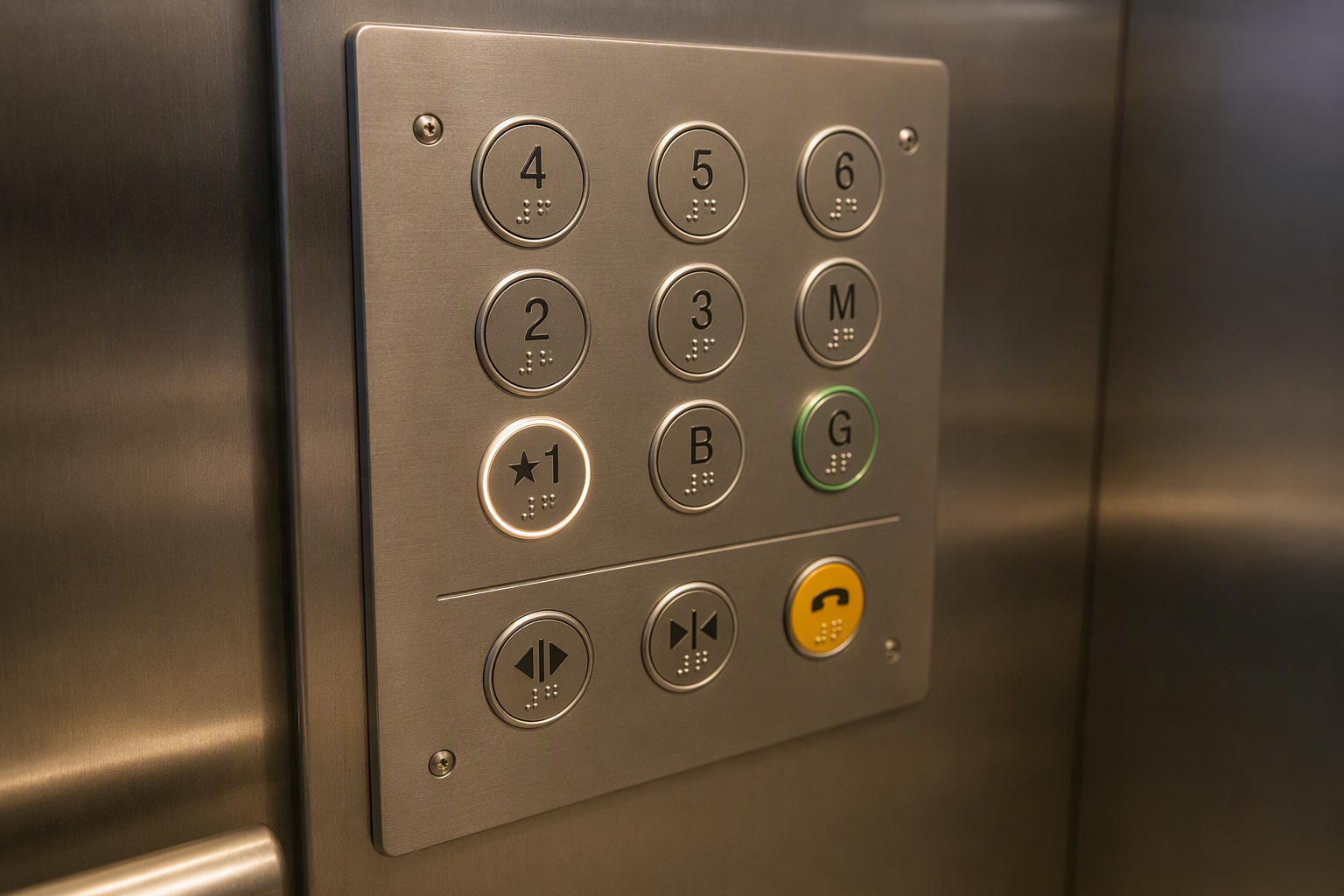
The ADA Standards for Accessible Design require that elevators in multi-story commercial facilities meet specific dimensional, operational, and signage standards so that people with disabilities have equivalent access to all floors.
Under the ADA, elevators must meet standards covering cab dimensions, door clear width, landing and leveling accuracy, controls, Braille and raised-character signage, audible announcements, and emergency communication systems. The key dimensional requirements include a minimum clear floor area inside the cab, a minimum clear door width (typically 36 inches), and precise floor-leveling tolerances so that wheelchair users can enter and exit safely. Controls must be within reach ranges defined by the standards, and two-way emergency communication must be functional at all times.
It is important to distinguish ADA requirements from the mechanical safety code. The ASME A17.1 Safety Code for Elevators and Escalators governs the mechanical, electrical, and structural safety of elevator equipment, while the ADA governs accessibility. Both sets of requirements apply simultaneously to commercial elevators, and compliance with one does not guarantee compliance with the other.
Which Commercial Buildings Are Required to Have an Elevator Under the ADA?
The ADA requires elevators in most new construction commercial buildings that have more than one story, with a specific exemption for buildings that are under three stories or have fewer than 3,000 square feet per floor — but that exemption does not apply to shopping centers, shopping malls, offices of health care providers, terminals, depots, or transportation stations.
Buildings constructed for first occupancy after January 26, 1993 must generally meet the full new construction requirements. Buildings that were in existence before the ADA effective date are subject to the “readily achievable” barrier removal standard for places of public accommodation, or the “path of travel” obligation when alterations are made. This means that even older buildings without elevators may have compliance obligations if they have undergone renovations that trigger accessibility requirements.
Arizona-based building owners should also consult local jurisdiction requirements, as cities such as Phoenix and Scottsdale may have adopted amendments to the International Building Code that interact with ADA obligations at the permitting and certificate-of-occupancy level.
What Is the Difference Between ADA Compliance and ASME A17.1 Code Compliance?
ADA compliance addresses whether a building’s elevator provides equitable access for people with disabilities, while ASME A17.1 compliance addresses whether the elevator’s mechanical and electrical systems are safe to operate.
Building owners must satisfy both frameworks independently. An elevator can pass a mechanical safety inspection and still be non-compliant under the ADA — for example, if controls are mounted too high, if Braille signage is missing, or if the cab dimensions do not meet the current standards. Conversely, an elevator can meet ADA dimensional requirements yet still require mechanical upgrades under ASME A17.1 provisions adopted by Arizona’s state elevator safety program.
Arizona administers elevator safety through the occupational and labor safety framework and through the Arizona Department of Occupational Safety and Health (ADOSH), which enforces periodic inspection requirements aligned with ASME A17.1 and its companion standard, ASME A17.3 for existing installations.
What Are the Specific Dimensional Requirements for an ADA-Compliant Elevator Cab?
The ADA Standards for Accessible Design specify minimum interior cab dimensions and clear floor configurations that depend on the door arrangement and cab type.
| Requirement | ADA Standard (Section 407) | Common Compliance Issue |
|---|---|---|
| Minimum clear door width | 36 inches | Older single-speed doors often fall short |
| Cab interior — door on narrow end | Min. 68 in. wide × 51 in. deep | Retrofitted cabs may not reach depth requirement |
| Cab interior — center-opening or side door | Min. 80 in. wide × 51 in. deep (alternate config.) | Varies by door configuration; verify with plans |
| Floor leveling tolerance | ½ inch maximum variation | Worn hydraulic systems frequently exceed tolerance |
| Control reach range (forward approach) | 15 in.–48 in. above floor | High-mounted panels in legacy installations |
| Control reach range (side approach) | 9 in.–54 in. above floor | Rarely the binding constraint but must be verified |
| Door reopening device | Required; must not require contact | Worn light curtains or door edge sensors |
| Two-way emergency communication | Required; must be usable by those with speech/hearing impairments | Older phone-only intercoms not TTY-compatible |
| Audible and visible floor indicators | Required at each floor | Burned-out indicators or missing audio signals |
| Braille and raised-character signage | Required on all control buttons | Worn or missing Braille on aging panels |
Does My Building’s Construction Date Affect Its ADA Elevator Obligations?
Yes — the ADA uses construction date and alteration history as the primary factors determining which compliance standard applies to a given building.
New construction completed after January 26, 1993 must comply fully with ADA new construction standards from the outset. Existing facilities built before that date that have not been substantially altered are subject to the lower “readily achievable barrier removal” standard for places of public accommodation. However, when a building owner undertakes an alteration — even a partial renovation — the path of travel to the altered area must be made accessible to the extent that the cost of accessibility modifications does not exceed a defined percentage of the overall alteration cost. Buildings that have undergone phased renovations since 1993 are often in a more complex situation and should be evaluated by a qualified elevator contractor or accessibility consultant.
What Happens If My Building Is Not ADA Elevator Compliant?
Non-compliance with the ADA can result in civil lawsuits brought by individuals with disabilities, complaints filed with the U.S. Department of Justice, loss of federal funding eligibility, and mandatory remediation orders — all of which carry significant financial and reputational consequences.
Title III of the ADA, which covers places of public accommodation, allows private individuals to sue for injunctive relief and attorneys’ fees. Title II, which covers state and local government entities, adds the possibility of damages. Arizona has seen elevator-related ADA complaints filed against a range of commercial property types, including medical offices, retail centers, and multi-tenant office buildings. Proactive compliance is substantially less expensive than reactive remediation under litigation pressure.
How Do I Determine Whether My Elevator Is Currently ADA Compliant?
Determining current compliance requires a systematic physical audit of the elevator against the applicable ADA Standards sections, cross-referenced with the building’s permitted drawings, construction date, and alteration history.
The following step-by-step process outlines how a compliance audit is typically conducted:
- Gather documentation: Collect the original building permit, elevator permit, certificate of occupancy, and any alteration permits issued since 1993.
- Identify applicable standard: Determine whether new construction standards, alteration standards, or readily achievable barrier removal standards apply based on construction and renovation dates.
- Measure cab dimensions: Physically measure clear door width, cab depth, and cab width with a certified measuring instrument.
- Test floor leveling: Measure the gap between the cab floor and each landing floor at all stops; document any deviation exceeding one-half inch.
- Inspect controls: Measure control panel button heights against reach range requirements and verify that all buttons have compliant Braille and raised-character labels.
- Test door safety devices: Verify that door reopening devices operate without requiring physical contact and respond within required timing.
- Test emergency communication: Confirm two-way communication functions and assess whether the system accommodates users with hearing or speech impairments.
- Inspect signage and indicators: Audit audible floor announcements, visible floor indicators, and cab identification signage at each landing.
- Document findings: Produce a written report identifying each non-conformance, the applicable standard section, and recommended corrective action.
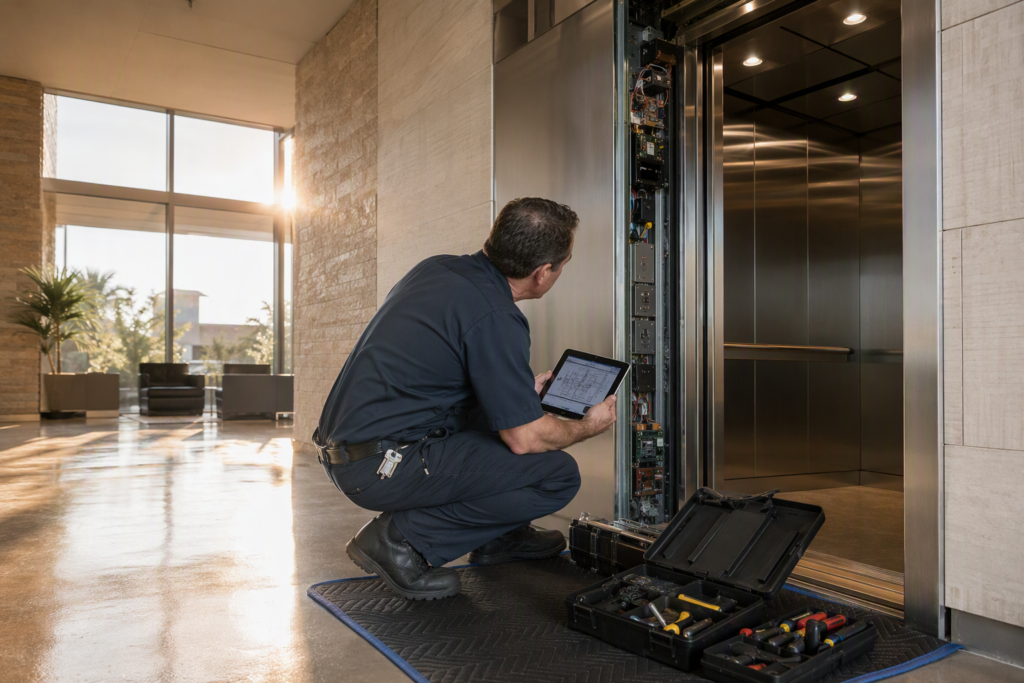
- Engage a qualified elevator contractor: Review findings with a licensed elevator service provider to develop a compliant remediation scope and cost estimate.
Arizona Elevator Solutions provides elevator compliance assessments for commercial properties in Phoenix, Tucson, Scottsdale, and Mesa, helping building owners systematically identify and address both ADA and ASME A17.1 deficiencies before they become regulatory or legal problems.
What Are the ADA Requirements for Elevator Signage and Controls?
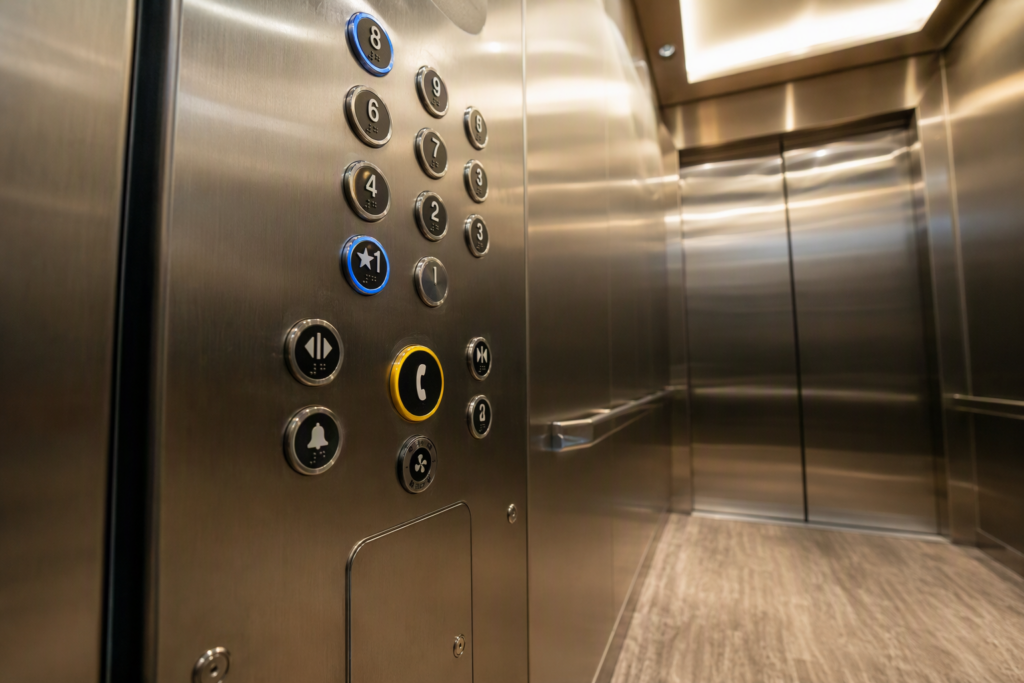
The ADA Standards require that every elevator control button include raised characters and Grade 2 Braille, that call buttons be a minimum of three-quarters of an inch in diameter, and that floor indicators be both audible and visible.
Control panels must include a door-open button, a door-close button, an emergency alarm button, and an emergency stop switch where provided. The emergency alarm button must be identified by a raised star on its left side. Hall call fixtures must include a raised floor designation and Braille. Inside the cab, the floor designation must be provided on both jambs of each hoistway entrance at a height of 60 inches above the floor, centered on the jamb. These requirements exist in older buildings primarily as retrofit obligations when alterations are undertaken, but they represent best practice for any building owner seeking proactive compliance.
Are There ADA Exemptions That Apply to Small Commercial Buildings in Arizona?
The ADA includes an elevator exemption for facilities that are fewer than three stories or have less than 3,000 square feet per story, but this exemption explicitly excludes shopping centers, shopping malls, professional offices of health care providers, transportation facilities, and certain other occupancy types.
For Arizona building owners, this means that a two-story medical office in Scottsdale cannot rely on the small-building exemption, even if its square footage per floor is below the threshold. A two-story private office building that does not serve the public as a place of public accommodation may qualify for the exemption, but the analysis depends on the specific use, tenant mix, and whether the building is subject to Title II or Title III of the ADA. Legal counsel familiar with ADA compliance is advisable when the exemption is being considered as a compliance strategy.
How Often Must Commercial Elevators Be Inspected Under Arizona Law?
Arizona requires periodic safety inspections of commercial elevators under state law enforced by ADOSH, with inspection intervals governed by ASME A17.1 and ASME A17.3 as adopted in Arizona’s elevator safety regulations.
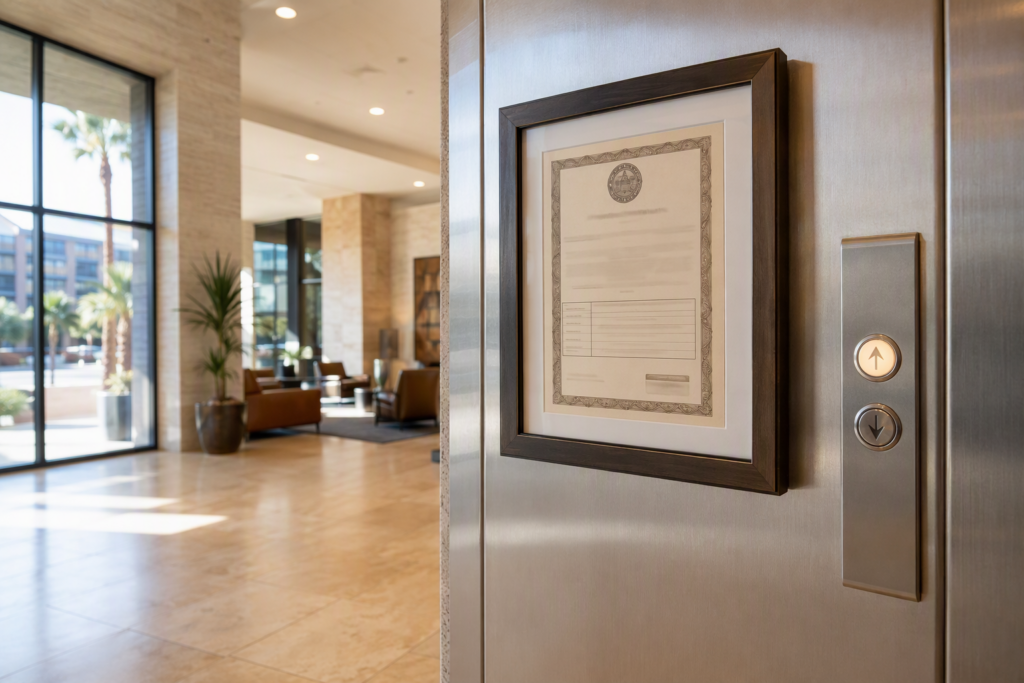
Inspections must be performed by a qualified elevator inspector holding appropriate state certification. Building owners are responsible for ensuring that valid inspection certificates are maintained and posted in the elevator cab as required by state law. Failure to maintain current inspection certificates is itself a compliance violation independent of ADA obligations. Arizona Elevator Solutions assists property owners in Phoenix, Mesa, Tucson, and Scottsdale with inspection scheduling and documentation management to ensure continuous certificate validity.
What Is the Difference Between an ADA Compliance Audit and a Routine Safety Inspection?
A routine safety inspection performed under ASME A17.1 evaluates whether the elevator’s mechanical, electrical, and structural components are operating safely — it does not assess ADA accessibility compliance.
An ADA compliance audit is a separate, purpose-specific evaluation that measures physical dimensions, tests operational features, reviews signage and communication systems, and compares findings against the applicable ADA Standards sections. Building owners frequently assume that passing a state safety inspection means the elevator is ADA compliant — this is not the case. The two evaluations address different regulatory frameworks and must be conducted independently. A comprehensive compliance program addresses both simultaneously.
What Modifications Are Most Commonly Needed to Bring an Elevator Into ADA Compliance?
The most frequently identified ADA deficiencies in existing commercial elevator installations relate to control panel reach ranges, Braille and raised-character signage, floor leveling tolerances, emergency communication systems, and door reopening device functionality.
Control panel replacement or repositioning to meet reach range requirements is one of the most common remediation measures in older Phoenix and Tucson commercial buildings. Braille overlay kits or full panel replacements address worn or missing tactile signage. Hydraulic system repairs or modernization address floor leveling tolerances in older hydraulic installations. Emergency communication upgrades to TTY-compatible or visual-alert systems address the hearing-impairment accessibility requirement. Door edge protection or light curtain replacement addresses non-contact door reopening requirements. In cases where cab dimensions are fundamentally inadequate, a cab rebuild or elevator modernization project may be the only path to full compliance.
How Does an Elevator Modernization Project Affect ADA Compliance Obligations?
When a building owner undertakes an elevator modernization — replacing the controller, drive, cab interior, or other major components — the project typically triggers an obligation to bring the elevator into compliance with current ADA Standards to the maximum extent feasible.
Under the ADA’s alteration requirements, a path-of-travel obligation attaches when an alteration is made to an area containing a primary function. An elevator modernization is itself an alteration that can trigger compliance requirements for the elevator and the accessible route to it. This means that a modernization project is both an opportunity and a legal trigger for comprehensive ADA remediation. Building owners in Mesa, Scottsdale, Phoenix, and Tucson who are planning modernization projects should engage their elevator contractor early to incorporate ADA compliance work into the overall project scope, avoiding the cost and disruption of a second mobilization.
What Are the ADA Requirements for Emergency Communication in Elevators?
The ADA Standards require that elevators provide a two-way emergency communication system that is accessible to individuals who are deaf or hard of hearing, which in practice means the system must not rely solely on voice communication.
Compliant emergency communication systems must include both audible and visible signals, and must be operable without voice communication. Many older elevator installations rely on a standard telephone handset that is inaccessible to users with hearing or speech impairments. Modern compliant systems use two-way visual display communication, automatic voice announcement with visual confirmation, or integrated building management system connections that enable text-based communication. Post-2010 ADA Standards guidance has reinforced this requirement, and building owners with legacy phone-only systems should treat upgrade as a priority compliance item.
Are Platform Lifts an ADA-Compliant Alternative to an Elevator?
Platform lifts are recognized under the ADA Standards as an accessible means of vertical access in specific limited circumstances, but they are not a general substitute for an elevator in buildings that require elevator access under the ADA.
The ADA Standards permit platform lifts in new construction and alterations only in specified conditions: to provide an accessible route to a raised or sunken area in a dining or performance space, to provide an accessible route in a transient lodging facility or guest room, to provide access to raised jury boxes or witness stands, to provide access in existing buildings when the installation of a ramp or elevator is technically infeasible, and in a few other defined situations. Platform lifts must meet ASME A18.1 Safety Standard for Platform Lifts and Stairway Chairlifts and must be independently operable by the user without assistance. For most commercial building owners, a platform lift is not a compliant substitute for an elevator where the ADA requires one.
How Long Does It Take to Complete ADA Elevator Remediation?
The timeline for ADA elevator remediation depends on the scope of deficiencies identified, the availability of parts, the complexity of the work, and whether a full modernization or targeted repairs are required.
Minor remediation — such as control panel signage replacement, door edge sensor upgrade, or emergency communication system replacement — can typically be completed within days to weeks once parts are sourced. Moderate remediation involving control panel repositioning, cab interior modifications, or hydraulic leveling system repairs may require several weeks of planning and a scheduled shutdown period. Full cab modernization or elevator replacement projects require engineering, permitting, and construction timelines that commonly extend over several months. Building owners should plan remediation timelines carefully to minimize tenant disruption, particularly in multi-tenant Phoenix and Tucson commercial buildings where elevator downtime has direct business impact.
What Documentation Should a Building Owner Maintain to Demonstrate ADA Elevator Compliance?
Building owners should maintain a compliance file that includes the original elevator permit and certificate of occupancy, dated ADA compliance audit reports, all inspection certificates, maintenance records, remediation work orders and completion documentation, and records of any modifications made to the elevator since original installation.
This documentation serves multiple purposes: it demonstrates good-faith compliance efforts in the event of a complaint or lawsuit, supports ongoing maintenance scheduling, provides the historical record needed to determine which ADA standard applies when alterations are made, and facilitates the due diligence process when a property is sold. Arizona Elevator Solutions recommends that commercial property owners in Phoenix, Tucson, Scottsdale, and Mesa maintain a centralized compliance file updated after every inspection, maintenance event, and modification.
What Is the Role of the 2010 ADA Standards for Accessible Design in Current Elevator Compliance?
The 2010 ADA Standards for Accessible Design, which became effective for new construction and alterations on March 15, 2012, represent the current governing standard for elevator accessibility compliance under the ADA.
Buildings that were designed and constructed in compliance with the original 1991 ADA Standards are considered to be in compliance with the 2010 Standards for the elements covered by the 1991 Standards, with certain exceptions. Where the 2010 Standards provide greater accessibility, new construction and alterations initiated on or after March 15, 2012 must comply with the 2010 Standards. As of 2026, any commercial elevator project — modernization, repair, or new installation — must be evaluated against the 2010 ADA Standards unless a specific grandfather provision applies. Building owners who have not reviewed their elevators against the 2010 Standards since 2012 should consider scheduling an updated compliance audit.
How Does Arizona’s State Elevator Safety Program Interact With Federal ADA Requirements?
Arizona’s state elevator safety program, enforced through ADOSH and aligned with ASME A17.1 and related ASME standards, operates independently of the federal ADA enforcement framework administered by the U.S. Department of Justice and the U.S. Access Board.
State inspectors enforce mechanical safety and ASME code compliance; they do not conduct ADA accessibility audits. Federal ADA enforcement can be triggered by a private complaint, a DOJ investigation, or a civil lawsuit — none of which require prior state inspection failure. This means a building can be current on all Arizona state inspection requirements and still face federal ADA exposure. The two compliance frameworks are complementary and both necessary, but they must be managed through separate processes with separate documentation.
How Can Arizona Elevator Solutions Help With ADA and ASME Compliance?
Arizona Elevator Solutions is a certified elevator service company serving commercial property owners in Phoenix, Tucson, Scottsdale, and Mesa, providing the full range of services needed to achieve and maintain both ADA accessibility compliance and ASME A17.1 mechanical code compliance.
Services available from Arizona Elevator Solutions include comprehensive ADA compliance audits that document current conditions against applicable standards, remediation planning and implementation for identified deficiencies, elevator modernization projects that incorporate ADA compliance as a core project objective, ongoing maintenance programs that preserve compliant operating condition, and inspection coordination that keeps Arizona state elevator certificates current. For commercial building owners navigating the intersection of ADA obligations, ASME safety requirements, and Arizona state elevator law, Arizona Elevator Solutions provides the technical expertise and local market knowledge needed to manage compliance proactively rather than reactively.
Need elevator service you can rely on? Arizona Elevator Solutions is ready to help.