Elevator Industry Statistics 2025: Who to Contact & Where to Find Authoritative Data

Understanding where to find reliable elevator industry data matters whether a building owner is benchmarking maintenance costs, preparing for a code compliance inspection, or evaluating a capital modernization project. This page identifies the leading sources of elevator industry statistics for 2025, explains what each publishes, and covers the full range of questions facility professionals and property managers typically ask when researching this topic.
What Are the Most Authoritative Sources for Elevator Industry Statistics in 2025?
No single agency owns all elevator data. Reliable statistics are distributed across several organizations, each with a distinct mandate:
- National Elevator Industry Inc. (NEII): NEII is the primary trade association representing elevator manufacturers and major contractors in North America. It publishes industry outlook reports, workforce data, and modernization trend summaries. NEII is widely cited in policy discussions and is considered the industry’s own statistical voice.
- U.S. Bureau of Labor Statistics (BLS): The BLS Occupational Employment and Wage Statistics program tracks employment counts, wage levels, and geographic distribution for elevator installers and repairers (SOC code 47-4021). This is the go-to source for workforce-level benchmarking.
- ASME International: ASME Codes & Standards — specifically the ASME A17.1 Safety Code for Elevators and Escalators — sets the technical baseline for inspection intervals, load requirements, and safety device specifications. Code editions and their adoption timelines are published directly by ASME.
- Occupational Safety and Health Administration (OSHA): OSHA publishes enforcement data, injury and fatality statistics related to elevator construction and maintenance work, and inspection violation summaries that are publicly searchable.
- Elevator Escalator Safety Foundation (EESF): The EESF focuses on public safety education and compiles incident data to support awareness campaigns. Its publications are often cited in building management and risk contexts.
- U.S. Consumer Product Safety Commission (CPSC): The CPSC tracks elevator-related injuries involving consumers and publishes data through its National Electronic Injury Surveillance System (NEISS), which is a key source for injury frequency data.
- Americans with Disabilities Act (ADA) Technical Assistance: ADA.gov publishes technical guidance on vertical accessibility requirements. For building owners assessing compliance exposure, ADA data on covered facilities and complaint trends is publicly accessible.
- State Departments of Labor and Industrial Commissions: In Arizona and most other states, the state-level agency that administers elevator inspection programs publishes permitting counts, inspection outcomes, and violation categories. These records are often available through public records requests.
What Does ASME A17.1 Require and Where Can I Find the Official Code?

The ASME A17.1 Safety Code for Elevators and Escalators is the foundational document governing elevator design, installation, inspection, testing, and maintenance in the United States and Canada. State and local jurisdictions typically adopt editions of A17.1 by reference into their building codes, meaning compliance with A17.1 is legally required in most commercial and multi-family residential buildings.
Key areas addressed by ASME A17.1 include:
- Periodic inspection and testing intervals for different elevator categories
- Safety device specifications including governor, safeties, and buffers
- Load capacity and platform area requirements
- Firefighters’ emergency operation requirements
- Maintenance program requirements introduced in more recent code editions
Because states adopt code editions on different schedules, building owners should verify which edition their jurisdiction has adopted before drawing compliance conclusions from any generalized statistics. Arizona Elevator Solutions works with clients to identify the applicable edition for their specific facility type and local jurisdiction.
What OSHA Standards Apply to Elevator Maintenance Workers?
OSHA enforces workplace safety regulations that apply to elevator constructors and maintenance technicians. The primary hazard categories tracked by OSHA in this sector include:
- Falls into or within elevator shafts
- Struck-by incidents from moving counterweights or cars
- Electrical hazards during maintenance and testing procedures
- Engulfment or entrapment in machinery spaces
OSHA’s publicly searchable enforcement database allows building owners, safety professionals, and researchers to query violation history by industry classification, which provides a practical proxy for identifying where systemic risks concentrate in elevator maintenance operations. This data is directly accessible through OSHA’s website and is updated on an ongoing basis.
What Workforce Data Is Available for the Elevator Industry in 2025?
The U.S. Bureau of Labor Statistics publishes annual Occupational Employment and Wage Statistics that cover elevator installers and repairers as a distinct occupation. These reports include national employment counts, median annual wages, wage percentile distributions, and state-level employment concentrations. The BLS also publishes occupational outlook projections that indicate whether employment in a field is expected to grow, decline, or remain stable over a ten-year horizon.
For 2025 planning purposes, building owners and property managers reviewing maintenance contract pricing can cross-reference BLS wage data with contractor bids to develop a general sense of labor cost baselines. However, regional labor market conditions, union agreements, and skill scarcity in specific markets can cause local rates to vary significantly from national medians.
Arizona Elevator Solutions monitors workforce trends in the Arizona market to provide clients with context-informed guidance when evaluating service contract proposals and modernization project timelines.
How Do I Find Elevator Inspection Violation Data for My State?
State-level elevator inspection programs are administered by varying agencies depending on jurisdiction — typically the Department of Labor, the Department of Fire Safety, or an Industrial Commission. In Arizona, the Elevator Safety Program operates under the state’s regulatory authority and maintains records of permitted elevators, inspection outcomes, and violation notices.
To access this data:
- Identify the state agency that administers elevator inspections in your jurisdiction (in Arizona, consult the Arizona Department of Occupational Safety and Health or the relevant municipal authority for your city).
- Submit a public records request for inspection reports, violation notices, or permit counts using the agency’s standard request form.
- Review OSHA’s online enforcement database for any federal inspection records tied to your facility or contractor, searchable by establishment name or NAICS code.
- Cross-reference any state citations with the applicable edition of ASME A17.1 to understand the technical basis for each violation category.
- Consult a qualified elevator service provider, such as Arizona Elevator Solutions, to interpret the practical compliance implications for your specific equipment.
What ADA Data Is Available for Elevator Accessibility Compliance?
The Americans with Disabilities Act establishes vertical accessibility requirements for most commercial buildings and places of public accommodation. ADA.gov publishes technical guidance documents, complaint data summaries, and technical assistance materials that are publicly available without cost.
For building owners assessing elevator accessibility compliance, the relevant ADA standards cover:
- Minimum cab dimensions and door clear width requirements
- Control panel height and reach range specifications
- Auditory and visual signal requirements at landings and inside cabs
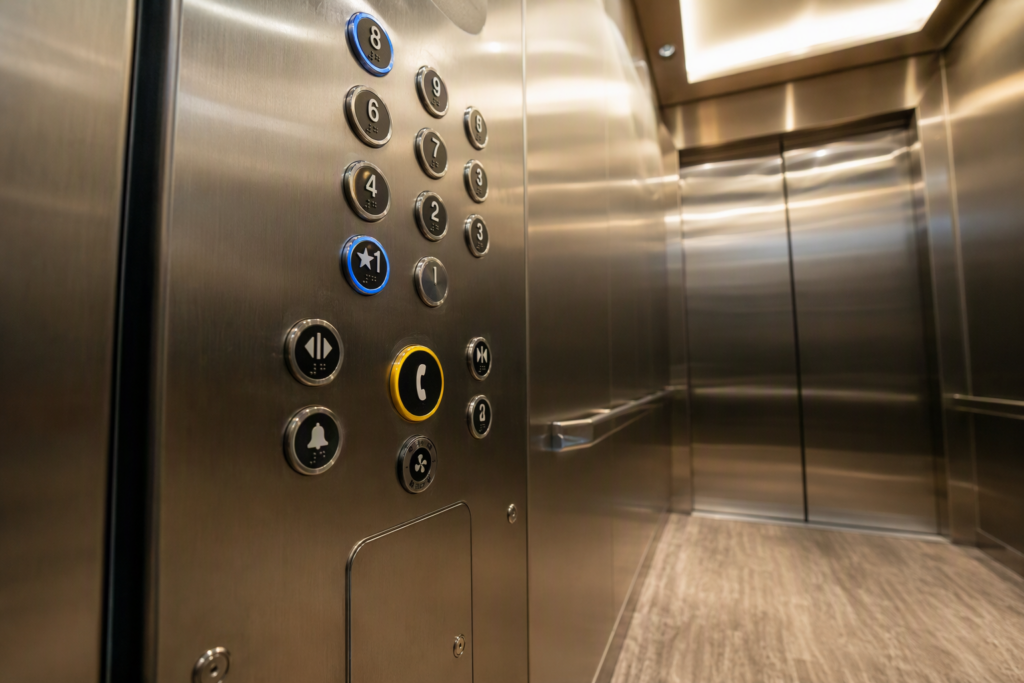
- Braille and raised character requirements for control buttons and floor designations
- Door timing requirements to allow safe entry and exit for individuals with mobility impairments
ADA complaint data, accessible through ADA.gov, can help building owners understand which categories of accessibility deficiency are most frequently cited, which is useful context when prioritizing modernization scope.
What Industry Trends Are Shaping Elevator Statistics in 2025 and 2026?
Several qualitative trends are reshaping the landscape that elevator statistics will reflect over the 2025–2026 period:
- Accelerating modernization demand: A large portion of the installed elevator base in the United States was installed or last modernized decades ago. As equipment ages past typical component life cycles, modernization inquiries are rising across all building categories. This trend drives increased permitting activity, which will appear in state inspection databases.
- Digital monitoring and predictive maintenance: Remote monitoring technology — which transmits real-time performance data from elevator controllers to service centers — is becoming increasingly standard in new installations and modernization scopes. This shift is changing the nature of maintenance data available to building owners, moving from reactive repair records toward predictive performance analytics.
- Code adoption cycles: States continue to adopt newer editions of ASME A17.1 on rolling schedules. As more jurisdictions move to recent editions, the population of buildings requiring upgrades to meet current code requirements grows, contributing to rising modernization and alteration permit counts in state data.
- Supply chain normalization: After disruption-driven lead time extensions in recent years, the elevator component supply chain is stabilizing, which is expected to improve project completion timelines for modernization work.
- Workforce development pressure: The specialized nature of elevator mechanic training — typically completed through multi-year apprenticeship programs — means that labor supply responds slowly to demand changes. Workforce data from BLS and NEII over the 2025–2026 period is expected to continue reflecting tight labor conditions in high-growth markets including Arizona.
How Should Building Owners Use Industry Statistics When Evaluating Maintenance Contracts?
Industry statistics serve several practical functions when a building owner or facility manager is reviewing a maintenance contract proposal:
- Benchmarking labor components: BLS wage data provides a general frame of reference for understanding the labor cost component embedded in a service contract price, though actual rates vary by market and labor agreement.
- Assessing compliance risk: State inspection violation data and OSHA enforcement records can reveal which equipment categories and maintenance practices are generating the most regulatory attention, helping owners prioritize contract scope.
- Setting inspection expectations: Understanding the inspection interval requirements in the applicable edition of ASME A17.1 allows building owners to verify that a proposed maintenance contract includes the required periodic tests and inspections rather than relying on a contractor’s characterization alone.
- Planning capital reserves: Modernization trend data from NEII and state permitting records can help building owners contextualize where their equipment sits relative to the broader installed base, supporting long-range capital reserve planning.
Arizona Elevator Solutions supports building owners through this evaluation process by providing data-informed guidance on compliance status, equipment condition, and service contract scope.
What Data Sources Are Most Relevant for Commercial Real Estate Owners Specifically?
Commercial real estate owners have specific data needs that differ from those of residential property managers or public facility operators. The most relevant sources for commercial contexts include:
- NEII industry reports for market-level modernization activity and manufacturer capacity
- ADA.gov technical guidance for accessibility compliance risk assessment across a portfolio
- State inspection program databases for permit status and violation history on specific assets
- OSHA enforcement data for contractor safety records, relevant during vendor due diligence
- ASME A17.1 for understanding what the applicable code requires at the equipment level, informing capital expenditure planning
Portfolio-level assessment becomes particularly important when a commercial real estate owner is conducting due diligence on an acquisition or preparing a building for disposition. Arizona Elevator Solutions provides assessments that translate code and inspection data into practical condition and compliance summaries for these contexts.
What Should I Do Immediately If I Suspect My Elevator Is Out of Compliance?
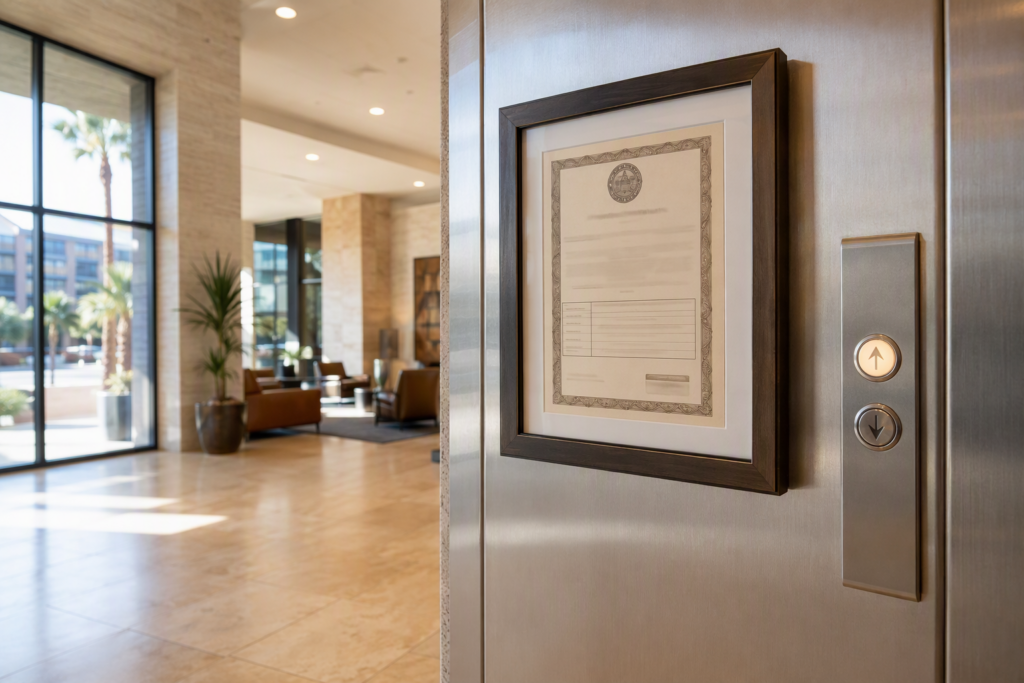
- Review the most recent inspection certificate posted in the elevator cab. In most jurisdictions, this certificate is required to be current and publicly displayed.
- Contact the state or local elevator inspection authority to verify the permit and inspection status of the equipment in question.
- Pull the maintenance log or service records from your current contractor to identify any open deficiencies or deferred repairs.
- Cross-reference any cited deficiencies against the applicable edition of ASME A17.1 to understand the severity and code basis for the issue.
- Review any ADA-related concerns separately against the current ADA standards, as ADA compliance is a civil rights obligation independent of state safety inspection status.
- Engage a qualified elevator service provider to conduct a documented condition and compliance assessment before the next scheduled inspection, so deficiencies can be remediated proactively rather than cited by the inspector.
- Document all steps taken and retain records, as demonstrated good-faith compliance efforts are relevant in any regulatory or legal context.
How Does Arizona Elevator Solutions Use Industry Data to Serve Clients?
Arizona Elevator Solutions approaches every client engagement as a data-informed process. Rather than relying on generalized assumptions, the team draws on publicly available code requirements from ASME, ADA technical guidance, and OSHA standards to contextualize equipment condition, inspection status, and compliance exposure for Arizona building owners.
The company serves commercial, multifamily, and institutional building owners across Arizona, providing assessments, maintenance oversight support, and modernization planning guidance that is grounded in the actual regulatory and technical standards applicable to each client’s equipment and jurisdiction. By staying current with code adoption developments and workforce conditions in the Arizona market, Arizona Elevator Solutions helps clients make informed decisions rather than reacting to compliance surprises.
Are Elevator Safety Statistics Different for Residential Versus Commercial Buildings?
The regulatory framework does distinguish between building types in meaningful ways. ASME A17.1 addresses both commercial and residential elevator categories, with separate requirements for private residence elevators (often covered under ASME A17.1 Part 25 or related standards) compared to commercial passenger elevators. Inspection requirements, testing intervals, and enforcement mechanisms typically differ by building category as well.
OSHA’s jurisdiction is focused on worker safety rather than passenger safety, so OSHA data is most directly relevant to facilities where elevator maintenance workers operate — essentially all buildings with power-operated elevators. The CPSC’s injury surveillance data, by contrast, covers consumer and public injuries regardless of building type.
ADA requirements apply specifically to places of public accommodation and commercial facilities, not to private residences, which means the ADA compliance data landscape is concentrated in commercial and institutional building types.
What Is a Realistic Timeline for an Elevator Modernization Project Based on Industry Conditions?
Modernization timelines vary based on equipment type, scope of work, component availability, permit processing time in the local jurisdiction, and contractor scheduling. Rather than citing figures that could quickly become outdated, the following qualitative framework reflects the factors that drive timeline variability:
- Permit processing: Local inspection authority permit review periods vary significantly and represent a fixed lead time that begins before physical work can start. Building owners should factor permit timelines into project planning.
- Component procurement: Certain modernization components, particularly control systems and door operators from specific manufacturers, may carry lead times that extend overall project duration. Supply chain conditions as of 2025 have improved relative to prior years but remain variable by manufacturer and component category.
- Inspection scheduling: Post-modernization inspections must be completed by the authority having jurisdiction before a modernized elevator can return to service. Inspector availability affects final project closeout timing.
- Scope complexity: Full cab modernizations, machine room reconfigurations, or projects involving seismic upgrades or ADA remediation in addition to mechanical modernization will have longer durations than single-system replacements.
Arizona Elevator Solutions works with clients to develop realistic project timelines that account for local permitting conditions and current procurement realities in the Arizona market.
How Often Should Elevators Be Inspected Under Current Code Requirements?
Inspection intervals are governed by the edition of ASME A17.1 adopted in the applicable jurisdiction, as well as any additional requirements imposed by state or local regulations. Generally, the code establishes distinct intervals for:
- Periodic inspections (typically annual for most commercial elevator types)
- Periodic tests, which may occur on different cycles than inspections (such as five-year full-load safety tests for certain categories)
- Category 1 and Category 5 tests, which are defined in A17.1 with specific procedures and intervals
Because the specific interval depends on elevator category, local jurisdiction, and the adopted code edition, building owners should not rely on generalized summaries alone. Verifying the applicable requirements directly with the state inspection authority or a qualified service provider is the appropriate approach.
Where Can I Compare Elevator Service Vendors Using Publicly Available Data?
Publicly available data useful for vendor comparison includes:
- OSHA enforcement records, searchable by establishment name, which reveal any federal safety citations issued to a contractor’s workforce
- State contractor licensing databases, which typically show license status, any disciplinary actions, and the categories of work a contractor is authorized to perform
- State inspection authority records, which in some jurisdictions allow owners to identify the contractor of record for inspected elevators and review associated outcomes
- Better Business Bureau and state attorney general complaint records for consumer-facing service issues
No single database provides a comprehensive vendor scorecard, so a multi-source approach to due diligence is advisable. Arizona Elevator Solutions encourages prospective clients to conduct this research and welcomes questions about how the company’s approach to compliance and documentation compares to alternatives.
Summary: Key Contacts for Elevator Industry Statistics in 2025
| Organization | Type of Data Published | Access Method |
|---|---|---|
| National Elevator Industry Inc. (NEII) | Industry outlook, workforce, modernization trends | NEII.org (public and member reports) |
| U.S. Bureau of Labor Statistics (BLS) | Employment counts, wages, occupation projections | BLS.gov — Occupational Employment Statistics |
| ASME International | A17.1 code requirements, inspection intervals, technical standards | ASME.org — Codes & Standards |
| OSHA | Enforcement actions, injury/fatality data, violation categories | OSHA.gov — Enforcement database |
| Elevator Escalator Safety Foundation (EESF) | Public safety incident data, awareness statistics | ElevatorSafety.org |
| U.S. Consumer Product Safety Commission (CPSC) | Consumer injury surveillance (NEISS data) | CPSC.gov — NEISS database |
| ADA.gov | Accessibility requirements, complaint trends, technical guidance | ADA.gov — Technical Assistance |
| State Elevator Inspection Programs | Permit counts, inspection outcomes, violation records | Public records request to state agency |
Note: This table lists organizations and the types of data they publish. All figures used for planning or compliance decisions should be drawn directly from the source organization’s current publications rather than from secondary summaries.
Get Expert Guidance Grounded in Current Industry Standards
Navigating elevator industry statistics, code requirements, and compliance obligations is more complex than searching a single database. Arizona Elevator Solutions brings together knowledge of applicable ASME codes, ADA requirements, OSHA standards, and Arizona-specific regulatory conditions to provide building owners with clear, actionable guidance.
Whether a building owner is preparing for an upcoming inspection, evaluating a modernization proposal, assessing ADA compliance exposure, or simply trying to understand what the data means for their specific equipment, Arizona Elevator Solutions provides the context and support needed to make informed decisions.
Contact Arizona Elevator Solutions for a free elevator assessment: 480-557-7600
Need elevator service you can rely on? Arizona Elevator Solutions is ready to help.