Commercial Building Elevator Service Contract: Complete FAQ Guide
A commercial elevator service contract protects building owners, tenants, and visitors by establishing a consistent, documented maintenance program. Whether you manage office towers in Phoenix, retail centers in Scottsdale, healthcare facilities in Tucson, or multi-family complexes in Mesa, understanding what a service contract covers — and what it should require — is essential to managing liability, controlling costs, and staying compliant with Arizona elevator regulations and federal standards.
What Is a Commercial Building Elevator Service Contract?
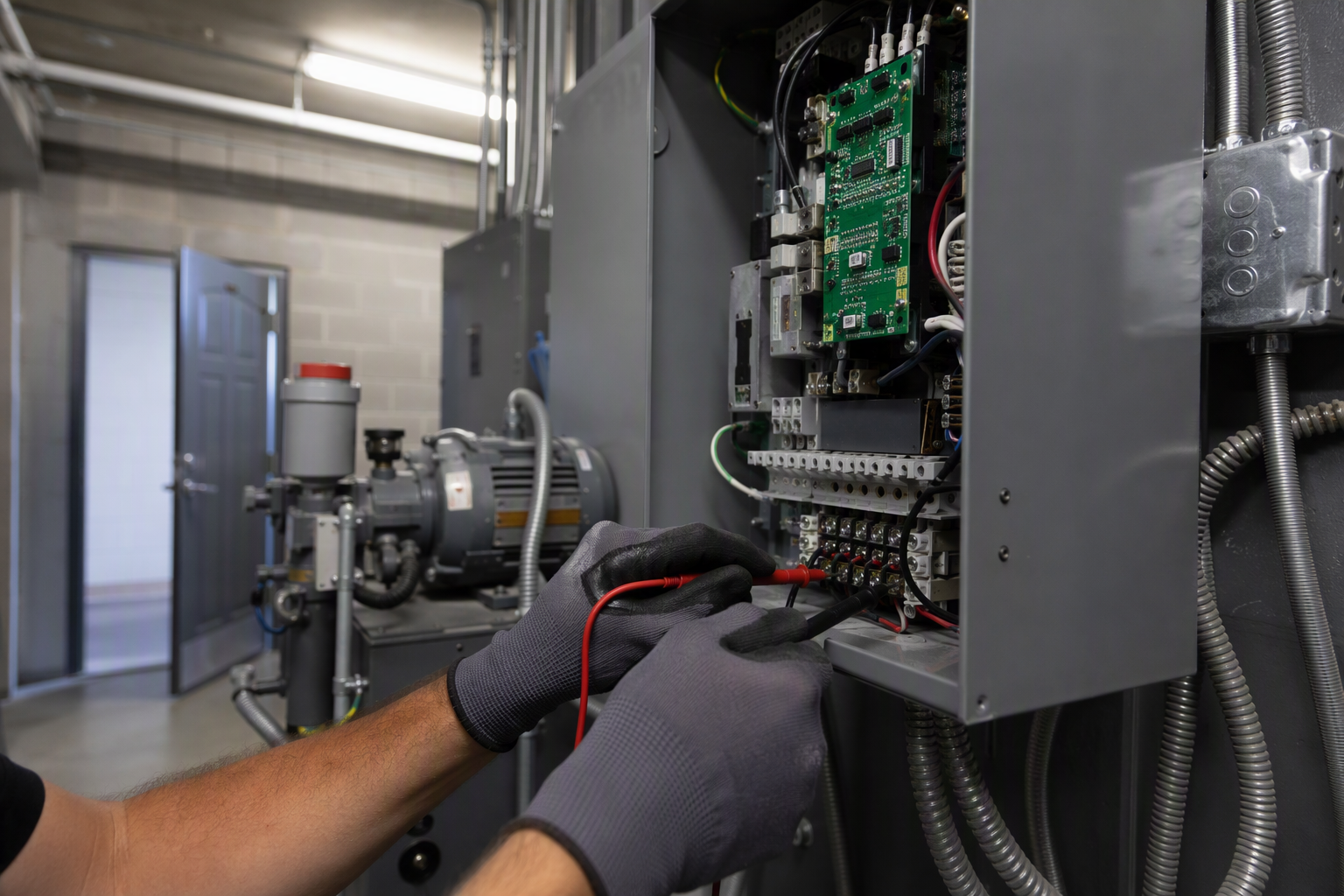
A commercial building elevator service contract is a legally binding maintenance agreement that specifies scheduled inspections, preventive maintenance tasks, parts coverage, emergency call protocols, and code-compliance documentation for one or more elevators in a commercial property.
Unlike a one-time repair call, a service contract creates an ongoing relationship between the property manager and the elevator service provider. The contract typically defines the frequency of technician visits, which components are covered under routine maintenance versus additional billing, how callbacks and emergency responses are handled, and who is responsible for maintaining state-mandated inspection records. In Arizona, elevators fall under the regulatory authority of the Arizona Department of Occupational Safety and Health (ADOSH), which enforces inspection and permit requirements for vertical transportation equipment in commercial buildings.
Why Does a Commercial Building Need an Elevator Service Contract?

Commercial buildings need elevator service contracts because elevators are life-safety systems subject to mandatory inspection schedules, and unplanned breakdowns create liability exposure, ADA compliance risks, and significant tenant disruption.
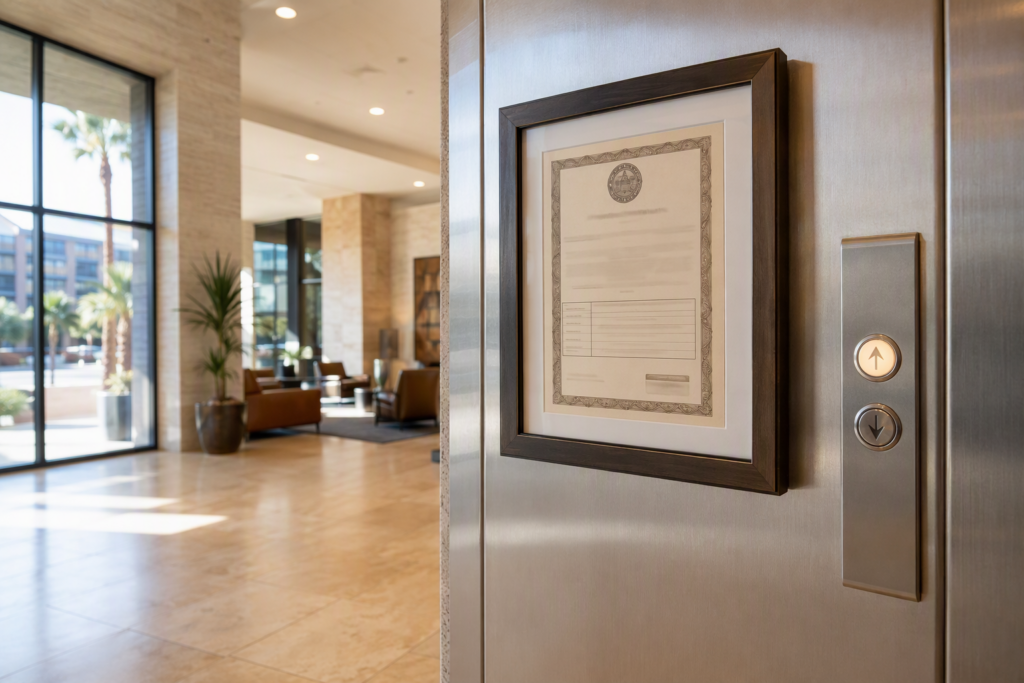
Arizona law requires periodic inspections for most commercial elevators, and building owners are responsible for ensuring equipment is maintained in safe operating condition between those inspections. A formal service contract creates the paper trail needed to demonstrate due diligence. Beyond regulatory compliance, a structured maintenance program helps identify wear before it becomes failure, reducing emergency repair costs and unplanned downtime. For properties with ADA-covered tenants or customers, elevator outages can also trigger complaints under the Americans with Disabilities Act, making reliable service a legal priority, not just a convenience.
What Are the Main Types of Elevator Service Contracts?
The three main types of elevator service contracts are oil-and-grease (lubrication-only) contracts, full maintenance contracts, and full coverage contracts — each offering a progressively broader scope of parts and labor inclusion.
Understanding these tiers is critical before signing any agreement. Below is a comparison of the most common contract structures:
| Contract Type | Preventive Maintenance Included | Parts Covered | Labor on Repairs Covered | Best Suited For |
|---|---|---|---|---|
| Oil & Grease / Lubrication Only | Yes — basic lubrication and adjustment | No | No | New equipment under manufacturer warranty |
| Full Maintenance | Yes — comprehensive PM tasks | Consumable/wear parts | Yes — during scheduled visits | Mid-age equipment in moderate-use buildings |
| Full Coverage / Comprehensive | Yes — all PM tasks | Yes — most parts including major components | Yes — including emergency callbacks | High-traffic or older equipment; risk-averse owners |
| Modernization Bridge Contract | Yes — focused on safety | Limited / as available | Yes — within scope | Equipment pending scheduled modernization |
Property managers should review the exclusions list of any contract carefully. Common exclusions include vandalism damage, cab interior cosmetics, hydraulic cylinder replacement, and pit flooding remediation. Negotiating these exclusions upfront is far more effective than disputing invoices after a major repair event.
What Does a Standard Commercial Elevator Service Contract Include?
A standard commercial elevator service contract includes scheduled preventive maintenance visits, lubrication of mechanical components, safety device testing, minor adjustments, emergency callback service, and annual inspection coordination with the authority having jurisdiction.
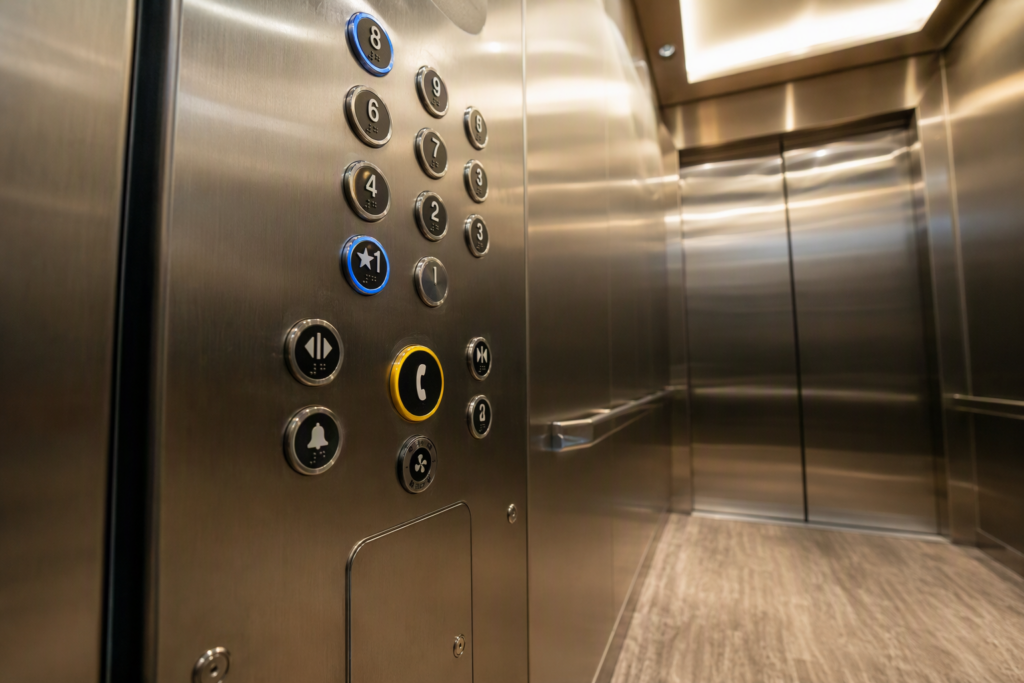
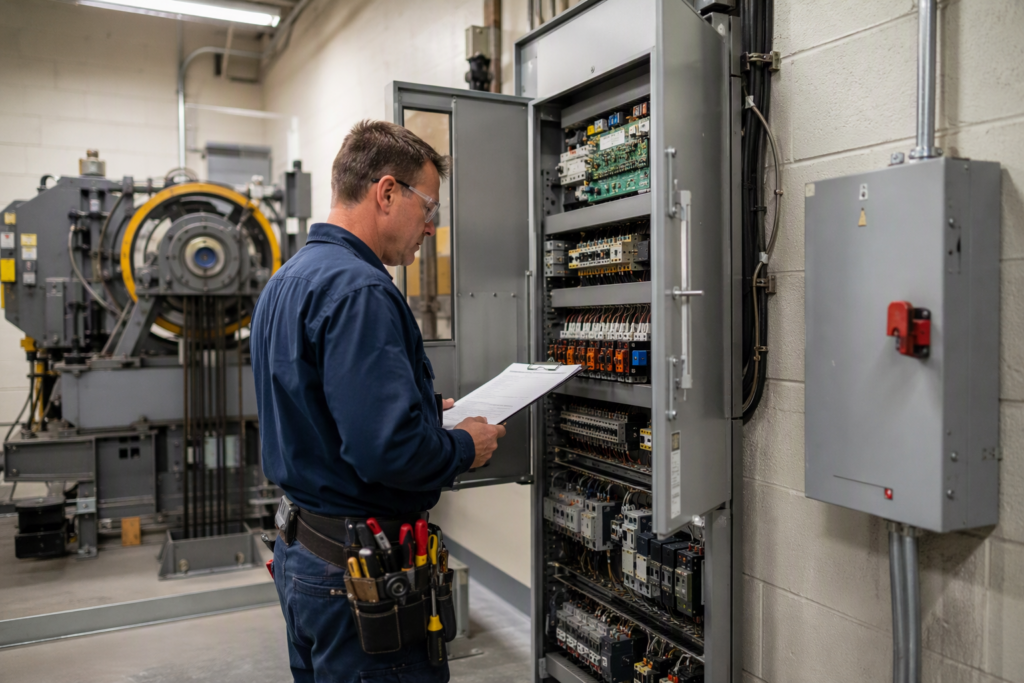
More specifically, a well-structured contract should address: machine room equipment (motor, controller, drive unit), hoistway components (rails, buffers, counterweights), door systems (operators, clutches, safety edges), cab equipment (lighting, signals, emergency phone), and pit equipment (oil, buffers, traveling cables). Each of these systems has specific maintenance tasks outlined in ASME A17.1 Safety Code for Elevators and Escalators, the primary national standard governing elevator design, installation, and maintenance across the United States, including Arizona.
How Often Should a Commercial Elevator Be Serviced Under a Contract?
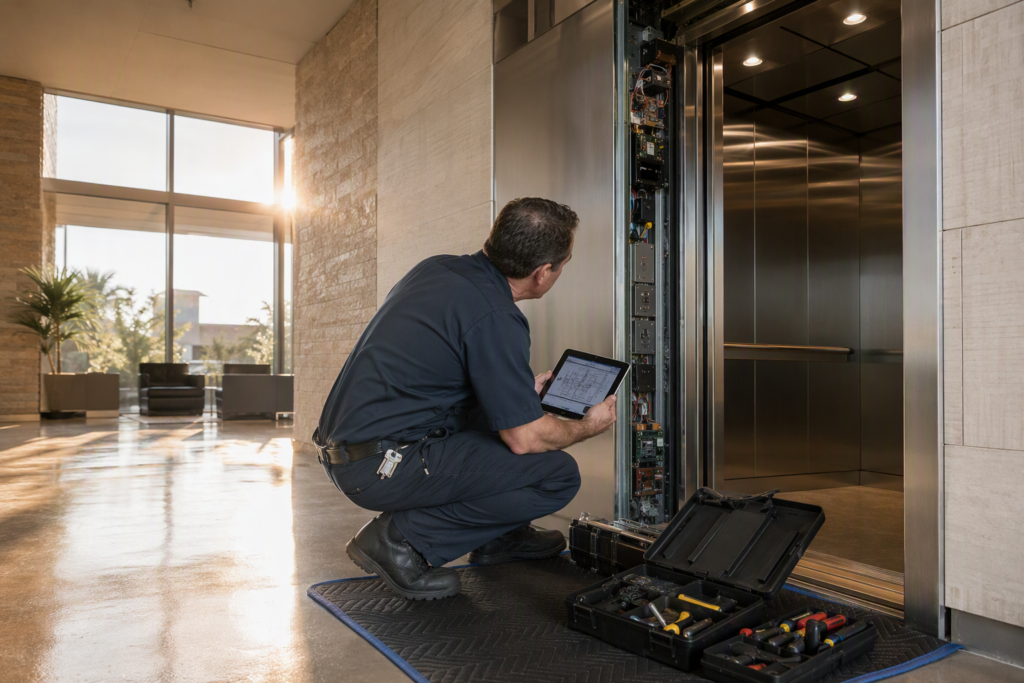
Most commercial elevator service contracts schedule preventive maintenance visits monthly or quarterly, with the appropriate frequency depending on equipment age, traffic volume, elevator type, and the specific tasks required by the maintenance control program.
The 2019 and current editions of ASME A17.1 introduced the concept of a Maintenance Control Program (MCP), which requires elevator contractors to document maintenance procedures and intervals for every covered component. This means service frequency is no longer simply a negotiating point — it must be defensible based on the actual equipment and usage conditions. High-traffic elevators in commercial office buildings or hospitals in Phoenix or Scottsdale typically warrant monthly visits, while lower-traffic equipment in smaller Mesa or Tucson properties may be appropriately served on a quarterly basis.
What Are the Arizona-Specific Inspection Requirements for Commercial Elevators?
In Arizona, commercial elevators must undergo periodic safety inspections conducted or overseen by a qualified elevator inspector, with the results filed with ADOSH, which enforces elevator safety standards under its general industry safety program.
Arizona enforces elevator safety regulations through ADOSH, the state’s OSHA-plan agency. Building owners are required to maintain current inspection certificates and to ensure deficiencies identified during inspections are corrected within the timeframes specified. The Occupational Safety and Health Administration (OSHA) federal framework also applies to elevators in certain workplace contexts, particularly during construction or when elevator equipment poses a recognized hazard to employees. A service contract should explicitly assign responsibility for coordinating state inspections and maintaining inspection records — this is a detail that distinguishes professional contracts from minimal agreements.
How Does the ASME A17.1 Code Affect a Commercial Elevator Service Contract?
The ASME A17.1 Safety Code for Elevators and Escalators directly shapes a service contract’s maintenance scope because it mandates specific inspection, testing, and maintenance tasks that contractors must follow and document as part of a compliant Maintenance Control Program.
As of the 2019 edition — which Arizona has adopted — ASME A17.1 requires that every elevator under maintenance contract have a written MCP that identifies all maintenance tasks, their required intervals, and the record-keeping format. When reviewing a proposed service contract, building owners should ask the contractor to provide a copy of the MCP for their specific equipment. A contractor unable or unwilling to produce this documentation may not be performing code-compliant maintenance, which creates liability for the property owner if an incident occurs.
What ADA Compliance Obligations Are Tied to Elevator Maintenance Contracts?
Under the Americans with Disabilities Act, commercial building owners must maintain accessible elevators in working order, meaning a service contract that allows extended downtime without an alternative access plan may expose the property to ADA complaints.
The ADA requires that accessible features, including elevators, be maintained in operable condition. While temporary outages for maintenance or repair are permitted, extended or recurring outages without reasonable alternative access can constitute a violation. A well-structured service contract addresses this by defining maximum acceptable outage durations, prioritizing emergency callback response for buildings where the elevator is the only accessible route, and requiring the contractor to communicate outage timelines clearly so building management can implement temporary accommodations. This is particularly relevant for medical office buildings, government facilities, and retail properties throughout the Phoenix metro and Tucson markets.
What Should Building Owners Look for When Comparing Elevator Service Contracts?
When comparing commercial elevator service contracts, building owners should evaluate the scope of covered components, the MCP documentation provided, the exclusions list, callback response terms, parts sourcing transparency, and whether the contractor holds appropriate state licensing and insurance.
Key red flags in a service contract include: vague language around “necessary” maintenance tasks without a defined task list; exclusions that cover the majority of high-cost components; auto-renewal clauses with steep cancellation penalties; and no reference to the ASME A17.1 Maintenance Control Program. Building owners should also verify that the service provider carries general liability insurance and that its technicians hold appropriate qualifications. Arizona Elevator Solutions serves commercial properties across Phoenix, Scottsdale, Mesa, and Tucson and can provide a transparent contract review process for property managers evaluating competing proposals.
How Are Emergency Callback Services Handled in an Elevator Service Contract?
Emergency callback services — meaning technician response to an elevator stoppage, entrapment, or safety failure outside of scheduled maintenance visits — should be explicitly defined in the service contract, including whether callbacks are included in the contract price or billed separately.
Not all service contracts include callback coverage in the base price. Some agreements bill callbacks at an hourly rate, others include a set number of callbacks per year, and comprehensive contracts cover unlimited callbacks. Property managers should understand which model applies to their agreement and ensure the contract specifies callback hours — particularly whether after-hours, weekend, and holiday responses are available and at what cost structure. For buildings where elevator failure would strand occupants or create immediate safety risks, unlimited callback coverage is generally the prudent choice.
What Is a Maintenance Control Program and Why Does It Matter for My Contract?
A Maintenance Control Program (MCP) is a documented set of maintenance procedures, task intervals, and record-keeping requirements mandated by ASME A17.1 that every elevator service contractor must maintain for each unit under their care.
The MCP requirement under ASME A17.1 is one of the most significant contractual and compliance developments of the past decade in the elevator industry. From a building owner’s perspective, the MCP serves as the written standard against which service quality can be measured. If a technician skips a task or reduces a maintenance interval, the MCP creates the paper trail for accountability. Property managers should request the MCP as an exhibit to any service contract and ensure they retain copies of completed maintenance logs after each visit. This documentation is also valuable during property sales, insurance audits, and regulatory inspections.
How Should Property Managers Prepare for an Elevator Service Contract Negotiation?
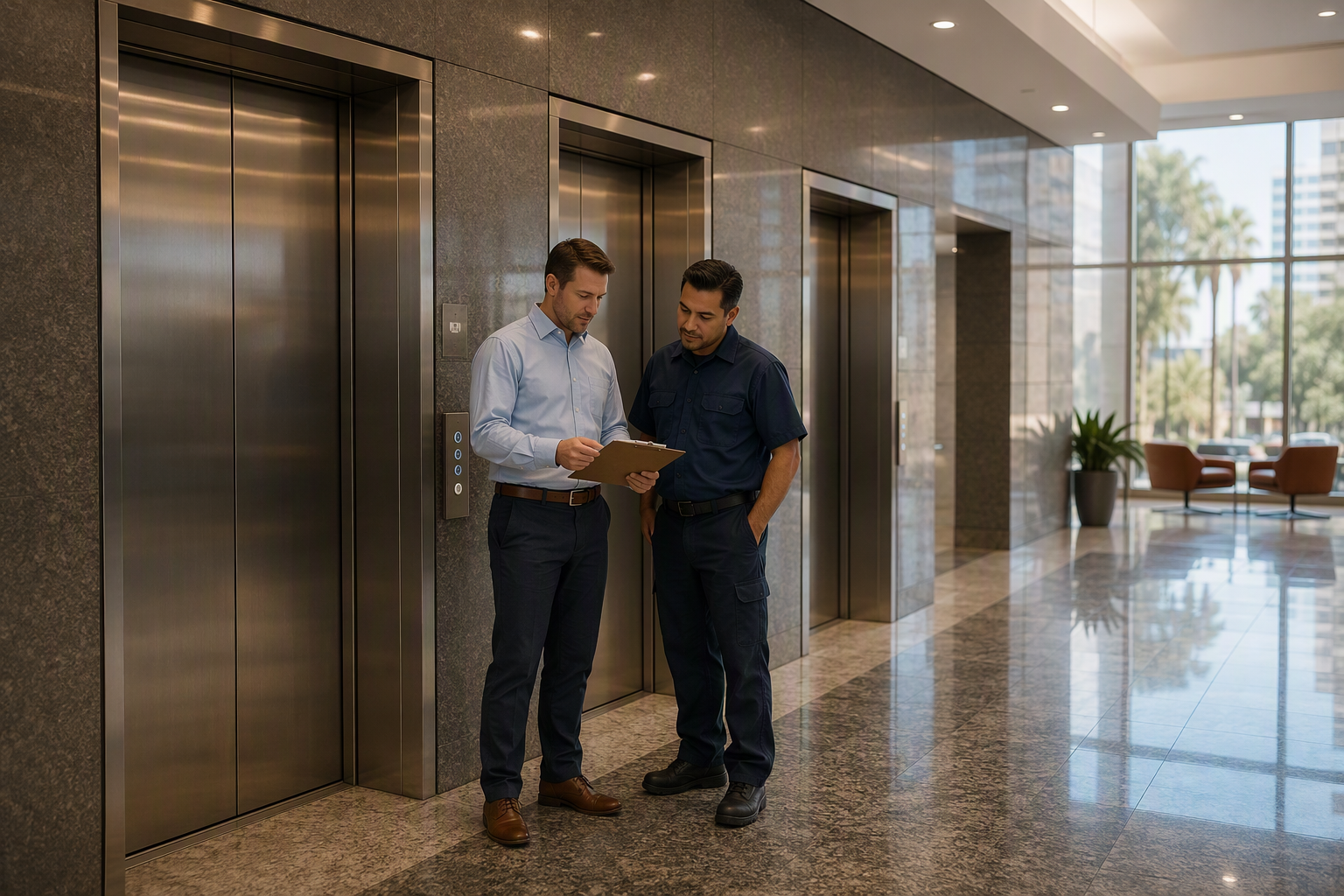
To negotiate an elevator service contract effectively, property managers should gather equipment specifications and maintenance history, identify their regulatory compliance gaps, define their operational priorities, and request itemized scope documents and MCP references from multiple contractors before comparing proposals.
- Compile the elevator equipment records: model, manufacturer, installation year, last major modernization, and current inspection certificate status.
- Review any outstanding violation or deficiency notices from previous ADOSH inspections.
- Document the building’s occupancy type, daily traffic volume, and hours of operation — these factors affect required service frequency.
- Identify whether the elevator serves as the sole ADA-accessible route, which affects the priority level of callback response.
- Request written proposals from at least two qualified, licensed Arizona elevator contractors.
- Compare proposals using a consistent checklist: covered components, exclusions, MCP documentation, inspection coordination, callback terms, and contract length.
- Negotiate specific provisions around parts transparency, price escalation caps, and termination rights before signing.
- Ensure the signed contract references ASME A17.1 compliance and identifies who maintains inspection records.
What Parts and Components Are Typically Excluded from a Commercial Elevator Service Contract?
Common exclusions from commercial elevator service contracts include hydraulic cylinders, hoistway structural repairs, cab interior finishes, vandalism or misuse damage, pit waterproofing, firefighters’ service modifications, and parts no longer available from original manufacturers.
Understanding exclusions is as important as understanding inclusions. A contract that appears comprehensive may carry exclusions that effectively shift the largest potential repair costs back to the building owner. Property managers should ask contractors to provide a written list of excluded components and scenarios, and should evaluate whether those exclusions represent realistic risk for their specific equipment. For example, older hydraulic elevators in Arizona — where underground cylinders can be affected by soil conditions — may face cylinder replacement costs that are almost universally excluded, making this a significant financial exposure point worth addressing in the contract or through capital reserve planning.
How Long Should a Commercial Elevator Service Contract Term Be?
Commercial elevator service contracts commonly range from one to five years in term length, with longer terms sometimes offering lower annual pricing but requiring careful attention to exit clauses, price escalation provisions, and performance benchmarks.
Shorter-term contracts provide flexibility to change providers if service quality declines, while longer terms can provide cost predictability and may incentivize the contractor to invest in learning the specific equipment. A well-negotiated longer-term contract should include provisions allowing termination for cause if the contractor fails to meet defined performance standards, an annual price escalation cap tied to a published index, and a process for contract amendment if the equipment undergoes significant modification. Arizona Elevator Solutions works with property managers across the Phoenix and Tucson markets to structure contract terms that align with their capital planning timelines and building operational needs.
What Happens at the End of a Commercial Elevator Service Contract?
At contract expiration or termination, the outgoing elevator service contractor is typically obligated to transfer maintenance records, MCP documentation, and inspection history to the building owner or the incoming contractor, and the building owner should ensure this transfer occurs before making final payment.
Transitions between elevator service providers can create compliance gaps if not managed carefully. Building owners should request a complete maintenance record file — including all completed MCP logs, inspection reports, and parts replaced during the contract period — at least thirty days before the contract end date. If a new provider is being engaged, the incoming contractor should be provided with this documentation prior to their first visit so they can establish a baseline understanding of the equipment condition. Auto-renewal provisions are common in elevator contracts; property managers should calendar renewal notice windows and review performance against contract standards before allowing automatic renewal to occur.
How Does Elevator Modernization Affect an Existing Service Contract?
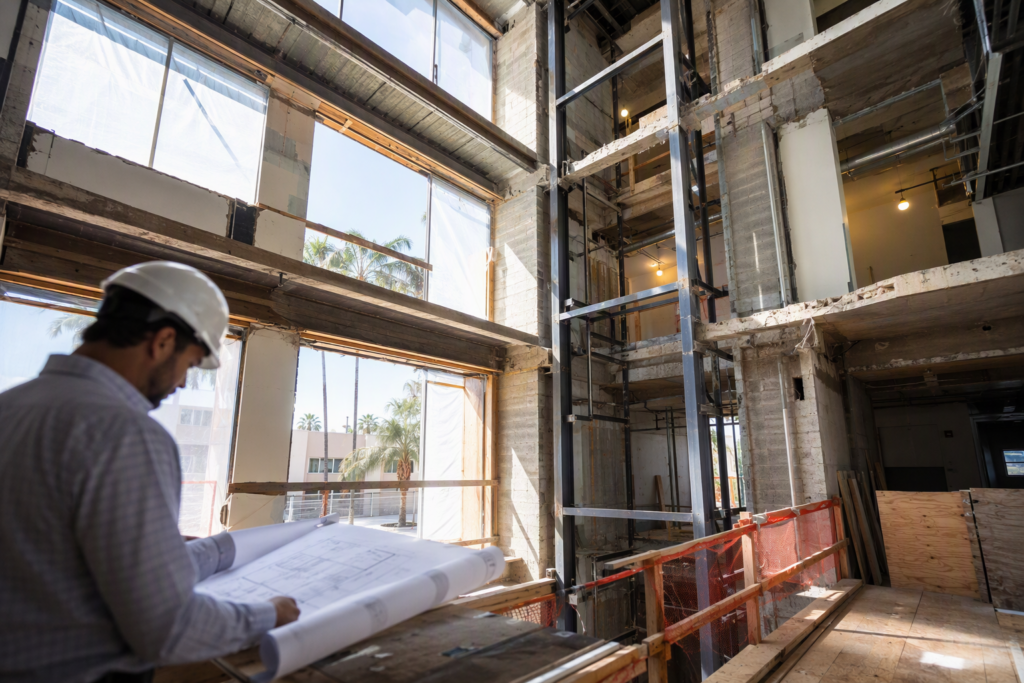
When an elevator undergoes modernization — replacement of major components such as the controller, drive system, or door operator — the existing service contract typically requires amendment or replacement, since the maintenance tasks and MCP for the upgraded equipment will differ substantially from those for the original configuration.
Modernization projects in Arizona commercial buildings often trigger a new certificate of occupancy inspection under ADOSH, which resets the compliance baseline for the equipment. A service contract written for an older relay-logic controller is not appropriate for a new solid-state drive system. Property managers planning modernization projects should notify their elevator service contractor in advance and plan for a contract revision as part of the project closeout process. In some cases, the modernization contractor and the ongoing service provider are different entities, which requires deliberate coordination to avoid coverage gaps immediately post-modernization.
What Questions Should Be Asked Before Signing an Elevator Service Contract?
Before signing a commercial elevator service contract, building owners should ask about the contractor’s state licensing status, their specific MCP for the subject equipment, callback terms and billing, parts sourcing practices, inspection coordination responsibilities, and the process for handling discovered deficiencies.
A structured pre-signing checklist helps property managers avoid common pitfalls. Specific questions worth asking every prospective contractor include: Does the contract include a written MCP as an exhibit? Are callbacks included or billed separately? How are parts priced and sourced — OEM or aftermarket? Who is responsible for scheduling and coordinating the annual ADOSH inspection? How are discovered deficiencies documented and communicated to building management? What is the escalation path if routine maintenance reveals a major safety issue? Is there a performance guarantee or service level agreement? What are the exact terms and penalties for early termination? Asking these questions before signing — rather than after a dispute — is the mark of a well-prepared commercial property manager.
How Do Service Contracts Differ for Hydraulic Versus Traction Elevators in Commercial Buildings?
Hydraulic and traction elevators require different maintenance tasks, parts, and inspection protocols, meaning service contracts should be specifically tailored to the equipment type rather than written as generic agreements.
Hydraulic elevators — common in low-rise commercial buildings throughout the Phoenix and Mesa markets — require maintenance of the hydraulic power unit, fluid levels and quality, underground or above-ground cylinder condition, and control valve operation. Traction elevators — typically found in mid- and high-rise commercial properties in Scottsdale and downtown Phoenix — require maintenance of the machine, sheaves, ropes or belts, counterweight system, brake, and controller. ASME A17.1 addresses both elevator types with distinct code sections, and a competent service contractor will produce separate MCPs for each equipment type. Property managers with mixed portfolios should verify that their service contract and MCP documentation reflect the specific equipment at each location.
What Are the Consequences of Operating a Commercial Elevator Without a Service Contract?
Operating a commercial elevator without an active service contract does not automatically violate Arizona law, but it significantly increases the risk of undetected safety deficiencies, missed inspection deadlines, ADA compliance failures, and liability exposure in the event of an incident.
Without a structured maintenance program, equipment deterioration tends to go undetected until a failure occurs — at which point the repair costs, downtime duration, and potential liability exposure are all substantially higher than they would have been under a proactive maintenance regimen. Insurance carriers increasingly require evidence of documented elevator maintenance programs as a condition of commercial property coverage. In the event of an elevator incident involving injury, the absence of maintenance records and a formal service agreement can be a significant liability factor. Arizona Elevator Solutions recommends that all commercial property operators in the Phoenix, Tucson, Scottsdale, and Mesa areas maintain a current, documented service contract for every elevator under their management.
How Does Arizona Elevator Solutions Approach Commercial Elevator Service Contracts?
Arizona Elevator Solutions provides commercial building elevator service contracts tailored to each property’s equipment type, traffic profile, and compliance requirements, with documentation aligned to ASME A17.1 Maintenance Control Program standards and coordination of Arizona ADOSH inspection requirements.
Serving commercial properties across Phoenix, Tucson, Scottsdale, and Mesa, Arizona Elevator Solutions structures service agreements to give property managers transparent scope definitions, clear exclusion disclosures, and MCP documentation they can rely on during regulatory inspections and insurance audits. The approach prioritizes code compliance, proactive communication when maintenance reveals emerging issues, and contract terms that support long-term equipment performance rather than short-term cost minimization. Property managers are encouraged to contact Arizona Elevator Solutions to discuss the specific maintenance needs of their equipment and receive a contract proposal aligned to their building’s operational and compliance profile.
Ready to Protect Your Building with a Compliant Elevator Service Contract?
Commercial elevator maintenance is not a commodity — it is a code-mandated, liability-sensitive function that directly affects tenant safety, ADA compliance, and property value. A well-structured service contract with a qualified, licensed elevator service provider is one of the most important risk management decisions a commercial property manager can make.
Contact Arizona Elevator Solutions for a free elevator assessment. The team will review your current equipment condition, existing contract coverage (if any), compliance documentation, and maintenance history to identify gaps and recommend a service contract structure appropriate for your commercial property.
Call us today: 480-557-7600
Arizona Elevator Solutions serves commercial building owners and property managers throughout Phoenix AZ, Tucson AZ, Scottsdale AZ, and Mesa AZ.
Need elevator service you can rely on? Arizona Elevator Solutions is ready to help.