Hotel Elevator Maintenance Best Practices: A Complete Comparison and Decision Guide
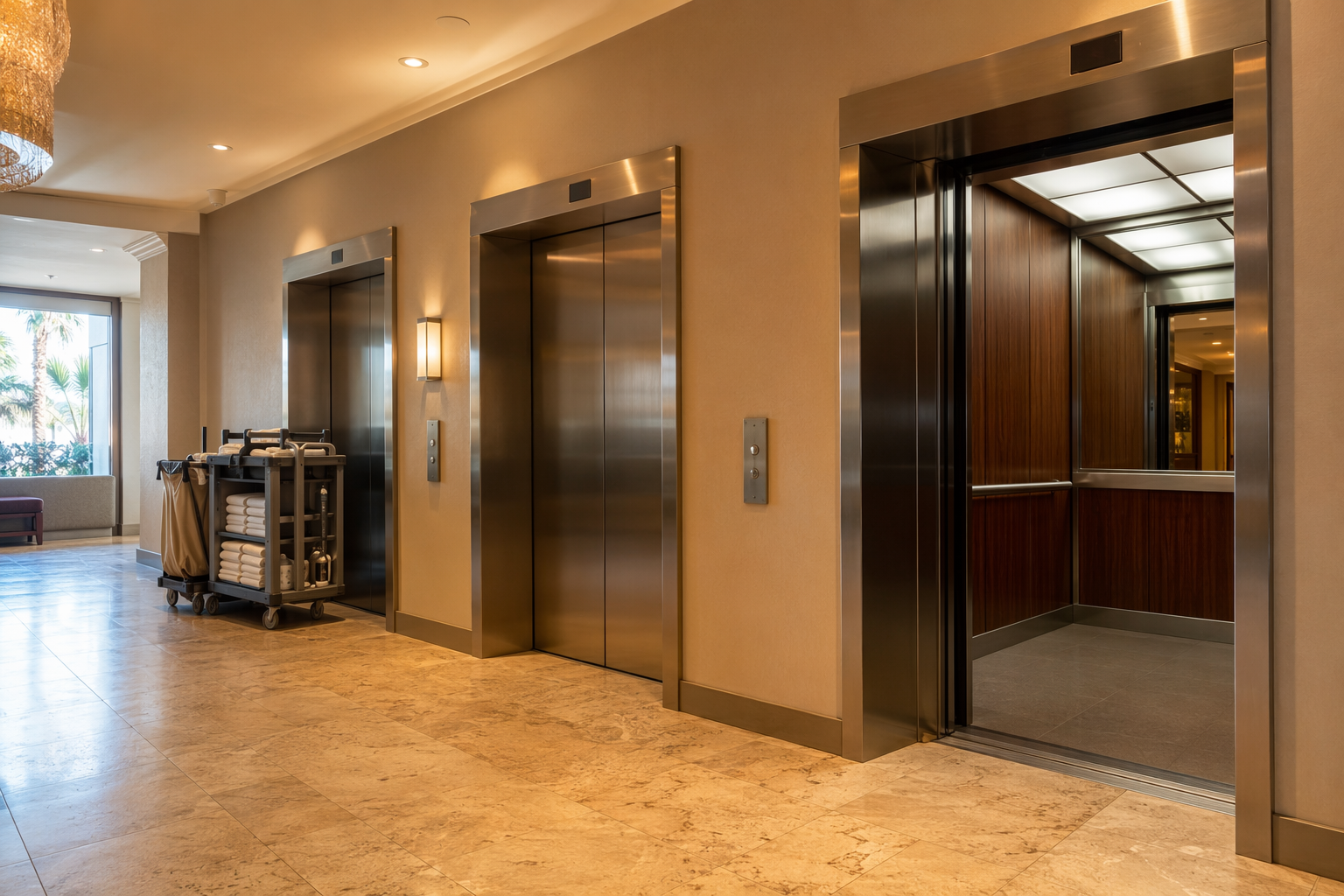
Hotels operate elevators at intensities that exceed most commercial buildings. Continuous guest traffic, luggage loads, housekeeping carts, and room service deliveries place exceptional mechanical stress on elevator systems around the clock. A well-structured maintenance program protects guests, preserves brand reputation, reduces costly emergency repairs, and keeps the property in full regulatory compliance. This guide compares maintenance approaches, breaks down key decision factors, and answers the questions hotel operators ask most.
What Are the Core Maintenance Approaches for Hotel Elevators?
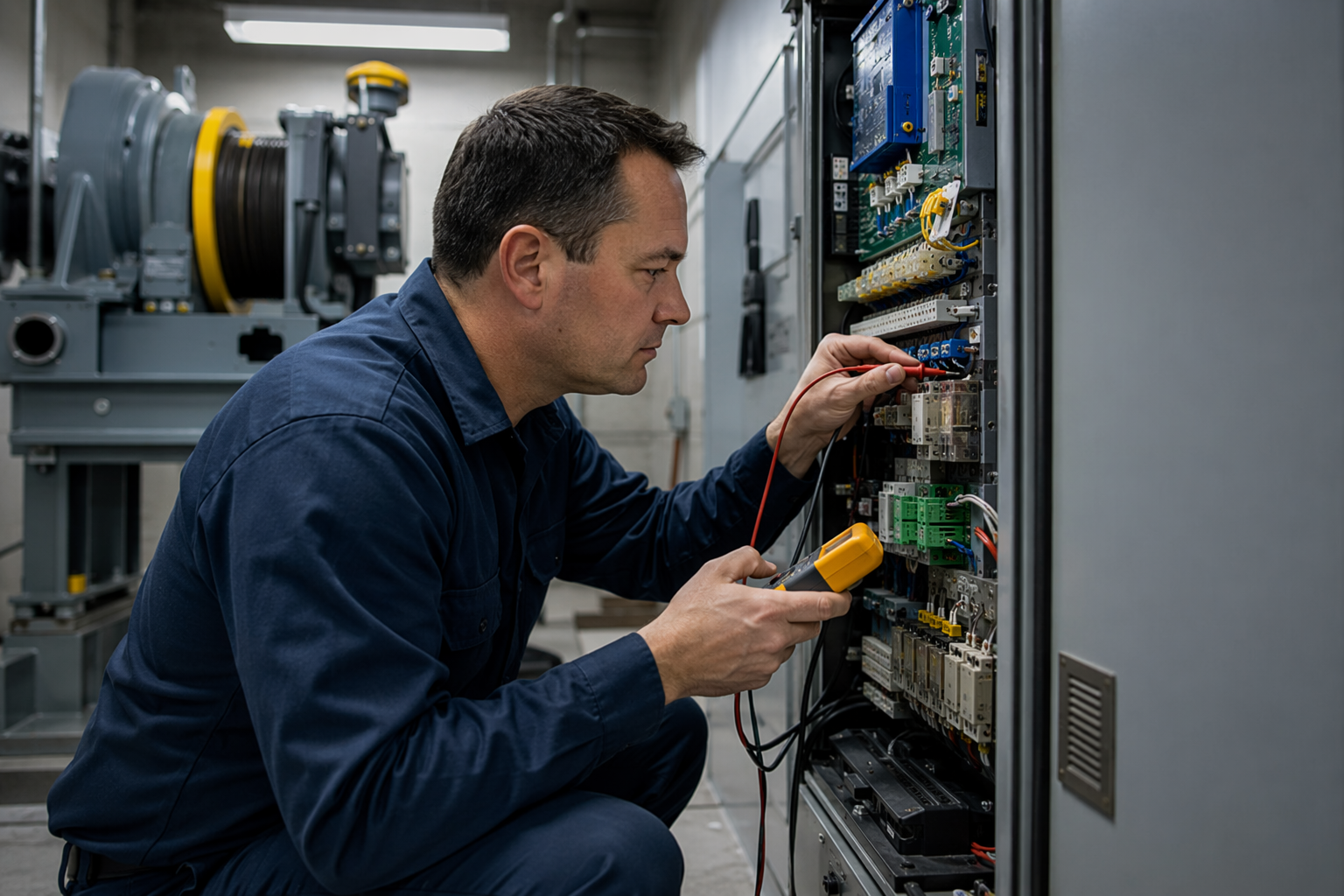
Hotel elevator maintenance generally falls into three strategic models. Understanding each model’s strengths and limitations helps property managers make informed investment decisions.
| Maintenance Model | Description | Best For | Key Advantage | Key Limitation |
|---|---|---|---|---|
| Reactive (Break-Fix) | Service is called only when a failure occurs | Very low-traffic properties with aging budget constraints | No upfront maintenance cost | Unpredictable downtime; highest long-term repair costs; guest experience risk |
| Preventive Maintenance (PM) | Scheduled inspections, lubrication, adjustments, and parts replacement on a fixed calendar | Most hotels of any size | Reduces unexpected failures; supports compliance documentation | May service components that don’t yet need attention; requires consistent scheduling discipline |
| Predictive / Condition-Based | Sensors and monitoring data trigger service only when measurements indicate wear or risk | Larger hotels, high-rise properties, multi-elevator portfolios | Highly efficient; catches problems before failure; data-driven decisions | Higher upfront technology investment; requires trained interpretation of data |
| Full-Service Contract (OEM or Independent) | A service provider covers PM, emergency calls, parts, and compliance management | Hotels prioritizing hands-off compliance and budget predictability | Single-vendor accountability; comprehensive coverage | Contract terms vary widely; independent providers often offer more flexibility than OEM-tied contracts |
Arizona Elevator Solutions recommends a preventive maintenance model as the baseline for all hotel properties, layered with condition-monitoring tools where budget and elevator count justify the investment.
What Does ASME A17.1 Require for Hotel Elevator Maintenance?

The ASME A17.1 Safety Code for Elevators and Escalators is the foundational standard governing elevator design, installation, operation, inspection, and maintenance across North America. In its current edition, the code mandates periodic inspections by a qualified inspector and requires that maintenance be performed by qualified personnel following documented procedures.
Key ASME A17.1 compliance requirements relevant to hotel operators include:
- Periodic and annual inspections by a certified elevator inspector, with the frequency defined by the authority having jurisdiction (AHJ) — typically the state or local elevator safety board in Arizona
- Maintenance records must be kept on-site or accessible, documenting all service performed, parts replaced, and test results
- Periodic testing of safety devices, including governors, safeties, buffers, and door operators
- Emergency lighting, communication systems, and firefighters’ service must be tested and maintained per code
- Any alterations to the elevator must comply with the code edition in effect at the time of alteration
Arizona properties must also comply with the OSHA standards applicable to maintenance worker safety during elevator service work, including lockout/tagout procedures and machine room safety requirements.
How Do ADA Requirements Apply to Hotel Elevator Maintenance?
Under the Americans with Disabilities Act (ADA), hotels are required to maintain accessible features in operable condition. Elevator accessibility is not a one-time installation requirement — it is an ongoing operational obligation. This means:
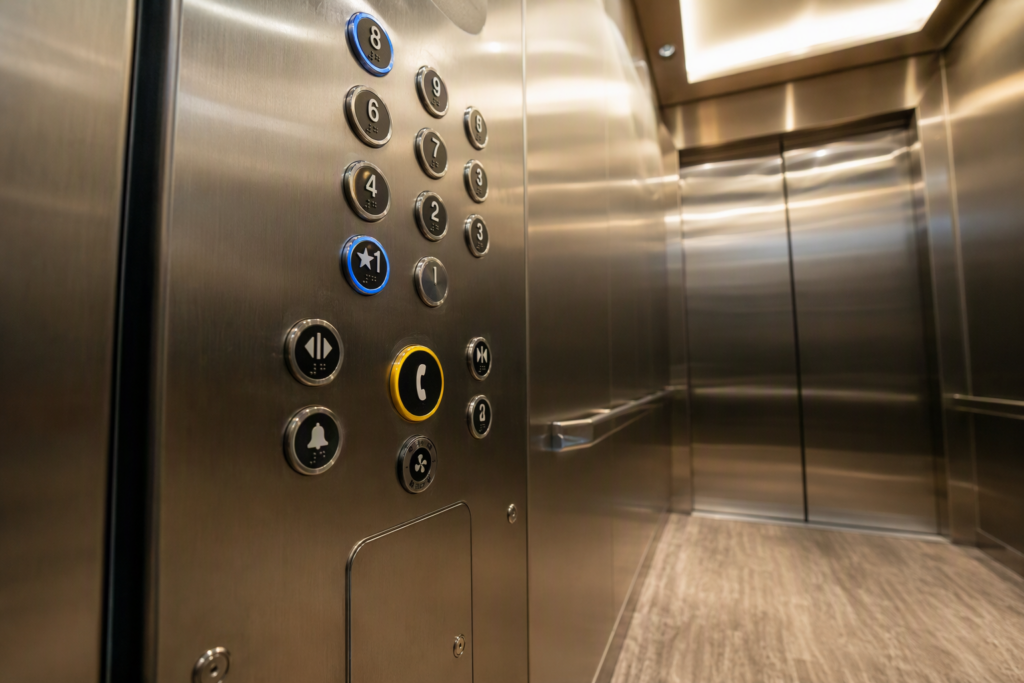
- Braille and raised character floor designations must be intact and legible
- Door timing must allow sufficient entry and exit time for guests with mobility devices
- Emergency two-way communication systems must be operational and accessible
- Car controls must be mounted at heights compliant with ADA standards and remain functional
- Floor leveling accuracy must be maintained so there is no significant gap or height differential at landings
A preventive maintenance checklist for hotels should include ADA compliance verification at every scheduled visit, not only at annual inspections.
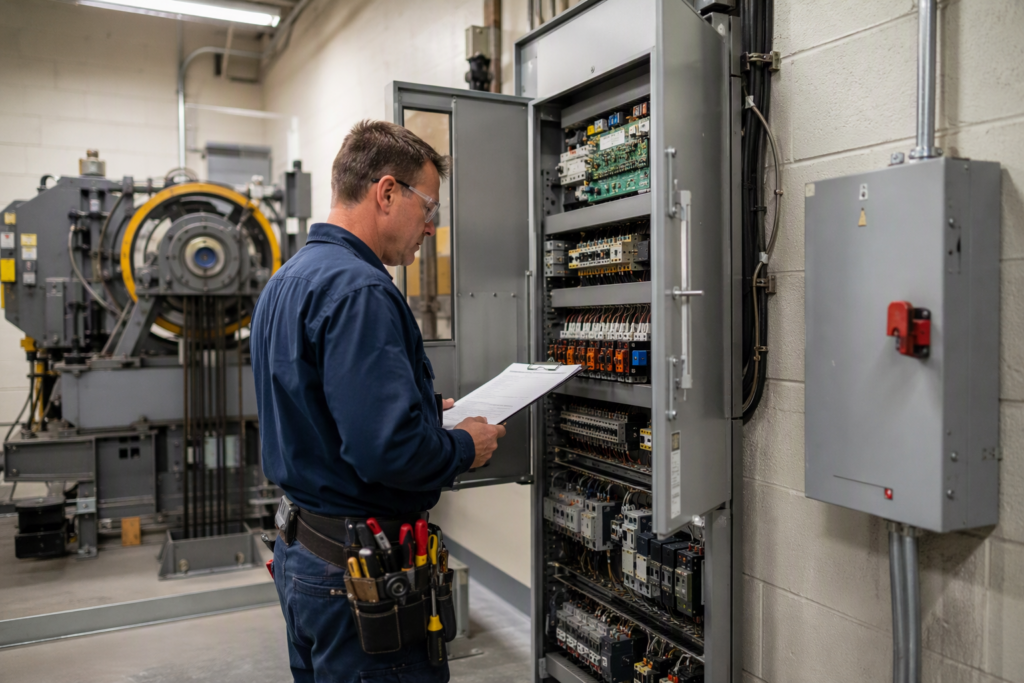
What Should a Hotel Elevator Preventive Maintenance Checklist Include?
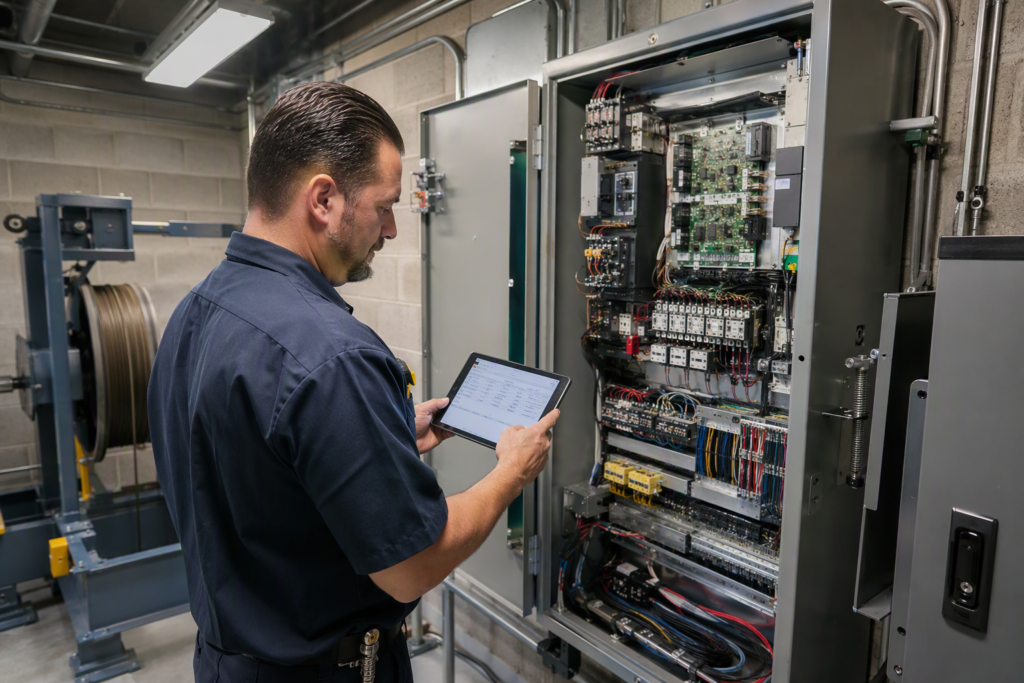
A thorough PM checklist for hotel elevators covers mechanical, electrical, safety, and guest-experience elements. The following categories represent an industry-standard scope:
| System Area | Key Inspection and Maintenance Tasks | Typical Frequency |
|---|---|---|
| Drive System | Motor inspection, drive belt or sheave wear check, machine room oil levels, brake adjustment | Monthly / Quarterly |
| Door System | Door operator adjustment, clutch and roller inspection, safety edge and light curtain test, sill cleaning | Monthly |
| Safety Devices | Governor and safety gear test, buffer inspection, pit safety switch verification, overspeed device check | Per ASME A17.1 schedule / Annually |
| Electrical Systems | Controller board inspection, wiring condition, contact cleaning, fuse and breaker check | Quarterly |
| Cab Interior | Lighting functionality, emergency lighting test, handrail security, flooring condition, ventilation | Monthly |
| Communication | Emergency phone test, intercom system verification, ADA two-way communication check | Monthly |
| Hydraulic Systems (if applicable) | Fluid level and condition, cylinder seal inspection, pressure relief valve test, pit sump check | Quarterly / Annually |
| Pit and Hoistway | Pit cleanliness, pit lighting, guide rail lubrication, counterweight inspection, rope condition | Quarterly |
What Is the ROI of Preventive vs. Reactive Maintenance for Hotels?
While specific cost figures depend on elevator type, age, and service agreement terms, the financial case for preventive maintenance over reactive maintenance in a hotel setting rests on several well-documented principles:
| Factor | Reactive Maintenance | Preventive Maintenance | Predictive Maintenance |
|---|---|---|---|
| Unplanned Downtime Risk | High — failure determines timing | Moderate — scheduled visits reduce surprise failures | Low — data-driven intervention before failure |
| Emergency Repair Costs | High — expedited parts, after-hours labor rates | Lower — most issues caught during scheduled visits | Lowest — components replaced at optimal intervals |
| Guest Experience Impact | High risk of guest entrapments and complaints | Low risk with proper scheduling | Minimal risk |
| Regulatory Compliance Risk | High — documentation gaps common | Low — PM visits generate inspection records | Low — continuous data log supports compliance |
| Equipment Lifespan | Shortened by deferred maintenance | Extended by consistent care | Maximized through precision servicing |
| Upfront Program Cost | Minimal | Moderate | Higher (monitoring technology investment) |
For hotel operators, the reputational and operational cost of a guest being trapped in an elevator — particularly during peak occupancy — significantly outweighs the cost of a structured preventive maintenance program.
What Should Hotels Do Immediately When an Elevator Fails?
- Activate emergency communication. If a guest is trapped, use the elevator’s emergency phone or intercom to communicate their location, confirm they are safe, and advise them that help is on the way. Do not instruct them to attempt self-rescue.
- Notify trained staff immediately. Alert your chief engineer, facilities manager, or on-duty maintenance supervisor. Do not rely solely on front desk staff to manage the situation.
- Contact your elevator service provider. Place a call to your contracted maintenance company for emergency response. Arizona Elevator Solutions provides emergency elevator service for hotels throughout Arizona.
- Secure the elevator landing doors. Place signage at all affected floors indicating the elevator is out of service and direct guests to alternative means of access.
- Do not attempt to open hoistway doors manually unless trained and authorized personnel are present. Unauthorized door opening poses serious fall hazards in compliance with OSHA safety standards.
- Document the incident. Record the time of failure, nature of the issue, any guests involved, staff actions taken, and the arrival and findings of the service technician. This documentation supports compliance records and liability management.
- Complete a post-incident inspection before returning the elevator to service. The technician must verify the root cause is resolved and that all safety systems are functional before the elevator is reopened to guests.
How Often Should Hotel Elevators Be Inspected?
Inspection frequency is governed by the ASME A17.1 Safety Code for Elevators and Escalators and enforced by the authority having jurisdiction in each state. In Arizona, the state elevator safety program sets inspection intervals, which typically require annual periodic inspections by a qualified third-party inspector. Periodic tests of safety components such as governors and safeties follow a separate schedule defined within the code.
Beyond mandatory inspections, hotels benefit from monthly maintenance visits due to the high-use nature of hospitality environments. A monthly service cadence allows technicians to catch door operator wear, lubrication deficiencies, and minor electrical issues before they escalate into failures.
What Is the Difference Between OEM and Independent Elevator Service Providers for Hotels?
| Criteria | OEM (Original Equipment Manufacturer) Service | Independent Service Provider (e.g., Arizona Elevator Solutions) |
|---|---|---|
| Equipment Brand Restriction | Typically limited to their own brand of elevator | Can service multiple brands and elevator types |
| Parts Availability | Proprietary parts; may limit third-party repair options | Access to OEM-equivalent and aftermarket parts across brands |
| Contract Flexibility | Often long-term contracts with penalties for early exit | Generally more flexible contract terms |
| Multi-Brand Hotel Portfolio | May require multiple vendors for different elevator brands | Single vendor can manage all units across a mixed portfolio |
| Local Response | Varies by region; national OEMs may dispatch from distant service centers | Local providers offer geographically focused response |
| Accountability | Large corporate structure; may result in less personalized service | Direct relationship with local team and management |
Arizona Elevator Solutions is an independent certified elevator service company serving hotels throughout Arizona. As an independent provider, the team services multiple elevator brands, allowing hotel operators with mixed-brand properties to consolidate service under a single local provider.
How Should Hotels Manage Elevator Maintenance Documentation?
Proper documentation is not optional — it is a compliance requirement under the ASME A17.1 Safety Code for Elevators and Escalators and a critical tool for managing liability and insurance relationships. Hotel facilities teams should maintain:
- A maintenance log for each elevator unit, recording date of service, technician identification, tasks performed, and any parts replaced
- Copies of all periodic and annual inspection certificates, kept on-site and accessible to inspectors
- Records of all safety device tests and results, with dates and technician sign-off
- Documentation of any incidents, entrapments, or unusual occurrences
- A log of all work orders, including emergency service calls
- Current copies of the certificate of inspection posted in each elevator cab, as required by Arizona elevator safety regulations
Digital maintenance management systems used by service providers can streamline this process and give hotel facilities managers real-time access to service records across their entire elevator portfolio.
What Are the Most Common Hotel Elevator Problems and How Are They Prevented?
| Common Problem | Likely Cause | Preventive Measure |
|---|---|---|
| Door Malfunctions | Worn rollers, misaligned door tracks, dirty sills, failing door operators | Monthly door system inspection and adjustment; sill cleaning every visit |
| Leveling Issues (floor misalignment) | Drive system wear, selector tape degradation, controller calibration drift | Quarterly leveling checks and drive system inspection; ADA compliance verification |
| Unusual Noise or Vibration | Insufficient lubrication, worn guide shoes, sheave wear | Regular lubrication schedules; guide shoe and rope inspection |
| Slow Performance / Sluggish Response | Controller software issues, drive system degradation, brake adjustment needed | Periodic controller inspection; brake adjustment at scheduled visits |
| Emergency Phone Failure | Telephone line disruption, aging communication hardware | Monthly communication system test; line monitoring |
| Hydraulic Fluid Leaks | Aged cylinder seals, fitting corrosion | Quarterly hydraulic system inspection; proactive seal replacement on aging units |
How Does Arizona’s Climate Affect Hotel Elevator Maintenance?
Arizona’s extreme heat creates specific maintenance challenges for hotel elevator systems. High ambient temperatures in machine rooms — particularly in properties without adequate climate control — can accelerate wear on electronic controllers, drive motors, and hydraulic fluid. Best practices for Arizona hotels include:
- Verifying that machine room ventilation and cooling systems maintain temperatures within the manufacturer’s specified operating range
- Monitoring hydraulic fluid viscosity more frequently during summer months, as heat can thin fluid and affect cylinder performance
- Inspecting motor insulation and drive electronics for heat-related degradation during annual and semi-annual visits
- Ensuring pit areas are dry and protected from monsoon-season moisture intrusion, which can cause electrical faults and corrosion
Arizona Elevator Solutions, as a locally based provider, brings specific knowledge of the state’s climate conditions to every hotel maintenance program it manages.
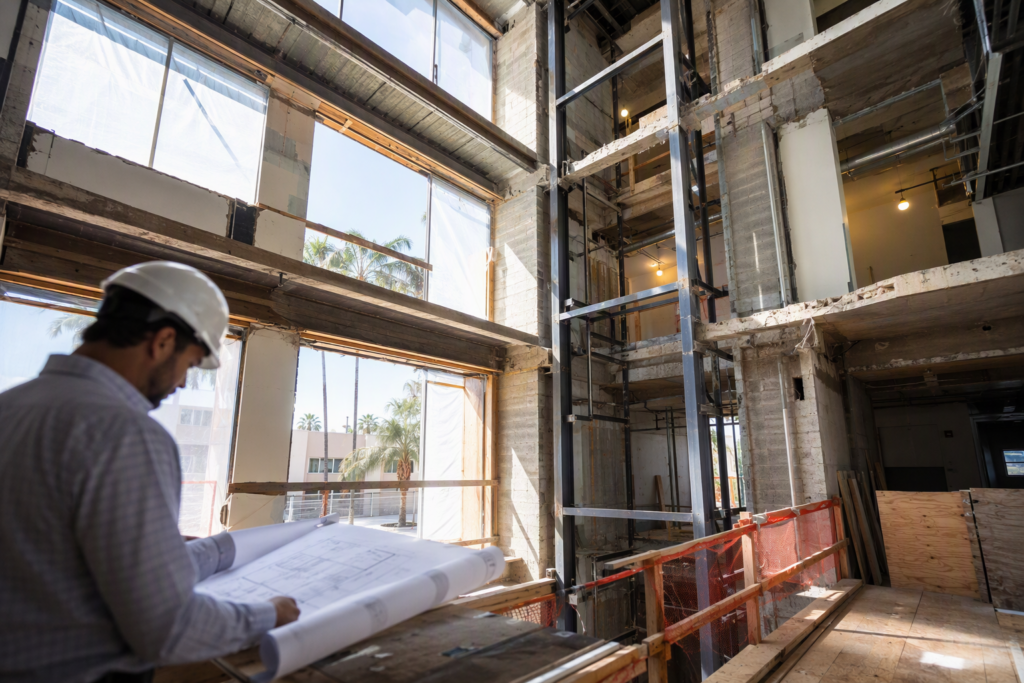
When Is It Time to Modernize Rather Than Maintain a Hotel Elevator?
Maintenance programs extend the life of elevator systems, but there are indicators that modernization delivers better long-term value than continued repair of aging equipment:
- Replacement parts for the elevator’s control system or drive are no longer manufactured or are difficult to source
- The elevator requires frequent emergency service calls despite a consistent PM program
- Energy consumption is disproportionately high compared to modern regenerative drive systems
- The cab and fixtures no longer align with the hotel’s brand standards or guest expectations
- The system cannot support required ADA upgrades without significant structural modification
- Insurance premiums or inspection findings reflect elevated risk on aging equipment
A qualified service provider can assess whether targeted component replacement, partial modernization, or full replacement represents the best investment for the property’s specific situation.
Why Should Hotels Choose Arizona Elevator Solutions?
Arizona Elevator Solutions is a certified, independent elevator service company focused exclusively on the Arizona market. The company provides hotel elevator maintenance programs designed around the specific demands of hospitality operations — including high-use scheduling, guest safety prioritization, multi-brand equipment capability, and compliance documentation management aligned with ASME A17.1 and ADA requirements.
As an independent provider, Arizona Elevator Solutions is not tied to any single elevator manufacturer, which means hotel operators receive objective service recommendations rather than brand-driven upsells. The company serves hotels of all sizes across Arizona, from boutique properties to large full-service resorts with multi-elevator requirements.
Ready to Protect Your Guests and Your Investment?
A properly maintained elevator program is one of the most important operational decisions a hotel can make. Contact Arizona Elevator Solutions for a free elevator assessment for your hotel property. Their team will evaluate your current maintenance program, identify compliance gaps, and recommend a maintenance strategy tailored to your property’s needs and usage demands.
📞 Call Arizona Elevator Solutions today: 480-557-7600
Need elevator service you can rely on? Arizona Elevator Solutions is ready to help.