Elevator Maintenance and Reliability Standards for Healthcare Facilities in Arizona
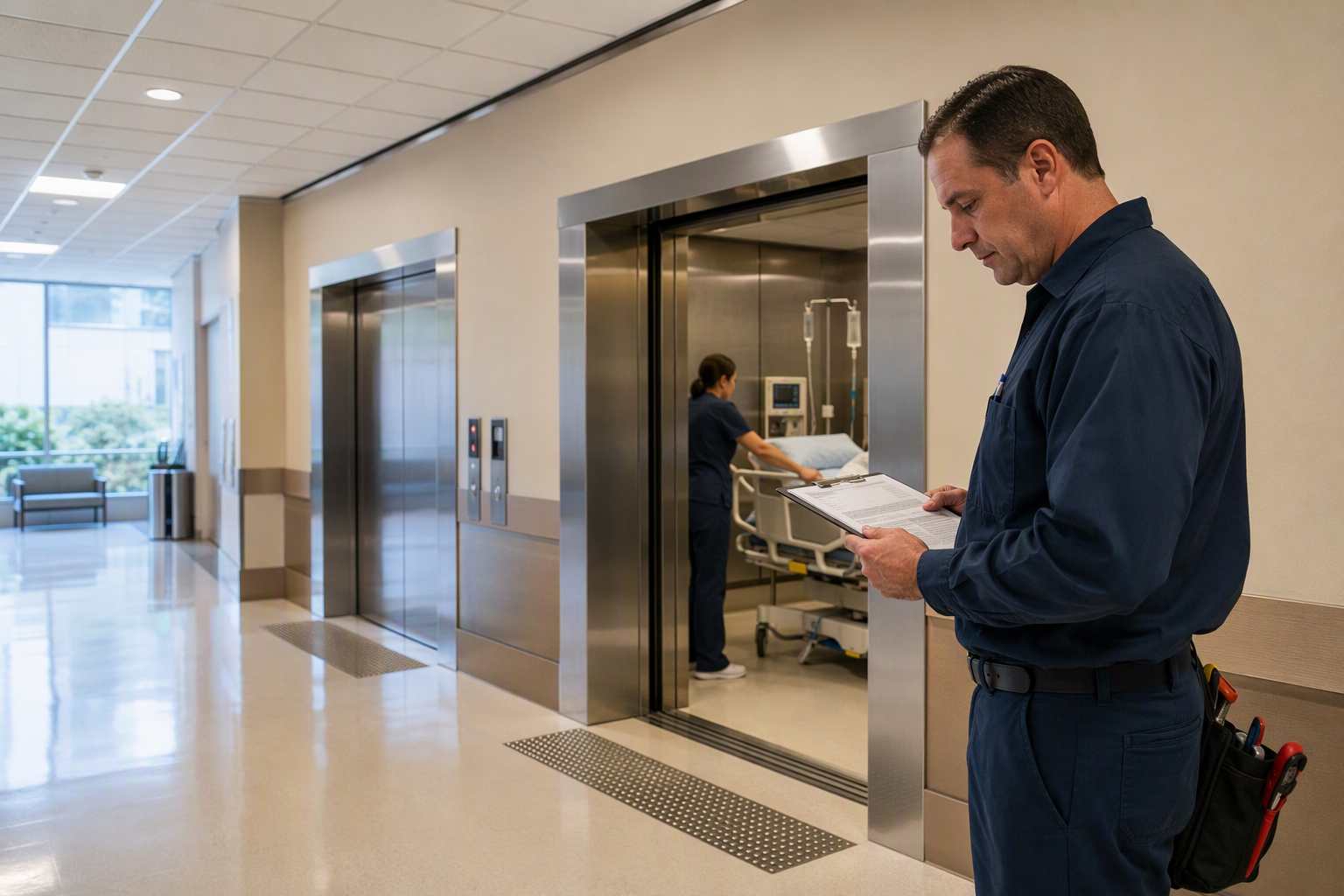
Hospitals, surgical centers, skilled nursing facilities, and outpatient clinics across Phoenix, Tucson, Scottsdale, and Mesa operate elevators under conditions that go far beyond those found in a typical commercial building. Patient beds, powered wheelchairs, medication carts, and biomedical equipment move through vertical transportation systems around the clock. When an elevator fails in a healthcare environment, the consequences reach beyond inconvenience — they affect patient safety, staff workflows, and regulatory standing. Understanding the exact maintenance and reliability standards that apply is the first step toward keeping a facility compliant and operationally sound.
—
What Federal Codes Govern Healthcare Elevator Standards?
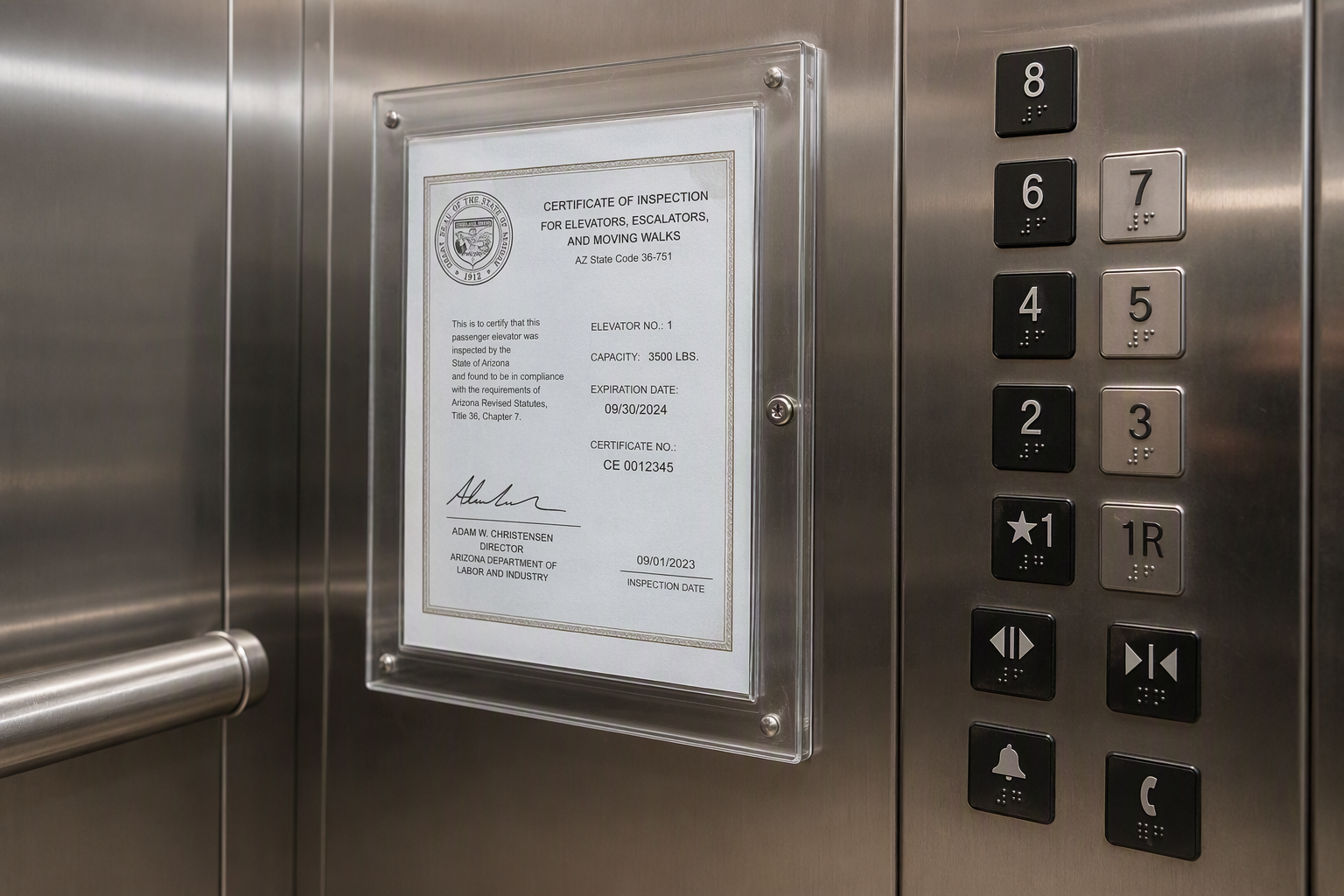
Two foundational federal frameworks define the minimum floor for elevator safety in any Arizona healthcare setting.
First, the ASME A17.1 Safety Code for Elevators and Escalators establishes design, installation, inspection, testing, and maintenance requirements for new elevator equipment. For existing equipment already in service, ASME A17.3, Safety Code for Existing Elevators and Escalators, governs ongoing compliance and periodic modernization thresholds. Healthcare facilities cannot opt out of these standards — Arizona adopts and enforces them through ADOSH, the state authority having jurisdiction (AHJ) for elevator regulation.
Second, the Americans with Disabilities Act (ADA) requires that elevators serving public and common-use areas of healthcare facilities be accessible to individuals with mobility impairments. This encompasses cab dimensions, door timing, call button placement, tactile markings, and audible signals. Because healthcare facilities routinely serve patients with disabilities, ADA compliance is not a secondary concern — it is a daily operational reality.
Additionally, OSHA standards apply to the working conditions of elevator mechanics and in-house maintenance staff who service equipment within healthcare facilities, including lockout/tagout procedures and machine room safety.
—
How Often Do Healthcare Elevators in Arizona Need to Be Inspected?
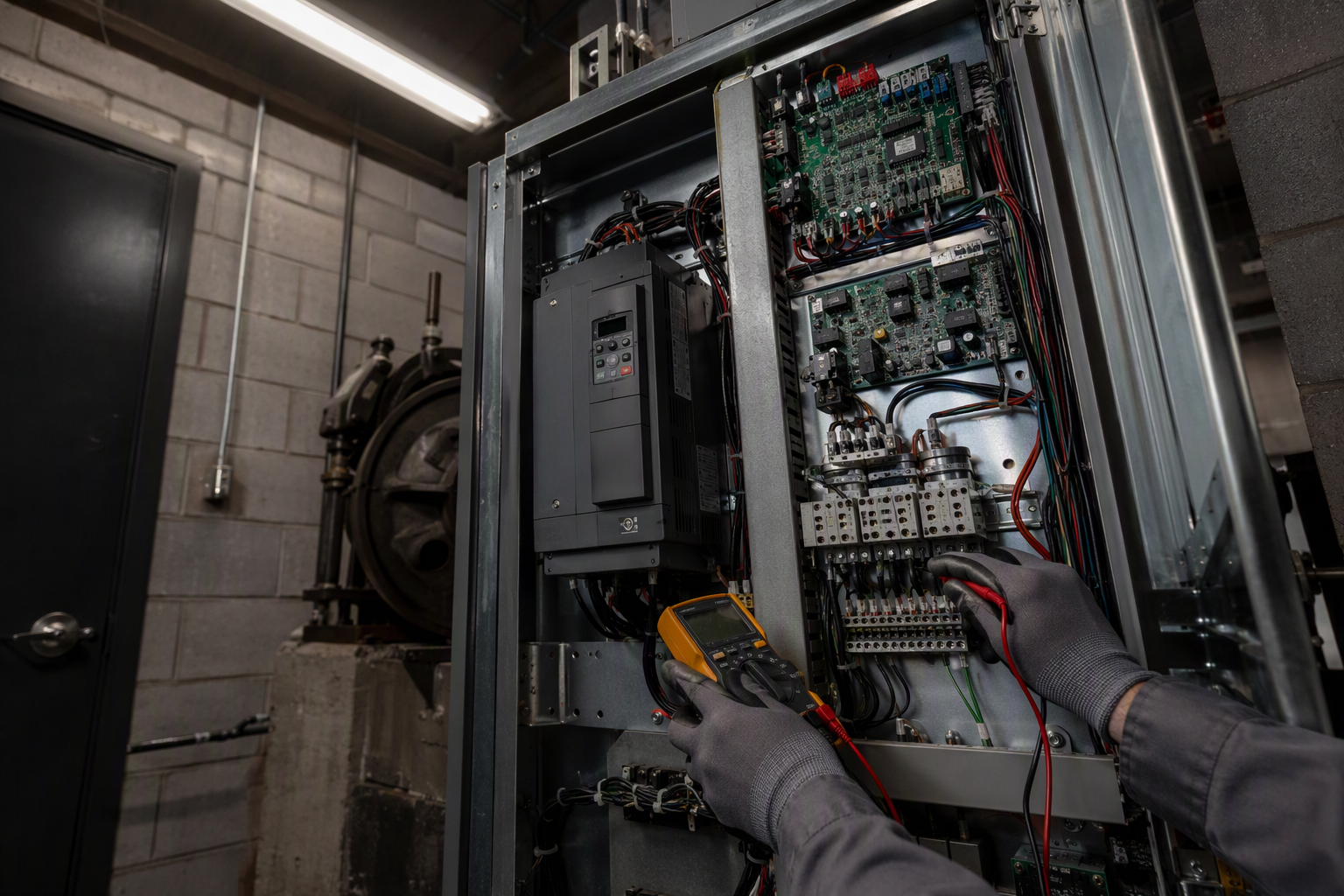
Arizona requires periodic inspections of elevator equipment enforced through ADOSH. Healthcare facilities should plan for both the mandatory state inspection cycle and their own internal maintenance intervals. ASME A17.1 outlines recommended maintenance frequencies, and ASME A17.3 addresses testing intervals for existing equipment — including periodic no-load safety tests and full-load tests depending on the type of equipment installed.
Beyond the state inspection schedule, healthcare environments benefit from more frequent preventive maintenance visits than many other building types. The combination of heavy daily use, specialized loading (stretchers, powered mobility devices, large carts), and life-safety implications makes a robust preventive maintenance program — not just reactive repair — an operational necessity. Arizona Elevator Solutions works with healthcare facility managers across Phoenix, Tucson, Scottsdale, and Mesa to develop maintenance schedules calibrated to actual equipment usage and patient care demands.
—
What ADA Requirements Are Specific to Healthcare Elevator Use?
The ADA sets precise technical requirements for accessible elevators. In a healthcare context, several specifications carry heightened importance:
- Door clear width and timing: Doors must provide sufficient clear width for wheelchairs and hospital beds. Door dwell time — how long doors remain open — must accommodate individuals who move more slowly due to mobility aids or injury.
- Call button height and usability: Call buttons must be reachable from a seated position and operable without tight grasping or pinching, which matters when patients or visitors use adaptive equipment.
- Cab interior dimensions: Minimum interior dimensions allow a wheelchair to enter, turn, and exit. Hospital beds and stretchers may require larger cab sizes governed by facility design standards, but ADA sets the floor.
- Audible and visual signals: Floor arrival chimes and illuminated indicators assist patients and visitors with sensory impairments.
- Tactile floor designations and braille: Required at all call stations and cab control panels.
ADA noncompliance in a healthcare facility can trigger complaints to the U.S. Department of Justice, affect CMS certification for Medicare and Medicaid-participating facilities, and create legal liability. Regular ADA audits of elevator cab interiors, landings, and control panels are a recommended practice.
—
What Are the Most Critical Elevator Reliability Risks in Healthcare Settings?
Healthcare elevators face a distinct set of failure risks compared to office or retail properties:
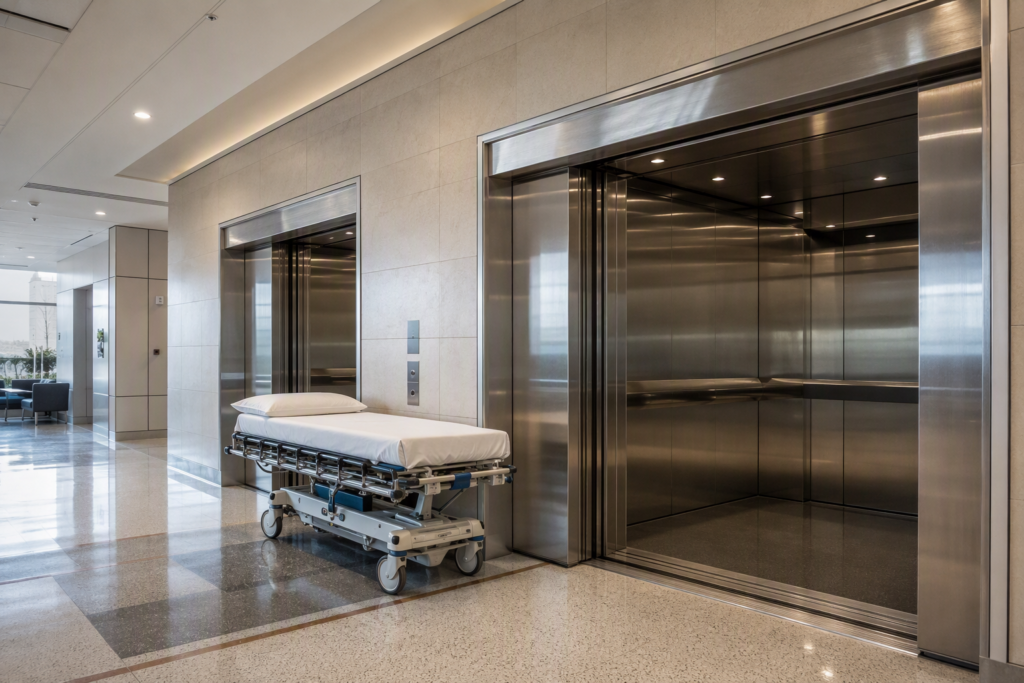
- Door system failures: Repeated loading and unloading of carts, beds, and powered wheelchairs places unusual stress on door sills, rollers, and sensors. Door malfunctions are among the most common causes of elevator downtime and entrapment.
- Overload and weight cycling: Patient transport elevators carry variable loads, often close to or at capacity, multiple times per hour. This accelerates wear on drive systems, buffers, and safety components.
- 24-hour operation fatigue: Unlike commercial elevators that rest overnight, hospital elevators operate continuously. Component replacement intervals need to reflect total run time, not calendar time alone.
- Infection control requirements: Maintenance procedures in healthcare settings must respect infection control protocols, including appropriate handling of materials and PPE use in clinical areas.
- Emergency power integration: Healthcare facilities rely on elevators during power outages for patient evacuation and critical supply movement. Backup power systems must integrate correctly with elevator controls and meet applicable code requirements.
—
What Preventive Maintenance Steps Should Healthcare Facilities Follow?
A structured preventive maintenance protocol reduces unplanned downtime and keeps equipment compliant with ASME requirements. The following sequence reflects standard industry practice for healthcare environments:
- Schedule routine maintenance visits at intervals appropriate to usage volume and equipment age, coordinated with facility operations to minimize impact on patient care floors.
- Inspect and lubricate door operating systems including sills, rollers, hangers, and safety edges at every visit, given the elevated door stress in healthcare environments.
- Test all safety devices including overspeed governors, safeties, buffers, and door reopening devices according to the intervals specified under ASME A17.1 and A17.3.
- Check and calibrate leveling accuracy to ensure cabs stop flush with landings — critical for safe movement of beds, stretchers, and wheeled equipment across the threshold.
- Inspect machine room conditions including temperature, ventilation, cleanliness, and electrical panel integrity, noting any conditions that may affect reliability.
- Test emergency communication systems in each cab to confirm they connect to a staffed monitoring point as required, particularly important in a 24-hour healthcare environment.
- Review and update maintenance logs with detailed records of all work performed, parts replaced, and test results — these records are reviewed during ADOSH inspections.
- Flag components approaching end of service life for proactive replacement before failure occurs, rather than waiting for breakdown.
Arizona Elevator Solutions provides maintenance programs for healthcare clients across the Phoenix metro, Tucson, Scottsdale, and Mesa that incorporate each of these steps and produce the documentation required for regulatory and accreditation reviews.
—
Does Joint Commission or CMS Accreditation Affect Elevator Requirements?
Healthcare facilities accredited by The Joint Commission (TJC) or subject to Centers for Medicare and Medicaid Services (CMS) Conditions of Participation are required to maintain documented equipment maintenance programs as part of their Environment of Care (EC) standards. While TJC and CMS do not write elevator-specific codes, they do expect facilities to demonstrate that life-safety equipment — including vertical transportation — is maintained according to applicable codes and that maintenance records are current, complete, and available for review during surveys.
An elevator that fails inspection or has a gap in its maintenance record can become a finding in an accreditation survey, potentially triggering a corrective action plan. Maintaining ASME-compliant preventive maintenance records, current ADOSH inspection certificates, and documented ADA compliance reviews supports a strong Environment of Care posture.
—
What Are the Rules for Elevator Modernization in Older Arizona Healthcare Facilities?
Many hospital campuses and long-term care facilities in Phoenix, Tucson, and the greater Arizona market operate elevators that have been in service for decades. When components are modernized or replaced, the work triggers review under ASME A17.3, which governs alterations to existing equipment and may require upgraded safety features on the modernized elements. ADOSH reviews and approves alteration permits before work begins.
Modernization decisions should be driven by a thorough condition assessment — evaluating the age and condition of controls, drive systems, door operators, and safety components against the cost trajectory of ongoing maintenance on aging equipment. Arizona Elevator Solutions assists healthcare facility managers in evaluating modernization options and navigating the ADOSH permit and inspection process.
—
How Should Healthcare Facilities Handle an Elevator Entrapment or Breakdown?
- Activate emergency communication immediately — ensure the in-cab phone or intercom reaches a staffed monitoring point that can contact the elevator service provider.
- Do not attempt to self-rescue passengers — instruct staff to keep passengers calm and in place until trained technicians arrive.
- Contact your elevator service provider and report the unit number, floor location, and number of passengers involved.
- Notify facility security and the nursing supervisor if patients are involved, so clinical staff can assess any medical needs from outside the cab.
- Place the affected unit out of service and post clear signage at all landings to redirect traffic to operational elevators.
- Document the incident including time, nature of the failure, response actions taken, and resolution — this record supports both internal review and ADOSH reporting if required.
- Request a post-incident inspection from your service provider before returning the unit to service, and confirm the root cause has been addressed and logged.
—
Questions Your Inspector Will Ask
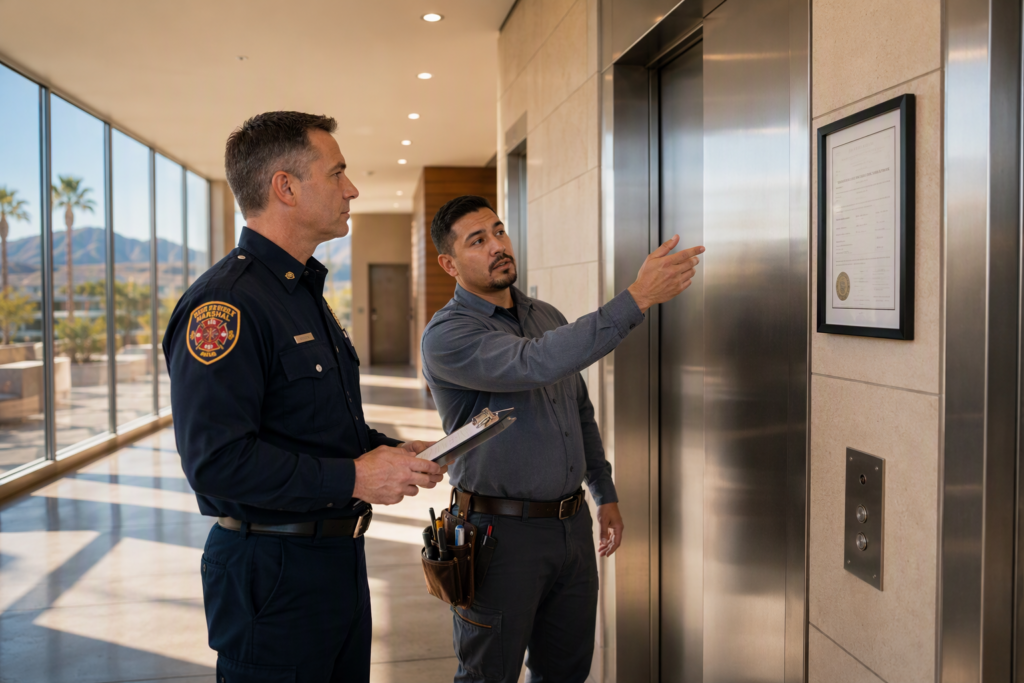
During an ADOSH inspection of a healthcare facility elevator, inspectors typically focus on the following areas. Facility managers benefit from reviewing these questions in advance and ensuring documentation is current and accessible:
- Is the current state inspection certificate posted in the elevator cab or machine room as required?
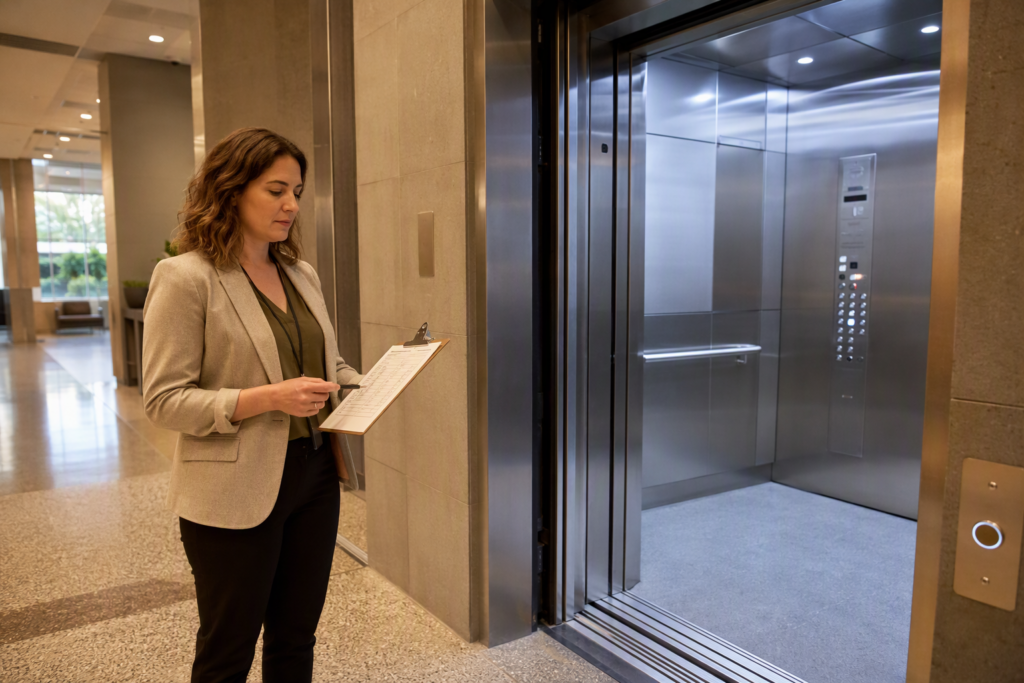
- Are maintenance logs complete, legible, and up to date, showing the dates, scope, and performing contractor for all service visits?
- Have all required periodic safety tests been completed within the applicable intervals under ASME A17.1 or A17.3?
- Is the machine room secured against unauthorized access, properly ventilated, and free of storage not related to elevator equipment?
- Do emergency lighting and communication systems in each cab function correctly?
- Are all safety devices — governors, safeties, buffers, door reopening devices — intact, unobstructed, and last tested within the required period?
- Has any alteration or major repair been performed since the last inspection, and if so, was an ADOSH alteration permit obtained and closed out?
- Are ADA-required features — call button height, door timing, audible signals, tactile markings — intact and functional at all served floors?
Preparing thorough answers to each of these questions — backed by organized documentation — is one of the most practical ways healthcare facilities can reduce inspection risk and support accreditation readiness.
—
How Do Arizona Healthcare Facilities Select a Qualified Elevator Service Provider?
Arizona requires elevator contractors to be licensed through ADOSH. When evaluating a service provider, healthcare facility managers should confirm that the contractor holds a current Arizona elevator contractor license, that mechanics performing work carry current Arizona elevator mechanic certificates, and that the company has demonstrated experience working within healthcare environments — including familiarity with infection control protocols, badge-access coordination, and the documentation demands of accreditation surveys.
Arizona Elevator Solutions is a certified elevator service company serving healthcare clients in Phoenix, Tucson, Scottsdale, and Mesa. The company’s work in healthcare settings reflects an understanding that elevator reliability in these environments is directly tied to patient care quality and regulatory compliance.
—
What Should a Healthcare Facility’s Elevator Maintenance Agreement Include?
A well-structured maintenance agreement for a healthcare facility should address the following elements:
- Scope of included services: Clearly define what preventive maintenance tasks are covered, what parts are included, and what falls outside the base agreement.
- Documentation and reporting: Specify that written maintenance logs will be provided after each visit and that records will be retained and accessible for inspection review.
- Callback and repair provisions: Define how unplanned service calls are handled, including priority for life-safety situations such as entrapments.
- Code compliance responsibility: Clarify that the contractor will perform work in accordance with ASME A17.1, A17.3, and applicable ADOSH requirements, and will notify the facility of any deficiencies that require corrective action.
- Modernization and capital planning support: Identify whether the contractor will provide condition assessments and recommendations for equipment nearing end of service life.
—
Get a Free Elevator Assessment for Your Healthcare Facility
Keeping patients, staff, and visitors safe depends on elevators that are properly maintained, inspected, and compliant with Arizona and federal requirements. Whether a facility is preparing for an ADOSH inspection, an accreditation survey, or simply wants greater confidence in its vertical transportation reliability, professional guidance makes a measurable difference.
Contact Arizona Elevator Solutions for a free elevator assessment: 480-557-7600
Serving healthcare facilities in Phoenix, Tucson, Scottsdale, Mesa, and surrounding Arizona communities.
Need elevator service you can rely on? Arizona Elevator Solutions is ready to help.