What Is Included in an Elevator Maintenance Contract? A Complete FAQ Guide
An elevator maintenance contract is a formal service agreement between a building owner or property manager and a licensed elevator contractor. It defines exactly which inspections, adjustments, repairs, and compliance tasks the contractor will perform — and how often — to keep the elevator operating safely and within code. Understanding what these contracts cover helps property owners in Phoenix, Tucson, Scottsdale, and Mesa make informed purchasing decisions and avoid costly gaps in coverage.
What Are the Core Components Included in a Standard Elevator Maintenance Contract?
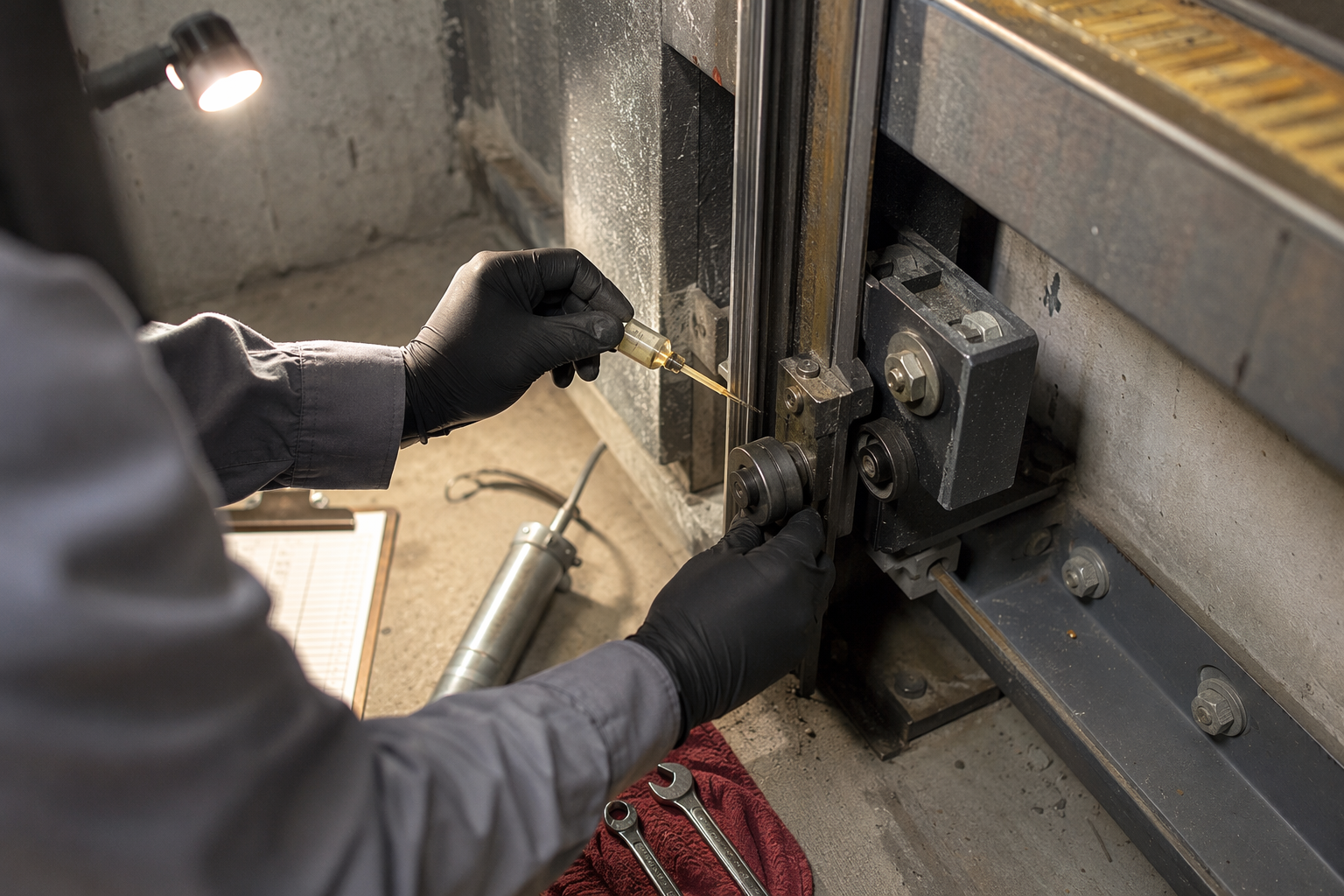
A standard elevator maintenance contract covers preventive inspections, lubrication, mechanical adjustments, safety device testing, and written service records — at minimum.
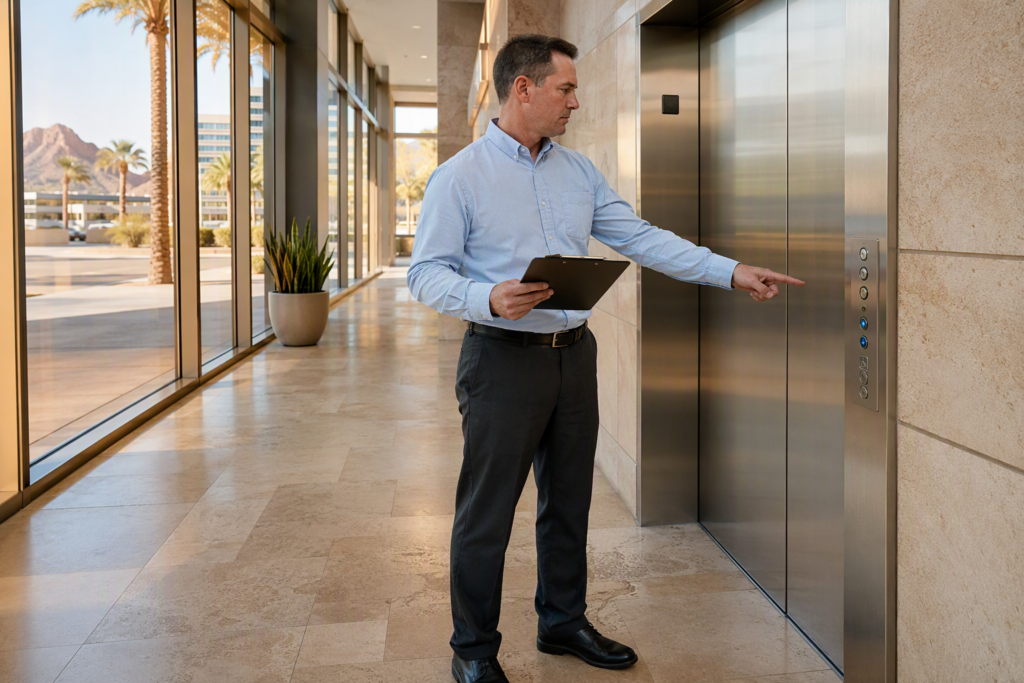
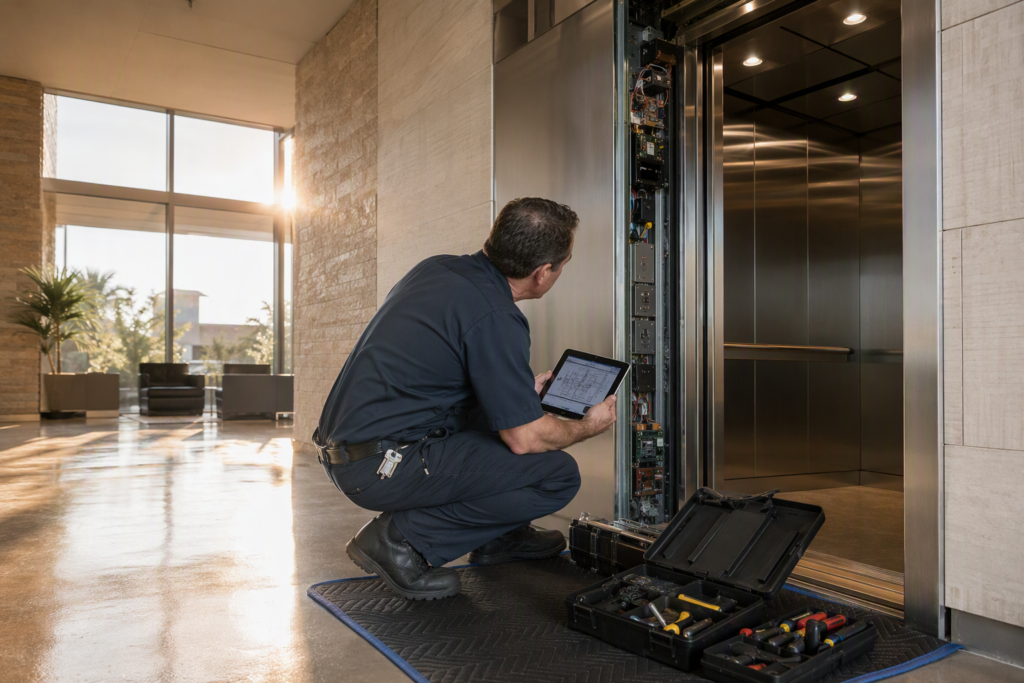
At its foundation, a maintenance agreement obligates the service provider to visit the elevator on a scheduled basis (typically monthly or quarterly), inspect all major systems, lubricate moving parts, adjust tensions and clearances, test door operators and safety circuits, and document each visit. Most contracts also include labor for minor adjustments and emergency callback response when the elevator goes out of service unexpectedly between scheduled visits.
Beyond the baseline, contracts differ significantly in whether they include replacement parts, major component repairs, or modernization work. Reviewing the exact language around parts coverage and exclusions is critical before signing any agreement.
What Are the Different Types of Elevator Maintenance Contracts?
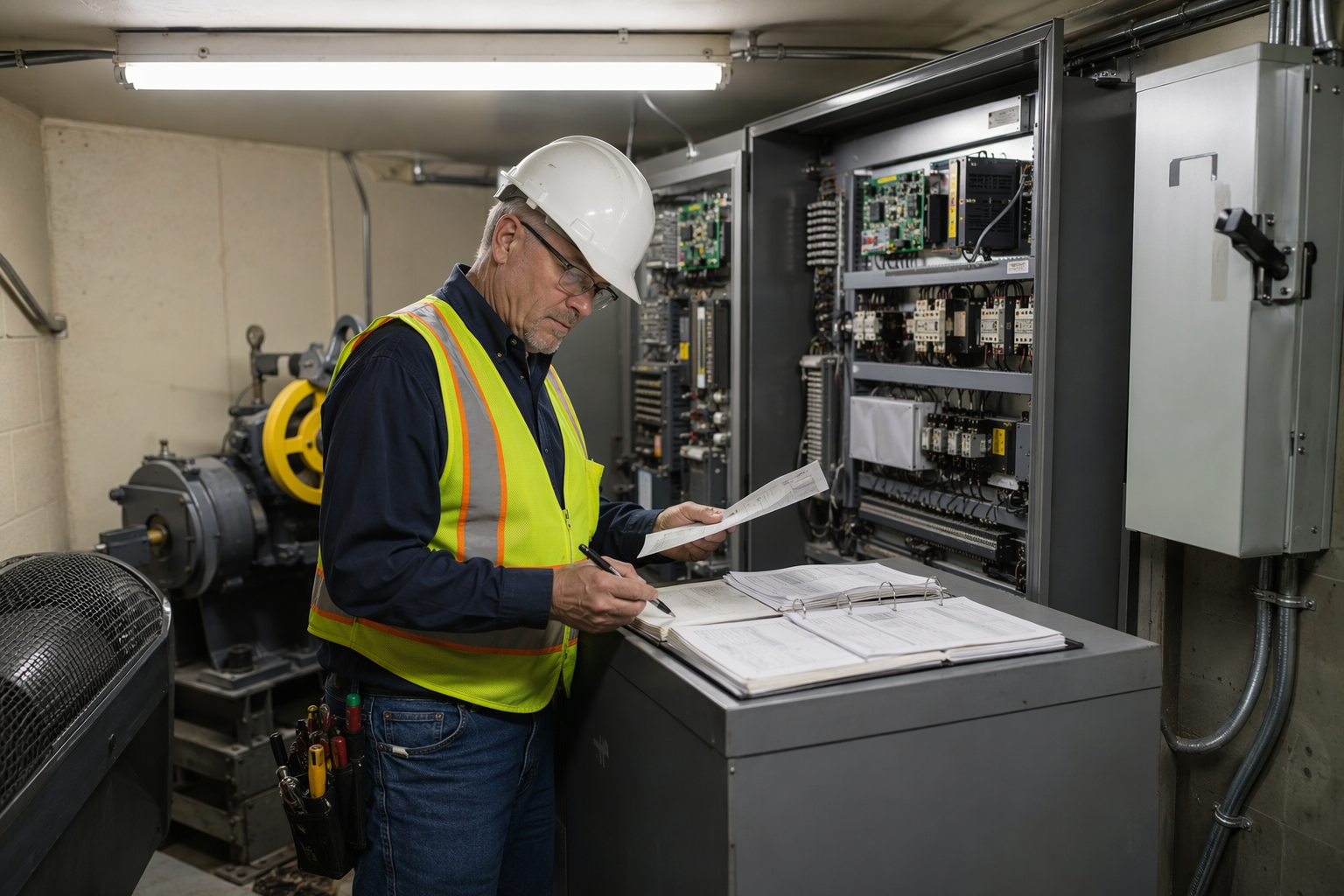
The three primary contract structures are full-maintenance (comprehensive), oil-and-grease (lubrication only), and parts-and-labor agreements — each carrying different cost and risk profiles.
Full Maintenance (Comprehensive): The contractor assumes responsibility for nearly all repairs and parts replacements, excluding major modernizations or damage from vandalism or misuse. This structure offers the most predictable budgeting and is common in high-rise commercial buildings and hospitals.
Oil-and-Grease (O&G): Covers only lubrication, cleaning, and minor adjustments. All parts and major labor are billed separately. This is the lowest-cost entry point but exposes the building owner to unpredictable repair expenses.
Parts-and-Labor: A hybrid model that includes labor costs for repairs but may exclude certain high-cost components (solid-state controllers, motors, or hydraulic cylinders). Coverage limits are spelled out in a “parts exclusion schedule” within the contract.
| Contract Type | Preventive Inspections | Lubrication & Adjustments | Labor Included | Parts Included | Emergency Callbacks | Best For |
|---|---|---|---|---|---|---|
| Full Maintenance (Comprehensive) | Yes | Yes | Yes (most repairs) | Yes (most parts) | Yes | High-traffic commercial, hospitals, high-rises |
| Parts & Labor | Yes | Yes | Yes | Partial (see exclusion schedule) | Often included | Mid-size commercial, multifamily residential |
| Oil & Grease (O&G) | Yes | Yes | No (billed separately) | No (billed separately) | Billable | Low-traffic, budget-constrained, owner-managed |
Which Safety Devices Must Be Tested Under a Maintenance Contract?
Safety device testing under a maintenance contract must include — at minimum — the governor, safeties, buffers, emergency lighting, alarm systems, and door restrictors as required by ASME A17.1 Safety Code for Elevators and Escalators.
The ASME A17.1 code establishes the national baseline for elevator safety testing intervals and procedures. In Arizona, the Arizona Department of Occupational Safety and Health (ADOSH) enforces elevator safety standards that align with ASME A17.1 requirements. A compliant maintenance contract should specify which ASME A17.1 tests will be performed, at what intervals, and by whom — and it must ensure that a licensed inspector witnesses or reviews the required periodic tests.
Key safety components covered in a thorough maintenance agreement include: overspeed governors, car and counterweight safeties, oil buffers or spring buffers, terminal stopping devices, emergency lighting and communication systems, door interlocks and restrictors, and firefighters’ service operation (Phase I and Phase II). For hydraulic elevators, the contract should also address pressure relief valve testing and seismic shutoff valve inspection where applicable.
How Often Do Scheduled Maintenance Visits Occur Under a Contract?
Most contracts specify monthly visits for high-use commercial elevators and quarterly visits for low-traffic residential or freight units, though frequency should be tailored to use intensity and equipment age.
Visit frequency is not a one-size-fits-all specification. Elevators serving high-rise office buildings or hospitals in Phoenix may require monthly or even more frequent attention due to the volume of trips per day. Residential elevators in a two-story home may be maintained adequately on a quarterly schedule. The maintenance contract should define visit frequency explicitly, and property owners should confirm that the stated frequency aligns with actual usage patterns and equipment manufacturer recommendations.
Separately from routine maintenance visits, ASME A17.1 mandates periodic tests at specific intervals — for example, annual inspections and five-year full-load safety tests. These required periodic tests should be clearly identified in the maintenance contract as either included or excluded from the base fee.
What Mechanical Components Are Covered in Elevator Preventive Maintenance?
Preventive maintenance typically covers the machine room equipment, hoistway components, car interior and operating panel, and pit equipment — with specific tasks defined for each area.
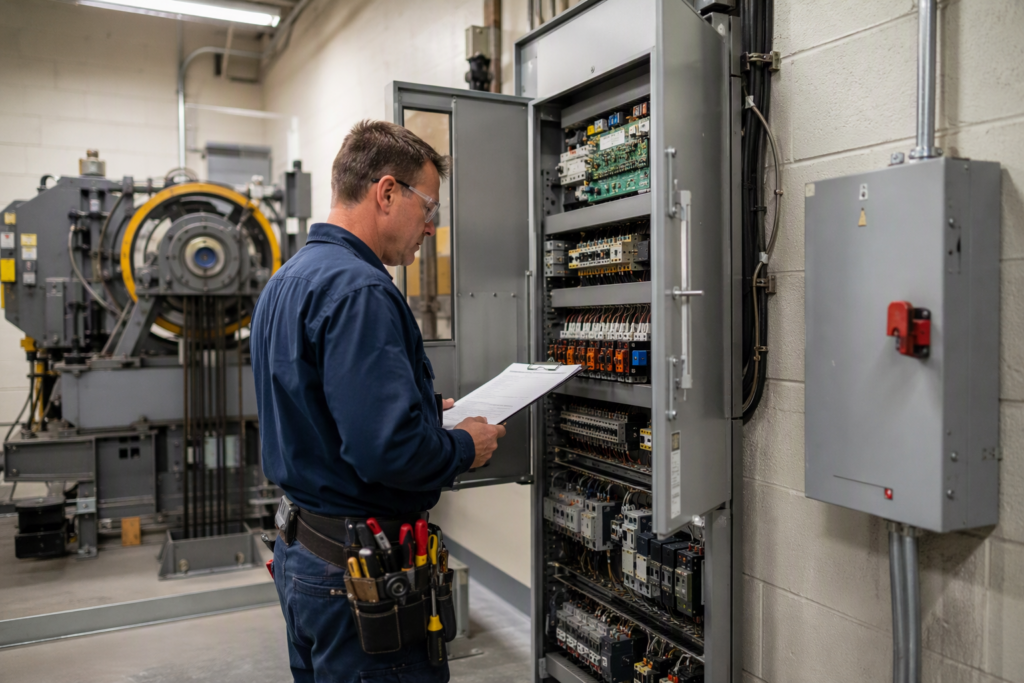
Machine Room: Motor and gearbox lubrication, brake adjustment and lining inspection, controller cleaning and contact inspection, drive belt or sheave inspection, and machine room cleanliness.
Hoistway: Rail lubrication, rope or belt inspection and tension adjustment, counterweight clearance verification, guide shoe or roller guide inspection, and hoistway wiring checks.
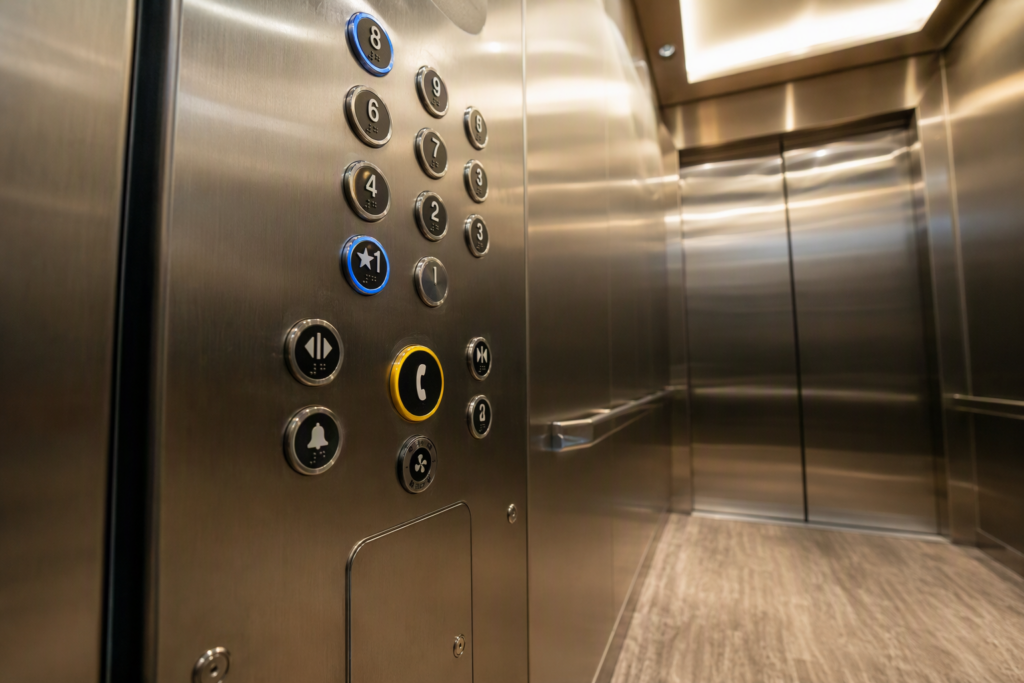
Car Interior and Operating Panel: Door operator adjustment, door panel alignment, button and indicator light testing, leveling accuracy adjustment, and interior lighting inspection.
Pit: Pit lighting, stop switch, oil collection pan inspection (hydraulic units), buffer inspection, and moisture or water intrusion checks — particularly relevant in Tucson and other areas where monsoon season can introduce water into below-grade pits.
Does an Elevator Maintenance Contract Cover ADA Compliance?
Elevator maintenance contracts do not automatically bring a unit into ADA compliance — ADA modifications are a separate scope of work, though a good contractor will flag deficiencies during routine visits.
The Americans with Disabilities Act establishes requirements for elevator dimensions, control heights, door timing, auditory signals, and Braille markings. These are design and installation standards, not maintenance items. However, during routine service visits, a qualified technician should identify when components — such as door timing, car leveling accuracy, or operational controls — are drifting out of ADA-compliant ranges. The maintenance contract should specify whether the technician will document such observations and whether corrective adjustments (where achievable through maintenance) are included in the service fee or billed separately.
What Documentation Should Be Provided Under a Maintenance Contract?
A compliant maintenance contract should require the contractor to provide a written service log for every visit, copies of all inspection certificates, and records suitable for regulatory review.
Documentation is not merely administrative — it is a legal and operational requirement. Arizona elevator regulations require that maintenance records be kept accessible in or near the machine room for review by ADOSH inspectors. A properly structured maintenance agreement commits the contractor to leaving a dated, signed service record after each visit, noting work performed, components adjusted, and any deficiencies identified. Certificates of inspection issued after state-witnessed periodic tests should also be filed by the contractor and a copy retained by the building owner.
Property managers in Scottsdale and Mesa overseeing multiple buildings should request consolidated reporting formats that allow portfolio-level tracking of maintenance activity and upcoming inspection due dates.
What Is Typically Excluded from an Elevator Maintenance Contract?
Common exclusions include repairs necessitated by vandalism, misuse, power surges, floods, or building code changes — and major components such as motors, controllers, or hydraulic cylinders are often excluded unless the contract explicitly states otherwise.
The exclusion schedule is one of the most important sections of any elevator maintenance agreement. Standard exclusions across most contract types include: cosmetic repairs to cab interior finishes, repairs caused by building structural issues, modernization or code-mandated upgrades triggered by a change-of-use, replacement of obsolete parts no longer available from original manufacturers, and repairs made necessary by unauthorized modifications to the elevator. Reviewing these exclusions with a knowledgeable contractor — such as Arizona Elevator Solutions — before contract execution prevents billing surprises when a major failure occurs.
How Does a Maintenance Contract Relate to the State Elevator Inspection Requirement?
In Arizona, elevators must pass periodic inspections conducted by ADOSH-licensed inspectors, and the maintenance contract should either include coordination of these inspections or clearly assign that responsibility to the building owner.
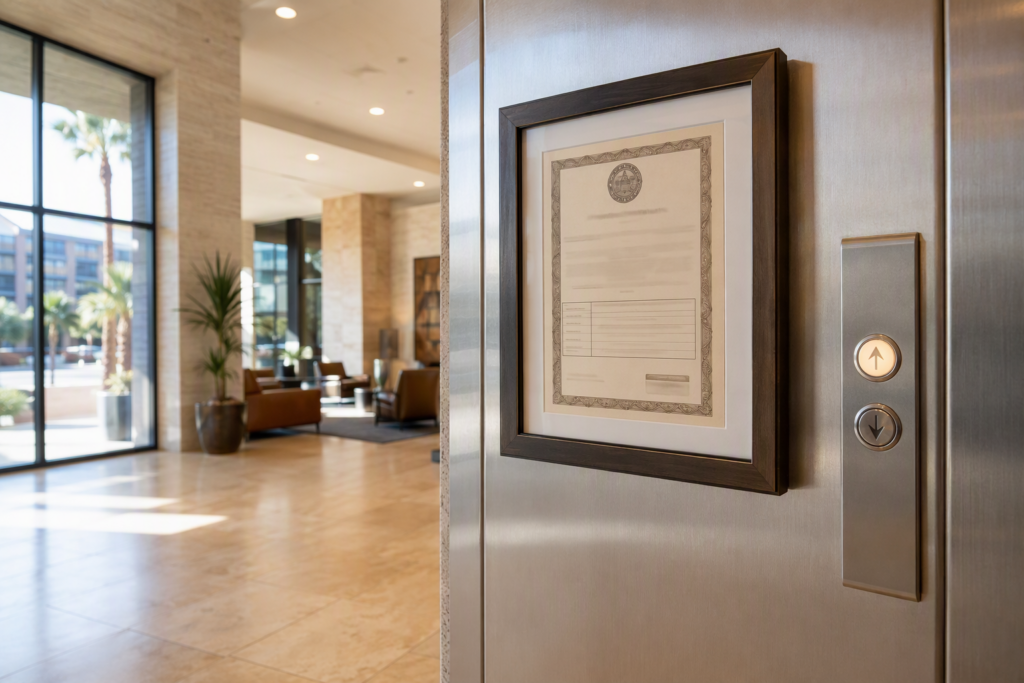
The Arizona Division of Occupational Safety and Health oversees elevator safety under authority that mirrors ASME A17.1 and related ASME standards. A compliant building must have a current certificate of inspection posted in the elevator car. The maintenance contract should specify whether the contractor will schedule and coordinate required periodic tests, prepare the elevator for the state inspection, and correct any deficiencies identified by the inspector — or whether these are billed as additional services. Property owners should confirm that the contractor is authorized to perform required periodic tests under state regulations.
What Is Emergency Callback Service and Should It Be in the Contract?
Emergency callback service is the contractor’s obligation to respond when an elevator becomes inoperable or traps a passenger between scheduled visits, and its inclusion — or absence — significantly affects total cost of ownership.
Entrapments and sudden shutdowns do not follow a maintenance schedule. A contract that does not include callback service leaves building owners paying for emergency dispatch at premium rates every time the elevator goes out of service between routine visits. When reviewing callback provisions, property owners should examine the contract language carefully for what qualifies as a callback, whether callback labor is fully covered or capped, and what exclusions apply. Arizona Elevator Solutions recommends that all commercial building owners and property managers in Phoenix, Tucson, Scottsdale, and Mesa explicitly confirm callback terms before signing a maintenance agreement.
How Should Building Owners Evaluate and Compare Elevator Maintenance Contract Proposals?
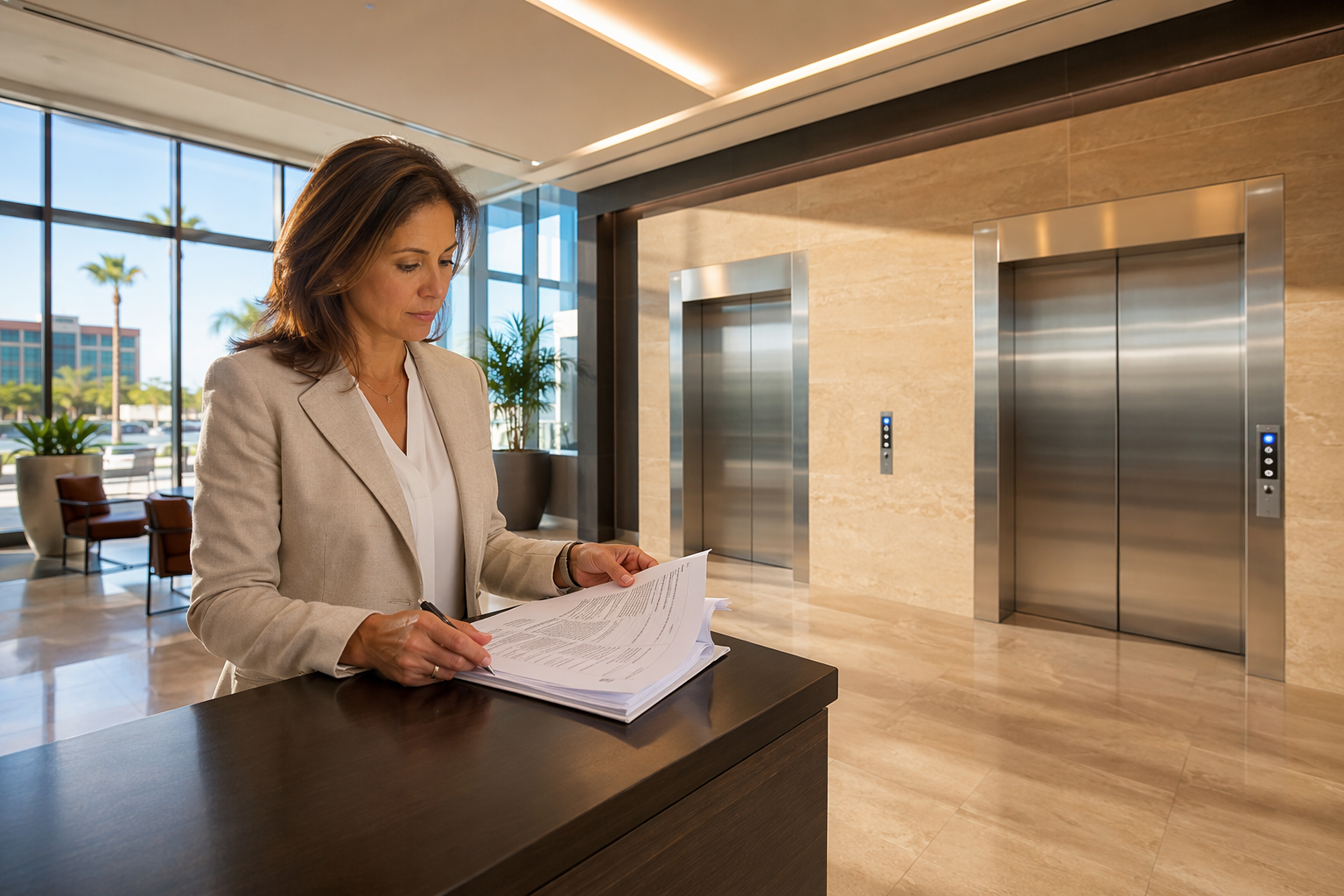
Comparing proposals requires evaluating scope of coverage, visit frequency, exclusion schedules, parts-supply capabilities, inspector qualifications, and compliance documentation practices — not price alone.
A low-cost O&G contract may appear attractive until a major component fails and all repair costs fall back on the building owner. The following step-by-step process helps property managers conduct an apples-to-apples comparison:
- Request a written scope of work from each bidder that specifies every maintenance task, its frequency, and which ASME A17.1 periodic tests are included.
- Review each bidder’s exclusion schedule and identify the five most likely failure points for the specific elevator model in question.
- Confirm that the contractor’s technicians are qualified under Arizona state requirements to perform maintenance and periodic testing on the equipment type.
- Ask for sample service logs from similar buildings to evaluate documentation quality and completeness.
- Verify parts sourcing: can the contractor obtain OEM or equivalent parts for the elevator’s make, model, and age within a reasonable timeframe?
- Clarify callback terms: Is emergency labor included? Are there hourly or trip-count caps?
- Request references from current customers with similar building types and elevator usage profiles.
What Questions Should Be Asked Before Signing an Elevator Maintenance Contract?
Before signing, building owners should ask about technician qualifications, parts availability for their specific equipment, callback provisions, escalation clauses, and contract cancellation terms.
Additional important questions include: Does the contract auto-renew, and with how much notice is cancellation allowed? Are price escalation clauses tied to a published index or at the contractor’s discretion? Who performs the work — the contracting company’s own technicians or subcontractors? What happens if the elevator requires a repair that exceeds the contract’s coverage limit? Getting clear written answers to these questions before execution prevents disputes later in the contract term.
How Does Elevator Age and Equipment Type Affect What a Maintenance Contract Should Cover?
Older elevators and hydraulic units require more detailed maintenance coverage than newer traction units, because aging components carry higher failure probability and replacement parts may be harder to source.
An elevator installed decades ago with relay-logic controls demands more intensive inspection of electrical contacts, wiring insulation, and mechanical components than a recently modernized unit with solid-state controls. For older hydraulic elevators — common in low-rise commercial buildings across Tucson and Mesa — the maintenance contract should explicitly address hydraulic cylinder inspection, seal integrity checks, oil fluid quality monitoring, and compliance with environmental regulations governing hydraulic fluid containment. Traction elevators over a certain age may also require modernization assessments as part of a comprehensive maintenance program, since some safety upgrades required by code changes may not be achievable through maintenance alone.
What Role Does OSHA Play in Elevator Maintenance Requirements?
The Occupational Safety and Health Administration (OSHA) establishes safety standards for workers who perform elevator maintenance and for employees who work in buildings where elevators operate.
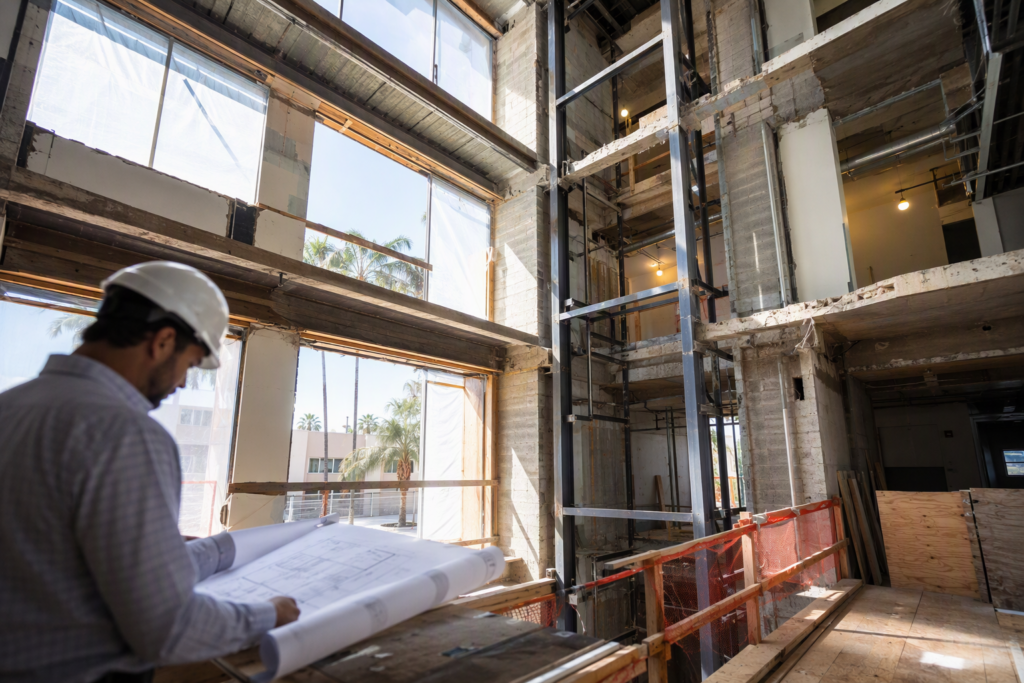
OSHA regulations require that elevator technicians follow lockout/tagout (LOTO) procedures when working on elevator equipment to prevent unexpected energization. Building owners contracting with an elevator service company should confirm that the company’s safety program meets OSHA standards, both to protect the technicians performing the work and to limit the building owner’s liability. OSHA standards also apply to construction hoists and temporary elevators, which fall outside the scope of most standard maintenance contracts but may be relevant during building renovation projects in Phoenix or Scottsdale.
Can a Maintenance Contract Be Transferred When a Building Is Sold?
Most elevator maintenance contracts contain assignment clauses that allow transfer to a new owner, though the incoming owner should review the contract terms before assuming the agreement rather than inheriting unfavorable provisions.
When a commercial property in Mesa or Phoenix changes hands, the existing elevator maintenance contract may be assignable with the contractor’s consent. Buyers in a real estate transaction should request a copy of the current maintenance agreement during due diligence, review remaining term length, coverage scope, and any open deficiencies identified in recent service logs. If the contract terms are unfavorable, the closing process may provide leverage to renegotiate or terminate the agreement and engage a preferred contractor such as Arizona Elevator Solutions from the start of new ownership.
What Happens If an Elevator Fails Inspection Under a Maintenance Contract?
When an elevator fails a state inspection, the building owner is responsible for correcting deficiencies — and whether the maintenance contract covers correction costs depends entirely on the contract type and the nature of the deficiency.
If the failed inspection item relates to wear or deterioration that a comprehensive maintenance contract was supposed to prevent or address, the contractor may bear responsibility under the contract terms. However, if the failure stems from a code change that imposes new requirements not previously required — such as a new edition of ASME A17.1 adopted in 2026 — the correction is typically treated as a capital upgrade outside the maintenance contract scope. Prompt response to inspection deficiencies is essential: an elevator with a failed inspection must be taken out of service until corrections are made and the unit passes re-inspection.
How Does a Maintenance Contract Reduce Liability for Building Owners?
A properly structured maintenance contract reduces building owner liability by demonstrating due diligence in equipment safety, creating a documented record of compliance, and shifting certain repair obligations contractually to the service provider.
In the event of an elevator-related injury or accident, courts and insurers will examine whether the building owner maintained the elevator in accordance with applicable codes and manufacturer recommendations. A complete service record showing regular, documented maintenance visits, prompt repair of identified deficiencies, and current inspection certificates provides evidence of a responsible maintenance program. Property owners and managers across Arizona’s commercial real estate market increasingly treat their elevator maintenance agreement as a risk management tool — not simply a service purchase.
What Should a Contract Say About Parts Quality and Sourcing?
The contract should specify whether replacement parts will be OEM (original equipment manufacturer), OEM-equivalent, or remanufactured — because parts quality directly affects safety, longevity, and warranty validity.
Using non-equivalent substitute parts can void the elevator manufacturer’s warranty and, in some cases, create compliance issues under ASME A17.1 if the substitution changes the performance characteristics of a safety-critical component. The maintenance agreement should commit the contractor to using parts that meet or exceed OEM specifications. For elevators past their expected service life where OEM parts are no longer manufactured, the contract should address the process for sourcing acceptable alternatives and obtaining any required engineering review.
How Is an Elevator Maintenance Contract Priced, and What Drives Cost Variation?
Maintenance contract pricing is driven by elevator type, age, usage intensity, contract coverage level, number of units, and local labor market conditions — and price alone is a poor indicator of value.
A full-maintenance contract on a high-use hydraulic elevator in a commercial building will cost more than an O&G agreement on a low-traffic traction unit in a mid-rise residential building — reflecting the greater labor, parts exposure, and frequency of visits required. Multi-unit agreements covering several elevators in a single building or across a portfolio typically carry pricing advantages compared to single-unit contracts. Building owners in Phoenix and Scottsdale should be cautious of contracts priced significantly below market — underbidding often signals that the contractor plans to upsell repairs at premium rates, or that technician visit frequency and thoroughness will be reduced to manage costs.
Why Should Property Owners in Phoenix, Tucson, Scottsdale, and Mesa Work with Arizona Elevator Solutions?
Arizona Elevator Solutions provides certified elevator maintenance services across the Phoenix metro and Southern Arizona, offering contract options tailored to building type, usage, and compliance requirements.
Property owners and facility managers throughout Phoenix, Tucson, Scottsdale, and Mesa benefit from working with a locally focused, certified elevator service company that understands the specific regulatory environment enforced by ADOSH, the climate-related maintenance considerations of Arizona’s desert environment — including monsoon-season pit inspections and heat-related stress on hydraulic fluid and electrical components — and the varied elevator equipment mix found across the region’s commercial, multifamily, and healthcare properties. Arizona Elevator Solutions structures maintenance agreements to align coverage level with each building’s actual risk profile, ensuring that neither coverage nor budget is wasted.
Get a Free Elevator Assessment from Arizona Elevator Solutions
Understanding what should be in an elevator maintenance contract is only the first step. The right contract for a Phoenix office tower differs from the right contract for a Tucson medical facility or a Scottsdale residential high-rise. Arizona Elevator Solutions will assess the current condition of the elevator equipment, review existing maintenance documentation, identify compliance gaps, and recommend a contract structure aligned with the building’s needs and regulatory obligations.
Contact Arizona Elevator Solutions for a free elevator assessment: 480-557-7600
Serving Phoenix, Tucson, Scottsdale, and Mesa, AZ.
Need elevator service you can rely on? Arizona Elevator Solutions is ready to help.