Elevator Inspection Requirements in Arizona: The Complete Compliance Guide
Arizona building owners, property managers, and facility directors face significant legal and safety obligations when it comes to elevator compliance. Failing to meet state inspection requirements can result in permit revocation, fines, and — most critically — risk to building occupants. This guide covers every aspect of elevator inspection requirements in Arizona, from code authority and inspection intervals to what happens during an inspection and how to prepare.
What Governs Elevator Inspections in Arizona?
Arizona’s elevator safety program is administered by the Arizona Division of Occupational Safety and Health (ADOSH), which operates under the Arizona Industrial Commission. ADOSH has statutory authority to regulate the installation, alteration, repair, and periodic inspection of conveyances — a category that includes traction elevators, hydraulic elevators, escalators, moving walks, dumbwaiters, material lifts, and platform lifts.
The technical standards that inspectors apply are drawn from the ASME A17.1 Safety Code for Elevators and Escalators, the nationally recognized benchmark for elevator design, construction, installation, and maintenance. Arizona adopts this code by reference, meaning that compliance with ASME A17.1 is the baseline for passing a state inspection. Accessibility requirements for public conveyances must also align with the Americans with Disabilities Act (ADA), which sets standards for cab dimensions, door timing, hall call controls, and Braille markings.
For elevators in workplaces covered by federal OSHA standards, additional requirements under OSHA’s general industry regulations may apply, particularly regarding maintenance records, employee safety, and machine room access.
How Often Are Elevators Inspected in Arizona?
Under Arizona’s conveyance safety program, the required inspection frequency depends on the type of conveyance and the nature of the inspection. There are two primary inspection categories:
- Annual Routine Inspection: Most elevators and escalators in Arizona are subject to a routine operational inspection at least once per calendar year. This inspection confirms that the conveyance is operating safely and that all required safety devices — door interlocks, overspeed governors, buffers, emergency lighting, and communication systems — are functional.
- Periodic (Full) Inspection and Test: The ASME A17.1 Safety Code for Elevators and Escalators establishes intervals for more comprehensive tests, including full-load tests, safety device tests, and pressure tests for hydraulic systems. For most hydraulic elevators, a full test is required every five years. Traction elevators have their own ASME-specified test intervals for governors, safeties, and buffers.
Building owners are responsible for scheduling these inspections proactively. ADOSH does not automatically notify owners when an inspection is due — the obligation rests with the permit holder to maintain a current Certificate of Operation.
What Is a Certificate of Operation and How Do You Get One?
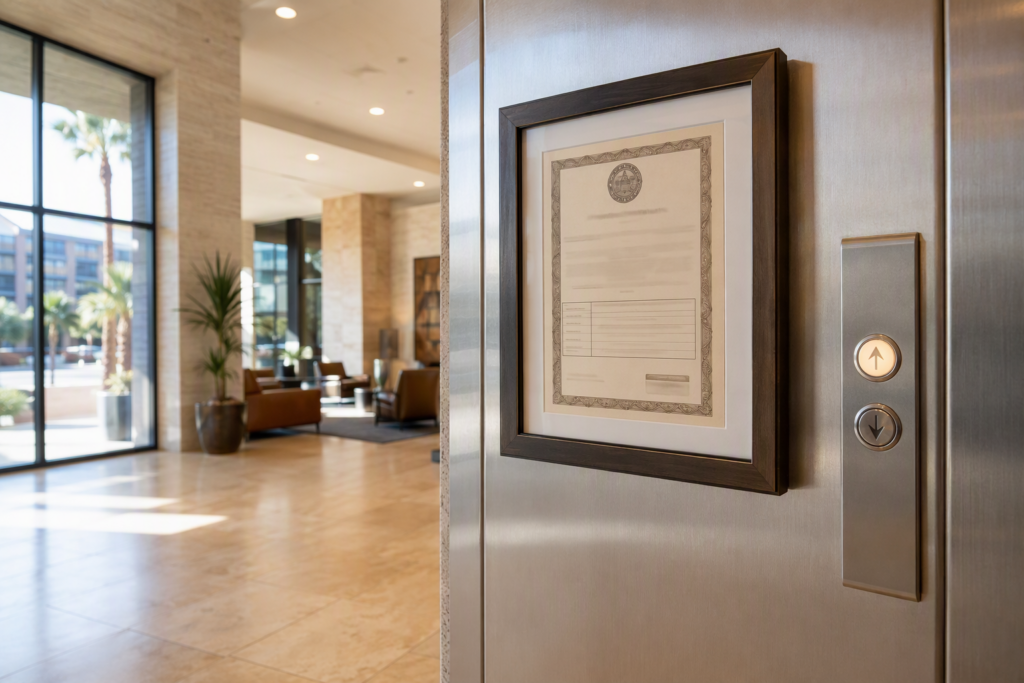
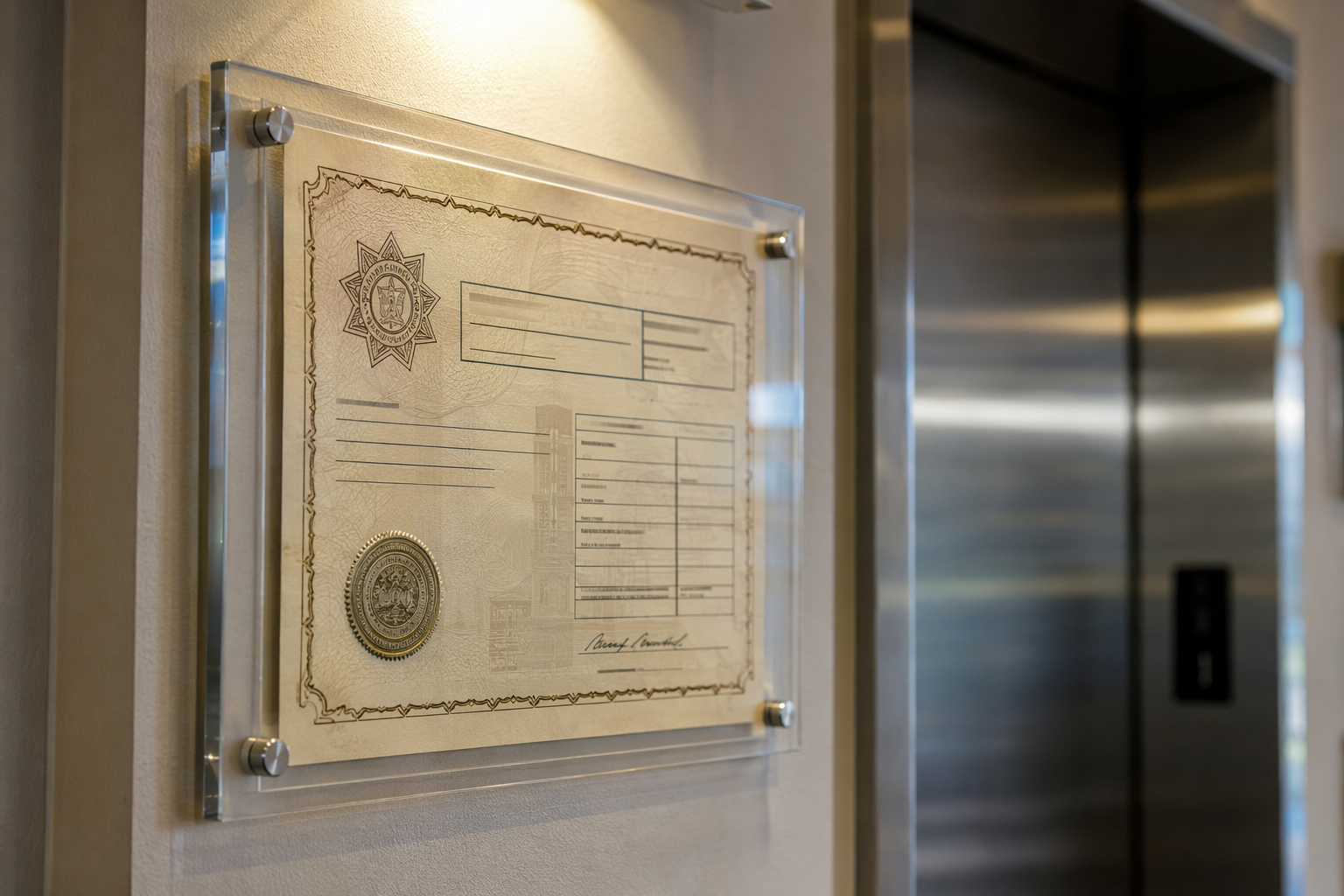
A Certificate of Operation is the official document issued by ADOSH confirming that an elevator has passed its required inspection and is authorized to be used by the public. Key facts about this certificate:
- The certificate must be posted inside the elevator cab or in a location accessible to the public — this is a hard legal requirement, not a recommendation.
- Operating an elevator without a current Certificate of Operation is a violation of Arizona law and can result in the unit being placed out of service by ADOSH.
- Certificates are tied to the specific conveyance and permit number, not the building address broadly.
- When ownership of a building changes, the new owner must notify ADOSH and ensure all certificates are transferred or re-issued under the correct entity.
To obtain or renew a Certificate of Operation, the building owner or their authorized representative schedules an inspection through ADOSH, an inspection is conducted by a state-licensed conveyance inspector, any deficiencies noted must be corrected and re-inspected, and the certificate is issued once the unit passes. Fees for permits and inspections are set by the Arizona Industrial Commission and are subject to periodic adjustment.
What Happens During an Arizona Elevator Inspection?
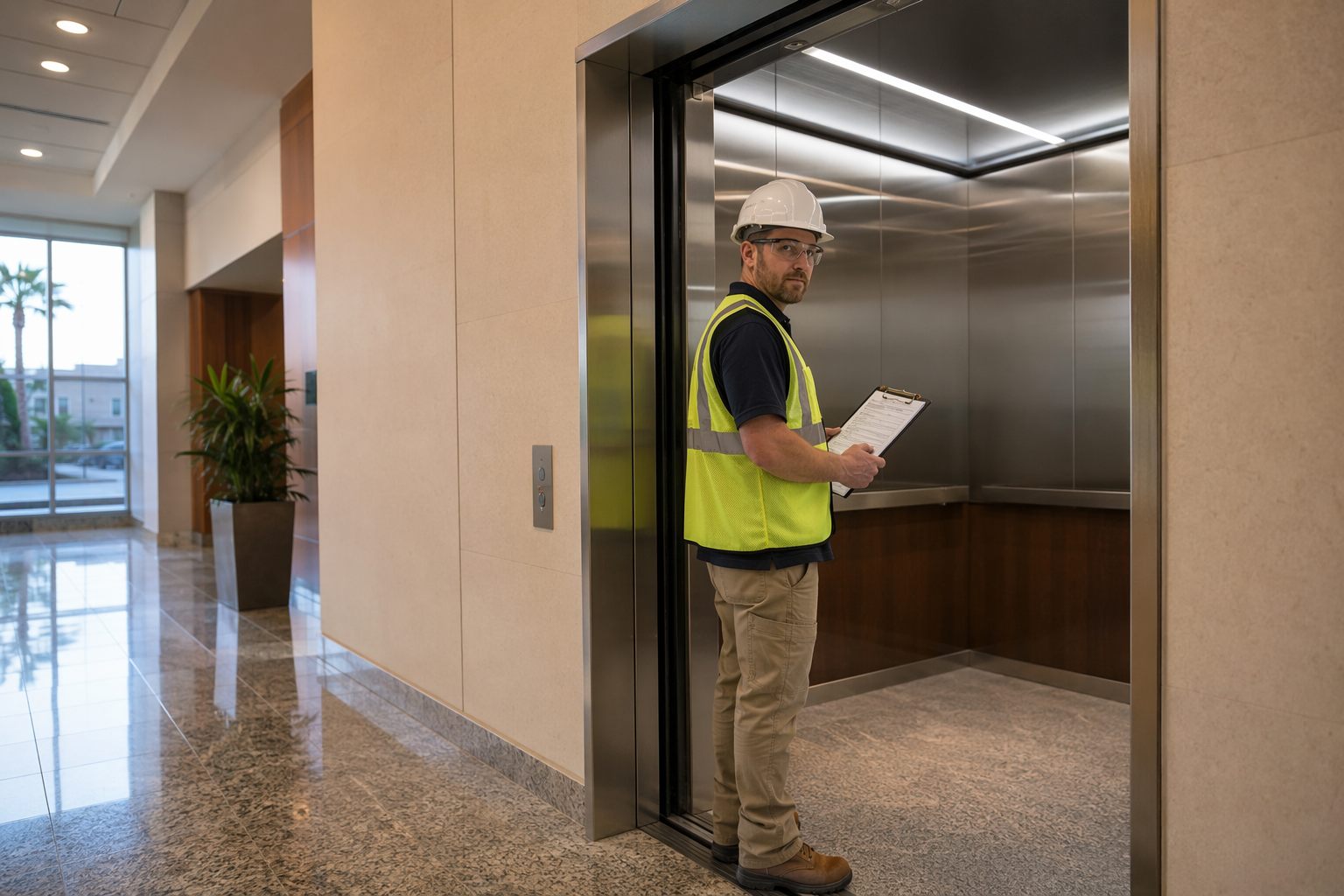
An ADOSH-conducted elevator inspection is a structured technical evaluation. While the exact scope varies by conveyance type and inspection category, a routine annual inspection typically covers the following areas:
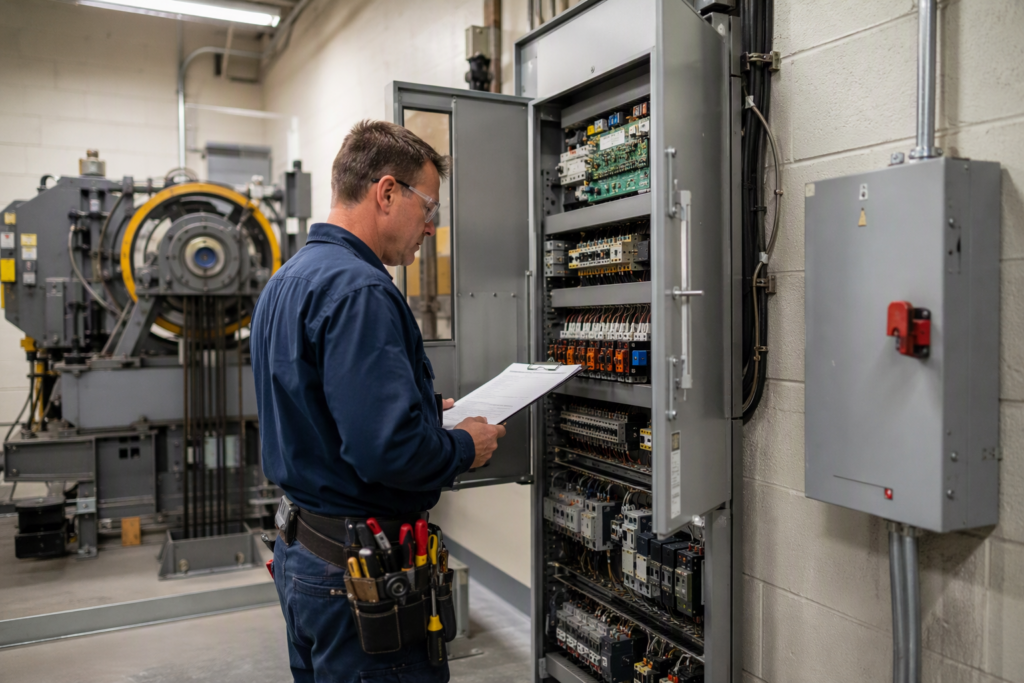
- Machine Room: Inspector checks for proper lighting, temperature control, housekeeping, fire protection, and access restrictions. Machine room doors must be self-closing and self-locking per ASME A17.1 requirements.
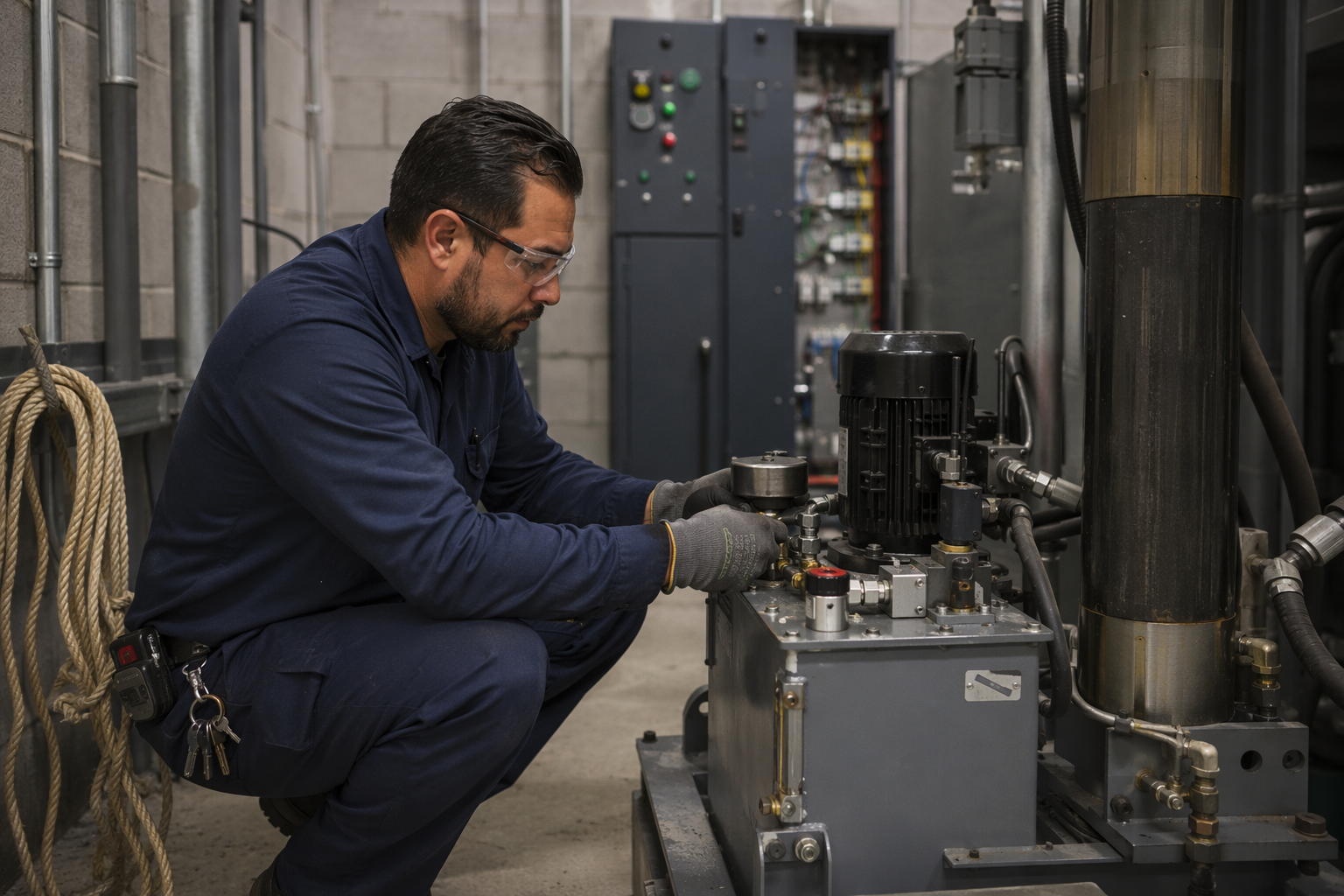
- Drive System: For traction elevators, the inspector reviews the machine, brake, sheaves, and ropes. For hydraulic elevators, the cylinder, jack assembly, fluid reservoir, and piping are examined.
- Safety Devices: All safeties, governors, buffers, interlocks, and limit switches must operate within code tolerances.
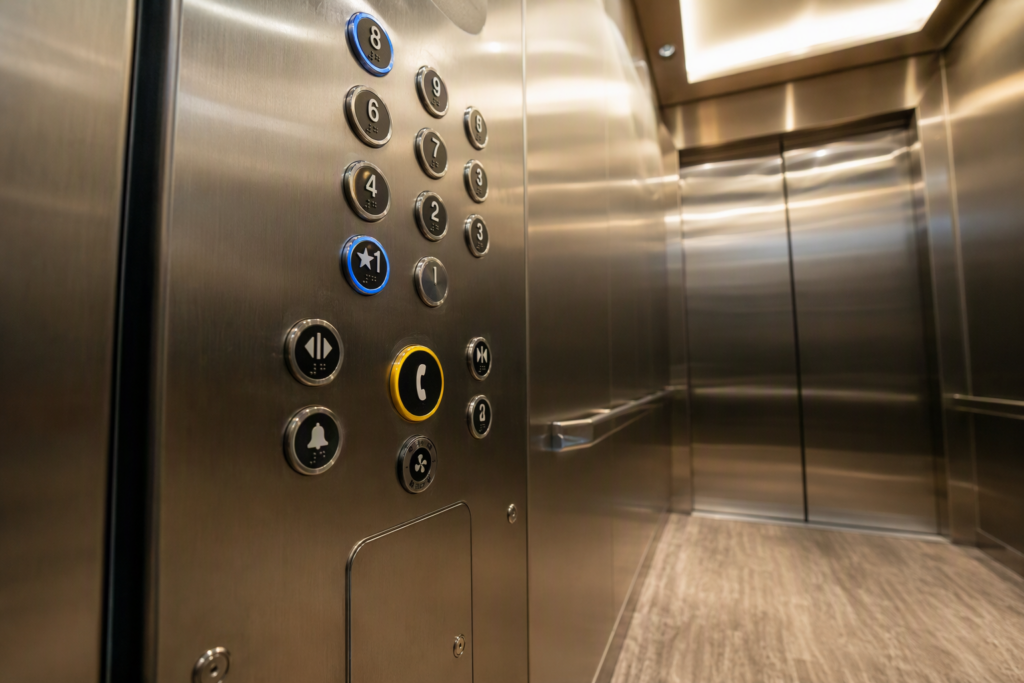
- Cab Interior: The inspector checks cab lighting, emergency lighting, ventilation, capacity signage, Certificate of Operation posting, emergency communication device (two-way phone), and door operation.
- Hoistway: Clearances, pit lighting, pit stop switch, pit ladder, and sump pump (where required) are reviewed.
- ADA Compliance Elements: Inspectors may note non-compliant features that affect accessibility under the Americans with Disabilities Act, including hall call button heights, door timing, and audible signals.
What Are the Steps to Prepare for an Arizona Elevator Inspection?
- Verify current permit status. Confirm with ADOSH that your conveyance permit is active and identify the inspection category due (routine annual vs. full periodic test).
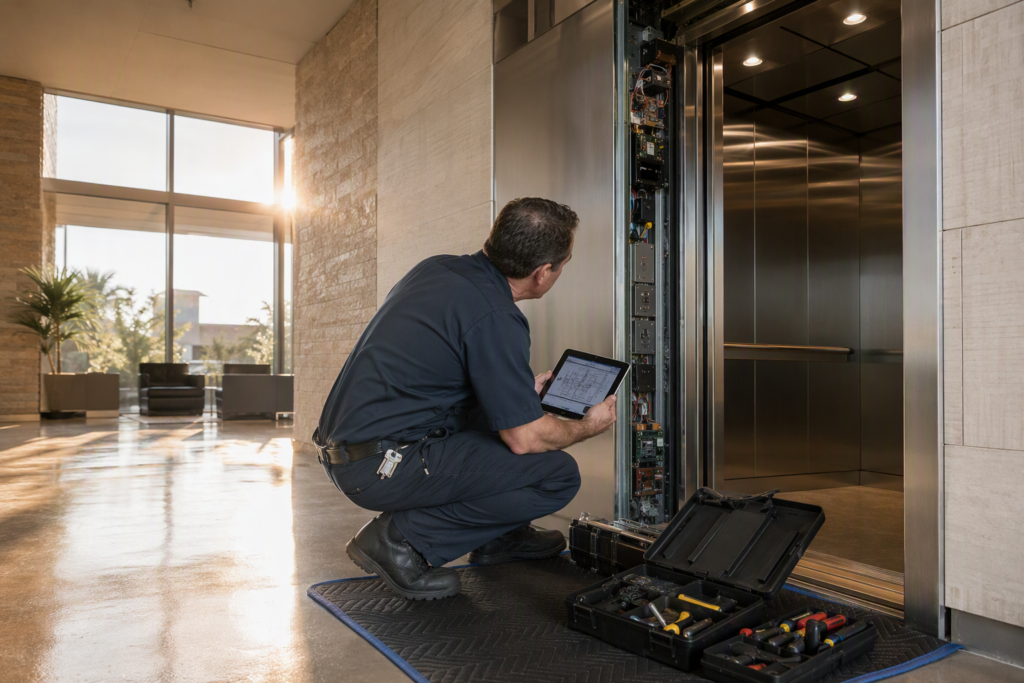
- Schedule a pre-inspection maintenance visit. Have a qualified elevator maintenance company perform a thorough maintenance check before the state inspection. This is the single most effective way to identify and correct deficiencies before they become official violations.
- Ensure machine room access. Confirm that the machine room is clean, properly lit, at the correct temperature range, and accessible to the inspector. Remove any non-elevator equipment or storage.
- Test the emergency communication device. Verify that the in-cab phone or two-way communication system connects to a monitored location and functions correctly.
- Check emergency lighting. Confirm that battery-powered emergency lighting activates upon power loss and provides adequate cab illumination.
- Confirm capacity and certification postings. Make sure the current Certificate of Operation and rated capacity placard are properly displayed inside the cab.
- Review maintenance logs. Organize maintenance records, lubrication logs, and any repair documentation. Inspectors may request these as evidence of ongoing maintenance.
- Address known deficiencies in advance. If your maintenance provider identified issues at the last service visit, ensure those items are repaired before the inspection date.
- Confirm pit condition. The pit must be clean, dry, properly lit, and equipped with a functional stop switch and, where required, a pit ladder.
- Be present or designate a representative. Arrange for a knowledgeable building or facilities representative to accompany the inspector and answer questions about the unit’s history.
What Happens If an Elevator Fails an Arizona Inspection?
When an ADOSH inspector identifies a deficiency, the outcome depends on the severity of the violation:
- Minor deficiencies may result in a written notice requiring correction within a specified timeframe, with a follow-up inspection scheduled to verify compliance. The elevator may continue operating during this period.
- Serious or imminent-hazard deficiencies can result in the elevator being placed out of service immediately. ADOSH has authority to affix a notice prohibiting use of the unit until the deficiency is corrected and a re-inspection passes.
- Repeated violations can result in escalating penalties and increased regulatory scrutiny of a building owner’s entire conveyance portfolio.
Building owners have the right to contest findings through the Arizona Industrial Commission’s administrative process, but the most cost-effective path is always prompt correction and re-inspection.
Does Arizona Require Licensed Elevator Inspectors?
Yes. Elevator inspectors performing official inspections in Arizona must hold a valid state license issued by the Arizona Industrial Commission. In-state inspections may be conducted by ADOSH staff inspectors or, in some circumstances, by certified inspectors working under a qualified elevator inspection company that has been authorized by ADOSH. The technical certification standard most commonly referenced for inspector qualifications is the ASME QEI-1 Standard for the Qualification of Elevator Inspectors, which defines the knowledge and examination requirements for inspector certification.
Building owners should always request proof of the inspector’s state licensure before allowing a third-party inspection to be conducted for permit purposes.
What ADA Requirements Apply to Arizona Elevators?
Elevators installed or altered in facilities subject to the Americans with Disabilities Act must comply with ADA Standards for Accessible Design. Key requirements include:
- Hall call buttons positioned at accessible heights for both ambulatory and wheelchair users.
- Minimum cab interior dimensions sufficient to accommodate a wheelchair and allow a turning radius.
- Door reopening devices that respond to obstruction without requiring physical contact (non-contact sensors).
- Raised and Braille characters on cab control panels.
- Audible and visual signals for floor designation and door operation.
- Leveling accuracy within a defined tolerance to ensure the cab floor is flush with the landing.
ADA compliance is evaluated separately from the state safety inspection, but failure to meet ADA requirements exposes building owners to civil rights complaints and potential Department of Justice enforcement. Arizona Elevator Solutions assists building owners in identifying ADA gaps alongside routine safety compliance reviews.
What Are the New Installation and Alteration Permit Requirements?
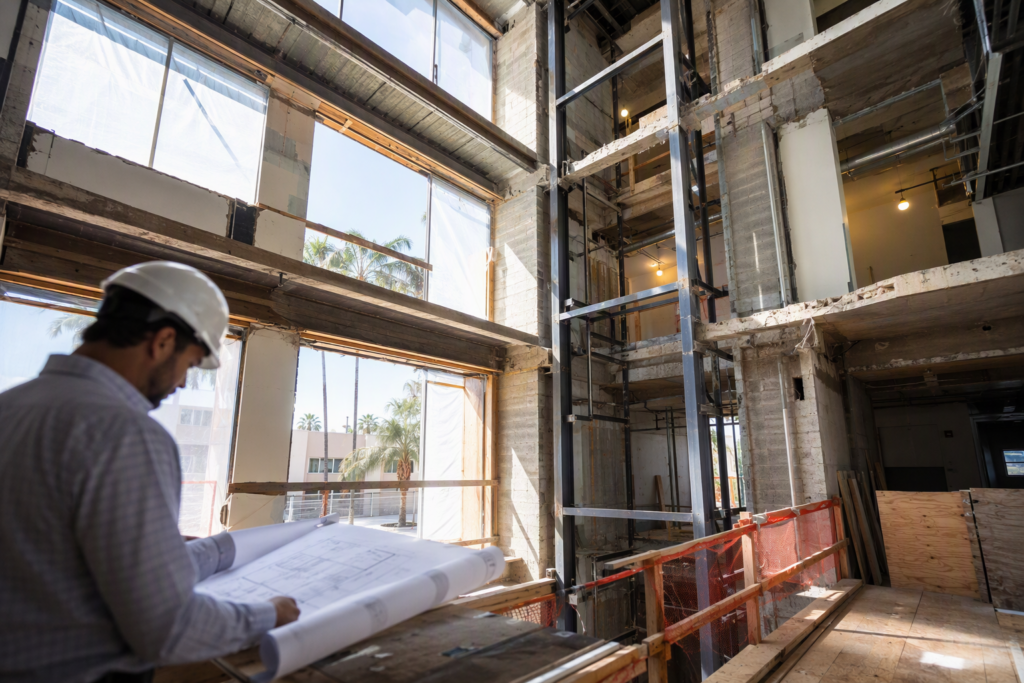
Any new elevator installation or major alteration in Arizona requires a permit from ADOSH before work begins. The permit process involves:
- Submission of engineering drawings and specifications demonstrating compliance with the current edition of ASME A17.1.
- Plan review by ADOSH or a contracted plan reviewer.
- Inspections at defined construction phases (rough-in, final).
- A final acceptance inspection and test before the unit is placed in service.
Alterations that trigger a new permit include changes to the drive system, cab dimensions, control system, or rated capacity. Cosmetic upgrades such as cab interior refinishing typically do not require a permit, but owners should confirm the scope with ADOSH before proceeding.
How Do Inspection Requirements Differ for Residential Elevators?
Private residence elevators — those installed in single-family homes and used exclusively by the occupants and their guests — are subject to different regulatory treatment than commercial elevators. In Arizona, private residence elevators are governed by ASME A17.1 Part XX (the section addressing private residence elevators) rather than the full commercial code. The state inspection and Certificate of Operation requirements that apply to commercial conveyances generally do not apply to private residence elevators, though installation permits may still be required by local building departments. Building owners of multi-family residential properties — apartments, condominiums, assisted living facilities — do fall under full ADOSH jurisdiction and commercial inspection requirements.
What Are the 2025–2026 Trends in Arizona Elevator Inspection Compliance?
Several qualitative trends are shaping elevator inspection and compliance in Arizona heading into 2026:
- Increased enforcement activity: ADOSH has expanded its conveyance program staffing and outreach in recent years, leading to a higher rate of proactive inspections rather than complaint-driven enforcement. Building owners who have historically operated on informal schedules are encountering more structured compliance timelines.
- Modernization driving permit complexity: The wave of elevator modernization projects across Arizona’s aging commercial building stock is generating a higher volume of alteration permits. Projects that replace legacy relay-logic controllers with microprocessor-based systems require careful documentation to demonstrate code compliance.
- Remote monitoring and predictive maintenance: More elevator service providers are deploying IoT-based monitoring systems that capture operational data between inspections. While these systems do not replace required ADOSH inspections, they help building owners identify potential deficiencies before an inspection occurs.
- ADA retrofit demand: Enforcement actions under the ADA continue to prompt building owners to commission accessibility audits and retrofit older elevators, particularly in hospitality, healthcare, and commercial office buildings.
- Supply chain normalization: The parts and equipment supply chain disruptions that delayed elevator repairs and modernizations in prior years have largely normalized, allowing building owners to address deferred maintenance and complete alteration projects on more predictable timelines.
How Much Does an Elevator Inspection Cost in Arizona?
The cost of an elevator inspection in Arizona has two components: the state permit and inspection fee set by the Arizona Industrial Commission, and the cost of any pre-inspection maintenance or repair work performed by a private elevator service company. State fees are established by regulation and are subject to periodic revision — building owners should contact ADOSH directly for current fee schedules, as these figures change and citing an outdated number could create compliance confusion. The cost of pre-inspection maintenance varies based on the type of conveyance, its age, condition, and the scope of work identified. Arizona Elevator Solutions provides transparent, itemized assessments so building owners understand exactly what work is recommended before committing to a scope.
How Do You Choose an Elevator Maintenance and Inspection Support Company in Arizona?
When evaluating elevator service providers in Arizona, building owners should consider the following factors:
- State licensing: Confirm that the company employs elevator mechanics holding current Arizona state licenses.
- Familiarity with ADOSH requirements: A provider with direct experience supporting ADOSH inspections across a range of conveyance types will be better positioned to identify compliance gaps than a generalist contractor.
- Maintenance documentation practices: A quality provider produces detailed maintenance records that can be presented to an inspector as evidence of ongoing care.
- Full-service capability: Companies that handle both routine maintenance and modernization work can provide a consistent perspective on a conveyance’s condition over time, rather than a fragmented view from multiple vendors.
- Code knowledge: Given that Arizona references ASME A17.1 as its technical standard, providers should demonstrate current familiarity with the code’s requirements rather than relying on outdated editions.
Arizona Elevator Solutions supports building owners throughout the compliance lifecycle — from pre-inspection maintenance and deficiency correction to alteration permits and ADA compliance reviews — applying current code knowledge to help buildings maintain continuous, lawful operation of their conveyances.
Quick-Reference: Key Arizona Elevator Inspection Facts
| Requirement | Detail | Authority |
|---|---|---|
| Governing state agency | Arizona Division of Occupational Safety and Health (ADOSH) | Arizona Industrial Commission |
| Technical code standard | ASME A17.1 Safety Code for Elevators and Escalators | ASME |
| Inspector qualification standard | ASME QEI-1 Standard for the Qualification of Elevator Inspectors | ASME |
| Accessibility standard | ADA Standards for Accessible Design | ADA.gov |
| Certificate of Operation posting | Required inside cab or accessible location | Arizona Industrial Commission |
| Workplace elevator safety | General industry standards may apply | OSHA |
Frequently Asked Questions: Arizona Elevator Inspection Requirements
Who is responsible for scheduling elevator inspections in Arizona?
The building owner or the permit holder of record is legally responsible for ensuring that required inspections are scheduled and completed on time. ADOSH does not send automatic renewal reminders for most permits. Building owners should track their Certificate of Operation expiration dates and proactively schedule inspections in advance of those dates to avoid lapses.
What happens if I operate an elevator without a valid Certificate of Operation in Arizona?
Operating a conveyance without a current Certificate of Operation is a violation of Arizona law. ADOSH can issue a notice of violation, assess civil penalties, and — in cases where the unit poses an immediate hazard — order it out of service until compliance is restored. Beyond the regulatory consequences, building owners also face potential civil liability if an occupant is injured while using an elevator operating outside its legal permit status.
Does a new building construction elevator need a separate permit from ADOSH?
Yes. Any elevator installed in a new building requires a permit from ADOSH before installation begins. The permit process involves submission of drawings, plan review, phased construction inspections, and a final acceptance test. The elevator cannot be placed in public service until it passes the final inspection and receives a Certificate of Operation.
Are escalators and moving walks subject to the same inspection requirements as elevators in Arizona?
Yes. Escalators and moving walks are classified as conveyances under Arizona’s regulatory program and are subject to the same permitting, inspection, and Certificate of Operation requirements as passenger elevators. The technical standards for escalators and moving walks are also contained within the ASME A17.1 Safety Code for Elevators and Escalators.
Can a building owner conduct their own elevator inspection in Arizona?
No. For official permit and Certificate of Operation purposes, inspections must be conducted by a state-licensed conveyance inspector. Building owners and maintenance technicians can and should conduct informal operational checks between formal inspections, but these internal checks do not satisfy the legal inspection requirement or result in certificate issuance.
What is the difference between a routine inspection and a periodic test?
A routine inspection is an operational and visual evaluation that confirms the elevator is functioning safely and that required safety devices are present and operational. A periodic test involves physical testing of specific safety components — such as governor and safety tests, buffer tests, and hydraulic pressure tests — at intervals specified in the ASME A17.1 Safety Code. Periodic tests are more involved and typically require the elevator to be taken out of service for a portion of the test day.
Does replacing an elevator’s control system require a new permit in Arizona?
Yes. Replacement of a control system is generally classified as a major alteration under Arizona’s conveyance regulations and requires an alteration permit from ADOSH before work begins. The new control system must comply with the applicable edition of ASME A17.1, and a final acceptance inspection is required before the elevator is returned to service.
How do I find out if my building’s elevator permit is current in Arizona?
Building owners can contact ADOSH directly through the Arizona Industrial Commission to verify the status of their conveyance permits. It is advisable to maintain an internal tracking record of all conveyance permits, their associated Certificate of Operation expiration dates, and the type of inspection due at each renewal cycle.
Are there elevator inspection exemptions for small buildings or low-use elevators in Arizona?
Arizona’s conveyance regulations do not provide blanket exemptions based on building size or elevator usage frequency for commercial properties. All conveyances that serve the public in commercial, institutional, or multi-family residential buildings are subject to the full permitting and inspection program. Low usage does not reduce the probability of a safety device failure — and in some respects, infrequently used elevators are at greater risk for certain types of deterioration if not properly maintained.
What role does OSHA play in Arizona elevator compliance?
Arizona is an OSHA State Plan state, meaning Arizona administers its own occupational safety and health program rather than operating under federal OSHA directly. For elevator-related workplace safety — including machine room access, worker protection during maintenance, and equipment in general industry settings — the applicable standards come from the Arizona OSHA program, which must be at least as effective as federal OSHA standards. Building owners with elevators in manufacturing, warehousing, or other general industry settings should review both ADOSH conveyance requirements and Arizona OSHA general industry standards for any overlapping obligations.
Why Work With Arizona Elevator Solutions for Inspection Compliance?
Navigating Arizona’s elevator inspection requirements involves tracking multiple regulatory timelines, understanding the technical requirements of ASME A17.1, and coordinating maintenance work with state inspection schedules. Arizona Elevator Solutions brings a code-grounded, documentation-focused approach to compliance support — helping building owners maintain continuous Certificate of Operation status, address deficiencies before they become violations, and plan for modernization projects that require alteration permits.
The team at Arizona Elevator Solutions uses current code references and a structured inspection-support process to help clients across Arizona’s commercial, multifamily, and institutional building sectors stay ahead of compliance deadlines rather than reacting to them after the fact.
Get a Free Elevator Compliance Assessment
Don’t wait for an ADOSH notice to find out your elevator is out of compliance. Contact Arizona Elevator Solutions for a free elevator assessment and find out exactly where your conveyances stand against current Arizona inspection requirements.
Contact Arizona Elevator Solutions for a free elevator assessment: 480-557-7600
Need elevator service you can rely on? Arizona Elevator Solutions is ready to help.