Elevator Service in Phoenix, AZ | Arizona Elevator Solutions
Choosing the right elevator service agreement is one of the most consequential decisions a Phoenix building owner or property manager will make. The two most common contract types — full maintenance and oil and grease — differ dramatically in scope, risk allocation, and long-term value. Understanding those differences in the context of Arizona’s regulatory environment helps property teams avoid surprise expenses and keep equipment compliant with state and local requirements.
—
What Is a Full Maintenance Elevator Contract?
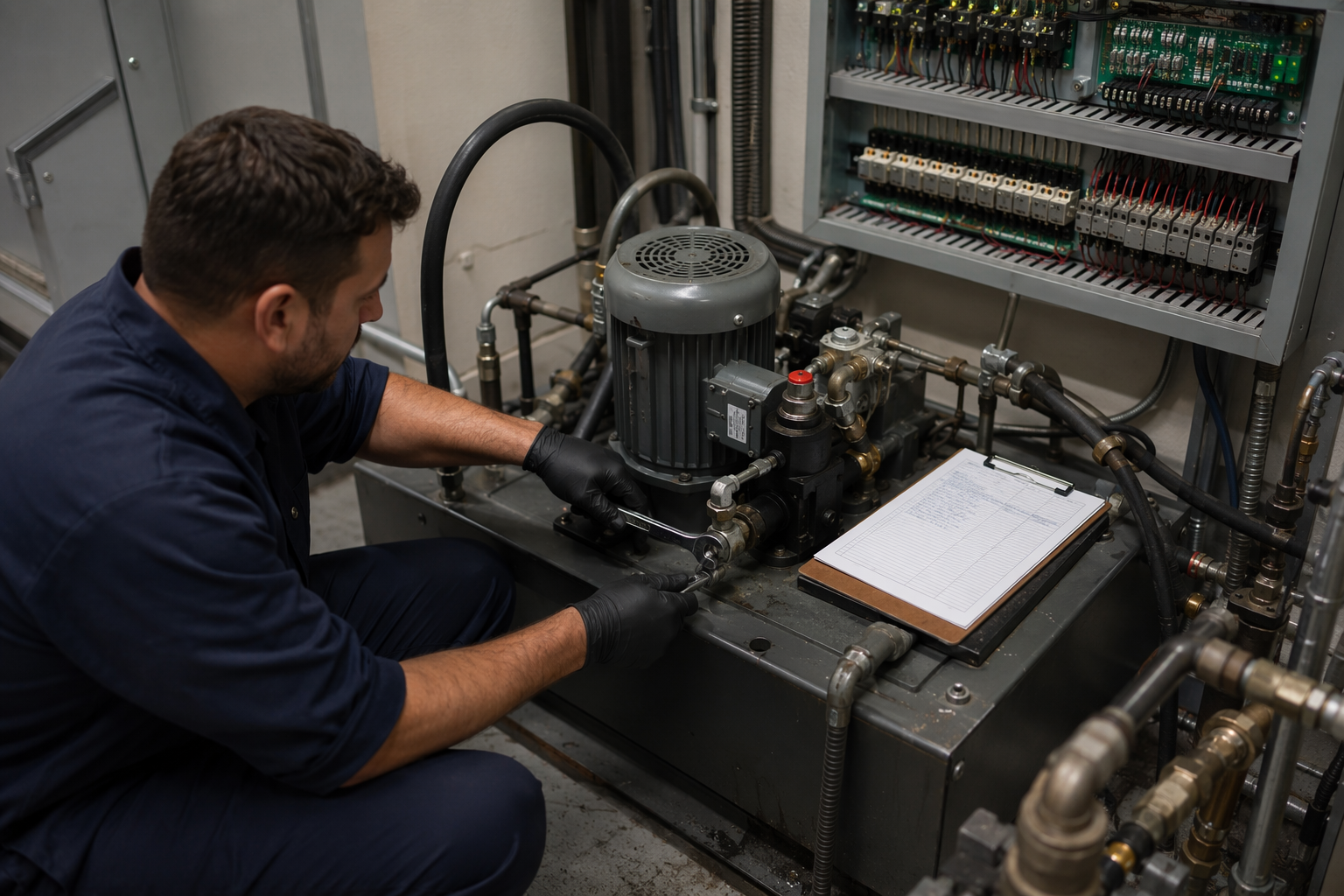
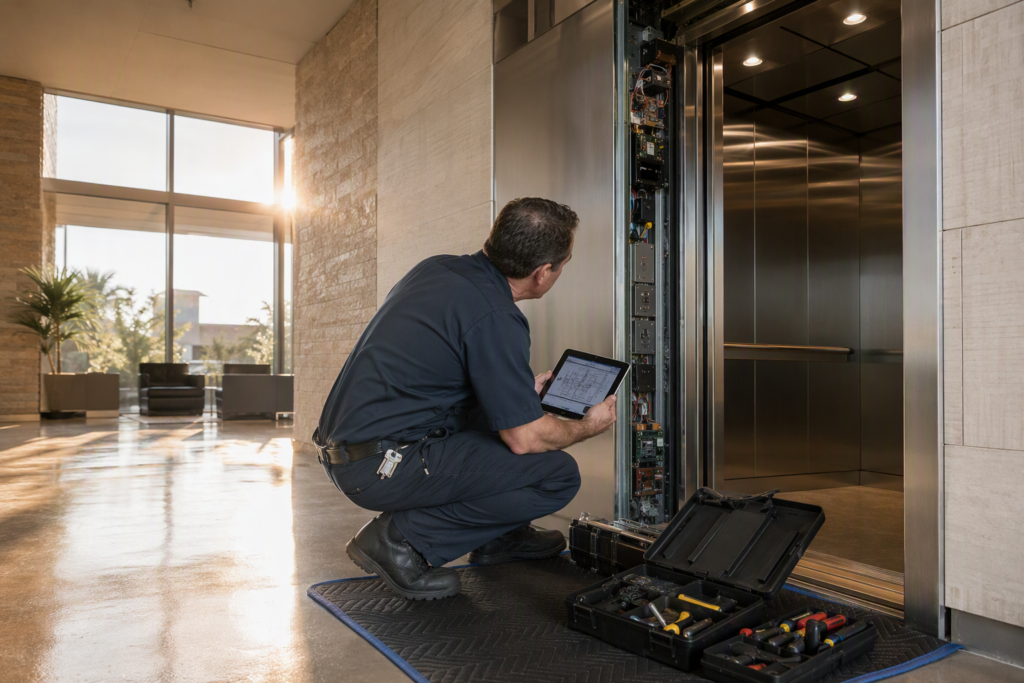
A full maintenance contract is a comprehensive service agreement in which the elevator company assumes responsibility for keeping the equipment in safe, fully operational condition. Under this structure, the service provider typically supplies all routine labor, lubrication, adjustments, and covered parts replacements as part of a fixed periodic payment.
For Phoenix building owners, the practical advantage is cost predictability. Mechanical wear, minor component replacements, and callback visits for malfunctions are absorbed by the contractor rather than invoiced separately. This model is particularly well-suited to high-traffic commercial properties, multi-family residential buildings, healthcare facilities, and any location where elevator downtime carries significant operational or liability consequences.
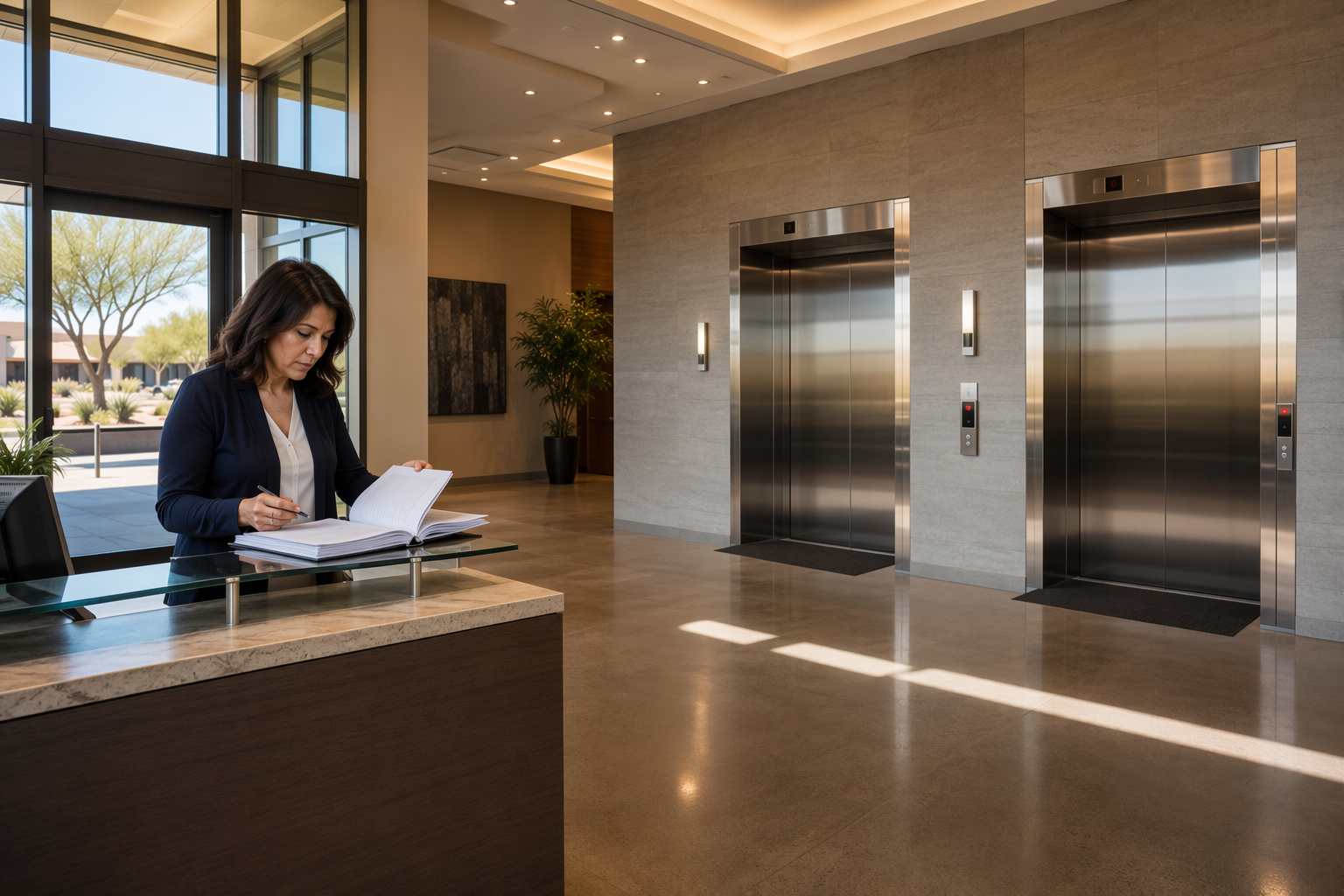
Full maintenance agreements also support compliance with ASME A17.1 Safety Code for Elevators and Escalators, which establishes the maintenance, inspection, and testing standards that Arizona adopts as the basis for its elevator safety regulations. Because the contractor is contractually responsible for the equipment’s condition, documentation and maintenance logs required for state inspections are typically maintained as part of the service.
—
What Does an Oil and Grease Contract Actually Include?
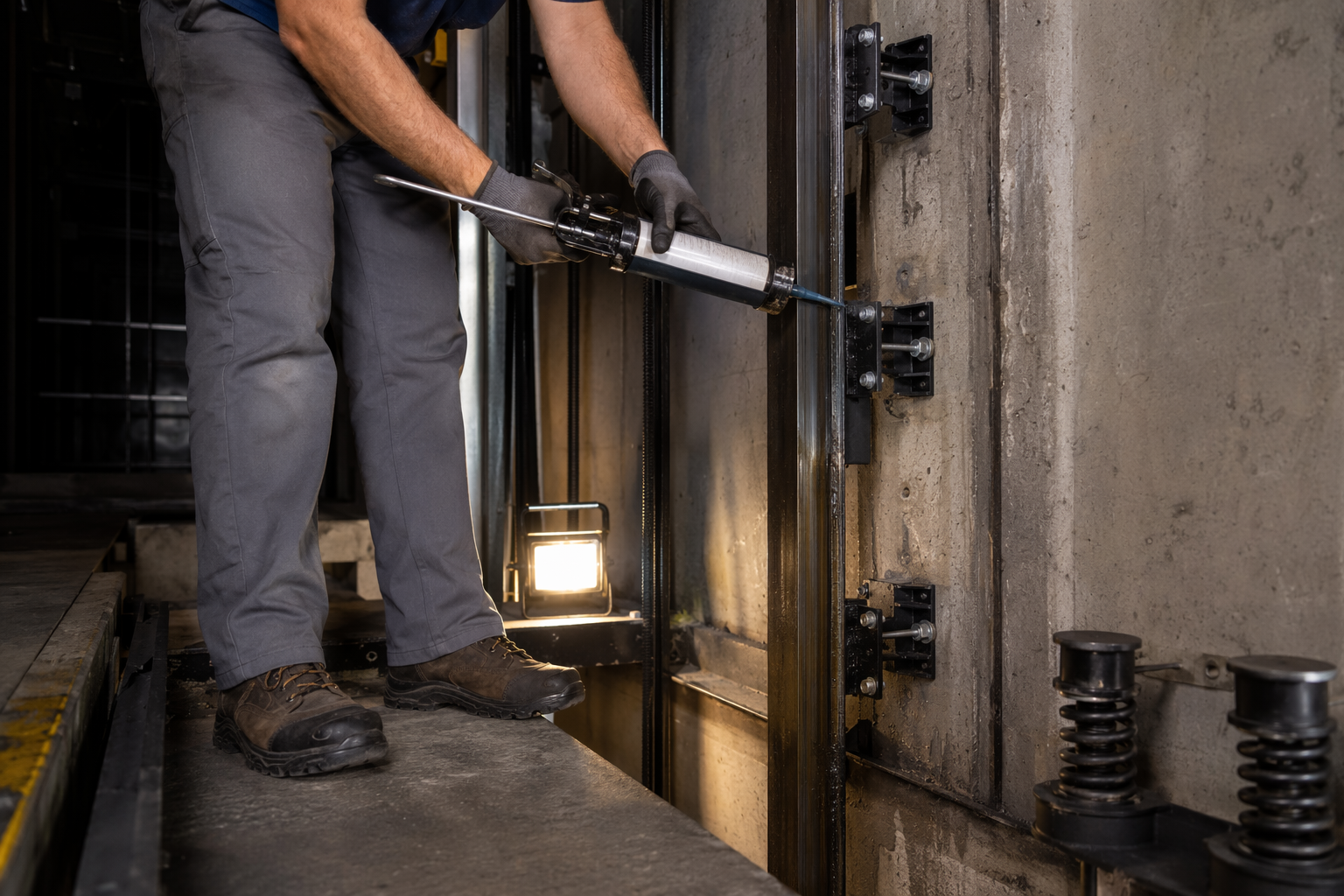
An oil and grease contract — sometimes called an O&G or lubrication-only contract — is a limited-scope agreement. The service provider visits the equipment on a scheduled basis to perform lubrication of moving components, visual checks, and basic cleaning. That is generally the extent of the obligation.
What an O&G contract does not include is equally important: parts, repair labor, callback visits for shutdowns, and component replacements are all billed separately at time-and-materials rates. For a Phoenix property running older hydraulic or traction equipment, those additional costs can accumulate quickly and unpredictably.
O&G contracts can be appropriate for low-traffic applications with newer, under-warranty equipment, or for owners who have in-house facilities staff capable of handling minor issues. However, building owners should review their insurance and lease obligations carefully — some commercial leases and lender requirements specify that elevator maintenance must meet a defined standard of care, which a bare-bones lubrication contract may not satisfy.
—
How Do Arizona Elevator Codes Affect Your Contract Choice?
Arizona’s elevator safety program requires periodic inspections and operational tests conducted by a licensed inspector. Equipment must be maintained in conformance with adopted editions of the ASME A17.1 Safety Code for Elevators and Escalators and, where applicable, ADA accessibility requirements.
When an inspection identifies a deficiency, the building owner — not the elevator contractor — bears the legal obligation to correct it. Under an O&G contract, every deficiency correction becomes a separate negotiation and a separate invoice. Under a full maintenance contract, corrections to covered components are typically the contractor’s responsibility, streamlining the path back to compliance.
Phoenix’s climate also imposes specific mechanical demands. Extreme summer heat accelerates hydraulic fluid degradation, stresses motor windings, and can affect controller electronics. A full maintenance agreement with a contractor experienced in the desert Southwest accounts for these conditions through adjusted service intervals and proactive fluid management — obligations that fall outside the scope of a standard O&G agreement.
—
Which Contract Type Is Better for High-Rise and Commercial Properties in Phoenix?
For multi-story commercial office towers, mixed-use developments, hotels, and healthcare campuses in the Phoenix metro area, full maintenance contracts are the prevailing standard. The reasoning is straightforward: high call volume, passenger safety expectations, ADA compliance obligations, and the reputational cost of downtime all create conditions where unpredictable repair billing is a liability rather than a savings strategy.
Facilities governed by OSHA standards — including certain industrial and warehouse environments — also benefit from the documented maintenance trails that a full maintenance provider delivers, supporting required hazard prevention programs.
—
What Should a Property Owner Evaluate Before Signing Either Contract?
Before committing to any elevator service agreement in Phoenix, property owners and managers should evaluate the following factors methodically.
- Review current equipment age and condition. Older equipment with worn components is a poor candidate for an O&G contract, since repair callbacks are statistically more frequent and parts costs higher.
- Assess passenger traffic and operational hours. High-cycle environments generate more wear and require more frequent adjustments than a limited-use residential elevator.
- Read the contract exclusions carefully. Both contract types contain exclusions. Full maintenance agreements may exclude vandalism damage, modernization components, or specific proprietary parts. Know what is and is not covered before signing.
- Verify the contractor’s licensing status. Arizona requires elevator contractors and mechanics to hold appropriate state licenses. Confirm that any provider is current with state licensing requirements.
- Confirm inspection and documentation practices. Ask how the contractor documents service visits and what records are provided for state inspection purposes.
- Understand callback and emergency service terms. Confirm that the contract clearly defines how after-hours or emergency service requests are handled and whether callbacks for covered failures are included.
- Compare total cost of ownership, not just monthly price. An O&G contract with a lower monthly fee may cost significantly more in aggregate when repair invoices are factored in over a multi-year term.
—
Are There Hybrid Contract Options Between Full Maintenance and O&G?
Yes. Many elevator service companies, including Arizona Elevator Solutions, offer intermediate agreements sometimes called “parts and labor” or “modified full maintenance” contracts. These arrangements typically cover labor for all service visits and a defined list of high-wear components while excluding major modernization parts, entrapment devices, or proprietary controllers.
Hybrid contracts can be a practical middle ground for mid-rise residential or light commercial applications in Phoenix where full maintenance pricing feels disproportionate to the actual use pattern, but where the open-ended liability of a pure O&G agreement is unacceptable.
—
How Does Emergency Elevator Service Work Under Each Contract Type in Phoenix?
Emergency response — whether for a passenger entrapment or a complete shutdown — is treated differently under each contract type. Under a full maintenance agreement, emergency callbacks are generally included as part of the service, with no additional labor charge for covered failures. Under an O&G contract, an emergency service call typically triggers a time-and-materials invoice regardless of the cause.
Arizona Elevator Solutions provides emergency service availability to Phoenix-area clients. Building owners should confirm with any prospective contractor how after-hours emergencies are handled operationally, and whether emergency labor is included or billed separately under their specific contract terms.
—
What Local Markets Does Arizona Elevator Solutions Serve in the Phoenix Area?
Arizona Elevator Solutions serves commercial, residential, healthcare, hospitality, and industrial clients throughout the Phoenix metropolitan area, including Scottsdale, Tempe, Mesa, Chandler, Gilbert, Glendale, Peoria, and surrounding communities. The team works with property managers, building owners, general contractors, and facilities directors across a broad range of elevator and lift equipment types, including traction, hydraulic, and limited-use/limited-application (LULA) systems.
Local knowledge matters in Phoenix. Service technicians operating in this market understand the specific impact of the Sonoran Desert climate on elevator hydraulics, motor performance, and electronic controls — conditions that differ meaningfully from what national maintenance standards written for temperate climates anticipate.
—
How Do You Switch from an O&G Contract to Full Maintenance?
- Request a current condition assessment. Before a full maintenance contractor assumes responsibility for equipment, a comprehensive inspection documents existing wear and identifies components that may require immediate attention.
- Review the existing contract’s termination provisions. Most elevator contracts contain notice periods, typically measured in days, required before cancellation. Confirm the required notice period and initiation date to avoid overlap or gap in coverage.
- Obtain a written scope of coverage from the new contractor. Confirm in writing which components, labor categories, and callback types are included before the agreement begins.
- Transfer maintenance records. Request all historical service documentation from the outgoing contractor. A complete maintenance history supports compliance documentation and helps the incoming contractor understand the equipment’s service life.
- Schedule a baseline service visit. The new contractor should perform an initial service visit to bring the equipment to the standard required under the new agreement before the coverage period formally begins.
—
Schedule a Free Consultation
Arizona Elevator Solutions works with Phoenix-area property owners and managers to evaluate elevator service contract options, assess equipment condition, and recommend the maintenance agreement structure that fits the building’s operational profile and compliance obligations.
Contact Arizona Elevator Solutions to schedule a free consultation and review the right maintenance strategy for your property.
Call: 480-557-7600
Need elevator service you can rely on? Arizona Elevator Solutions is ready to help.