Elevator Inspection Checklist: Requirements, Standards & Compliance Guide
Regular elevator inspections are not optional — they are a legal and safety obligation for every building owner operating a vertical transportation system. Whether managing a commercial high-rise, a multi-family residential property, or a healthcare facility in Arizona, understanding exactly what belongs on an elevator inspection checklist is the difference between a passed certificate and a costly shutdown order.
This guide covers every major checkpoint, the governing standards that drive each requirement, what to expect during an inspection, how Arizona’s regulatory environment applies, and what building owners should do when an inspection reveals deficiencies.
What Is an Elevator Inspection Checklist?
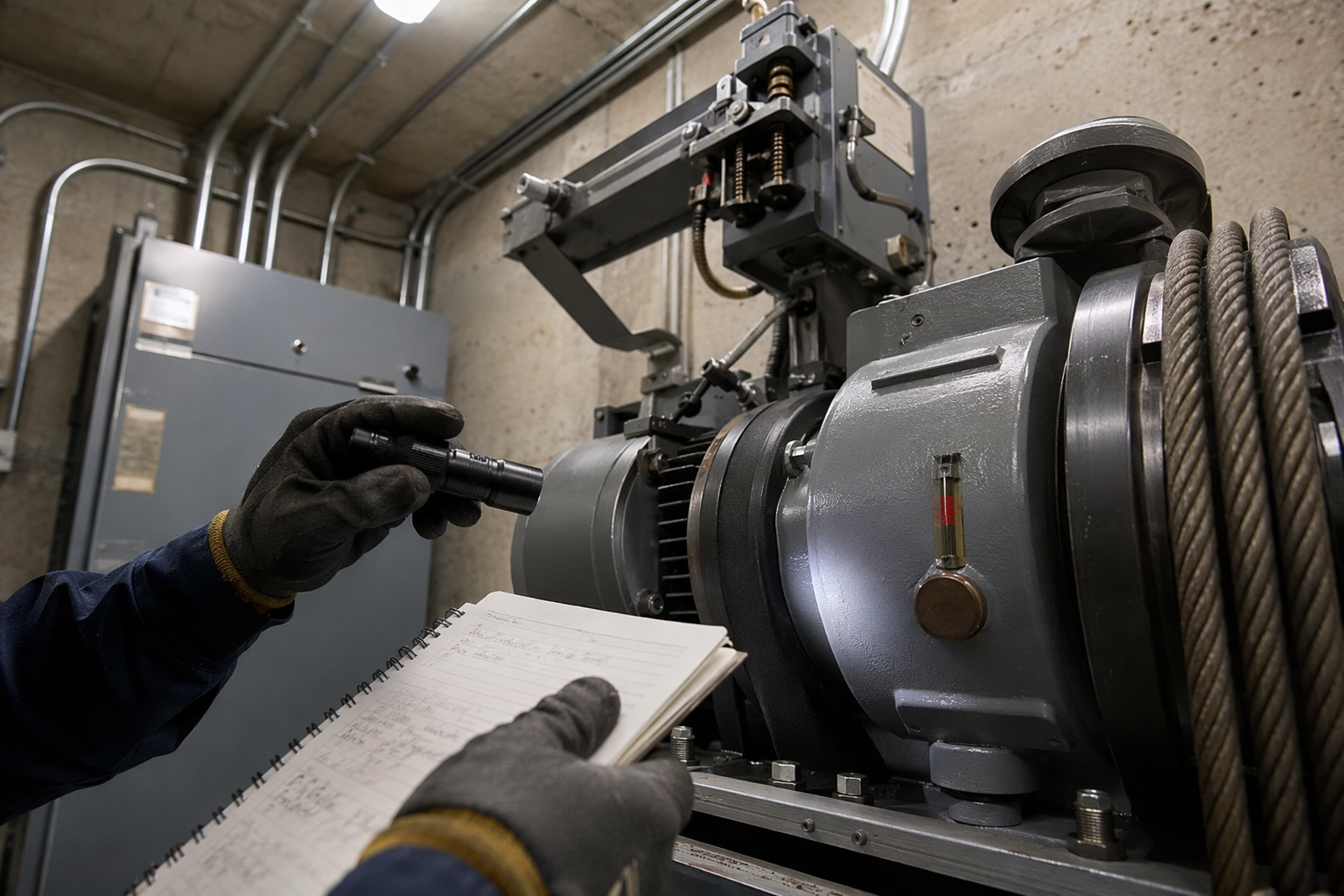
An elevator inspection checklist is a structured document used by licensed elevator inspectors to verify that every critical system, component, and safety device on an elevator meets the minimum requirements established by adopted codes. The checklist ensures inspections are systematic, repeatable, and legally defensible.
Inspection checklists are informed primarily by the ASME A17.1 Safety Code for Elevators and Escalators, the most widely adopted elevator safety standard in North America. State and local jurisdictions — including the State of Arizona — typically adopt ASME A17.1 by reference and may layer additional requirements on top of it.
What Are the Core Categories on an Elevator Inspection Checklist?

A complete elevator inspection checklist is organized by system category. Each category corresponds to a set of code requirements that the inspector must verify visually, operationally, or through physical testing.
1. Machine Room and Drive System
- Machine room lighting, ventilation, and access control
- Condition of the traction machine, sheaves, and drive belts or chains
- Governor and overspeed device functionality
- Main line disconnect switch and electrical panel condition
- Firefighters’ service operation panel (Phase I and Phase II)
- Oil levels, lubrication, and visible corrosion or wear
2. Hoistway and Pit
- Hoistway enclosure integrity — no combustible materials stored in the shaft
- Pit ladder, lighting, and stop switch
- Pit sump pump or drainage condition
- Traveling cable condition and routing
- Buffers — oil or spring — condition and clearances
- Bottom-of-car clearance and runby measurements
- Counterweight clearances and guide rail fastening
3. Car and Door Systems
- Car door operator, clutch, and interlocks
- Door reversal devices — safety edges, light curtains, or proximity sensors
- Hoistway door interlocks and retiring cam function
- Door open and close times measured against code tolerances
- Car leveling accuracy at each landing
- Car lighting, emergency lighting, and ventilation fan
- Car enclosure, floor, and handrail condition
4. Safety Devices
- Safety governor rope and safety device activation
- Slack rope and broken rope switches
- Terminal stopping devices — final and normal limits at top and bottom
- Anti-creep leveling device (hydraulic elevators)
- Car and counterweight safety (safeties)
- Seismic switch (where required by local jurisdiction)
5. Electrical and Control Systems
- Wiring condition — insulation, routing, and grounding
- Control panel components — contactors, relays, and solid-state boards
- Inspection station operation
- Car and hall position indicators
- Emergency communication system — two-way means of communication per ADA accessibility requirements and ASME A17.1
6. Hydraulic Systems (Where Applicable)
- Hydraulic power unit — pump, motor, and fluid level
- Underground cylinder leak detection or environmental compliance
- Relief valve setting and operation
- Low-oil cutout switch
- Rupture valve on single-bottom cylinders
What Does ASME A17.1 Require for Inspection Frequency?
The ASME A17.1 Safety Code for Elevators and Escalators defines two primary inspection and test categories:
- Periodic Inspection: A visual and operational inspection of the elevator in its normal service condition. Most jurisdictions schedule this annually, though some require more frequent intervals for high-traffic or high-risk installations.
- Periodic Tests: Physical performance tests, including full-load and no-load tests, governor and safety tests, and relief valve tests. Full safety tests are generally required every five years under ASME A17.1, with certain individual component tests falling on different cycles.
Arizona building owners should verify the exact inspection interval required by their local authority having jurisdiction (AHJ), as municipal and county requirements can be more stringent than the base ASME standard.
What Happens During an Elevator Inspection? (Step-by-Step)
- Pre-inspection notification: The building owner or property manager is notified of the inspection date and required to ensure access to the machine room, pit, and all floors.
- Documentation review: The inspector reviews the previous inspection certificate, maintenance log, and any outstanding violation corrections.
- Machine room inspection: The inspector examines drive machinery, electrical panels, governor, and safety systems from the machine room.
- Top-of-car inspection: The inspector rides the top of the car at inspection speed to examine the hoistway, guide rails, traveling cables, and overhead clearances.
- Pit inspection: The pit is checked for water intrusion, buffer condition, bottom safety clearances, and pit equipment.
- Operational tests from inside the car: Door operation, leveling, emergency lighting, communication device, and firefighters’ service are tested.
- Full-load or safety tests (if scheduled): Load weights are applied to verify brake, safety, and buffer performance against code specifications.
- Inspector report issuance: The inspector documents findings, identifies any violations or deficiencies, and issues either a certificate of operation or a notice of violation.
- Deficiency correction period: If violations are cited, the AHJ typically grants a correction deadline. Serious safety violations may trigger an immediate out-of-service order.
- Re-inspection: After corrections are completed by a licensed elevator contractor, the inspector re-examines the cited items to close the violation.
What Are Common Elevator Inspection Failures?
Inspections reveal deficiencies across every system category, though certain issues appear with particular frequency in the field. Common reasons elevators fail inspection include:
- Door interlock failures — worn or damaged interlocks that allow doors to open outside a landing zone
- Non-functioning or absent emergency lighting
- Inoperable or non-compliant two-way emergency communication
- Governor rope wear or improper tension
- Excessive pit water accumulation and non-functional sump pumps
- Firefighters’ service (Phase I or Phase II) not operating correctly
- Leveling inaccuracy exceeding code tolerances — a tripping hazard
- Machine room used for storage or with inadequate lighting
- Outdated or expired annual maintenance records
- Hydraulic fluid leaks or low-oil cutout switch failure
How Does ADA Compliance Factor Into Elevator Inspections?
The Americans with Disabilities Act (ADA) establishes accessibility requirements that overlap with elevator inspection criteria. Inspectors verify that passenger elevators serving multiple floors in public accommodations and commercial facilities meet accessibility standards, which include:
- Minimum cab dimensions to accommodate wheelchairs
- Two-way emergency communication systems that do not rely solely on voice communication
- Visual and audible floor indicators
- Accessible control panel button heights and Braille/raised-character labeling
- Door timing — adequate time for passengers with mobility limitations to enter and exit
ADA compliance is distinct from the mechanical safety inspection but can trigger separate enforcement action from the U.S. Department of Justice or through civil litigation if elevators in covered buildings are not accessible.
What Are OSHA’s Elevator Inspection Requirements for Workplaces?
OSHA regulations address elevators primarily in the context of construction hoists and material lifts used on job sites, as well as vertical personnel lifts in industrial settings. For permanent passenger elevators in workplaces, OSHA generally defers to the state elevator safety program and adopted ASME standards. However, OSHA’s General Duty Clause requires employers to maintain elevators free of recognized hazards, meaning an elevator with a known deficiency that causes injury can result in an OSHA citation even if state inspection is not yet overdue.
What Does an Elevator Inspection Cost in Arizona?
Inspection costs in Arizona vary based on the type of elevator, number of units, local jurisdiction fee schedules, and whether the inspection is a routine periodic inspection or a full five-year load test. Because fee schedules are set by individual AHJs and private inspection companies price services independently, specific dollar figures are not published here to avoid inaccuracy. Building owners should request itemized quotes from licensed inspection companies and verify that the inspector holds the certification accepted by their local AHJ.
Factors that typically drive inspection costs higher include: older equipment requiring longer inspection times, hydraulic elevators requiring additional environmental compliance review, out-of-service situations requiring emergency re-inspection, and buildings with multiple units inspected under one mobilization.
How Should Building Owners Prepare for an Elevator Inspection?
- Confirm that the current maintenance log is up to date and accessible for the inspector to review.
- Verify that the machine room is clear of stored materials, properly lit, and that the access key is available.
- Test the emergency communication device and emergency lighting from inside the car before the inspection date.
- Ensure the pit is dry — address any water intrusion or pump failure prior to the inspector’s arrival.
- Notify building tenants of the inspection window so the elevator can be taken out of service as needed.
- Review the previous inspection report and confirm that any previously cited deficiencies have been corrected and documented.
- Have the contact information for a licensed elevator contractor available in case the inspector identifies items requiring immediate repair.
What Are the Consequences of Failing an Elevator Inspection?
When an elevator fails inspection, the AHJ may issue a written violation notice with a specified correction deadline, or in serious cases, an immediate out-of-service order requiring the elevator to be shut down until corrections are made and a re-inspection is passed. Operating an elevator against a shutdown order exposes the building owner to fines, increased liability in the event of an injury, and potential legal action from the jurisdiction.
Beyond regulatory consequences, documented inspection failures that are not corrected promptly create significant liability exposure. Insurance carriers routinely review inspection records, and a pattern of deferred maintenance or unresolved violations can affect coverage terms.
What Are the 2025–2026 Trends in Elevator Inspection Requirements?
Several qualitative trends are shaping elevator inspection practice heading into 2026:
- Adoption of newer ASME A17.1 editions: Jurisdictions continue to update their adopted code editions toward more recent versions of ASME A17.1, which introduce updated requirements for remote monitoring, seismic protection, and door protection systems. Arizona building owners should confirm which edition their local AHJ has adopted.
- Remote monitoring and predictive maintenance integration: Modern elevator systems increasingly support real-time monitoring that can flag component degradation between inspection cycles. While this does not replace mandated periodic inspections, regulators and insurers are beginning to recognize its value in risk management.
- Increased focus on entrapment prevention and door system reliability: Door-related incidents remain a leading category of elevator injuries, and inspection criteria around door timing, force limits, and reversal device testing are receiving heightened attention in updated guidance.
- Workforce and inspector capacity: The licensed elevator inspector workforce is aging in many states, creating scheduling delays for inspections in high-demand markets. Building owners who schedule inspections proactively — rather than waiting for certificate expiration — avoid compliance gaps caused by inspector availability constraints.
- Digital recordkeeping requirements: Some jurisdictions are moving toward or encouraging electronic maintenance logs and digital certificate systems, making it easier for AHJs to audit compliance across large commercial portfolios.
How Does Arizona’s Regulatory Environment Affect Elevator Inspections?
Arizona elevator safety is administered at the state level with additional oversight by local municipalities. The state adopts the ASME A17.1 code framework and requires that inspections be conducted by or under the oversight of licensed personnel. Arizona’s climate — including extreme heat and monsoon-related humidity fluctuations — presents specific maintenance challenges that competent inspectors account for, including thermal expansion effects on guide rails, hydraulic fluid viscosity changes, and moisture intrusion in pit areas during summer storm events.
Building owners operating elevators in Arizona should confirm their specific jurisdiction’s inspection cycle, fee structure, and preferred inspector qualification with their local AHJ, as requirements vary between incorporated municipalities, counties, and unincorporated areas.
What Is the Difference Between an Inspection and a Maintenance Contract?
An elevator inspection is a formal, typically government-mandated evaluation of the elevator’s compliance with adopted safety codes. It results in a pass/fail determination and a certificate of operation if the unit is compliant.
A maintenance contract is an ongoing service agreement between a building owner and a licensed elevator contractor covering routine lubrication, adjustment, parts replacement, and minor repairs on a scheduled basis. Maintenance contracts do not satisfy the requirement for a periodic inspection by an independent inspector, but they significantly reduce the likelihood of inspection failures by keeping equipment in proper operating condition between inspection cycles.
Building owners should treat maintenance and inspection as complementary obligations, not interchangeable ones.
How Can Arizona Elevator Solutions Help with Inspection Compliance?
Arizona Elevator Solutions supports building owners across Arizona with data-driven elevator assessments that evaluate equipment condition against current ASME A17.1 and applicable local code requirements. By reviewing existing inspection records, identifying maintenance gaps, and providing documented findings, Arizona Elevator Solutions helps property managers and facility directors understand their compliance posture before the official inspection takes place — reducing the risk of shutdown orders, fines, and liability exposure.
The team at Arizona Elevator Solutions approaches every assessment with reference to the applicable adopted code edition for the jurisdiction, ensuring that recommendations reflect actual regulatory requirements rather than generalized industry guidance.
Elevator Inspection Statistics: Sourced Data Table
| Requirement | Standard / Source | Detail |
|---|---|---|
| Periodic (routine) inspection frequency | ASME A17.1 | Typically annual; exact interval set by adopting jurisdiction |
| Full safety / load test cycle | ASME A17.1 | Every 5 years for most traction and hydraulic elevators |
| Two-way emergency communication | ADA & ASME A17.1 | Required in passenger elevators; must not rely solely on voice |
| Workplace elevator safety standard | OSHA General Duty Clause | Employers must maintain elevators free of recognized hazards |
Frequently Asked Questions: Elevator Inspection Checklist
How often does an elevator need to be inspected?
Under the ASME A17.1 Safety Code for Elevators and Escalators, elevators require periodic inspections on a schedule set by the adopting jurisdiction — typically once per year for routine inspections and once every five years for full safety and load tests. Building owners should confirm the exact schedule with their local authority having jurisdiction.
Who is qualified to perform an elevator inspection?
Elevator inspections must be performed by a licensed or certified elevator inspector accepted by the authority having jurisdiction. Most states, including Arizona, require inspectors to meet specific qualification standards, which may include national certification through organizations recognized by the relevant AHJ. Building owners should verify inspector credentials before accepting an inspection report as valid for certificate purposes.
What documents should a building owner have ready for an inspection?
Building owners should have the current maintenance log, the previous certificate of operation, any prior inspection reports with documented corrections, and records of any major repairs or modernization work performed since the last inspection. Incomplete documentation is itself a finding that inspectors may note.
Can an elevator be shut down immediately during an inspection?
Yes. If an inspector identifies a condition that poses an immediate safety hazard — such as a failed door interlock, a non-functioning safety device, or evidence of structural failure — the inspector has authority under most state elevator laws and the adopting ASME code framework to issue an immediate out-of-service order. The elevator cannot legally return to service until the hazard is corrected and a re-inspection is passed.
Does ASME A17.1 apply to all elevators in Arizona?
The ASME A17.1 Safety Code for Elevators and Escalators is the reference standard adopted by Arizona and most other states for passenger and freight elevators. However, specific editions adopted and any state or local amendments vary by jurisdiction. Platform lifts and dumbwaiters may fall under separate ASME standards. Building owners should confirm which specific code edition applies to their installation.
What is the difference between a periodic inspection and a periodic test?
A periodic inspection is primarily a visual and operational review of the elevator in normal service. A periodic test involves physical performance tests — including loading the car, testing safety devices under controlled conditions, and verifying buffer and governor performance against code specifications. ASME A17.1 specifies which tests are required and on what cycle, with full safety tests generally required less frequently than routine inspections.
What happens if a building owner ignores an inspection violation?
Unresolved violations expose building owners to fines levied by the AHJ, potential shutdown orders, increased insurance liability, and civil litigation if a person is injured on an elevator with a known documented deficiency. Most jurisdictions have escalating enforcement mechanisms for repeat or prolonged non-compliance.
Are residential elevators subject to the same inspection requirements as commercial elevators?
Private residence elevators installed in single-family homes are typically governed under a separate portion of ASME A17.1 and may be subject to reduced inspection requirements or exemptions depending on state law. However, elevators in multi-family residential buildings — apartments, condominiums — are generally treated as commercial installations and subject to full periodic inspection requirements. Building owners should verify their specific classification with the local AHJ.
Does an elevator inspection cover ADA compliance?
A standard mechanical safety inspection under ASME A17.1 verifies the safety and operational requirements of the code. ADA compliance under the Americans with Disabilities Act is a separate legal obligation and may be evaluated separately. Some AHJs include accessibility checks within their inspection process; others do not. Building owners in covered facilities should ensure both mechanical and accessibility compliance are regularly evaluated.
How does Arizona’s climate affect elevator inspection priorities?
Arizona’s extreme summer heat, significant temperature swings between seasons, and monsoon humidity create conditions that accelerate wear on certain elevator components. Hydraulic fluid viscosity changes with temperature affect pump performance and require appropriate fluid specification. Pit flooding during monsoon events is a recurring issue that can damage electrical components and buffers. Guide rail expansion in high heat can affect clearances. A thorough inspection in Arizona accounts for these environmental factors alongside standard code requirements.
Get a Free Elevator Assessment from Arizona Elevator Solutions
Understanding your elevator’s compliance status before the official inspection protects your building, your tenants, and your liability exposure. Arizona Elevator Solutions provides data-driven assessments aligned with current ASME A17.1 and Arizona regulatory requirements — giving building owners a clear picture of where their equipment stands and what action is needed.
Contact Arizona Elevator Solutions for a free elevator assessment: 480-319-7157
Need elevator service you can rely on? Arizona Elevator Solutions is ready to help.