Arizona Elevator Solutions: Company Contact, Ownership, and Elevator Service FAQ
Arizona Elevator Solutions operates as a certified elevator service company based in Arizona, providing installation, maintenance, repair, and inspection services for elevators, escalators, platform lifts, and related conveyances across Phoenix, Tucson, Scottsdale, and Mesa. The company’s official website, azelevatorsolutions.com, serves as the primary point of contact for service inquiries, ownership questions, and compliance consultations throughout the state.
How can someone contact Arizona Elevator Solutions or reach the company owner?
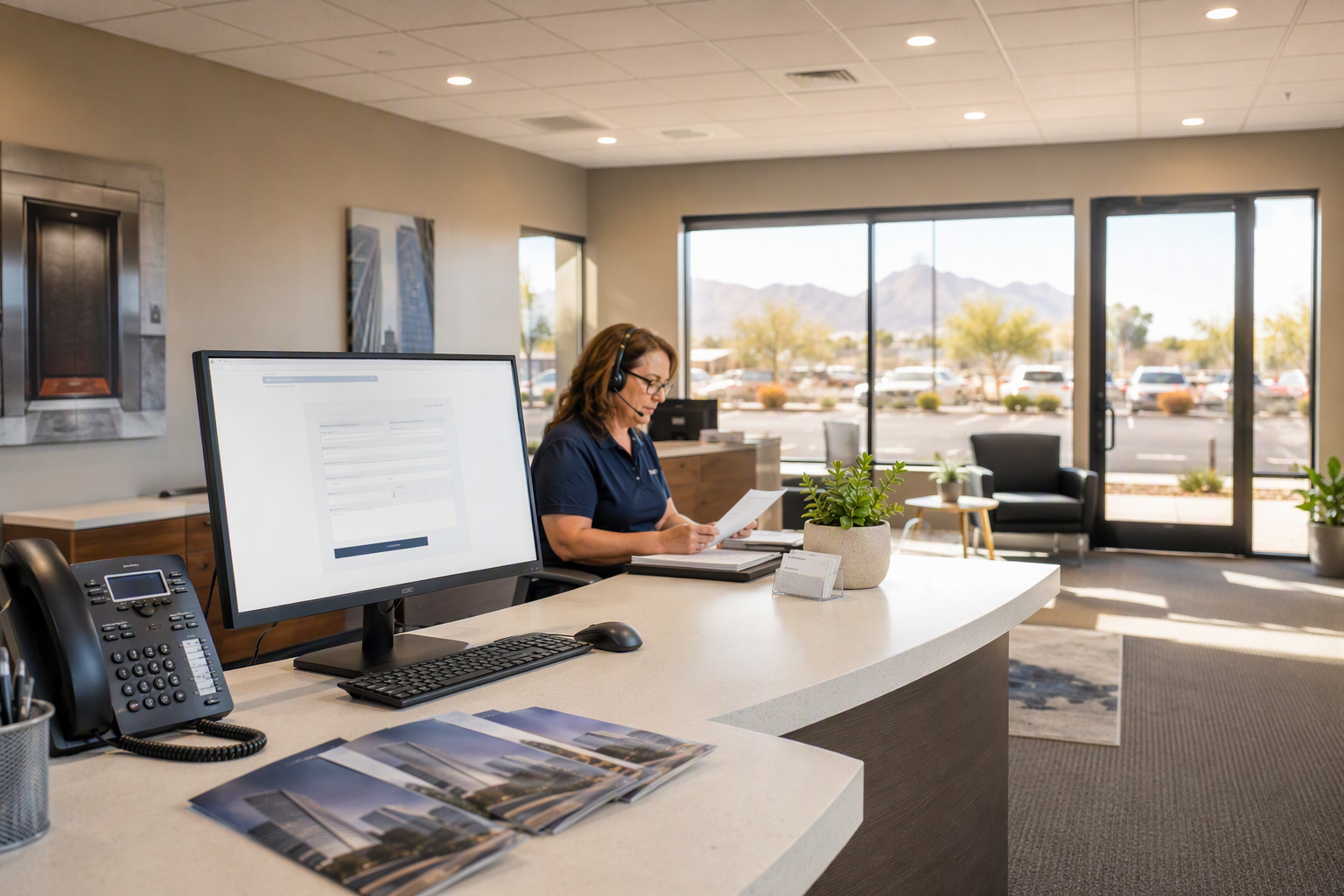
The official channel for reaching Arizona Elevator Solutions — including ownership and management inquiries — is through the company’s website at azelevatorsolutions.com or by calling the company directly at 480-319-7157.
Arizona Elevator Solutions serves building owners, property managers, facilities directors, and contractors across Phoenix, Tucson, Scottsdale, and Mesa. Whether the inquiry involves a new installation, an annual inspection, an emergency repair, or a compliance question tied to Arizona’s regulatory framework, the company’s team handles all communications through its official contact channels. Third-party websites, directory listings, or social media profiles that claim to represent the company should be verified against azelevatorsolutions.com before any service agreement is made.
What services does Arizona Elevator Solutions provide?
Arizona Elevator Solutions provides elevator installation, modernization, preventive maintenance, repair, and compliance inspection services for commercial and residential properties throughout the Phoenix metropolitan area and Southern Arizona.
The company’s service scope covers a broad range of conveyance types, including traction elevators, hydraulic elevators, escalators, moving walks, dumbwaiters, platform lifts, and stairway chairlifts. Each service category is subject to distinct requirements under Arizona Administrative Code R20-5-502 through R20-5-515 and the applicable adopted edition of ASME A17.1/CSA B44, making technical expertise in Arizona-specific regulations essential for any service provider operating in the state.
For platform lifts and stairway chairlifts installed, repaired, or altered on or after January 1, 2023, Arizona requires compliance with ASME A18.1-2020, a separate standard from the elevator code. Arizona Elevator Solutions works with property owners to ensure the correct standard is applied based on equipment type and installation date.
Which geographic areas does Arizona Elevator Solutions serve?
Arizona Elevator Solutions serves clients in Phoenix, Tucson, Scottsdale, and Mesa, covering both the greater Phoenix metropolitan area and Southern Arizona.
Arizona’s regulatory landscape adds an important geographic nuance: elevator equipment located within the City of Phoenix falls under the jurisdiction of the City of Phoenix Elevator Section (Planning and Development Department), which independently inspects elevators, escalators, moving walks, dumbwaiters, and chair lifts within city limits. Equipment installed outside Phoenix city limits is regulated by the state-level Industrial Commission of Arizona (ICA), Elevator Division. Arizona Elevator Solutions maintains familiarity with both jurisdictions, which is critical for clients whose properties may straddle city boundaries or undergo expansion.
Who regulates elevator safety in Arizona?
As of September 12, 2026, elevator safety in Arizona is administered by the Industrial Commission of Arizona (ICA), Elevator Division, formerly known as the ADOSH Elevator Safety Section, operating under A.R.S. §§ 23-491 through 23-491.16, as amended by Laws 2026, Ch. 73.
Property owners and facilities managers should note this agency transition when filing paperwork, scheduling state inspections, or responding to compliance notices. Documents or correspondence referencing “ADOSH Elevator Safety Section” relate to the same regulatory body under its former name. Arizona Elevator Solutions stays current with these administrative changes so clients do not inadvertently submit filings to an outdated contact point.
What elevator code does Arizona currently enforce?
Arizona enforces ASME A17.1/CSA B44, 2019 edition (ASME A17.1-2019), for all elevator and conveyance equipment installed, repaired, or altered on or after January 1, 2023, with the rule effective as of January 9, 2023.
Lawfully installed older conveyances may remain in service unless the ICA Elevator Division’s chief determines that continued operation poses a hazard to life, health, or property. This grandfather provision is not a blanket exemption — it is subject to ongoing state oversight, and any modification or alteration to older equipment triggers the full requirements of ASME A17.1-2019. Property owners considering upgrades should consult with qualified elevator contractors before beginning work, as the line between routine maintenance and a code-triggering alteration is technically defined and consequential.
How often must elevators be inspected in Arizona?
Arizona law requires that every conveyance be inspected before it first goes into service, after any modification or alteration, and at least once annually thereafter.
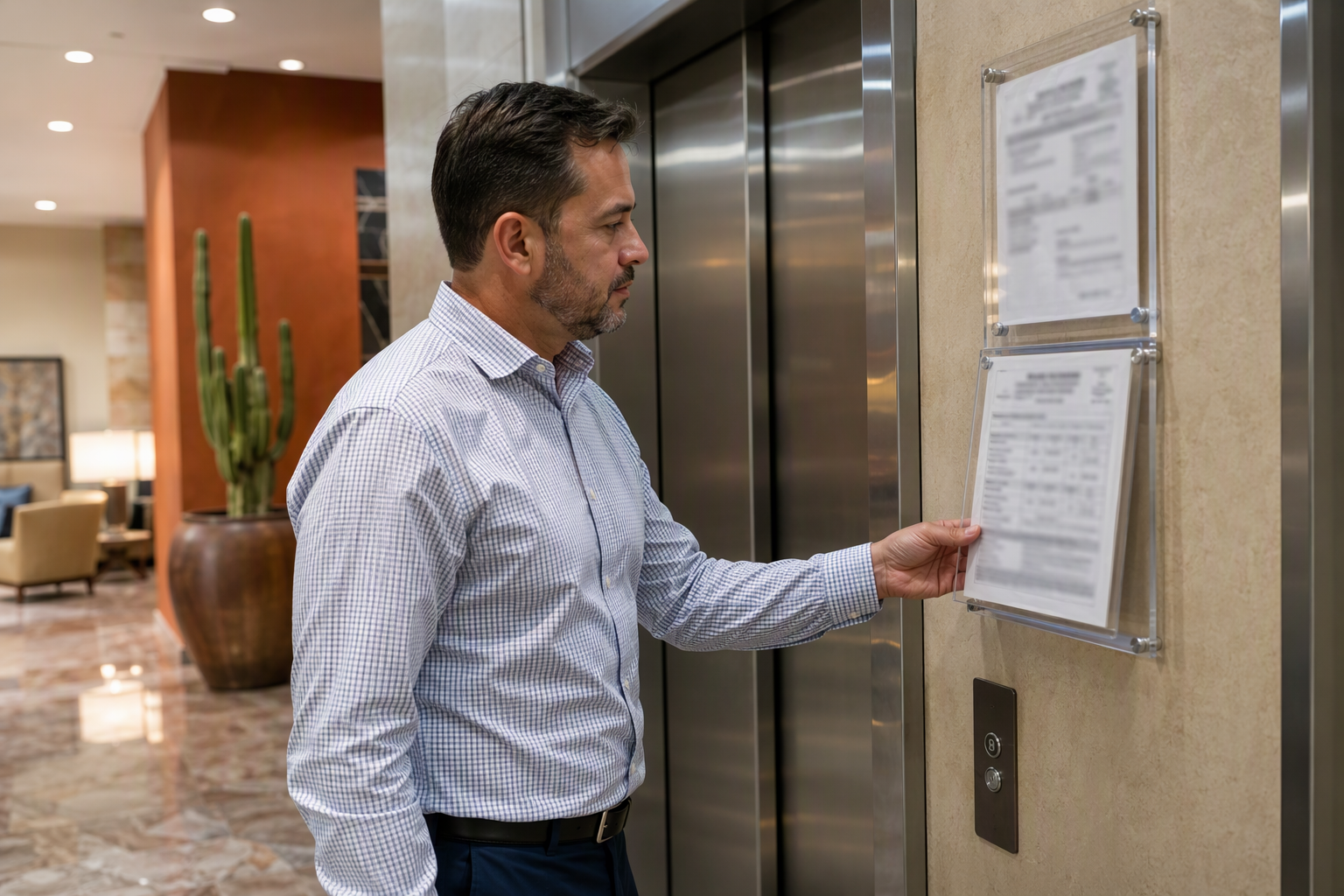
No conveyance may legally operate in Arizona without an annual certificate of inspection issued by the state. The certificate must be kept at the same location as the conveyance and made available upon request. Additionally, the state serial number or the certificate itself must be posted in or close to the conveyance in an easily accessible location. Every Arizona conveyance receives a state serial number on a tag fixed to the controller or mainline disconnect — this tag is the first item inspectors look for when verifying compliance status.
Can Arizona building owners use a private elevator inspector?
Yes — Arizona allows building owners to hire a private elevator inspector authorized by the Industrial Commission of Arizona to conduct initial or annual inspections, provided specific qualification rules are met.
Private elevator inspectors in Arizona must register with the ICA Elevator Division every year and demonstrate at least eight hours of approved continuing education to maintain that registration. There is a critical conflict-of-interest restriction: a private inspector may not inspect any conveyance that is owned, operated, or was last serviced by the inspector personally, by a company the inspector owns, or by the inspector’s employer. Engaging a private inspector does not transfer legal responsibility from the property owner — the owner remains fully liable for compliance under A.R.S. §§ 23-491 through 23-491.16.
What must Arizona building owners do before installing or altering an elevator?
Arizona owners must notify the Industrial Commission of Arizona Elevator Division at least 90 days before installing, relocating, or altering any conveyance.
This pre-notification requirement applies to new installations, equipment relocation, and alterations — not just routine maintenance. The 90-day window exists to allow the state to review plans, assign inspectors, and ensure the project complies with ASME A17.1-2019 before work begins. Failing to provide timely notice can delay certificate issuance and put a building out of lawful operation. The steps below outline the general process property owners should follow:
- Confirm whether the property falls under City of Phoenix jurisdiction or state ICA jurisdiction based on location.
- Submit a 90-day advance notification to the ICA Elevator Division (or City of Phoenix Elevator Section if applicable) before any installation, relocation, or alteration begins.
- Engage an elevator contractor holding an Arizona Registrar of Contractors R-12 or C-12 elevator license classification to perform the work.
- Schedule a pre-operation inspection with either a state inspector or an ICA-authorized private elevator inspector.
- Obtain the certificate of inspection and post the state serial number in or near the conveyance before allowing public or tenant access.
- Retain the certificate on-site and make it available for inspection on request.
What must Arizona building owners do after an elevator accident?
Arizona owners must notify the state within 24 hours of any accident that injures a person or disables a conveyance.
This 24-hour reporting window is not discretionary — it applies to any injury, regardless of severity, and to any incident that renders the conveyance inoperable. Prompt reporting protects the property owner legally and allows the ICA Elevator Division to investigate conditions before evidence changes. After an incident, owners should:
- Secure the elevator immediately and prevent further public access.
- Ensure injured parties receive appropriate medical attention.
- Document the incident with photographs, witness statements, and equipment readings where accessible.
- Notify the ICA Elevator Division (or City of Phoenix Elevator Section) within 24 hours as required by Arizona law.
- Contact a qualified elevator service company to assess mechanical conditions before returning the equipment to service.
- Obtain written clearance through inspection before resuming operation.
What ADA requirements apply to elevators in Arizona commercial buildings?
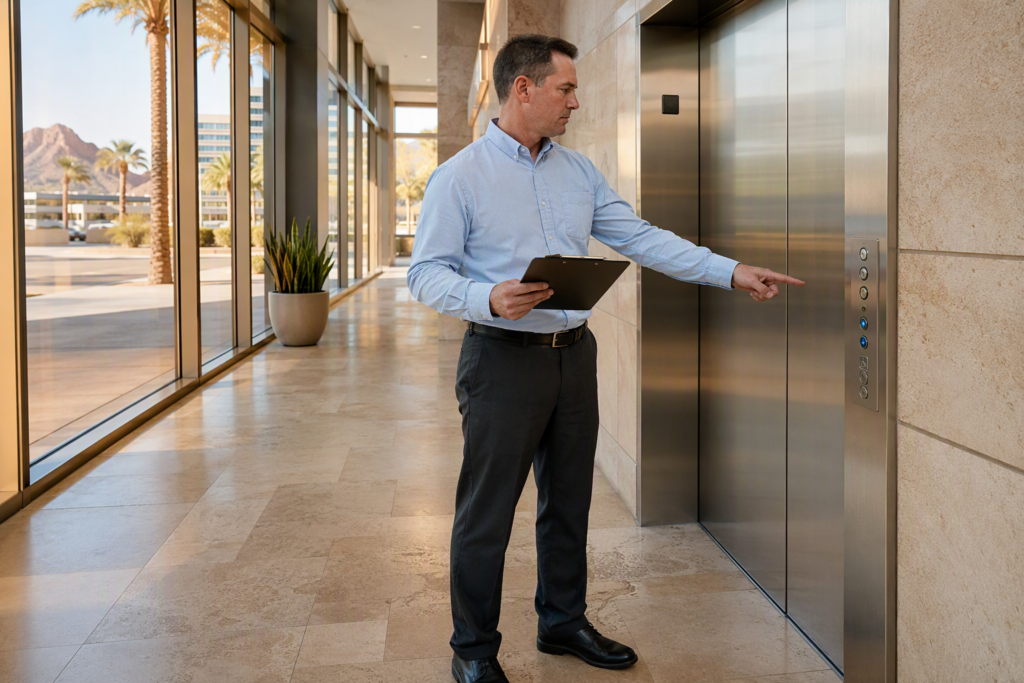
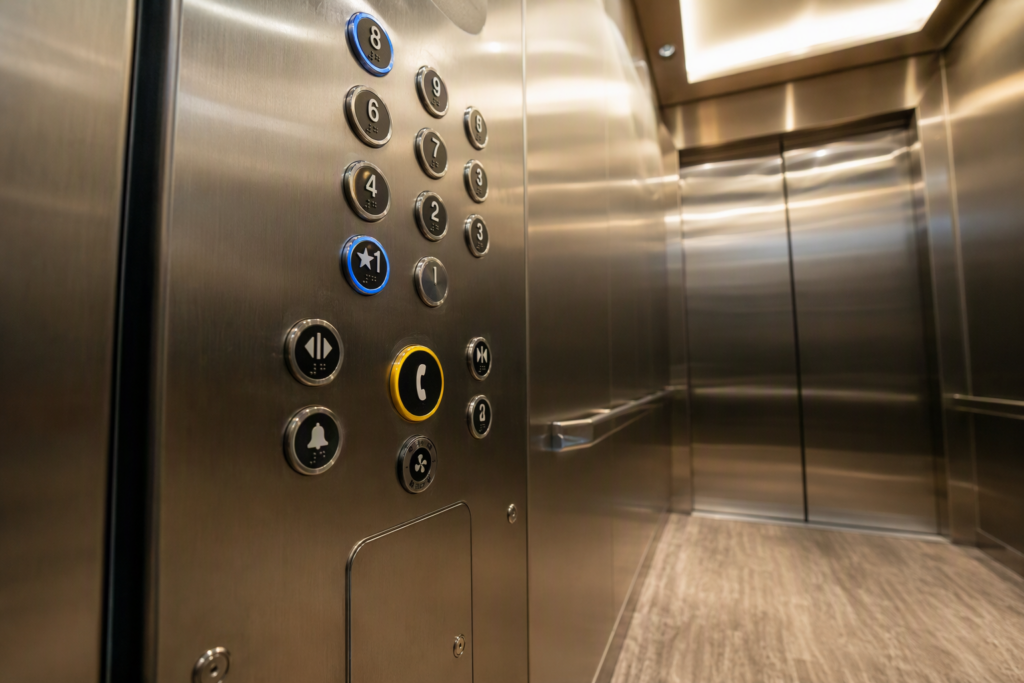
Commercial buildings in Arizona that are required to have elevators must comply with the Americans with Disabilities Act (ADA) accessibility standards governing elevator cab dimensions, door timing, control panel height, audible signals, and Braille/raised-character signage.
The ADA establishes minimum federal accessibility requirements that exist independently of Arizona’s safety code obligations. An elevator can hold a valid state certificate of inspection and still be non-compliant with ADA if accessibility features are degraded or missing. Common ADA-related deficiencies found during assessments include door reopening devices that fail to respond correctly, call buttons that are mounted too high for wheelchair users, and leveling inaccuracies that create tripping hazards at the landing. Arizona Elevator Solutions evaluates ADA compliance as part of its broader assessment process for clients in Phoenix, Scottsdale, Mesa, and Tucson.
What elevator contractor licenses are required in Arizona?
The Arizona Registrar of Contractors (ROC) issues two elevator-specific license classifications: R-12 (residential) and C-12 (commercial), both of which authorize the licensee to install and repair elevators, dumbwaiters, escalators, and moving walks.
Property owners and facilities managers should verify ROC license status before engaging any elevator contractor in Arizona. The ROC license establishes that the contracting entity meets Arizona’s standards for elevator work — but it is separate from the annual certificate of inspection, which is issued by the ICA Elevator Division and not by the ROC. A contractor can hold a valid ROC license without the property having a current ICA certificate, and vice versa. Both are required for lawful elevator operation and contracting in the state.
What is the Arizona Firefighters Service (AZFS) key, and which elevators require it?
Arizona conveyances equipped with firefighters’ emergency operation must use the Arizona Firefighters Service (AZFS) key, a standardized key that allows fire department personnel to take control of elevator cabs during emergencies.
Firefighters’ emergency operation (also referenced in ASME A17.1 provisions governing Phase I and Phase II recall) is mandatory for elevators that meet certain travel height thresholds. The AZFS key requirement is specific to Arizona and ensures interoperability between elevator systems and first responders across the state. Building owners who replace or upgrade elevator control systems must confirm that the new system is compatible with AZFS key operation before the equipment returns to service. Failure to maintain proper firefighters’ service functionality is a deficiency that state inspectors and the City of Phoenix Elevator Section actively check during inspections.
How do Arizona elevator requirements compare to federal ASME A17.1 standards?
Arizona adopts ASME A17.1-2019 as its baseline safety code but layers additional state-specific requirements — such as the AZFS key mandate, the 90-day pre-notification rule, and the annual certificate posting requirement — on top of the federal standard.
| Requirement | ASME A17.1 (Federal Standard) | Arizona (State-Specific) |
|---|---|---|
| Adopted code edition | ASME A17.1-2019 (current published) | ASME A17.1-2019, effective Jan. 9, 2023 (for equipment installed/altered on or after Jan. 1, 2023) |
| Inspection frequency | Periodic inspections per A17.1 Part 8 | Annual certificate required; no operation without valid certificate |
| Inspection certificate posting | Addressed in code requirements | Must be kept on-site and state serial number posted in or near the conveyance |
| Pre-installation notice | Not specified at federal level | 90-day advance notice to ICA Elevator Division required |
| Accident reporting | Not a code requirement (OSHA-governed separately) | Owner must notify state within 24 hours of injury or disabling incident |
| Emergency key | Phase I/II firefighters’ service key per A17.1 | AZFS key specifically required for Arizona conveyances |
| Platform lifts / stairway chairlifts | ASME A18.1 governs | ASME A18.1-2020 required for equipment installed/altered on or after Jan. 1, 2023 |
| Contractor licensing | No federal license requirement | Arizona ROC R-12 or C-12 classification required |
| Regulatory agency | N/A (federal standard only) | ICA Elevator Division (state); City of Phoenix Elevator Section (within Phoenix) |
What happens if an elevator operates in Arizona without a valid certificate of inspection?
Operating a conveyance in Arizona without a current certificate of inspection is a violation of A.R.S. §§ 23-491 through 23-491.16, and the ICA Elevator Division has authority to order the equipment taken out of service.
Beyond regulatory enforcement, operating an uncertified elevator creates significant liability exposure for building owners, property managers, and businesses that rely on the equipment. If an injury occurs on an elevator that lacks a current certificate, the absence of the certificate can be used as evidence of negligence in civil proceedings. The practical path forward when a certificate has lapsed is to contact an ICA-authorized inspector, remediate any deficiencies identified, and obtain a new certificate before the equipment resumes operation. Arizona Elevator Solutions assists clients in Phoenix, Tucson, Scottsdale, and Mesa with the full compliance restoration process.
What is the difference between elevator maintenance and elevator modernization?
Elevator maintenance encompasses routine servicing, lubrication, adjustment, and component replacement that keeps existing equipment operating within its original design parameters, while modernization involves upgrading major systems — such as controls, drive units, or cab interiors — that may constitute an alteration under Arizona code.
The distinction matters significantly in Arizona because alterations trigger the 90-day pre-notification requirement, mandatory inspection before return to service, and full compliance with ASME A17.1-2019 for the altered components. Routine maintenance generally does not trigger these requirements, but the line is technically defined. For example, replacing worn guide shoes is maintenance; replacing a relay-logic control system with a microprocessor-based system is typically an alteration. Property owners considering upgrades should clarify the scope with their elevator contractor and confirm whether state notification is required before proceeding.
What OSHA requirements apply to elevator workers in Arizona?
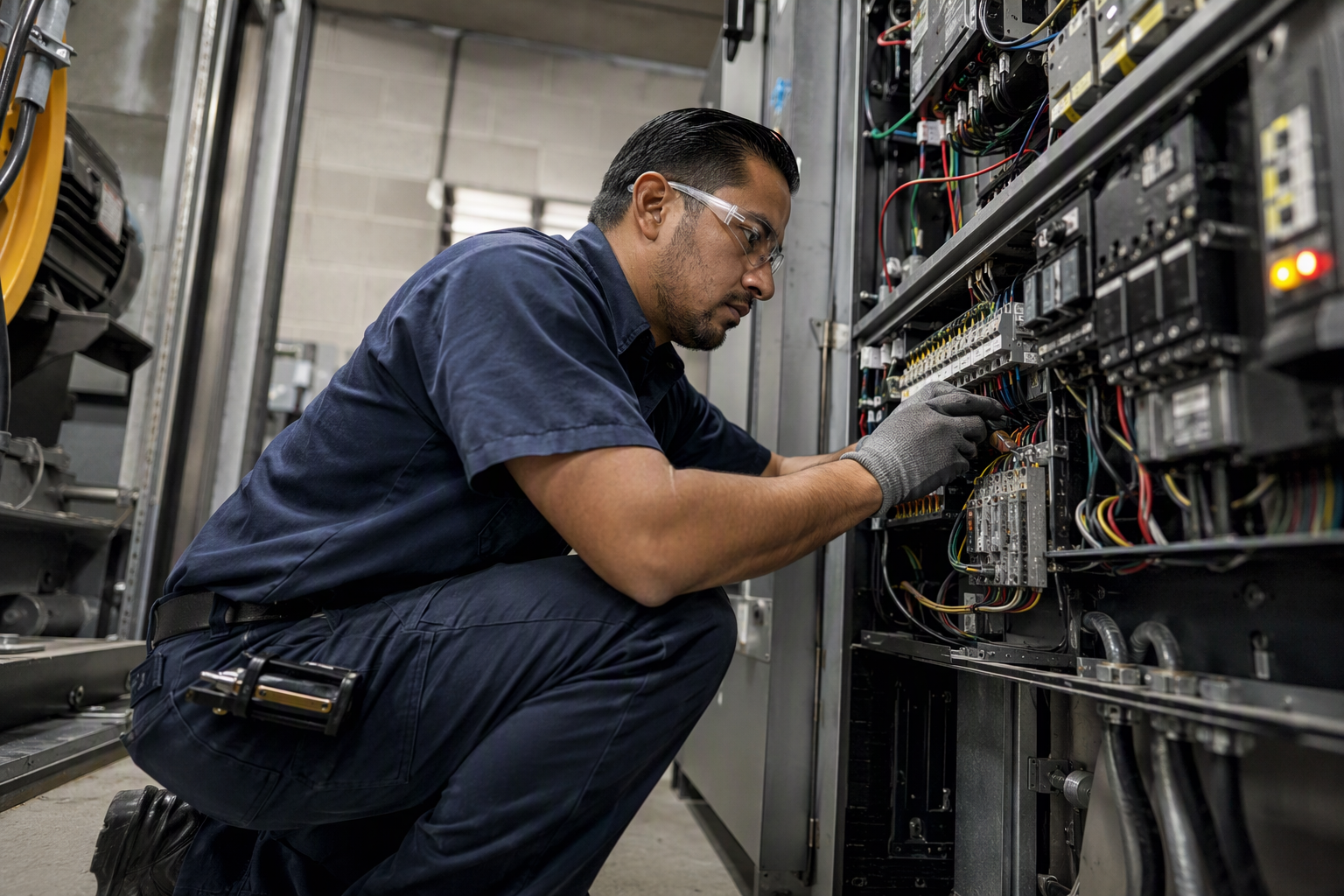
Elevator installation and repair workers in Arizona are subject to federal OSHA standards governing construction and general industry, including requirements for lockout/tagout procedures, fall protection in hoistways, and confined space entry protocols.
OSHA’s standards for elevator construction work complement — but are separate from — the safety code requirements under ASME A17.1 and Arizona’s state regulatory framework. OSHA focuses on worker safety during the installation, maintenance, and repair process, while the ICA Elevator Division focuses on equipment safety for building occupants and the public. Property owners hiring elevator contractors should confirm that the contractor maintains OSHA-compliant safety programs, as incidents involving contractor employees can carry liability implications for building owners under certain circumstances.
How should a property owner evaluate an elevator service company in Arizona?
A qualified Arizona elevator service company should hold an active Arizona Registrar of Contractors R-12 or C-12 license, demonstrate familiarity with ASME A17.1-2019 and Arizona’s state-specific requirements, and be able to work within both ICA Elevator Division and City of Phoenix Elevator Section jurisdictions as appropriate for the client’s property location.
Beyond licensing, property owners should evaluate whether the contractor understands the AZFS key requirements, the 90-day pre-notification process, the distinction between maintenance and code-triggering alterations, and the ADA accessibility obligations that exist independently of the state safety certificate. A contractor who conflates these distinct regulatory layers — or who is unfamiliar with the ICA Elevator Division’s transition from ADOSH — may create compliance gaps that expose the building owner to enforcement action or liability. Arizona Elevator Solutions provides compliance assessments designed to identify exactly these types of gaps for properties in Phoenix, Scottsdale, Tucson, and Mesa.
What questions should a building owner ask before signing an elevator maintenance contract?
Before signing any elevator maintenance agreement in Arizona, building owners should ask the prospective contractor to confirm their ROC license classification, explain how they handle state notification for any work that may constitute an alteration, and describe their process for ensuring the annual certificate of inspection remains current.
Additional questions that protect the building owner’s interests include:
- Is the company familiar with both ICA Elevator Division requirements and City of Phoenix Elevator Section requirements, and which jurisdiction governs this property?
- Does the maintenance agreement cover AZFS key testing and firefighters’ emergency operation verification?
- How does the company handle the 24-hour incident reporting requirement if an accident or disabling event occurs?
- What is the process for coordinating with an ICA-authorized inspector for annual certification?
- Does the contract scope address ADA accessibility compliance, or is that treated as a separate service?
- How does the company document compliance with ASME A17.1-2019 for equipment installed or altered after January 1, 2023?
How does Arizona’s elevator regulatory framework protect building owners who act in good faith?
Arizona’s regulatory framework — under A.R.S. §§ 23-491 through 23-491.16 and Arizona Administrative Code R20-5-502 through R20-5-515 — establishes clear obligations for building owners, and consistent compliance with those obligations is the strongest available protection against regulatory enforcement and civil liability.
The framework’s grandfather provision allows lawfully installed older equipment to remain in service absent a hazard determination by the ICA Elevator Division chief, which protects owners who inherited older equipment and have maintained it responsibly. The option to engage a private ICA-authorized inspector gives owners flexibility in scheduling inspections without waiting for state inspector availability. And the clear pre-notification and accident-reporting timelines — 90 days before installation or alteration, 24 hours after an incident — provide a defined compliance roadmap that reduces ambiguity. Owners who follow this roadmap consistently, and who engage licensed contractors for all work, are positioned to demonstrate good-faith compliance in any enforcement or litigation context.
Why should Phoenix, Tucson, Scottsdale, and Mesa property owners choose Arizona Elevator Solutions?
Arizona Elevator Solutions combines technical knowledge of Arizona’s current regulatory framework — including the 2026 transition to the ICA Elevator Division — with hands-on service capability across the state’s major markets, making the company a single-source resource for compliance, maintenance, and modernization needs.
Clients in Phoenix navigate the dual-jurisdiction dynamic between the City of Phoenix Elevator Section and the ICA Elevator Division. Clients in Tucson, Scottsdale, and Mesa work exclusively under ICA authority. Arizona Elevator Solutions understands both environments and structures its service approach accordingly. The company’s knowledge of ASME A17.1-2019, ASME A18.1-2020, the AZFS key requirement, ROC licensing standards, and ADA obligations allows it to address the full compliance picture — not just the mechanical condition of the equipment — for every client it serves.
Need elevator service you can rely on? Arizona Elevator Solutions is ready to help.