
Elevator Emergency Phone Number

Elevator Emergency Phone Number: Complete Guide for Building Owners & Managers Direct Answer: An elevator emergency phone number is a dedicated, always-active telephone line installed inside an elevator cab that connects trapped passengers to emergency responders or a 24/7 monitoring center within 60 seconds — required by ASME A17.1 Section 2.27.1.1 and the Americans with […]
Who Should I Contact When Much Does Elevator Maintenance Cost?

Who Should I Contact for Elevator Maintenance & How Much Does It Cost? Quick Answer: For elevator maintenance in Arizona, contact a licensed elevator contractor holding an R-12 or C-12 license from the Arizona Registrar of Contractors and registered with the Industrial Commission of Arizona (ICA) Elevator Division. Annual maintenance contracts typically range from $3,000 […]
24 Hour Elevator Repair Service

Direct Answer: 24-hour elevator repair service means IUEC-certified technicians respond to elevator breakdowns, passenger entrapments, and safety-code failures at any hour — including weekends and holidays — typically arriving on-site within 1–4 hours depending on incident type. Service restores safe operation and maintains compliance with ASME A17.1-2019 safety standards and Arizona’s annual certificate-of-inspection requirements under […]
How Often Should Elevators Be Inspected?

How Often Should Elevators Be Inspected? Complete FAQ Guide for Arizona Building Owners Quick Answer: In Arizona, elevators must be inspected before first use, after any modification or alteration, and at least once every 12 months after that — with no conveyance permitted to operate without a valid annual certificate of inspection issued by the […]
Who Should I Contact For Elevator Entrapment Rescue Procedure?

Direct Answer: For elevator entrapment, call 911 immediately — firefighters carry Arizona Firefighters Service (AZFS) emergency keys and are trained in passenger life-safety response. Simultaneously notify building management, then dispatch your certified elevator service company, such as Arizona Elevator Solutions at 480-557-7600, for mechanical rescue, post-incident inspection, and compliance documentation required under ASME A17.1-2019 and […]
How Fast Can Elevator Be Repaired?

How Fast Can an Elevator Be Repaired? Complete FAQ Guide for Arizona Building Owners Quick Answer: Most elevator repairs in Arizona are completed within 2 to 8 hours for common issues such as door malfunctions, sensor faults, or control board failures. Complex hydraulic or mechanical repairs typically take 1 to 5 business days depending on […]
Who Should I Contact When Often Should Elevators Be Inspected?

Who Should I Contact & How Often Should Elevators Be Inspected? Complete FAQ Guide Quick Answer: Contact the Industrial Commission of Arizona’s Elevator Division and a licensed elevator contractor holding an Arizona Registrar of Contractors R-12 or C-12 license. Arizona law requires every elevator to be inspected before first use, after any alteration, and annually […]
Elevator Stuck Between Floors Who To Call

Elevator Stuck Between Floors: Who to Call and What to Do Right Now Quick Answer: If an elevator is stuck between floors, call your building’s contracted elevator service company on their 24/7 emergency line immediately — and dial 911 first if any passenger is in medical distress, injured, or has been trapped more than 15 […]
Elevator Modernization Vs Replacement Cost

Elevator Modernization vs. Replacement Cost: Complete FAQ Guide for Arizona Building Owners Direct Answer: Elevator modernization typically costs $50,000–$200,000 depending on scope, while full replacement runs $100,000–$750,000 or more. For elevators under 30 years old with a structurally sound hoistway and cab, modernization is almost always the more cost-effective path — delivering code compliance, energy […]
elevator entrapment rescue procedure
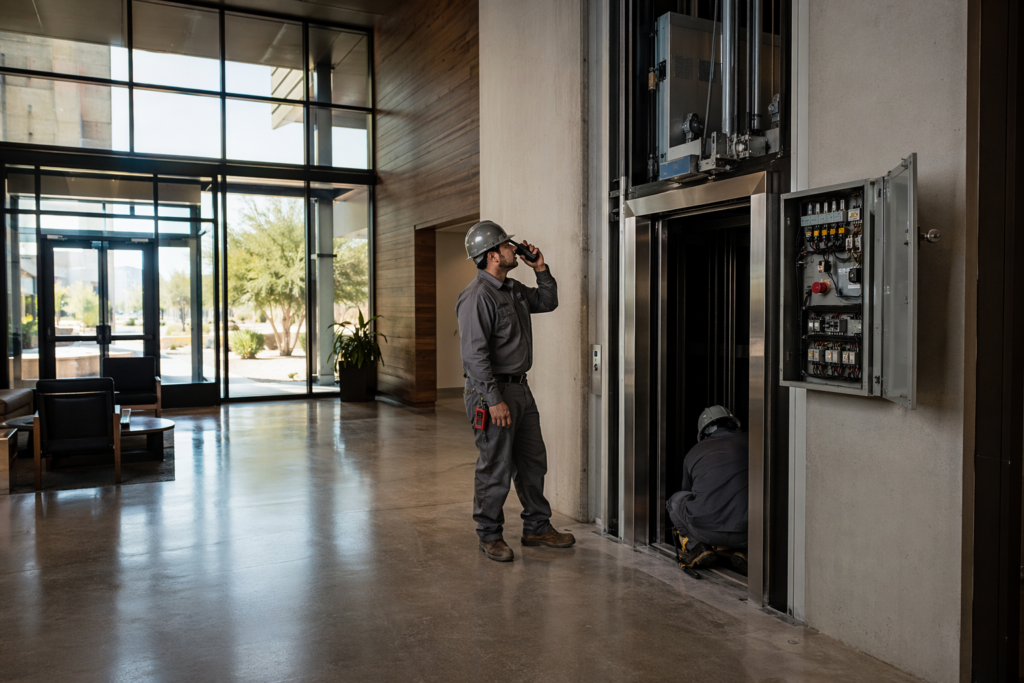
Quick Answer: Elevator entrapment rescue procedure requires trained, licensed personnel to halt the car safely, maintain two-way communication with trapped passengers, use emergency lowering controls or manual brake release to reposition the cab level with the nearest floor, then mechanically open doors for assisted egress — passengers must never be instructed to exit between floors, […]