Quick Answer: Choosing the right elevator maintenance contract depends on your building’s age, elevator usage volume, budget structure, and risk tolerance — oil-and-grease contracts offer the lowest upfront cost for newer or low-traffic elevators, while full-coverage contracts reduce financial exposure for older or high-use equipment, and comprehensive contracts fall in between for buildings that want predictable costs without paying for repairs already covered by warranty.

Elevator maintenance contracts are not one-size-fits-all agreements. Property managers, building owners, and facility directors across Arizona face a recurring decision: which contract structure actually protects the building, the budget, and the people who depend on vertical transportation every day? This guide breaks down each contract type, compares them side by side, and helps identify which option aligns with specific building profiles.
What Are the Main Types of Elevator Maintenance Contracts?
Three contract structures dominate the commercial elevator service market. Understanding what each one covers — and more importantly, what each one excludes — is the foundation of any smart purchasing decision.
Oil-and-Grease (Lubrication-Only) Contracts
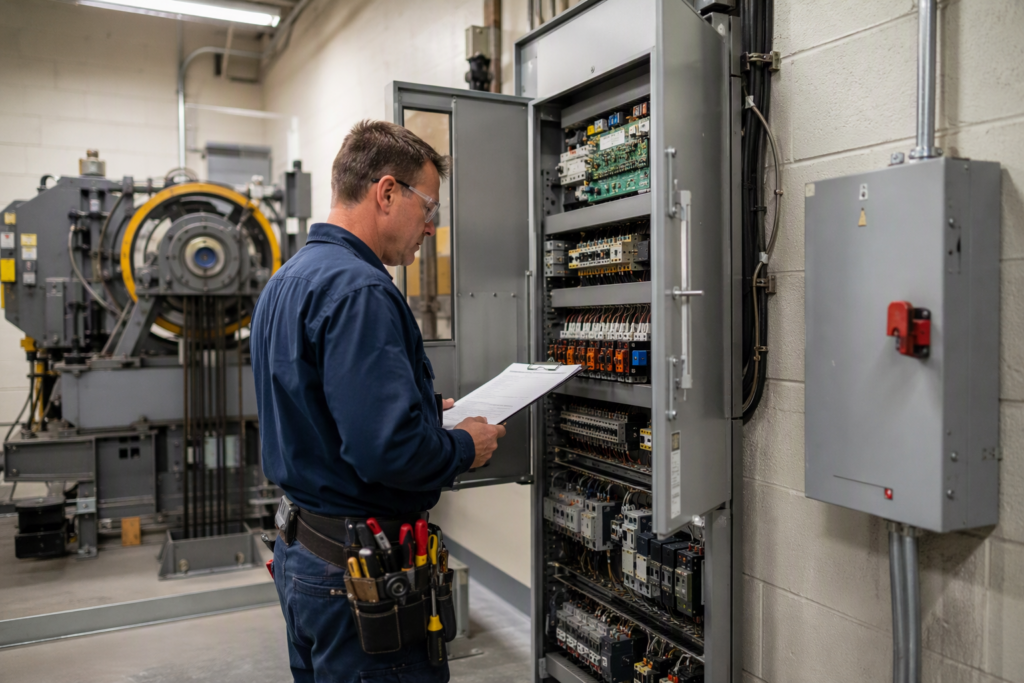
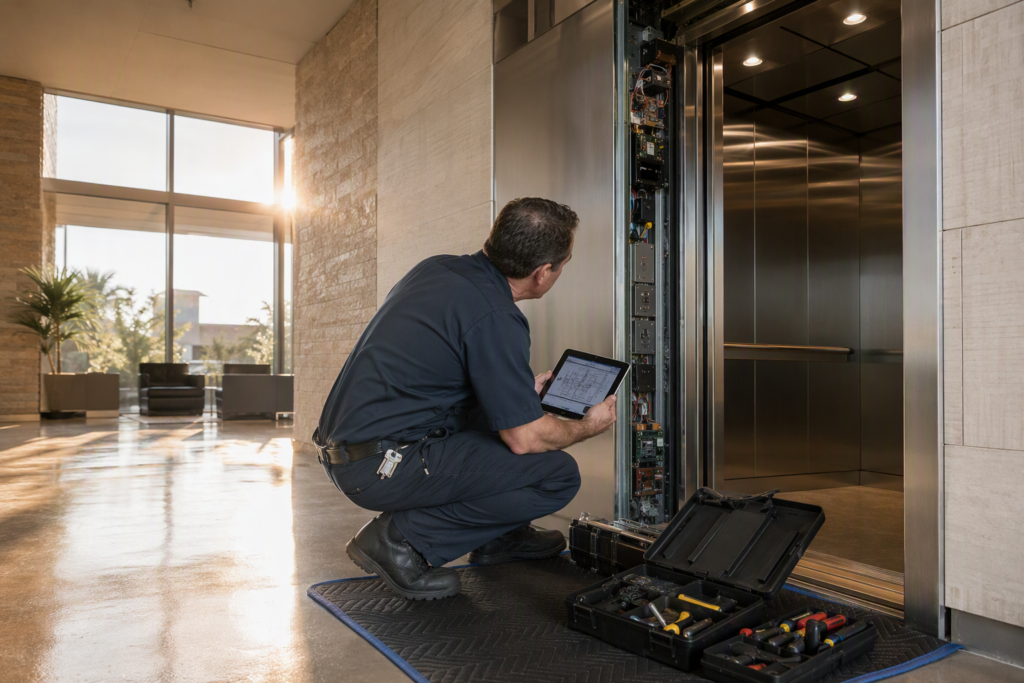
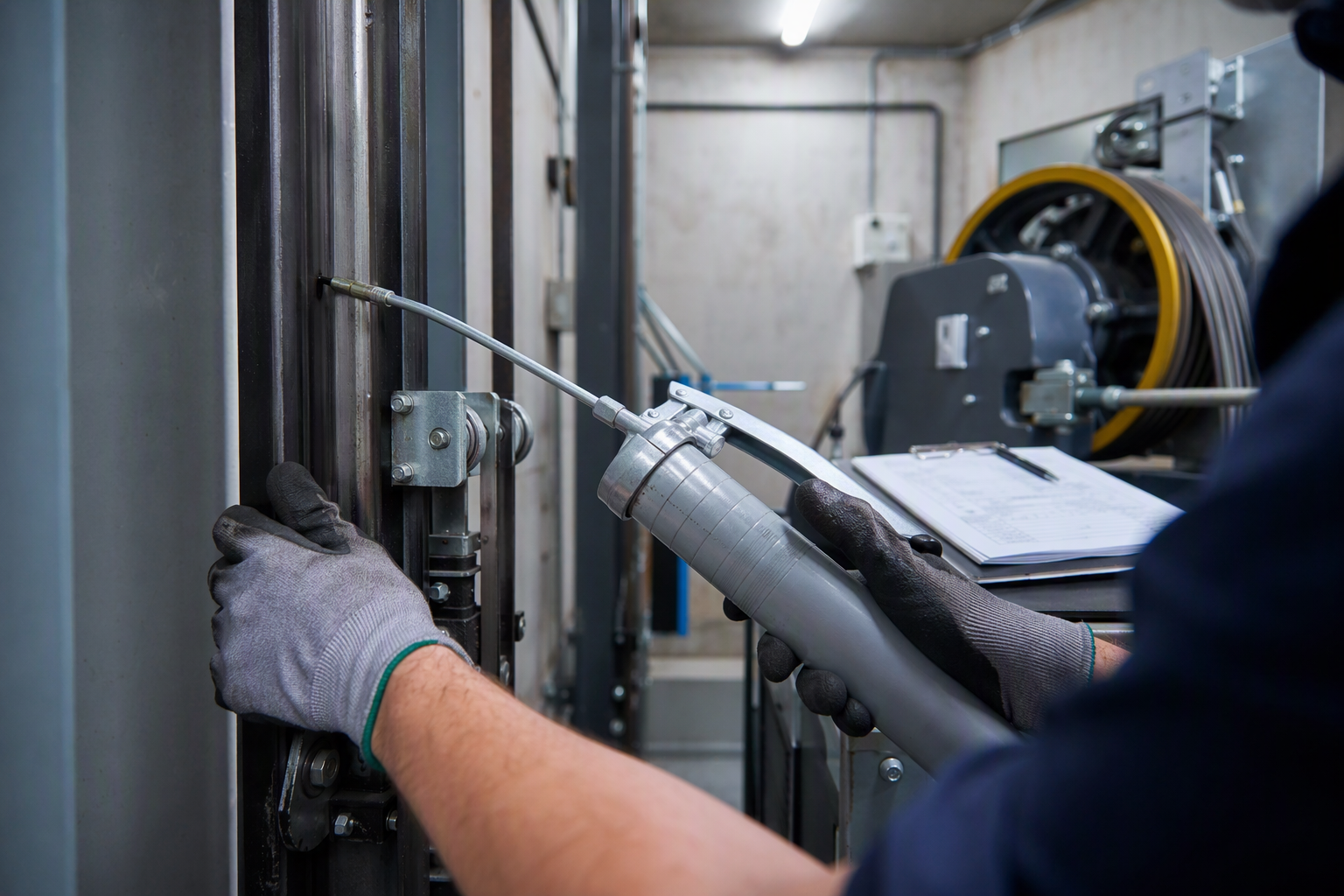
An oil-and-grease contract, sometimes called a lubrication-only or preventive maintenance contract, covers scheduled visits during which a technician lubricates moving parts, cleans key components, makes minor adjustments, and conducts a visual inspection. It does not cover the cost of replacement parts or repair labor when something breaks down.
Comprehensive Maintenance Contracts
A comprehensive contract covers everything in an oil-and-grease agreement plus labor costs for repairs. However, it typically excludes the cost of parts, particularly major components such as motors, controllers, door operators, or hydraulic cylinders. When a repair is needed, the building pays for parts but not the technician’s time.
Full-Coverage (Full-Service) Contracts
A full-coverage contract bundles scheduled preventive maintenance, repair labor, and replacement parts into a single recurring payment. These agreements offer the most financial predictability because a single unexpected failure will not generate a surprise invoice. Some full-coverage contracts exclude specific high-cost items like complete controller replacements or major modernization work — reviewing the exclusion list carefully before signing is essential.
How Do These Contract Types Compare Side by Side?
| Feature | Oil-and-Grease | Comprehensive | Full Coverage |
|---|---|---|---|
| Preventive Maintenance Visits | ✔ Included | ✔ Included | ✔ Included |
| Repair Labor | ✘ Extra charge | ✔ Included | ✔ Included |
| Replacement Parts | ✘ Extra charge | ✘ Extra charge | ✔ Included (see exclusions) |
| Emergency Call Coverage | ✘ Usually extra | Varies by contract | ✔ Usually included |
| Budget Predictability | Low — repairs billed separately | Medium — labor covered, parts variable | High — fixed recurring cost |
| Best Fit | New elevators, low-use buildings, tight budgets | Mid-age elevators, moderate use | Older elevators, high-traffic buildings |
| Financial Risk to Building Owner | High | Medium | Low |
| Typical Contract Length | 1–3 years | 1–3 years | 1–5 years |
Which Contract Type Is Right for My Building?
No single contract type is universally superior. The right choice depends on several building-specific variables evaluated together.
Building and Equipment Profile Matching
| Building Profile | Recommended Contract | Primary Reason |
|---|---|---|
| New construction, elevator under OEM warranty | Oil-and-Grease or Comprehensive | Warranty may already cover parts and some labor |
| Low-rise residential (2–4 stops), light use | Oil-and-Grease | Lower failure frequency, contained risk |
| Mid-rise commercial, 5–15 years old | Comprehensive | Parts are aging but not yet at high-failure risk |
| High-rise commercial or medical facility | Full Coverage | Downtime is costly; financial exposure is high |
| Elevator 20+ years old, no modernization | Full Coverage | Component failure frequency increases with age |
| HOA or condominium community | Comprehensive or Full Coverage | Predictable budgeting is critical for HOA reserves |
| Retail or hospitality (high daily traffic) | Full Coverage | Guest experience and liability exposure demand reliability |
What Does Elevator Maintenance Compliance Require in Arizona?
Arizona elevator owners are required to maintain equipment in safe operating condition. The ASME A17.1 Safety Code for Elevators and Escalators establishes the minimum maintenance, inspection, and testing requirements that apply broadly across jurisdictions, including Arizona. Regardless of which contract type a building owner selects, the maintenance performed must meet the standards outlined in ASME A17.1.
Accessibility compliance is governed separately. Elevators in buildings subject to the Americans with Disabilities Act (ADA) must meet applicable accessibility requirements, and maintenance neglect that results in non-functional accessibility features can create significant legal exposure. A well-structured maintenance contract should explicitly address ADA-relevant components such as door timing, button operation, and cab leveling.
Workplace safety during elevator maintenance work is governed by OSHA standards. Building managers contracting with elevator service companies should confirm that any service provider complies with applicable OSHA regulations for confined space entry and lockout/tagout procedures.
What Are the Pros and Cons of Each Elevator Maintenance Contract?
| Contract Type | Pros | Cons |
|---|---|---|
| Oil-and-Grease |
|
|
| Comprehensive |
|
|
| Full Coverage |
|
|
What Should I Look for in the Fine Print of an Elevator Service Contract?
Contract language varies significantly between service providers. Before signing any elevator maintenance agreement, building owners and property managers should evaluate the following elements:
- Exclusion lists: Full-coverage contracts often exclude high-value components. Identify exactly which parts are excluded before comparing costs.
- Callback and emergency coverage: Confirm whether emergency service calls outside business hours are included or billed separately, and whether there are limits on the number of callbacks per year.
- Automatic renewal and cancellation clauses: Many contracts auto-renew and include penalties for early termination. Understand the exit terms before signing.
- Price escalation provisions: Multi-year contracts often include annual cost escalation clauses tied to labor indices. Know what increases are contractually permitted.
- Parts sourcing: Clarify whether the provider can use OEM parts, approved equivalent parts, or remanufactured components. This affects both cost and equipment longevity.
- Documentation and reporting: A quality contract should include provisions for written maintenance logs, inspection records, and compliance documentation required by ASME A17.1.
How Do I Evaluate an Elevator Service Provider Before Signing a Contract?
The contract type matters less than the quality and accountability of the service provider executing it. When evaluating elevator service companies in Arizona, building owners should consider the following:
- Verify that the company is an independent, certified elevator service provider — not a reseller or subcontractor arrangement.
- Request references from comparable properties (similar building type, elevator age, and usage profile).
- Ask for a sample maintenance log from a current client to evaluate the depth and consistency of service documentation.
- Confirm compliance familiarity with ASME A17.1, state elevator codes, and ADA accessibility requirements.
- Inquire about parts sourcing relationships — a provider with established parts supplier relationships can often reduce repair timelines significantly.
- Review the contract exclusions list with legal or facilities counsel for any multi-year or full-coverage agreement.
- Evaluate whether the provider performs a free pre-contract assessment to document current equipment condition — this protects both parties and establishes a fair baseline.
Arizona Elevator Solutions offers free elevator assessments for building owners and property managers evaluating their maintenance contract options. An independent assessment from Arizona Elevator Solutions provides an unbiased documentation of current equipment condition before any contract is signed.
Does Elevator Age Affect Which Maintenance Contract Type Makes Financial Sense?
Equipment age is one of the most significant factors in contract selection. As elevator components age, the probability and frequency of repairs increases. For older equipment, paying the higher recurring cost of a full-coverage contract is often more economical over a multi-year period than absorbing unpredictable repair and parts costs under an oil-and-grease or comprehensive structure.
Conversely, for an elevator recently installed or recently modernized, full-coverage pricing reflects a risk premium that the building may not yet need to pay. In these cases, a well-structured oil-and-grease or comprehensive contract provides adequate protection without overpaying.
A professional equipment assessment — such as the free assessment offered by Arizona Elevator Solutions — provides a documented view of component condition and remaining useful life that makes this calculation much more precise than relying on calendar age alone.
How Does Elevator Usage Volume Affect the Right Contract Choice?
Traffic volume accelerates component wear independent of age. A five-year-old elevator in a busy hospital emergency department may experience component wear comparable to a much older elevator in a low-traffic residential building. Usage-intensive environments — including healthcare facilities, transit hubs, hotels, high-density residential towers, and busy retail centers — tend to benefit most from full-coverage agreements because the statistical likelihood of in-contract repairs is meaningfully higher.
Building owners who track elevator usage data (typically available from modern elevator controllers or building management systems) are better positioned to make a data-informed contract decision.
What Happens If I Choose the Wrong Contract Type?
The consequences of mismatching contract type to building profile are financial in both directions. Choosing an oil-and-grease contract for an aging, high-use elevator can result in large unbudgeted repair invoices that strain operating budgets and reserve funds. Choosing full-coverage for a brand-new, low-use elevator means paying for coverage that statistically will rarely be used.
Beyond cost, an inadequate maintenance contract can affect safety compliance. Equipment that receives only minimal preventive attention without prompt repair of identified issues may fall short of the standards required under ASME A17.1, creating regulatory and liability exposure for building owners.
Most maintenance contracts can be renegotiated at renewal. Building owners who recognize a mismatch mid-term should document performance, repair frequency, and total out-of-pocket costs to support a renegotiation or provider change at the next contract milestone.
Can I Switch Elevator Service Providers Mid-Contract?
Switching providers mid-contract is possible but typically involves penalties specified in the original agreement. Many elevator maintenance contracts — particularly those from large national providers — include multi-year auto-renewal terms and early termination fees. Reading cancellation clauses carefully before signing any new contract is essential.
When switching providers, it is advisable to:
- Request a complete copy of all maintenance and inspection records from the outgoing provider before the transition date.
- Schedule a full equipment assessment with the incoming provider to document baseline condition and identify any deferred maintenance.
- Confirm there is no service gap between the expiration of the old contract and the start of the new one, particularly for inspection-critical compliance dates.
- Review ASME A17.1 maintenance documentation requirements so the new provider understands the record-keeping obligations from day one.
Why Choose Arizona Elevator Solutions as Your Elevator Maintenance Provider?
Arizona Elevator Solutions is a certified, independent elevator service company serving building owners and property managers throughout Arizona. As an independent provider, Arizona Elevator Solutions is not tied to a single equipment manufacturer — meaning contract recommendations and parts sourcing decisions are made in the interest of the building owner, not a manufacturing parent company.
Arizona Elevator Solutions offers all three primary contract structures — oil-and-grease, comprehensive, and full coverage — and helps clients match the right contract type to their specific building profile, equipment condition, and budget requirements. Every new client relationship begins with a free elevator assessment to establish an accurate equipment baseline before any contract recommendation is made.
For building owners managing multiple elevators or mixed-use properties with varying elevator ages and usage profiles, Arizona Elevator Solutions provides portfolio-level contract analysis to optimize coverage across all units without overpaying on newer equipment or underprotecting aging assets.
What Steps Should I Take Right Now to Choose the Right Elevator Maintenance Contract?
- Document your elevator inventory: Record the age, type (hydraulic, traction, MRL), and approximate daily usage for every elevator in your building.
- Gather your current contract: Identify what is and is not covered, when the contract renews, and what the cancellation terms are.
- Review your repair history: Compile any repair invoices or service records from the past two to three years to establish your actual out-of-pocket repair costs under your current agreement.
- Identify compliance deadlines: Confirm upcoming inspection or testing dates required under state and local elevator codes and ASME A17.1.
- Request a free assessment: Contact Arizona Elevator Solutions for an independent, no-obligation evaluation of your equipment condition and contract options.
- Compare total cost of ownership: Evaluate each contract type based on the base contract cost plus your historical average repair and parts spend — not the contract price alone.
- Review the exclusions list of any full-coverage contract being considered before signing.
Ready to Find the Right Elevator Maintenance Contract for Your Building?
Arizona Elevator Solutions provides free elevator assessments for building owners and property managers throughout Arizona. Get an independent, no-obligation evaluation of your current equipment condition and contract options — so you can make a confident, informed decision before your next contract renewal.
Contact Arizona Elevator Solutions for a free elevator assessment: 480-557-7600
Need elevator service you can rely on? Arizona Elevator Solutions is ready to help.