
Elevator Service Contract Negotiation Tips: A Complete FAQ Guide
Negotiating an elevator service contract is one of the most consequential decisions a building owner or property manager will make. A poorly structured agreement can leave a property exposed to unexpected repair costs, compliance failures, and extended equipment downtime. The questions and answers below cover every critical dimension of the negotiation process — from scope of coverage and pricing structures to Arizona-specific regulatory requirements and vendor evaluation criteria.
What should be the first step when negotiating an elevator service contract?

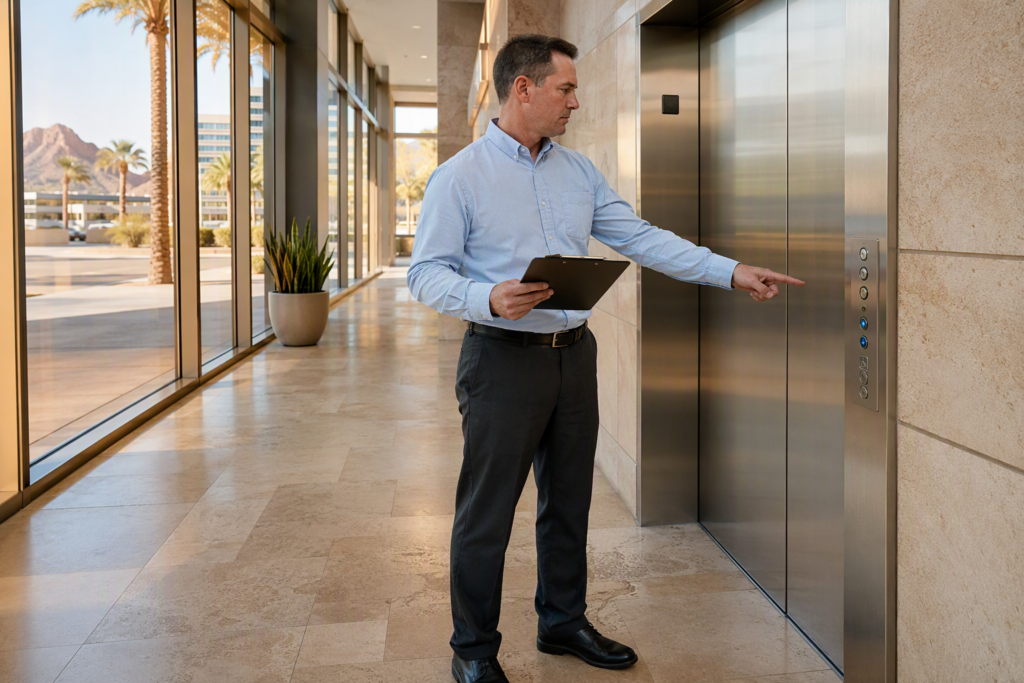
The first step is to conduct a full audit of the existing elevator equipment, its maintenance history, and current compliance status before approaching any vendor.
Walking into a contract negotiation without knowing the condition of the equipment puts the building owner at a significant disadvantage. A vendor can easily upsell unnecessary coverage tiers or exclude pre-existing deficiencies if those issues are not already documented. A thorough equipment audit should capture the age of the unit, the date of the last state inspection, any outstanding violations, the make and model of major components, and the status of current modernization needs.
This baseline documentation gives negotiators concrete data to challenge exclusion clauses, dispute inflated repair estimates, and benchmark proposed contract terms against the actual risk profile of the installation.
What are the main types of elevator service contracts available?
The three primary contract structures are oil-and-grease (lubrication-only), parts-and-labor, and full-maintenance (comprehensive) agreements, each representing a progressively broader scope of coverage.
Understanding these distinctions is essential before entering any negotiation. A lubrication-only contract covers basic adjustment and lubrication visits but excludes virtually all repair costs. A parts-and-labor contract includes defined repairs but may carve out major components such as controllers, door operators, or hydraulic units. A full-maintenance or comprehensive contract covers most repairs and replacement parts, making the monthly cost higher but more predictable.
| Contract Type | Typical Coverage | Owner’s Residual Risk | Best Suited For |
|---|---|---|---|
| Oil & Grease (Lubrication Only) | Lubrication, minor adjustments, inspections | High — all parts and labor billed separately | New equipment under manufacturer warranty |
| Parts & Labor | Defined parts list + associated labor | Medium — major components often excluded | Mid-age equipment in good condition |
| Full Maintenance / Comprehensive | Most parts, labor, callbacks, adjustments | Low — exclusions limited to misuse or code upgrades | Older equipment or high-traffic installations |
| Modernization + Service Bundle | Upgrade financing paired with ongoing maintenance | Variable — depends on modernization scope | Equipment requiring significant capital investment |
Which parts and components are most commonly excluded from elevator service contracts?
The most frequently excluded items include aesthetic components (cab interior finishes, flooring, lighting fixtures), vandalism damage, code-mandated upgrades, and major structural components such as guide rails, machine rooms, and hydraulic cylinders.
Exclusion clauses are where contracts most often disadvantage building owners. Vendors may exclude “obsolete” parts — a particularly impactful carve-out for older traction or hydraulic units — meaning the owner is responsible for sourcing and paying for components that the contractor deems no longer standard. Negotiators should demand a written list of every excluded part category and push to narrow exclusions wherever possible, especially on aging equipment where component failure risk is elevated.
Code upgrade exclusions deserve particular attention. When Arizona or federal standards require retrofits — such as fire service recall compliance under ASME A17.1 Safety Code for Elevators and Escalators — the cost typically falls on the building owner unless the contract explicitly addresses it. Negotiate who bears responsibility for mandatory upgrades triggered by code changes during the contract term.
How does Arizona state law affect elevator service contract terms?
Arizona requires elevators to be inspected and certified under state authority, meaning the service contract must align with these mandatory inspection cycles or the building owner faces compliance liability regardless of what the contract states.
The Arizona Department of Occupational Safety and Health (ADOSH) oversees elevator inspection and permitting in the state. Elevator service contracts executed in Phoenix, Tucson, Scottsdale, Mesa, and other Arizona jurisdictions must account for state inspection scheduling, permit renewal requirements, and the remediation of any deficiencies cited during official inspections. If a vendor’s contract assigns inspection coordination responsibility ambiguously, the building owner should insist on clear language specifying who schedules, facilitates, and is accountable for addressing state inspection findings.
References to federal workplace safety standards under OSHA may also apply in commercial settings, particularly regarding technician safety protocols during maintenance visits. Contracts should confirm that the service provider meets all applicable OSHA standards for confined space entry, lockout/tagout, and machine room safety.
What ASME and ADA compliance requirements should be referenced in a service contract?
A properly structured service contract should explicitly reference the ASME A17.1 Safety Code for Elevators and Escalators for maintenance and inspection standards and acknowledge ADA requirements for accessible design and operation.
ASME A17.1 establishes the minimum maintenance, inspection, and testing requirements for elevators and escalators in the United States. A service contract that does not reference this standard — or worse, one that describes a maintenance scope inconsistent with it — should raise immediate red flags. The 2019 edition of ASME A17.1/CSA B44 and subsequent guidance clarify routine maintenance tasks, periodic test intervals, and the qualifications required of service personnel.
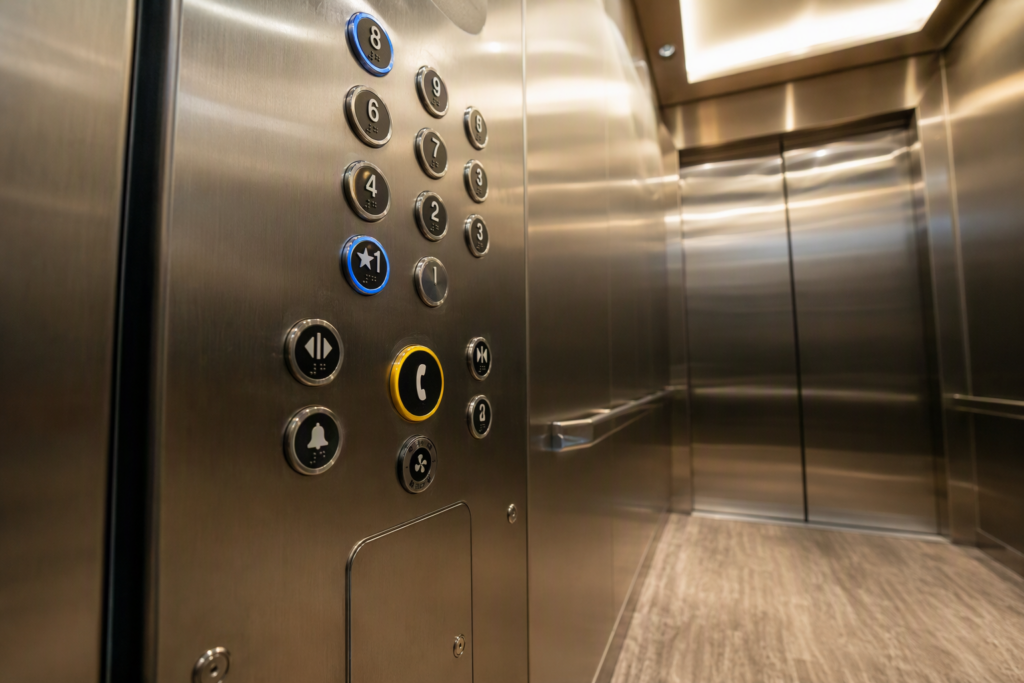
ADA considerations are relevant when maintenance activities affect cab dimensions, door timing, auditory signals, braille signage, or floor leveling accuracy. If a maintenance action inadvertently disrupts ADA-compliant features, the question of liability should be addressed contractually. Building owners should confirm that their service provider is knowledgeable about ADA requirements and will restore any affected accessible features as part of standard maintenance scope.
How should response time requirements be structured in a service contract?
Response time terms should differentiate between emergency entrapment situations, standard breakdown calls, and routine callback visits, with each category assigned a clearly defined maximum timeframe and a contractual remedy if the vendor fails to meet it.
Vague language such as “prompt response” or “reasonable time” provides no enforceable protection. Negotiators should push for specific, measurable commitments. Entrapment situations — where a passenger is trapped in the cab — represent the most critical scenario and deserve priority treatment in any agreement. Standard outages and non-urgent callbacks can carry longer windows, but those windows must still be defined with precision.
Equally important is the remedy clause: what happens if the vendor misses the stated response window? Remedies may include service credits, the right to call a competing technician at the vendor’s expense, or grounds for contract termination without penalty. Without a defined remedy, a response time commitment is effectively unenforceable.
What is an escalation clause and why does it matter in an elevator service contract?
An escalation clause is a contract provision allowing the service provider to increase the contract price annually based on a defined index or percentage cap, and understanding its terms is essential to protecting the building owner’s long-term budget.
Multi-year elevator service contracts almost always include escalation clauses. Without careful negotiation, a building owner may sign a contract with an attractive year-one rate only to see costs climb substantially in subsequent years. Escalation should be tied to a verifiable external benchmark — such as a published cost index — rather than left to the vendor’s discretion. Owners should also negotiate a ceiling on any single-year increase and ensure that extraordinary escalation triggers the right to terminate or renegotiate.
For properties in high-cost commercial corridors such as Scottsdale and Phoenix, where labor markets can be competitive, escalation clauses deserve particular scrutiny. Working with a locally rooted provider like Arizona Elevator Solutions can provide more stable and transparent pricing conversations than dealing with a national chain operating through regional subcontractors.
How many competing bids should a property manager obtain before signing an elevator service contract?
Obtaining a minimum of three competitive bids is considered sound procurement practice, as it provides enough market data to evaluate pricing, scope, and vendor quality without creating an unmanageable comparison process.
Each bid should be solicited using a standardized scope of work document so that proposals are genuinely comparable. Without a uniform scope, vendors will propose different coverage tiers, making price comparisons misleading. The scope document should specify the number of maintenance visits per year, required ASME A17.1 periodic tests, callback response expectations, and the parts categories to be covered.
Evaluation should extend beyond price. A low-cost bid from a vendor with limited local presence, no Arizona-licensed technicians, or a history of slow inspection facilitation will frequently cost more over the contract term than a slightly higher bid from a reputable local provider. Arizona Elevator Solutions serves property owners across Phoenix, Scottsdale, Tucson, and Mesa and can provide a detailed, transparent proposal for direct comparison against any competing offer.
What contract length is typically most advantageous for building owners?
Contract terms of one to three years generally offer the best balance between pricing stability for the vendor and flexibility for the building owner, with longer terms warranting stronger termination rights and performance guarantees in return.
Vendors often offer lower per-month pricing in exchange for longer contract commitments. While a five-year agreement may appear economical on paper, it substantially reduces negotiating leverage if service quality declines, the building’s needs change, or the equipment is modernized mid-term. If a long-term contract is accepted, it must include meaningful performance benchmarks and unambiguous termination provisions tied to measurable failures.
Short-term contracts (one year or less) preserve maximum flexibility but may result in less favorable pricing. The ideal approach is a two- to three-year initial term with renewal options — structured so the building owner, not the vendor, controls the renewal decision.
What termination rights should a building owner insist on in an elevator service contract?
Building owners should negotiate for termination for cause (tied to defined performance failures), termination for convenience with a reasonable notice period, and protections against automatic renewal traps that lock the owner in without affirmative consent.
Automatic renewal clauses are among the most costly provisions for unwary building owners. If a contract renews automatically unless canceled within a narrow window — sometimes as short as 30 to 60 days before the anniversary date — missing that window can commit the property to another full contract term with no exit. Negotiators should require that any auto-renewal be preceded by written vendor notification sent well in advance, and they should push to extend the cancellation window.
Termination for cause should be triggered by specific, objectively measurable failures: repeated missed response times, failed state inspections attributable to inadequate maintenance, or failure to provide required documentation. Requiring the vendor to cure within a defined period before termination becomes effective is reasonable, but the cure period should not be so long that it prevents timely transition to a new provider.
How should elevator service contracts address regulatory inspection documentation?
The contract should clearly assign responsibility for scheduling and completing all required state and local inspections, retaining official inspection certificates, and providing the building owner with copies within a defined timeframe after each inspection.
In Arizona, elevators must maintain current inspection certificates issued by ADOSH-authorized inspectors. If this documentation lapses, the elevator may be ordered out of service, creating operational disruption and potential liability. The service contract should specify who coordinates the inspection appointment, who ensures the certificate is posted as required, and who addresses any deficiencies cited by the inspector — and within what timeframe.
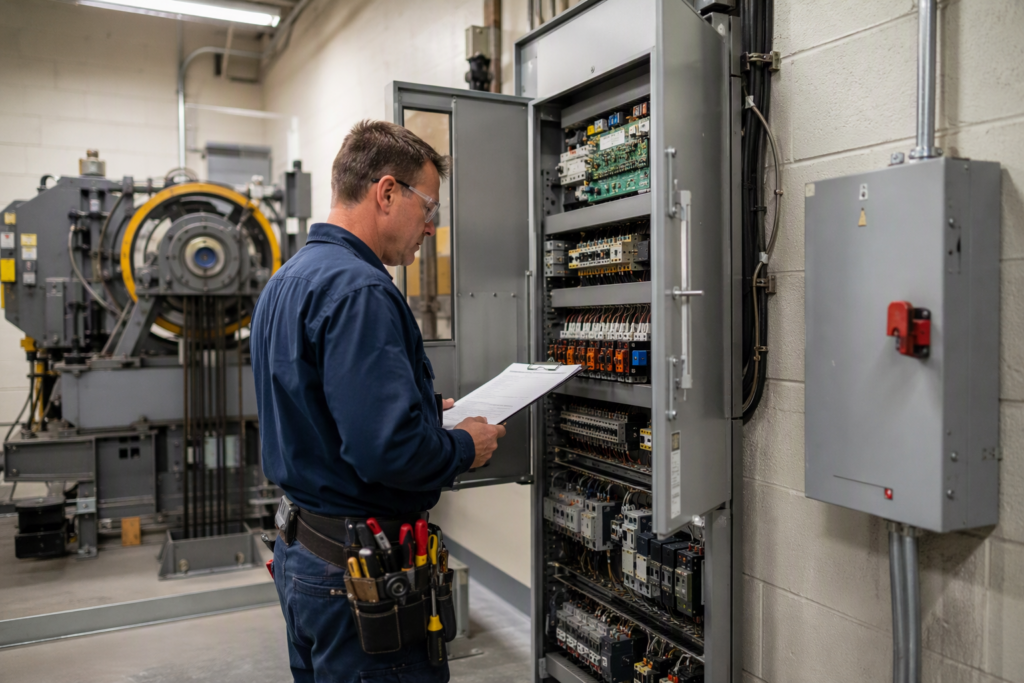
Maintenance log requirements under ASME A17.1 Safety Code for Elevators and Escalators also apply. Logs must document each maintenance visit, the work performed, and the technician’s qualifications. Building owners should contractually require that these logs be made available upon request and retained for the duration prescribed by applicable standards.
What step-by-step process should a property manager follow when negotiating an elevator service contract?
A structured negotiation process reduces the risk of overlooking critical provisions and produces a contract that genuinely protects the building owner’s interests.
- Audit existing equipment: Document make, model, age, maintenance history, outstanding violations, and current inspection certificate status for every elevator in the building.
- Define the scope of work: Draft a standardized scope document covering maintenance frequency, required tests, parts categories, response expectations, and documentation requirements.
- Solicit at least three bids: Issue the scope document to multiple qualified vendors and require that each bid use the same format for direct comparison.
- Evaluate vendors beyond price: Verify Arizona licensing, ASME A17.1 compliance familiarity, local technician availability, and references from similar properties in the Phoenix, Tucson, Scottsdale, or Mesa markets.
- Review exclusion clauses: Identify every excluded part, service category, and scenario. Negotiate to narrow exclusions or obtain pricing for coverage add-ons.
- Negotiate response time commitments: Establish specific timeframes for entrapment emergencies, standard outages, and routine callbacks — with defined remedies for non-compliance.
- Address escalation limits: Tie any annual price increases to a verifiable index and cap the maximum single-year increase by negotiation.
- Insert performance benchmarks: Define measurable service standards (inspection pass rates, callback resolution times) that trigger cure rights or termination for cause.
- Negotiate termination rights: Require a reasonable termination-for-convenience notice period, eliminate or extend auto-renewal windows, and define cure periods for cause-based termination.
- Obtain legal review: Have an attorney familiar with commercial service contracts review the final draft before execution, particularly the indemnification, liability limitation, and dispute resolution provisions.
What indemnification and liability provisions should be examined closely?
Indemnification clauses determine who bears financial responsibility if an elevator accident, injury, or property damage occurs, and building owners must ensure these provisions do not unreasonably shift vendor liability onto the property owner.
Vendors sometimes include broad indemnification language requiring the building owner to defend and hold harmless the service company even in situations where the vendor’s maintenance failure contributed to the incident. Mutual indemnification — where each party is responsible for damages arising from its own negligence — is the more equitable standard. Any indemnification clause that does not distinguish between the parties’ respective contributions to a loss should be flagged for revision.
Liability caps — provisions limiting the total financial exposure of the service vendor — are common and not inherently unreasonable. However, building owners should ensure that caps are not so low as to be meaningless relative to the potential harm of an elevator failure, and that they do not apply in cases of gross negligence or willful misconduct.
How can building owners verify that an elevator service vendor is properly licensed in Arizona?
Building owners should request proof of Arizona contractor licensing, technician certifications, and insurance certificates, and independently verify this information through the Arizona Registrar of Contractors and ADOSH before executing any agreement.
An unlicensed or underqualified vendor represents both a safety risk and a legal liability. If an injury occurs on an elevator maintained by an unlicensed contractor, the building owner’s exposure increases substantially. Verification steps include checking the vendor’s contractor license number against the Arizona Registrar of Contractors database, confirming that insurance certificates — general liability and workers’ compensation — are current and list the property owner as an additional insured, and asking for documentation of technician training aligned with ASME A17.1 Safety Code for Elevators and Escalators and applicable OSHA requirements.
Arizona Elevator Solutions operates with full regulatory compliance across its service areas in Phoenix, Tucson, Scottsdale, and Mesa, and welcomes building owners to request all relevant documentation as part of the pre-contract due diligence process.
How should modernization or upgrade costs be handled in a service contract?
Service contracts should clearly specify whether the vendor has any obligation to recommend modernization, whether the contract price includes allowances for code-mandated upgrades, and what happens to the service agreement if a major modernization project is undertaken mid-term.
Older elevator systems — particularly hydraulic units installed before current ASME editions — may require progressive upgrades to remain compliant. If a service contract does not address who identifies these needs and who bears the cost when they are mandated by code, disputes are predictable. Building owners should request that the vendor provide a written condition assessment at contract inception, identifying any anticipated compliance-driven capital needs over the contract term.
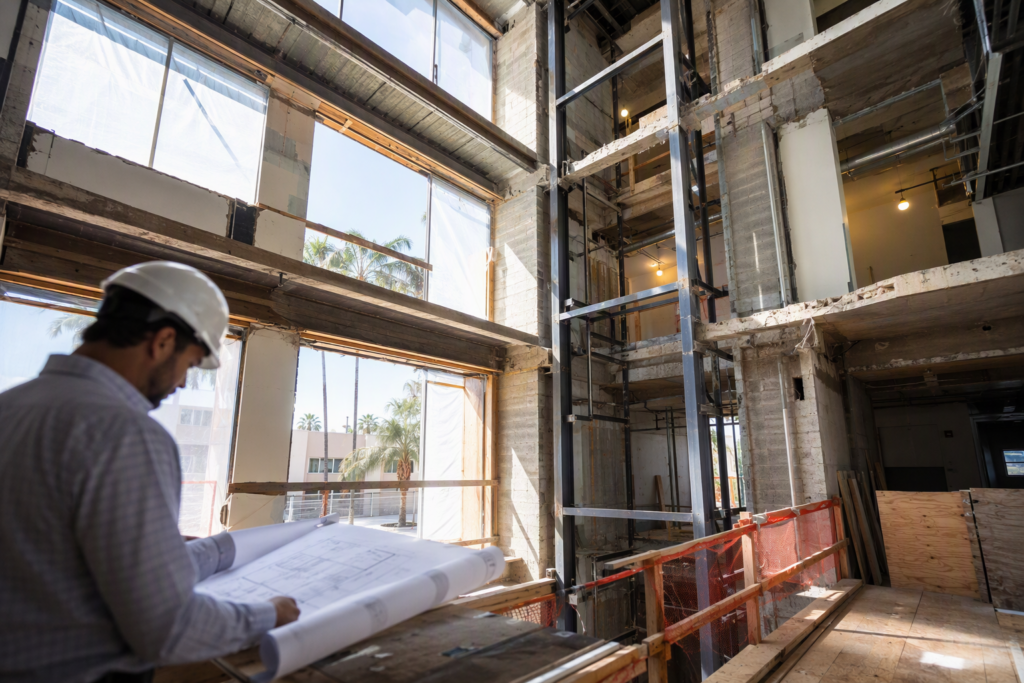
Contracts should also address what occurs if the owner undertakes a full modernization during the service term. Modernization typically involves new equipment and components that may require revised service terms. A well-drafted contract allows for renegotiation of scope and pricing following a modernization rather than binding the owner to terms designed for the old equipment configuration.
What documentation should a building owner receive at contract signing and throughout the service term?
At signing, owners should receive a complete executed copy of the contract, current insurance certificates, and the vendor’s license documentation; during the service term, they should receive maintenance logs after each visit, inspection certificates after each official inspection, and written reports for any repair work performed.
Ongoing documentation serves multiple purposes: it provides evidence of compliance in the event of a regulatory audit or litigation, it establishes a maintenance history that supports future contract negotiations, and it allows the building owner to monitor whether the vendor is meeting contractual obligations. A vendor that resists providing timely documentation is a significant red flag.
Digital record-keeping is increasingly standard in the industry. Building owners should inquire whether the vendor offers an online portal or digital reporting system that provides real-time access to maintenance records, upcoming test due dates, and inspection certificate status.
How do multi-elevator buildings differ from single-elevator properties in contract negotiation?
Buildings with multiple elevators have greater negotiating leverage and should use that leverage to secure volume pricing, bundled inspection scheduling, and dedicated service prioritization within the contract.
A portfolio of elevators is a more valuable contract to a service vendor than a single unit, and that value should translate into tangible concessions. Negotiators representing multi-elevator buildings should explicitly request tiered pricing for additional units, a single point-of-contact for all service coordination, and guaranteed inspection scheduling that minimizes simultaneous downtime across the elevator bank.
Mixed fleets — buildings with both traction and hydraulic elevators, or elevators from different manufacturers — require vendors with demonstrated competency across equipment types. The contract should confirm that the vendor has qualified technicians for each equipment category and that coverage terms are equivalent across all units, not more favorable for the vendor’s preferred equipment brands.
What performance benchmarks should be included in an elevator service contract?
Measurable performance benchmarks — such as minimum inspection pass rates, maximum allowable callback frequency, and maximum cumulative downtime per unit per year — give building owners enforceable standards against which to evaluate vendor performance and trigger contract remedies.
Without performance benchmarks, a vendor can provide consistently marginal service and remain technically within the contract’s terms. Quantifiable standards convert service expectations into enforceable obligations. Benchmarks should be realistic but meaningful: an elevator that fails its state inspection due to vendor-attributable maintenance gaps, for example, should trigger a defined cure obligation and, upon repeat failure, grounds for termination.
Benchmark data should be tracked jointly, with the vendor providing monthly or quarterly service reports that allow the building owner to monitor trends before they become crises. Arizona Elevator Solutions supports transparent performance reporting as a standard component of its service relationships, ensuring property managers in Phoenix, Mesa, Scottsdale, and Tucson have the data needed to hold their service agreement accountable.
How should dispute resolution be structured in an elevator service contract?
Dispute resolution provisions should specify a mandatory negotiation period before formal proceedings, identify the governing jurisdiction (Arizona), and designate a preferred resolution mechanism — mediation, arbitration, or litigation — that balances speed and enforceability.
Arbitration clauses are common in commercial service contracts and can provide faster resolution than court litigation, but they also limit appeal rights and may favor repeat-player vendors who are more familiar with the arbitration process. Building owners should evaluate whether mandatory arbitration is acceptable or whether they prefer to retain litigation rights. At minimum, any arbitration clause should specify a neutral arbitration administrator, the governing rules, the location of proceedings (preferably within Arizona), and the allocation of arbitration costs between the parties.
A mandatory pre-dispute negotiation period — requiring both parties to meet and attempt good-faith resolution before invoking formal proceedings — is a low-cost provision that resolves many disputes without the expense of arbitration or litigation.
What are the most common mistakes building owners make when signing elevator service contracts?
The most frequent and costly mistakes include accepting broad exclusion clauses without review, overlooking automatic renewal provisions, failing to verify vendor licensing, and signing without understanding who bears responsibility for code-mandated upgrades.
Additional common errors include accepting vague response time language, not requiring performance benchmarks, neglecting to negotiate escalation caps, and failing to obtain legal review of indemnification provisions. Building owners who treat elevator service contracts as routine administrative documents rather than significant legal and financial commitments routinely pay the price in unexpected repair bills, compliance failures, and vendor disputes.
The negotiation process outlined in this guide, combined with guidance from a reputable local service provider and qualified legal counsel, substantially reduces these risks. For property owners and managers across the Phoenix metro area, Tucson, Scottsdale, and Mesa, a thorough pre-signing review is the most cost-effective investment available in the elevator service procurement process.
Need elevator service you can rely on? Arizona Elevator Solutions is ready to help.