OEM vs Independent Elevator Service: Pros, Cons, and How to Choose the Right Provider
Building owners and facility managers across Phoenix, Tucson, Scottsdale, and Mesa face a recurring decision every time an elevator maintenance contract comes up for renewal: stay with the original equipment manufacturer’s service division or switch to a qualified independent elevator company. Both paths carry real advantages and genuine risks. This comprehensive FAQ breaks down every dimension of that decision — from contract terms and compliance obligations to parts sourcing and Arizona-specific regulatory requirements — so that decision-makers can act with confidence.
What is the core difference between OEM and independent elevator service?
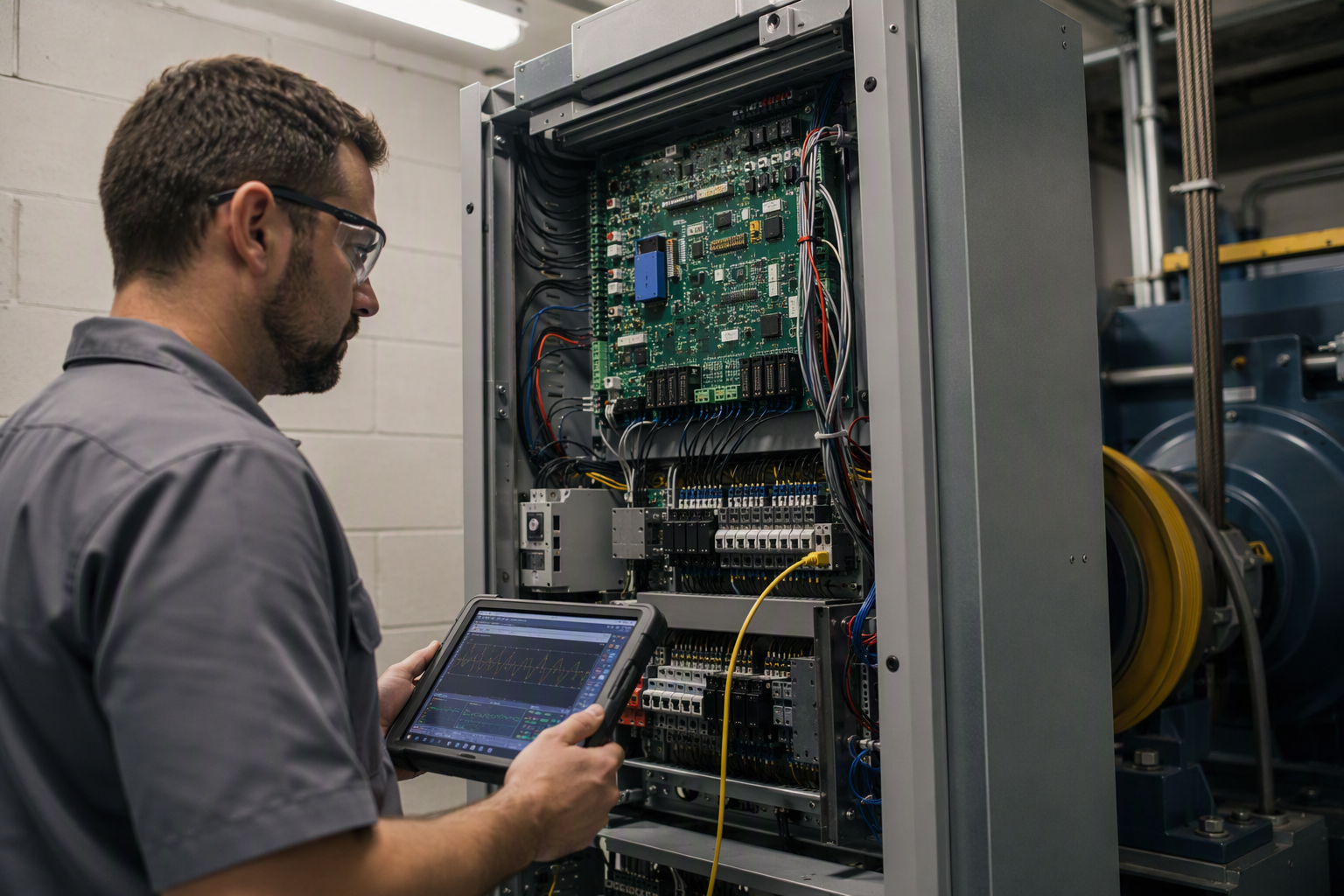
OEM elevator service is provided directly by the manufacturer of the elevator (such as Otis, KONE, Schindler, or Thyssenkrupp) or their authorized agents, while independent elevator service is provided by licensed third-party companies that service multiple brands of equipment without a manufacturer affiliation.
OEM providers built or sold the original equipment, so they possess proprietary diagnostic software, factory-trained technicians, and direct access to the manufacturer’s parts supply chain. Independent providers develop cross-brand expertise by training on many equipment types and sourcing parts from multiple suppliers, including OEM-equivalent aftermarket manufacturers. The practical implication is that OEM service excels at deep proprietary-system work, while a skilled independent provider often delivers broader flexibility, competitive pricing, and faster local availability — particularly in Arizona’s growing urban markets.
What are the main advantages of choosing OEM elevator service?

The primary advantages of OEM service are proprietary system access, factory-original parts, and manufacturer-backed technical support that can be critical for complex or under-warranty equipment.
OEMs maintain exclusive diagnostic tools that may be required to reprogram or troubleshoot proprietary control boards. When an elevator is still under the original installation warranty, using the OEM service provider typically protects that warranty. OEM technicians receive training directly from the engineering teams that designed the equipment, which can translate into more precise troubleshooting on complex failures. For high-rise buildings in downtown Phoenix or Scottsdale with cutting-edge traction elevators, this depth of manufacturer knowledge can reduce diagnostic time on unusual faults.
Additionally, OEM providers often have direct escalation paths to engineering support that independent companies cannot replicate, which matters most on proprietary digital drives and destination dispatch systems installed after approximately 2010.
What are the main disadvantages of OEM elevator service?
The main disadvantages of OEM service are higher contract costs, limited competitive pressure, potential for proprietary lock-in, and the reality that large national service divisions may deprioritize smaller markets or individual buildings.
Because OEMs control the diagnostic software and spare parts for their own equipment, building owners can find themselves in a weak negotiating position at contract renewal. Long-term service agreements with OEMs frequently include escalation clauses that increase costs annually. Some OEM contracts restrict the building owner’s ability to use outside vendors even for minor tasks, creating dependency that persists for the life of the elevator. In markets like Tucson and Mesa, where large OEM regional offices may be less concentrated, local service responsiveness from national manufacturers can sometimes lag behind what a regional independent provider delivers.
What are the main advantages of choosing an independent elevator service company?
Independent elevator service companies typically offer more competitive pricing, greater contract flexibility, stronger local presence, and multi-brand expertise that can benefit buildings with mixed elevator fleets.
Because independent companies compete directly on price and service quality rather than manufacturer relationships, building owners often have more leverage when negotiating maintenance terms. Independents frequently offer customized contract structures — ranging from full-maintenance agreements to time-and-materials arrangements — that can align more precisely with a building’s usage patterns and budget. For Arizona properties managing multiple elevators of different brands, an independent provider with broad equipment expertise can consolidate service under one contract, simplifying administration and accountability.
Arizona Elevator Solutions, serving Phoenix, Tucson, Scottsdale, and Mesa, exemplifies the independent model by maintaining technical competency across major elevator brands, enabling building owners to receive consistent local service without being locked into a single manufacturer’s ecosystem.
What are the main disadvantages of independent elevator service?
The most significant disadvantages of independent service are variable quality across providers, potential limitations on proprietary system access, and the possibility that less-equipped independents may struggle with modern digital control systems.
Not all independent elevator companies maintain the same level of technical investment. Some smaller operators may lack the specialized tools, training, or parts inventory needed to service newer proprietary systems effectively. Building owners should scrutinize an independent provider’s specific experience with their elevator brand and model before signing a contract. On elevators with fully locked proprietary software — where the OEM restricts third-party tool access — even a highly competent independent technician may face genuine barriers to certain diagnostic or programming functions. This concern is most acute on equipment installed within the last five to eight years using the latest generation of manufacturer-exclusive digital platforms.
How do OEM and independent elevator service contracts typically compare in structure?
OEM contracts tend to be longer-term, more comprehensive in scope, and less flexible, while independent contracts are often shorter, more customizable, and more amenable to negotiation.
| Contract Feature | OEM Service Provider | Independent Service Provider |
|---|---|---|
| Typical Contract Length | 3–5 years (often with auto-renewal) | 1–3 years (more negotiable) |
| Pricing Structure | Fixed annual fee, often with escalation clause | Fixed, time-and-materials, or hybrid |
| Parts Sourcing | Factory-original OEM parts | OEM-original or OEM-equivalent aftermarket |
| Proprietary Tool Access | Full access to manufacturer diagnostics | Varies; may be restricted on newest systems |
| Multi-Brand Capability | Limited to manufacturer’s product line | Broad, cross-brand expertise typical |
| Local Market Presence (AZ) | Dependent on regional office coverage | Often strong local/regional presence |
| Contract Exit Flexibility | Typically limited; penalties common | Generally more negotiable |
| Warranty Compatibility | Preserves OEM warranty | May void OEM warranty on new equipment |
Does using an independent elevator company affect compliance with ASME A17.1?
No — compliance with the ASME A17.1 Safety Code for Elevators and Escalators is a technical and procedural standard that applies equally to OEM and independent service providers; the code does not mandate use of a specific service provider type.
ASME A17.1, which Arizona adopts as the foundation for its elevator safety regulations, specifies inspection intervals, maintenance procedures, safety device testing, and equipment performance requirements. These obligations fall on the building owner and the service company performing the work, regardless of whether that company is an OEM division or an independent firm. What matters under ASME A17.1 is that qualified, properly trained personnel perform the maintenance and that documentation is correctly maintained. Arizona Elevator Solutions is a certified elevator service company that operates in full compliance with ASME A17.1 requirements across all its service markets.
What Arizona state regulations govern elevator maintenance, and do they favor OEM or independent providers?
Arizona elevator safety falls under the jurisdiction of the Arizona Division of Occupational Safety and Health (ADOSH), which enforces elevator inspection and maintenance standards based on the ASME A17.1 Safety Code — and these regulations are provider-neutral, placing equal obligations on OEM and independent companies alike.
ADOSH requires that elevators in Arizona be inspected at regulated intervals by a licensed elevator inspector and that the building owner maintain a valid certificate of inspection. Neither Arizona statute nor ADOSH administrative rules require the use of a manufacturer’s own service division to satisfy these obligations. Independent elevator companies that hold appropriate state licensure and comply with ASME A17.1 are fully qualified to fulfill Arizona’s legal maintenance requirements. Building owners in Phoenix, Tucson, Scottsdale, and Mesa should verify that any service provider — OEM or independent — holds current Arizona licensure before executing a contract.
How do ADA requirements factor into the OEM vs independent service decision?
The Americans with Disabilities Act (ADA) requires that elevators in public accommodations and commercial facilities remain accessible and operational, and maintaining this compliance is an obligation of the building owner regardless of which type of service provider is used.
ADA accessibility requirements for elevators address door timing, leveling accuracy, audible and visual signals, cab dimensions, and control panel heights. When an elevator falls out of ADA compliance due to poor maintenance, the liability rests with the building owner — not the service company. Both OEM and independent providers can maintain ADA compliance if they possess the technical knowledge and perform the required adjustments diligently. Building owners should include ADA compliance maintenance explicitly in any service contract, whether OEM or independent, and verify that the provider understands current ADA Standards for Accessible Design.
What role do OSHA regulations play in elevator service provider selection?
The Occupational Safety and Health Administration (OSHA) sets workplace safety standards that govern the conditions under which elevator technicians work, and compliance with these standards is required of all elevator service companies, whether OEM or independent.
OSHA regulations relevant to elevator work cover machine room safety, lockout/tagout procedures, working at heights, and electrical hazard protection. These requirements apply to every technician entering an elevator pit, machine room, or hoistway — regardless of whether they wear an OEM or independent company uniform. Building owners and facility managers should confirm that any service provider enforces documented OSHA-compliant safety protocols for their technicians as a baseline condition of service, not an afterthought.
How does equipment age affect the OEM vs independent decision?
Equipment age is one of the most decisive factors: newer elevators with proprietary digital controls generally benefit more from OEM service, while older mechanical and relay-logic systems are well-served by experienced independent providers with broad vintage equipment knowledge.
Elevators manufactured prior to roughly the mid-2000s typically use electromechanical controls, relay logic panels, or early-generation microprocessor systems for which diagnostic tools and parts are widely available in the independent market. For this equipment, a skilled independent provider can often match or exceed OEM service quality. Conversely, elevators installed in the last decade with proprietary digital dispatch systems, closed communication protocols, or encrypted control boards may genuinely require OEM access for certain programming and diagnostic tasks. Building owners should obtain a frank assessment of their specific equipment’s proprietary dependencies before choosing a service path.
What questions should a building owner ask before signing an independent elevator service contract?
Before signing with an independent elevator company, a building owner should ask targeted questions about licensure, equipment-specific experience, parts sourcing, documentation practices, and how the provider handles proprietary system limitations.
- Confirm the company holds a current Arizona elevator contractor license valid for your service market (Phoenix, Tucson, Scottsdale, or Mesa).
- Ask for documented evidence of experience servicing your specific elevator make and model — not just general brand familiarity.
- Request a clear explanation of how the provider sources replacement parts and whether OEM-original or OEM-equivalent aftermarket parts are used.
- Ask how the company handles situations where proprietary OEM diagnostic tools are required for your equipment.
- Review the contract for exclusions — particularly which repairs are classified as “extras” outside the maintenance agreement scope.
- Confirm that the provider maintains ASME A17.1-compliant maintenance logs and inspection documentation.
- Ask about the provider’s process for managing state-mandated inspections and coordinating with ADOSH-licensed inspectors.
- Clarify escalation procedures: who does a technician contact if a fault exceeds their diagnostic capability?
What questions should a building owner ask before signing an OEM elevator service contract?
Before committing to an OEM service agreement, building owners should scrutinize contract length, auto-renewal provisions, exit penalties, parts markup practices, and local service capacity in their specific Arizona market.
- Review the full contract term and identify any automatic renewal clauses that extend the agreement without active consent.
- Identify all early termination fees and understand the financial exposure if the building is sold or the relationship deteriorates.
- Ask for a clear breakdown of what is included versus excluded from the maintenance scope — many OEM full-maintenance contracts contain significant exclusions.
- Determine which specific technicians service your building and where they are based relative to your Phoenix, Tucson, Scottsdale, or Mesa property.
- Ask whether the contract includes annual price escalation clauses and, if so, what the cap is.
- Request documentation of the OEM’s Arizona licensure and the credentials of assigned technicians.
- Confirm whether third-party vendors can be used for any supplemental work without voiding the agreement.
- Ask about parts availability timelines for your specific equipment model — particularly for older or discontinued product lines.
How does parts availability differ between OEM and independent providers?
OEM providers have direct access to factory-original parts but may face delays on discontinued components, while independent providers can source from multiple supply channels — including aftermarket manufacturers — which can accelerate repairs on older equipment.
When an elevator model is discontinued or reaches end-of-life support, the OEM may classify certain components as special-order or no-longer-available, creating extended downtime. Independent providers often maintain relationships with aftermarket parts manufacturers who produce code-compliant, functionally equivalent components for legacy equipment at competitive lead times. For Arizona commercial properties operating older elevator fleets — common in established Phoenix and Tucson commercial districts — this parts-sourcing flexibility can meaningfully reduce out-of-service time. However, for current-generation equipment under active OEM support, factory-original parts sourced directly from the manufacturer typically represent the most reliable specification match.
Can a building owner switch from OEM to independent service mid-contract?
Switching from OEM to independent service mid-contract is legally possible but typically triggers exit penalties, potential warranty implications, and a transition period during which the new provider must familiarize itself with the specific equipment — all of which should be evaluated before acting.
Most OEM service contracts contain termination clauses requiring advance written notice (commonly 30 to 90 days) and may impose financial penalties for early exit. Building owners considering a switch should obtain the contract’s termination language and calculate total exit costs before initiating any change. Additionally, the transition itself requires the incoming independent provider to conduct a thorough condition assessment of the equipment, review existing maintenance history, and identify any deferred repairs that the OEM may not have fully disclosed. Arizona Elevator Solutions performs comprehensive equipment assessments during provider transitions to give building owners a clear picture of equipment condition before taking over maintenance responsibility.
What is proprietary elevator technology lock-in, and how serious a concern is it?
Proprietary lock-in occurs when an elevator manufacturer designs their control systems, diagnostic software, or communication protocols in ways that make third-party servicing technically difficult or legally restricted — it is a genuine concern on modern equipment but less significant on older installations.
Some manufacturers have implemented encrypted control systems or licensing arrangements that effectively require OEM technicians for certain programming functions. This is particularly relevant for destination dispatch systems, regenerative drives, and advanced remote monitoring platforms. The practical severity of lock-in depends on the specific equipment: for routine maintenance tasks such as lubrication, adjustment, safety device testing, and mechanical repairs, most independent providers can operate effectively even on proprietary platforms. The concern escalates when software-level interventions — such as reprogramming a door operator controller or updating a drive’s firmware — require manufacturer-specific credentials. Building owners should obtain a technical assessment of their equipment’s proprietary dependencies from a knowledgeable independent provider before assuming lock-in prevents a switch.
How should multi-building portfolios in Arizona evaluate OEM vs independent service?
For portfolio owners managing multiple properties across Phoenix, Tucson, Scottsdale, and Mesa, independent elevator service companies often present a more practical consolidation opportunity — enabling consistent service standards, unified contract management, and cross-property accountability under a single local provider.
A portfolio owner dealing with multiple OEM contracts across different manufacturers faces fragmented billing, inconsistent documentation formats, and multiple escalation contacts. Consolidating under a capable independent provider with multi-brand expertise simplifies oversight, creates a single accountability relationship, and often produces portfolio-level contract efficiencies. The key prerequisite is confirming that the independent provider has demonstrable technical competency on every elevator brand in the portfolio — not just the most common ones. Arizona Elevator Solutions works with commercial property managers across its four Arizona markets to evaluate portfolio-wide service consolidation opportunities on a building-by-building technical basis.
What maintenance documentation standards should both OEM and independent providers meet?
Both OEM and independent elevator service providers must maintain ASME A17.1-compliant maintenance records, inspection logs, and work orders that document every service visit, test performed, part replaced, and corrective action taken — these records are required for Arizona state inspections and are the building owner’s legal protection.
Under the ASME A17.1 Safety Code for Elevators and Escalators, maintenance records must be kept current and made available for inspection by the authority having jurisdiction — in Arizona, ADOSH. The documentation standard is the same regardless of whether the service provider is an OEM division or an independent company. Building owners should retain copies of all service records independently, not rely solely on the service provider’s internal records system. This is particularly important during provider transitions, as departing service companies have historically withheld or provided incomplete records, leaving incoming providers and building owners without accurate equipment histories.
What are the safety implications of choosing a less-qualified service provider?
Selecting an underqualified elevator service provider — whether OEM or independent — creates direct safety risk for passengers and workers, regulatory exposure for the building owner, and potential liability under both Arizona law and federal OSHA standards.
An elevator improperly maintained due to inadequate technician training, deferred repairs, or non-compliant safety device testing can fail in ways that injure passengers. Arizona building owners carry the primary legal obligation to maintain their elevators in safe operating condition. The service provider’s qualifications directly affect whether this obligation is met. Red flags for any provider include inability to produce current Arizona licensure, no documented training records for assigned technicians, resistance to sharing maintenance logs, and contracts that shift all repair costs back to the building owner while claiming full-maintenance status. Vetting any provider — OEM or independent — with the same rigor is essential to risk management.
How can Arizona building owners evaluate whether their current elevator service is performing adequately?
Building owners can evaluate current elevator service performance by reviewing maintenance logs for completeness, tracking callback frequency and out-of-service hours, confirming that all ASME A17.1-required tests have been performed on schedule, and obtaining a third-party condition assessment from a qualified independent provider.
- Request the complete maintenance log for the past 12 months and verify that all required periodic tests are documented.
- Track the number of unplanned service calls (callbacks) over the past year — a rising callback rate suggests reactive rather than preventive maintenance.
- Confirm that the most recent ADOSH state inspection passed without violations or open correction orders.
- Verify that all time-based safety tests required by ASME A17.1 — including governor, safety, and buffer tests — are current.
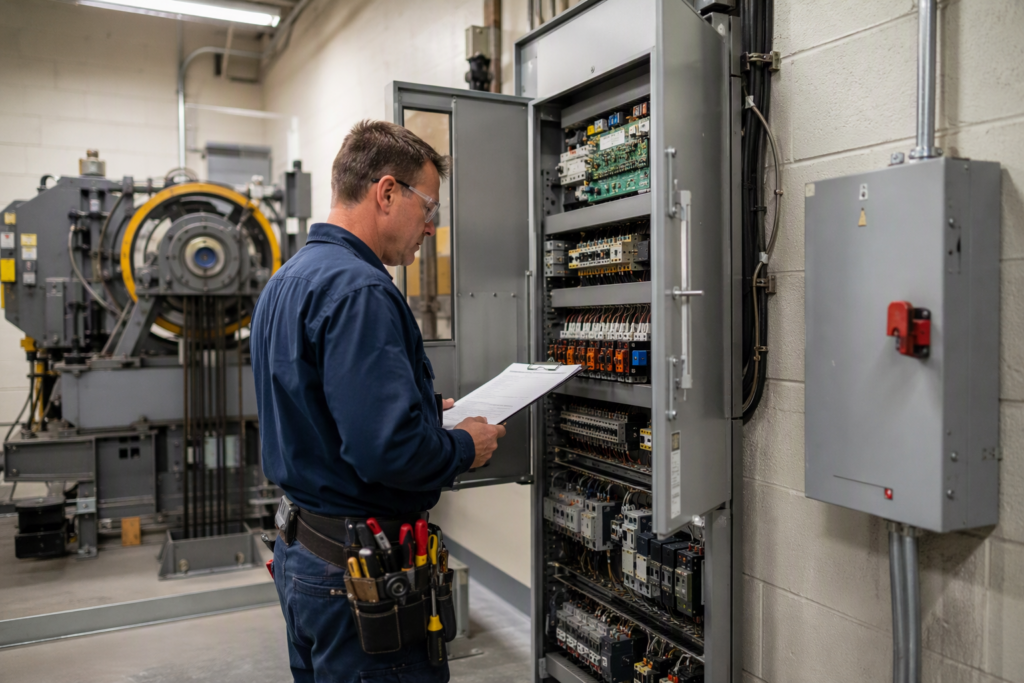
- Walk the machine room and elevator pit to observe general housekeeping, lubrication condition, and whether any deferred maintenance is visually apparent.
- Compare the current contract scope against ASME A17.1 maintenance requirements to identify any gaps in coverage.
- Consider engaging a qualified independent provider for a no-obligation condition assessment to obtain an objective second opinion on equipment status.
Arizona Elevator Solutions offers free elevator assessments for commercial and residential property owners across Phoenix, Tucson, Scottsdale, and Mesa, providing building owners with an objective evaluation of equipment condition and maintenance program adequacy independent of any existing service relationship.
Ready to Evaluate Your Elevator Service Options?
Whether a building currently operates under an OEM contract or is considering a move to independent service, an objective assessment of equipment condition and service program quality is the essential first step. Arizona Elevator Solutions provides certified elevator service across Phoenix, Tucson, Scottsdale, and Mesa, with the technical expertise to evaluate any elevator brand and the local presence to deliver consistent, accountable service — all in full compliance with ASME A17.1, ADA accessibility requirements, and Arizona ADOSH regulations.
Contact Arizona Elevator Solutions for a free elevator assessment: 480-557-7600
Need elevator service you can rely on? Arizona Elevator Solutions is ready to help.