ADA Elevator Requirements for Healthcare Buildings
Hospitals, outpatient clinics, rehabilitation centers, and long-term care facilities in Phoenix, Tucson, Scottsdale, and Mesa face a uniquely demanding compliance landscape. When an elevator fails to meet ADA requirements, a healthcare organization risks federal enforcement action, costly retrofits, and — most critically — compromised patient care. The sections below cover every dimension of ADA elevator compliance as it applies to healthcare environments.
—
What Are the Core ADA Elevator Requirements for Healthcare Facilities?
The Americans with Disabilities Act establishes accessibility requirements that apply to nearly all healthcare buildings open to the public. The following requirements are drawn directly from ADA Standards for Accessible Design and are non-negotiable for multi-story healthcare facilities:
- Elevator access on all floors: Any multi-story healthcare building must provide at least one accessible elevator connecting all publicly used floors unless a specific exemption applies.
- Cab dimensions: The elevator car must provide enough floor space to allow a wheelchair user to enter, turn, and exit. The ADA Standards specify minimum clear floor dimensions inside the cab.
- Door width and timing: Doors must provide a minimum clear width and must remain open long enough for a person using a mobility device to enter or exit without being struck.
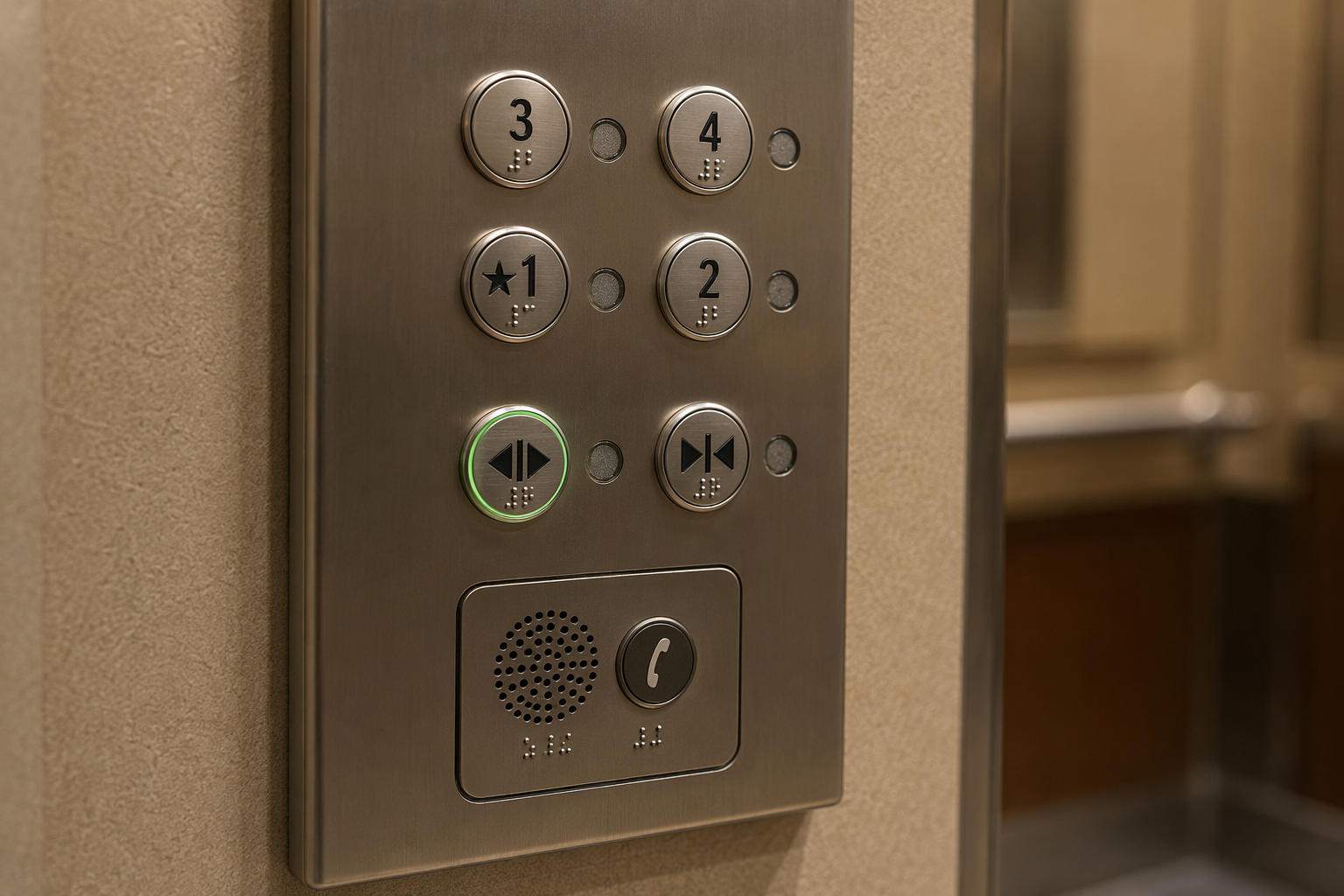
- Controls and call buttons: Call buttons must be mounted at an accessible height, and car controls must be within reach ranges defined in the ADA Standards. Buttons must be raised or flush, not recessed.
- Audible and visual signals: Hall lanterns must provide both audible and visible signals indicating the direction of elevator travel. A chime must sound as the car arrives.
- Braille and raised characters: Floor designations must appear in both raised characters and Grade 2 Braille on both jambs of the hoistway entrance.
- Two-way emergency communication: Cabs must contain a two-way communication system allowing passengers to contact building personnel or emergency services.
- Illumination: Cab interiors must be illuminated to a level that supports safe use by individuals with low vision.
These requirements interact with ASME A17.1 Safety Code for Elevators and Escalators, which sets the mechanical, electrical, and structural standards that underpin safe, compliant elevator operation. Healthcare facilities in Arizona must satisfy both federal ADA requirements and ASME A17.1, as well as applicable state and local codes enforced through Arizona’s elevator inspection program.
—
Which Healthcare Buildings in Arizona Must Have Accessible Elevators?
The ADA applies to places of public accommodation and commercial facilities, categories that encompass virtually every outpatient clinic, hospital, surgical center, dialysis facility, and medical office building in Phoenix, Tucson, Scottsdale, and Mesa. Multi-story buildings that serve patients, residents, or the general public are required to provide vertical accessibility.
Long-term care and skilled nursing facilities fall under additional federal oversight through the Centers for Medicare & Medicaid Services (CMS) conditions of participation, which reference physical accessibility as part of a resident’s right to a safe environment. This layered regulatory environment means that elevator non-compliance in a nursing home or assisted living community can trigger both ADA enforcement and CMS deficiency citations simultaneously.
New construction and significant alterations trigger the most rigorous requirements. When a healthcare organization renovates a floor or installs a new elevator, the entire accessible path of travel — including the elevator — must be brought into full current compliance with ADA Standards. Arizona Elevator Solutions assists healthcare clients in understanding which renovation triggers apply so that facility managers can plan proactively rather than react to citations.
—
How Does ASME A17.1 Apply to Hospital and Clinical Elevators?
The ASME A17.1 Safety Code for Elevators and Escalators governs the design, construction, installation, inspection, testing, and maintenance of elevators across the United States. In healthcare settings, ASME A17.1 compliance is especially critical because elevator failure can directly impact patient transport, emergency evacuation, and the movement of critical equipment such as hospital beds, surgical carts, and supply systems.
Key ASME A17.1 provisions relevant to healthcare include:
- Firefighters’ Emergency Operation (FEO): Required in buildings four or more stories tall, FEO enables trained personnel to control elevator movement during fire emergencies — a life-safety feature in any multi-story hospital.
- Seismic requirements: Arizona’s seismic risk varies by region, and ASME A17.1 includes provisions for seismic protection that must be incorporated in new installations and certain modernizations.
- Periodic inspection and testing intervals: ASME A17.1 establishes mandatory inspection and testing schedules. Arizona enforces these intervals through the state’s elevator safety program, and hospitals must maintain current inspection certificates to remain compliant.
- Door reopening devices: Hoistway doors must be equipped with approved reopening devices that respond to both light-beam and physical contact, reducing the risk of door-related injury for patients using wheelchairs, walkers, or IV poles.
—
What Are the Specific Cab Size Requirements for Accessible Healthcare Elevators?
ADA Standards for Accessible Design specify minimum cab configurations. The most commonly referenced configuration for a standard accessible elevator requires a clear floor area sufficient for a wheelchair user to maneuver. In healthcare environments, where hospital beds, stretchers, and large medical equipment must also be transported, facilities routinely install larger “hospital-grade” or “bariatric” elevator cabs that exceed the ADA minimums.
Facility planners should consult both the ADA Standards and ASME A17.1 for dimensional requirements, and work with a qualified elevator contractor to confirm that cab dimensions accommodate the specific patient transport equipment used in their facility. Arizona Elevator Solutions evaluates existing cab configurations against both ADA and ASME A17.1 requirements as part of its assessment process for healthcare clients in the Phoenix metro and Tucson regions.
—
What Is the Process for Bringing a Non-Compliant Healthcare Elevator Into Compliance?
Achieving compliance is a structured process. The following steps represent a standard remediation pathway for a healthcare facility in Arizona:
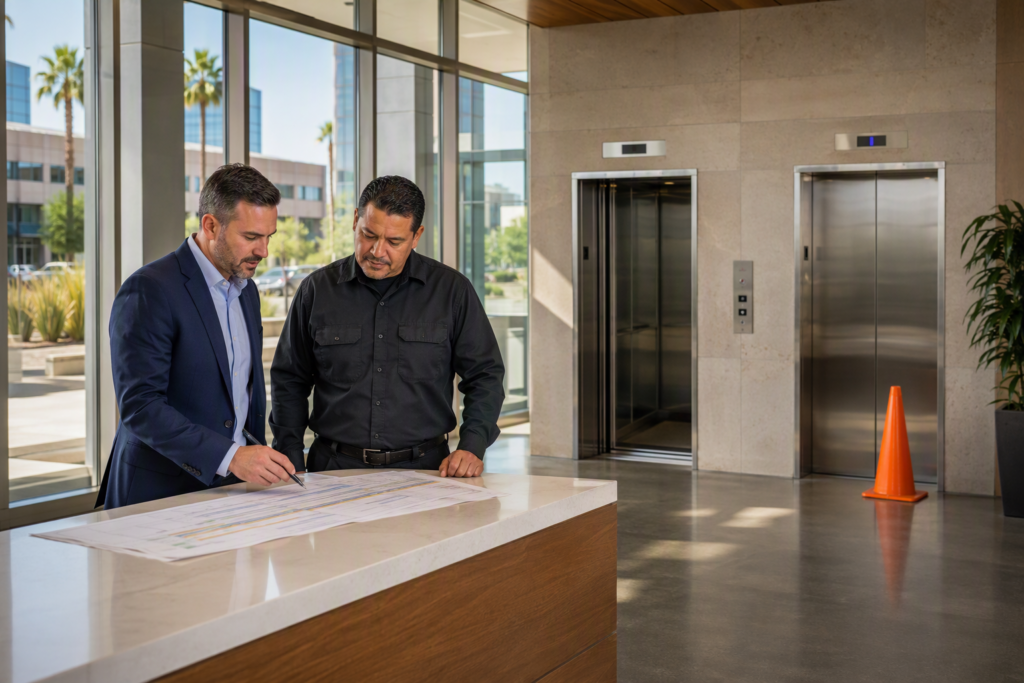
- Schedule a compliance assessment. A qualified elevator contractor reviews the existing installation against current ADA Standards and ASME A17.1 requirements, identifying every area of non-conformance.
- Obtain a written deficiency report. The assessment produces a documented list of deficiencies, prioritized by safety risk and regulatory urgency.
- Develop a remediation scope of work. The contractor and facility team determine which deficiencies require immediate correction, which can be addressed through a modernization project, and whether any exemptions or equivalencies apply.
- File for required permits. In Arizona, elevator alterations require permits from the state’s elevator safety program and, in some jurisdictions, local building departments.
- Complete the remediation work. Certified elevator technicians perform the approved scope of work, which may include cab modifications, control panel replacement, signage upgrades, door operator replacement, and communication system installation.
- Schedule the state inspection. After work is complete, the elevator undergoes a state inspection. The inspector verifies that all corrections meet current code requirements.
- Obtain a new certificate of inspection. Upon passing inspection, the facility receives an updated certificate, which must be posted in the elevator cab as required by Arizona law.
- Establish an ongoing maintenance program. Compliance is not a one-time event. A preventive maintenance agreement ensures the elevator remains in compliant, safe operating condition between inspections.
—
What Do ADA Elevator Controls Look Like in a Healthcare Setting?
Control panels inside accessible healthcare elevators must meet precise requirements: buttons must be raised or flush (never recessed), must be labeled with raised characters and Braille, and must be mounted within ADA-defined reach ranges from the finished floor. In healthcare environments, panels often feature larger buttons to accommodate users wearing gloves, and some facilities add voice-guidance systems for patients with visual impairments.
Emergency controls — including the emergency stop switch, alarm button, and two-way communication device — must also be accessible and clearly labeled. The two-way communication system is particularly important in healthcare settings, where a patient experiencing a medical event inside an elevator cab needs to be able to summon help immediately.
—
How Do ADA Requirements Interact With Fire and Life Safety Codes in Hospitals?
Healthcare facilities must reconcile ADA accessibility requirements with fire and life safety codes, including those referenced by The Joint Commission and CMS. Elevators in hospitals are frequently designated for use in phased evacuation plans, and OSHA requirements for worker safety in healthcare environments add another layer of oversight.
Firefighters’ Emergency Operation, required under ASME A17.1 for qualifying buildings, must be maintained and tested on schedule. Phase I recall (automatic return to the designated landing upon alarm) and Phase II firefighters’ service (manual control by emergency personnel) must function correctly. An elevator that fails either phase during a fire emergency creates both a life-safety failure and a regulatory violation.
—
What Are the Consequences of ADA Elevator Non-Compliance for Healthcare Organizations?
The consequences of failing to meet ADA elevator requirements range from formal complaints and Department of Justice investigations to private lawsuits and consent decrees requiring facility-wide accessibility audits. For healthcare organizations that receive federal funding — including Medicare and Medicaid reimbursement — non-compliance with accessibility requirements can also trigger scrutiny under Section 504 of the Rehabilitation Act.
Beyond legal exposure, an inaccessible elevator creates direct harm to patients who rely on mobility devices and to healthcare workers with disabilities. Facilities in Phoenix, Scottsdale, Mesa, and Tucson that proactively address elevator compliance protect both their patients and their organizations.
—
How Often Must Healthcare Elevators Be Inspected in Arizona?
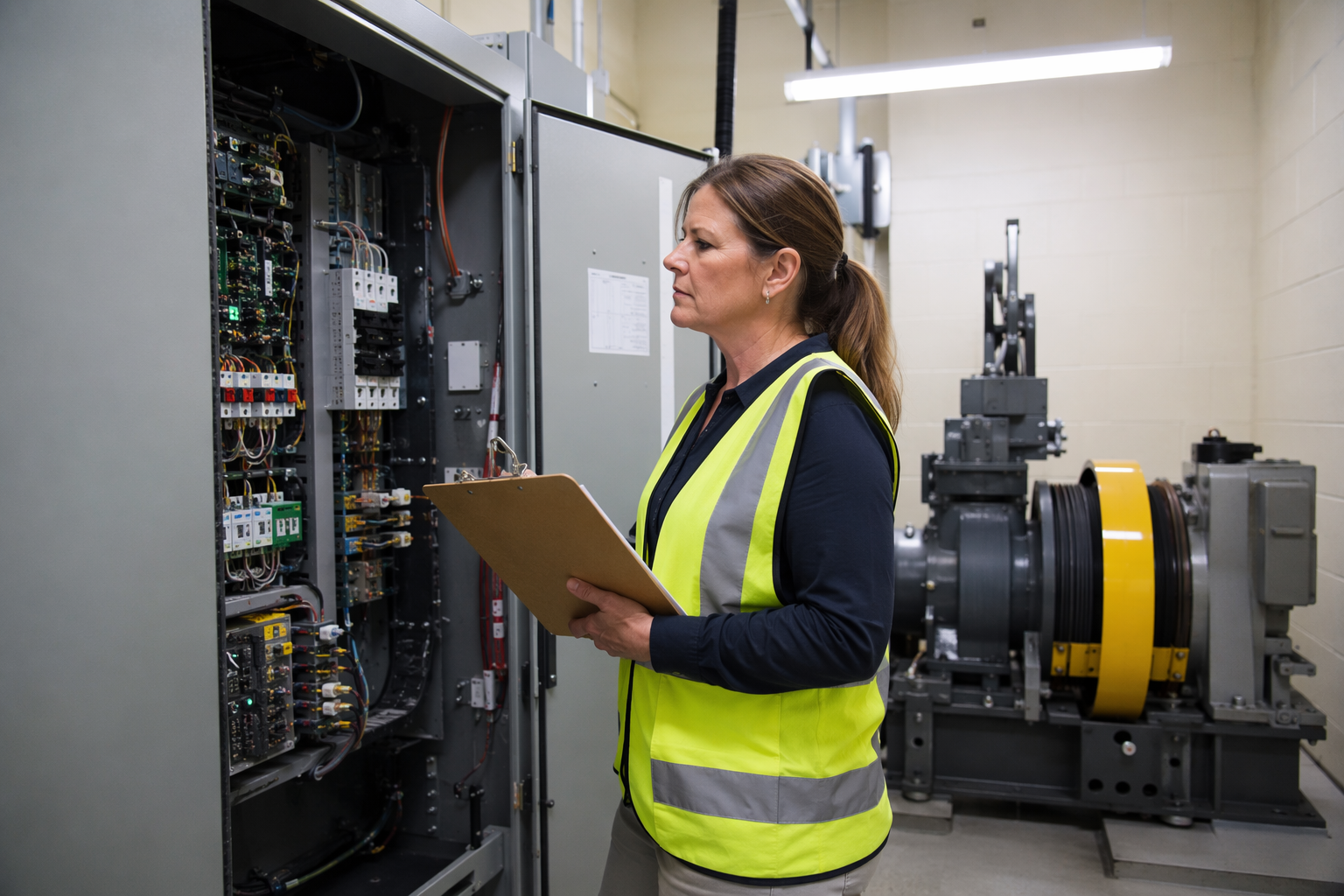
Arizona requires periodic inspections of elevators in accordance with ASME A17.1 Safety Code for Elevators and Escalators inspection and testing intervals. Healthcare facilities must maintain valid inspection certificates and ensure that required periodic tests — including full-load, safety, and governor tests — are completed on schedule. The current certificate of inspection must be posted inside the elevator cab at all times.
Arizona Elevator Solutions coordinates inspection scheduling for healthcare clients across the Phoenix, Tucson, Scottsdale, and Mesa markets, helping facility managers track due dates and avoid lapses that could result in elevator shutdown orders.
—
What Is the Difference Between ADA Compliance and ASME A17.1 Compliance?
ADA compliance governs accessibility — ensuring that people with disabilities can use the elevator independently and safely. ASME A17.1 governs mechanical and structural safety — ensuring that the elevator operates without risk of injury or failure for all users. A healthcare elevator must satisfy both: an elevator can be mechanically safe under ASME A17.1 but still violate the ADA if its controls are inaccessible, and conversely, a well-labeled elevator with accessible controls can still pose a safety hazard if its mechanical systems are not maintained to ASME A17.1 standards. True compliance requires attention to both frameworks simultaneously.
—
Questions Your Inspector Will Ask
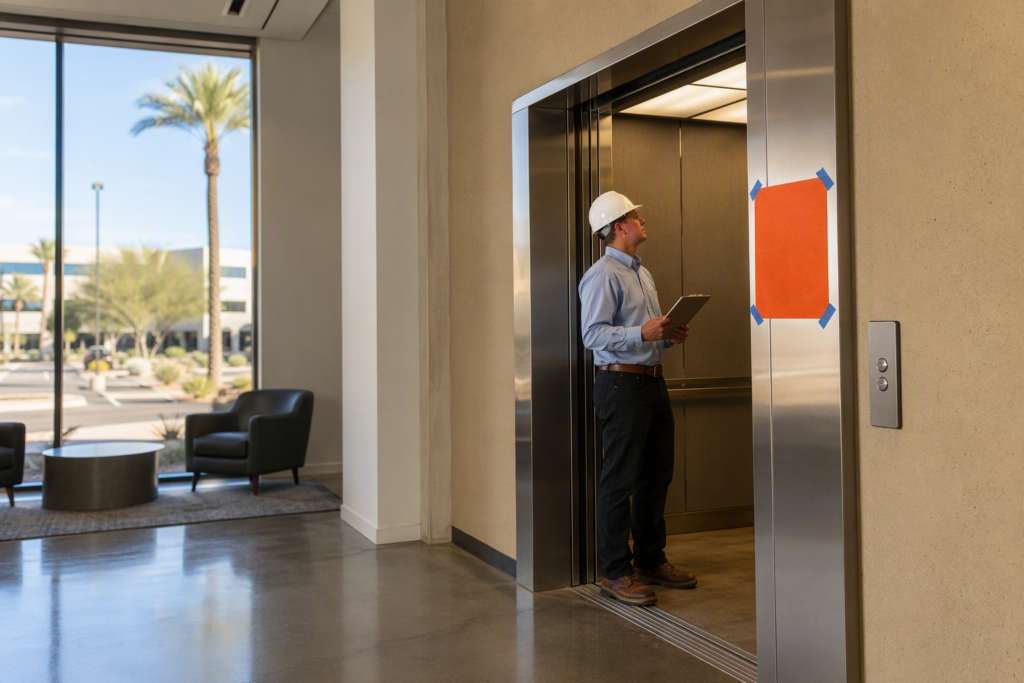
When an Arizona elevator inspector visits a healthcare facility, the following questions and verification points are standard areas of review. Facility managers should be prepared to answer each one and produce supporting documentation:
- Is a current, valid certificate of inspection posted inside each elevator cab?
- Have all required periodic tests — including safety tests and governor tests — been completed within the intervals specified by ASME A17.1 and Arizona regulations?
- Do all call buttons and cab controls meet ADA reach-range and tactile requirements?
- Are raised characters and Grade 2 Braille floor designations present on both jambs at every hoistway entrance?
- Do hall lanterns provide both audible and visible direction-of-travel signals?
- Is the two-way emergency communication system operational and tested?
- Does Firefighters’ Emergency Operation (Phase I and Phase II) function correctly?
- Are door reopening devices functional and responsive to both light-beam and contact triggers?
- Is the maintenance log current, and has the elevator been serviced under a documented maintenance program?
- Have any alterations or repairs been performed under proper permits, and is permit documentation available?
—
How Can Healthcare Facilities in Arizona Stay Ahead of Elevator Compliance Requirements?
Proactive compliance management is far less costly than reactive remediation. Healthcare facility managers in Phoenix, Tucson, Scottsdale, and Mesa can take several practical steps to stay current:
- Maintain a preventive maintenance agreement with a certified elevator service provider that includes documentation of all work performed.
- Track inspection and testing due dates on a facility calendar and confirm scheduling well in advance.
- Conduct internal accessibility walk-throughs whenever a renovation project is planned to identify whether the path of travel — including elevators — must be upgraded.
- Review ADA Standards and ASME A17.1 updates as new editions are published, particularly the 2026 code cycle, to identify requirements that affect existing installations.
- Engage a qualified elevator contractor for periodic compliance assessments even between mandatory state inspections.
Arizona Elevator Solutions works with healthcare organizations throughout Arizona to develop compliance calendars, conduct assessments, and implement maintenance programs that keep elevators inspection-ready year-round.
—
Get a Free Elevator Compliance Assessment for Your Healthcare Facility
Non-compliant elevators put patients at risk and expose healthcare organizations to regulatory action. Arizona Elevator Solutions provides thorough elevator assessments for hospitals, clinics, long-term care facilities, and medical office buildings across Phoenix, Tucson, Scottsdale, and Mesa — evaluating every aspect of ADA and ASME A17.1 compliance and providing a clear remediation plan.
Contact Arizona Elevator Solutions for a free elevator assessment: 480-319-7157
Need elevator service you can rely on? Arizona Elevator Solutions is ready to help.