
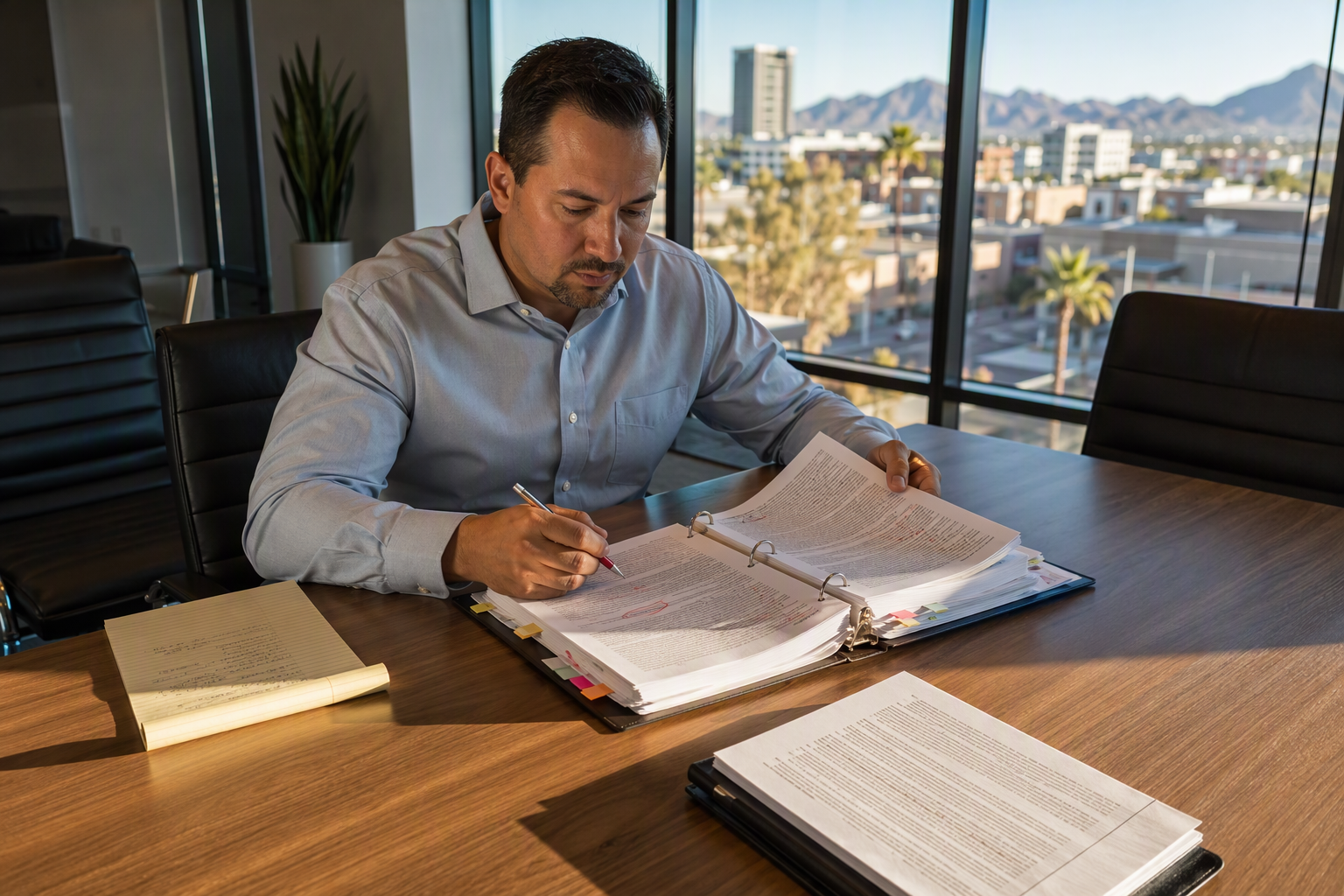
When an elevator maintenance contract renewal lands on your desk, the fine print matters as much as the monthly rate. Arizona building owners face specific obligations under A.R.S. §§ 23-491 through 23-491.16 (Safety Conditions for Elevators and Similar Conveyances) and the Industrial Commission of Arizona’s Elevator Division, meaning a poorly structured contract can leave owners exposed to compliance gaps, unexpected repair bills, and extended equipment downtime. This guide covers what to look for, what to demand, and where independent service providers like Arizona Elevator Solutions can offer a meaningful alternative to manufacturer-captive maintenance programs.
What Are the Most Important Terms to Review in an Elevator Maintenance Contract Renewal?
Every elevator maintenance agreement contains terms that appear routine but carry significant financial and legal weight. Before signing a renewal, Arizona building owners should evaluate each of the following areas carefully:
- Scope of Covered Services: Does the contract define exactly which components, systems, and repairs are included? Vague language like “routine maintenance” can leave major repairs uncovered.
- Parts and Labor Exclusions: Many contracts exclude proprietary parts, electronic controls, or modernization components. Understand what you will pay for out of pocket.
- Automatic Price Escalation Clauses: Some contracts include annual rate increases tied to CPI or discretionary vendor adjustments. Cap these or negotiate fixed rates.
- Inspection and Certificate Obligations: Arizona law requires an annual certificate of inspection for every conveyance. Confirm who is responsible for scheduling and paying for the inspection, and whether the contractor uses an ICA-authorized private inspector.
- Response Time Commitments: Callback windows for entrapments and emergency repairs should be spelled out clearly in writing.
- Termination and Renewal Notice Windows: Auto-renewal clauses with short opt-out windows are common — missing a 30- or 60-day notice deadline can lock you in for another full term.
- Liability and Indemnification Language: Know who is responsible if a maintenance failure leads to an injury or code violation.
- Proprietary Parts Lock-In: Some OEM-affiliated contractors install proprietary components that only they can service, effectively eliminating your ability to switch vendors.
What Are the Biggest Red Flags in an Elevator Maintenance Contract?
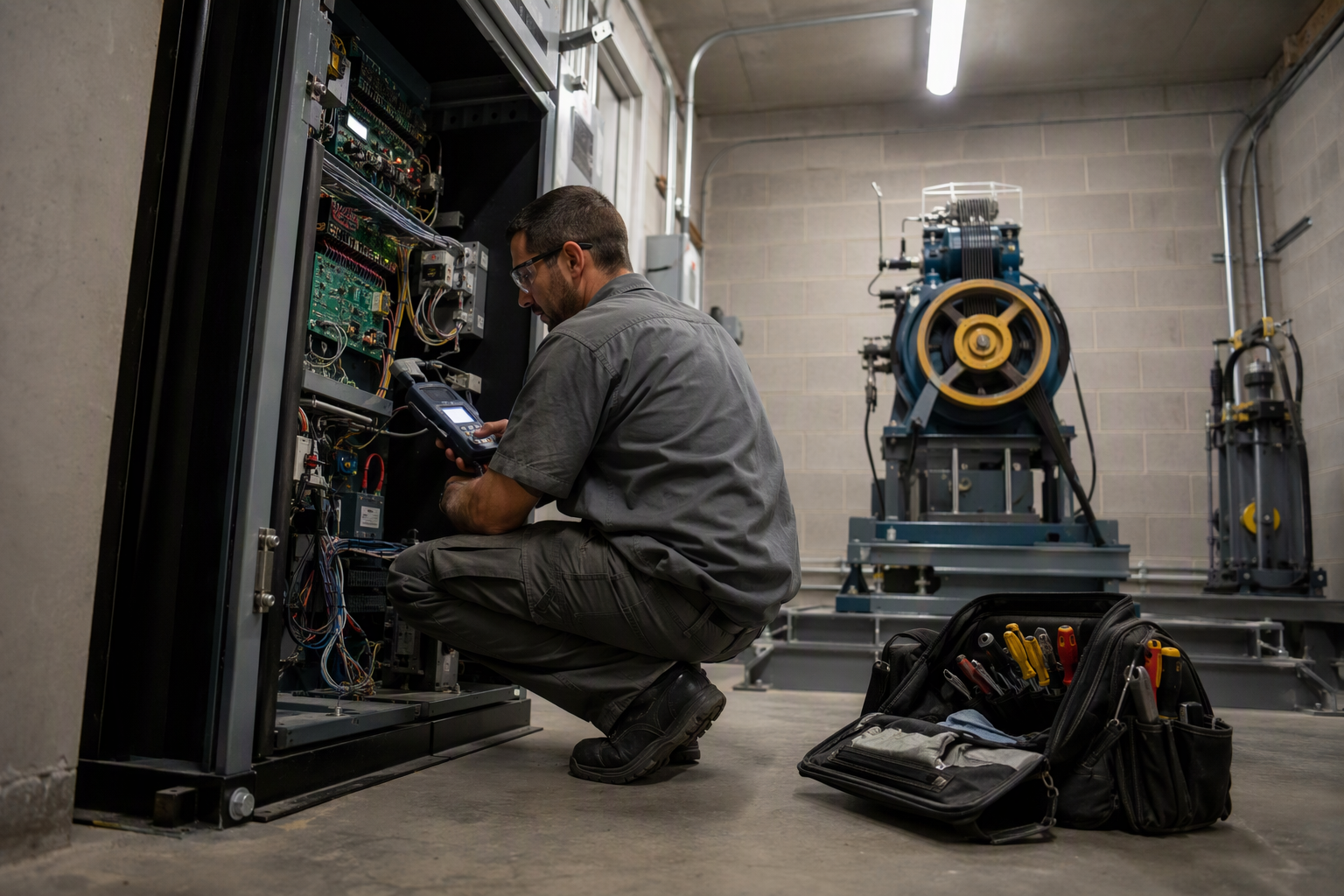
Not all red flags are obvious. The following issues frequently appear in renewal contracts and deserve immediate scrutiny:
| Contract Issue | Red Flag Language | What to Demand Instead | Risk If Ignored |
|---|---|---|---|
| Auto-renewal clause | “Contract renews automatically unless cancelled 90 days prior” | 30-day written notice, mutual renewal requirement | Locked into another multi-year term unintentionally |
| Undefined price escalation | “Rates subject to adjustment at provider’s discretion” | Fixed rate or CPI cap with defined ceiling | Unpredictable budget exposure year over year |
| Broad parts exclusions | “Electronic, hydraulic, and proprietary components excluded” | Itemized inclusion list with defined exclusions | Major repair costs billed separately |
| Proprietary parts installation | No language prohibiting proprietary-only components | Clause requiring use of standard, interchangeable parts | Vendor lock-in; inability to switch contractors |
| No inspection coverage | Contract silent on annual state inspection | Explicit clause covering scheduling and coordination with ICA-authorized inspector | Owner bears full compliance burden under A.R.S. § 23-491 |
| Vague response commitments | “Technician dispatched as soon as available” | Specific callback window in writing with escalation protocol | Extended downtime; liability during entrapment |
| Unilateral termination rights | Vendor can terminate contract for any reason with 30 days notice; owner must pay full term to exit | Symmetrical termination rights for both parties | Financial penalty for switching to a better provider |
| No compliance documentation | No mention of record-keeping, logs, or certificate support | Requirement for written maintenance logs and inspection record retention | Unable to demonstrate compliance during ICA audit or after an incident |
Which Terms Are Negotiable in an Elevator Maintenance Contract?
Building owners often assume that elevator maintenance contracts are fixed documents. In practice, most terms are negotiable, particularly when the owner is an experienced buyer or is considering switching providers. The following areas typically have the most room for negotiation:
- Contract Length: Multi-year agreements typically favor the vendor. Request annual terms, or at minimum, include exit provisions after the first year without financial penalty.
- Price Escalation Limits: Push for a defined ceiling on annual increases, tied to a published index rather than vendor discretion.
- Parts Markup: Ask for transparency on how parts are priced when billed outside the base contract. Request a capped markup percentage over documented wholesale cost.
- Scope Additions: If your building has modernized equipment or has undergone recent alterations, ensure the contract scope reflects current equipment rather than a legacy configuration.
- Cancellation Windows: Shorter auto-renewal notice periods are reasonable; 30 days is common in well-structured agreements.
- Performance Benchmarks: Response time, callback frequency, and equipment uptime targets can be written into the agreement with remedies for non-performance.
- Inspection Coordination: Specify that the contractor will coordinate with or assist during annual inspections required by the Industrial Commission of Arizona’s Elevator Division.
How Do Arizona Regulations Affect What Your Elevator Contract Must Cover?
Arizona building owners carry direct legal obligations that no maintenance contract can fully transfer to a vendor. Under A.R.S. §§ 23-491 through 23-491.16 and Arizona Administrative Code R20-5-502 through R20-5-515, owners must:
- Ensure every conveyance is inspected before it first goes into service, after any modification or alteration, and annually thereafter.
- Maintain a valid annual certificate of inspection — no conveyance may legally operate in Arizona without one.
- Keep the state certificate at the same location as the conveyance and post the state serial number or certificate in or close to the conveyance in an easily accessible location.
- Notify the Industrial Commission of Arizona’s Elevator Division at least 90 days before installing, relocating, or altering a conveyance.
- Notify the state within 24 hours of any accident that injures a person or disables a conveyance.
A maintenance contract that does not address how the vendor supports compliance with these obligations leaves the owner exposed. Specifically, confirm whether your contract:
- Requires the contractor to maintain documentation that supports your annual inspection submission.
- Specifies whether the vendor employs or coordinates with an ICA-authorized private elevator inspector — noting that any such inspector cannot inspect equipment they last serviced, per Arizona rules.
- Addresses who bears responsibility if a deficiency found during an ICA inspection was caused by a maintenance failure.
Equipment installed, repaired, or altered on or after January 1, 2023 must comply with the ASME A17.1/CSA B44 Safety Code for Elevators and Escalators, 2019 edition. Platform lifts and stairway chairlifts in that same category must meet ASME A18.1-2020. Verify that your contractor’s work practices and replacement parts meet the adopted edition in force.
Full-Service vs. Oil-and-Grease Contracts: How Do They Compare?
Elevator maintenance contracts are generally offered in two broad formats. Understanding the difference is essential before renewal.
| Factor | Full-Service (Comprehensive) Contract | Oil-and-Grease (Basic) Contract |
|---|---|---|
| What’s Included | Routine maintenance, adjustments, most parts and labor for covered repairs | Lubrication, minor adjustments only; all parts and most labor billed separately |
| Budget Predictability | Higher predictability; fewer surprise repair invoices | Lower base cost but highly variable total annual spend |
| Best For | High-traffic or aging equipment where repair frequency is elevated | New or recently modernized equipment with low expected repair frequency |
| Risk | Risk of paying for coverage you don’t use on reliable equipment | Risk of significant out-of-pocket costs on aging or high-use equipment |
| Exclusions | Still typically excludes vandalism, misuse, cab finishes, and proprietary electronic controls | Excludes nearly all parts and most labor categories |
| Inspection Support | Often includes coordination assistance for annual state inspection | Inspection coordination typically not included |
| Vendor Lock-In Risk | Higher if proprietary parts are installed during covered repairs | Lower if standard parts are used and documented |
What Step-by-Step Process Should You Follow When Reviewing a Contract Renewal?
- Request the renewal at least 90 days before expiration. Give yourself time to read, compare, and negotiate without deadline pressure.
- Pull your current contract and compare it line by line. Vendors frequently insert new exclusions or escalation clauses into renewals without flagging changes.
- Inventory your equipment and compare it to the contract scope. Confirm the contract lists all conveyances at your location and reflects any alterations made since the previous term.
- Verify your annual inspection status. Confirm your ICA certificate of inspection is current and understand whether your contractor coordinated the last inspection or whether you handled it independently.
- Identify all exclusions and cost exposure. List every excluded component or scenario and estimate the realistic out-of-pocket cost if repairs are needed in those categories.
- Check the termination and auto-renewal clause. Calendar the opt-out notice deadline immediately so you do not miss it.
- Request bids from at least one independent elevator service contractor. An independent provider such as Arizona Elevator Solutions can offer a comparative proposal that often includes greater parts flexibility and non-proprietary component options.
- Negotiate in writing. Any verbal commitments from a vendor representative should be incorporated into the written contract before you sign.
- Confirm the vendor’s contractor license. In Arizona, the Arizona Registrar of Contractors issues R-12 and C-12 elevator license classifications. Verify that your contractor holds the appropriate classification before signing.
- Retain a copy of the signed contract, all maintenance logs, and ICA certificates. These records are essential for compliance, insurance, and liability purposes.
Should You Stay With Your Current Elevator Contractor or Switch?
| Factor | Staying With Current Contractor | Switching to an Independent Provider |
|---|---|---|
| Equipment Familiarity | Existing technician familiarity with your system | Requires transition period; good independent contractors conduct thorough initial assessment |
| Parts Availability | May be faster if vendor stocks proprietary parts — but you remain dependent on them | Independent providers typically use open-market parts, reducing lock-in |
| Contract Flexibility | Often more rigid; renewal presented as non-negotiable | Generally more flexible terms; independent providers compete on service quality |
| Pricing Transparency | Variable; OEM-affiliated contractors often command premium pricing | Independent providers typically offer more itemized, transparent billing |
| Compliance Support | Varies widely by contractor | Quality independents actively support Arizona ICA compliance documentation |
| Pros | Continuity; no transition disruption | Competitive pricing; fewer proprietary restrictions; potentially better terms |
| Cons | Complacency risk; may miss better service options | Short-term transition coordination required |
Arizona Elevator Solutions is an independent elevator service provider serving Arizona building owners who want competitive, transparent maintenance contracts without the proprietary lock-in common to OEM-affiliated programs. As an independent contractor, Arizona Elevator Solutions works with open-market parts and builds contracts around the owner’s actual equipment and compliance obligations under Arizona law.
What Happens If Your Elevator Fails an Arizona Annual Inspection During an Active Maintenance Contract?
An inspection deficiency during the annual ICA review creates an immediate compliance problem — and the question of who pays for remediation is often answered by your maintenance contract, not by the inspector.
Key points to understand:
- Under Arizona law, no conveyance may operate without a valid annual certificate of inspection. A failed inspection means the unit must be taken out of service until deficiencies are corrected and re-inspected.
- If the deficiency stems from a maintenance failure — a worn component, missed lubrication cycle, or improper adjustment — review whether your contract covers the repair at no additional charge or treats it as an excluded billable event.
- Arizona owners must notify the Industrial Commission of Arizona’s Elevator Division within 24 hours of any accident that injures a person or disables a conveyance. An inspection failure that results in an entrapment or injury triggers this obligation regardless of what your contract says.
- Confirm in writing that your contractor will prioritize inspection-driven repairs and support re-inspection scheduling through the ICA or an authorized private inspector.
Does an Elevator Maintenance Contract Satisfy Your ADA Obligations?
A maintenance contract addresses mechanical upkeep — it does not on its own satisfy accessibility requirements under the Americans with Disabilities Act (ADA). Building owners should be aware that:
- ADA compliance is the building owner’s obligation, not the elevator contractor’s, unless the contract explicitly includes ADA-related modifications or accessibility audits.
- Routine maintenance that keeps an elevator operational supports ADA accessibility, but does not address whether the cab dimensions, control heights, door timing, or audible signals meet accessibility standards.
- If your elevator serves as the accessible route for individuals with disabilities, extended downtime during maintenance or repair work may trigger ADA concerns. A contract with clear response time commitments and an accessible-route downtime protocol is advisable.
What Should You Ask a Contractor Before Signing an Elevator Maintenance Renewal?
Before committing to another contract term, building owners should ask prospective or incumbent contractors the following questions and require written answers:
- Does your company hold an active Arizona Registrar of Contractors R-12 or C-12 license? Can you provide the license number for verification?
- Which components are explicitly excluded from this contract, and what is the estimated cost range for repairs on excluded items?
- Will your technicians install proprietary parts that limit my ability to use another service provider in the future?
- How do you coordinate with the Industrial Commission of Arizona’s Elevator Division for annual inspection scheduling and deficiency resolution?
- What is your documented process for an entrapment or emergency callback? Is that process reflected in writing in the contract?
- How are maintenance records documented and made available to me as the building owner?
- If I need to exit this contract early, what are the financial terms and notice requirements?
- Has your company had any disciplinary actions, license suspensions, or ICA citations in Arizona? Where can I verify that?
How Does Elevator Equipment Age Affect What Contract Type Makes Sense at Renewal?
The age and condition of your elevator equipment should directly influence the type of maintenance contract you accept at renewal. Considerations include:
| Equipment Situation | Recommended Contract Approach | Key Contract Term to Prioritize |
|---|---|---|
| New or recently modernized (0–5 years) | Oil-and-grease or limited service contract may be sufficient | Parts markup transparency; ASME A17.1-2019 compliance documentation |
| Mid-life equipment (6–15 years) | Full-service contract with defined parts inclusions recommended | Specific parts inclusion list; escalation cap |
| Aging equipment (16+ years) | Comprehensive full-service contract; modernization planning discussion | Labor and parts coverage breadth; modernization planning clause |
| Equipment recently altered | Contract must reflect updated scope; verify ASME A17.1-2019 compliance for altered systems | Updated equipment schedule in contract; ICA 90-day alteration notification confirmation |
| Equipment with open ICA deficiencies | Do not renew without a remediation plan in writing | Remediation timeline; responsibility for re-inspection costs |
Why Choose Arizona Elevator Solutions for Your Maintenance Contract Review and Renewal?
Arizona Elevator Solutions is an independent, Arizona-based elevator service company supporting building owners across the state with maintenance, inspection coordination, and compliance guidance. As an independent provider, Arizona Elevator Solutions is not affiliated with a single equipment manufacturer, which means the company can work with a broader range of parts, equipment brands, and service configurations without the proprietary lock-in that often characterizes OEM-aligned contracts.
Arizona Elevator Solutions assists building owners in reviewing renewal terms, identifying contract gaps relative to Arizona regulatory obligations under A.R.S. §§ 23-491 through 23-491.16, and structuring maintenance agreements that reflect actual equipment needs rather than vendor-favorable defaults. For building owners in the City of Phoenix, Arizona Elevator Solutions is also familiar with the City of Phoenix Elevator Section’s inspection process under the Planning and Development Department.
Whether an owner is renewing with a current provider or evaluating a switch, a free elevator assessment from Arizona Elevator Solutions provides an independent baseline — condition of equipment, compliance status, and a comparison of current contract terms against what a well-structured agreement should include.
Get an Independent Review Before You Sign
Do not renew an elevator maintenance contract without an independent assessment of your equipment condition, compliance status, and current contract terms. Arizona Elevator Solutions reviews what your existing agreement covers, identifies gaps that expose you to unexpected costs or regulatory risk, and provides a transparent alternative proposal with no proprietary lock-in.
Contact Arizona Elevator Solutions for a free elevator assessment: 480-557-7600
Need elevator service you can rely on? Arizona Elevator Solutions is ready to help.






